
Weekly Update #8 4/8/16
Weekly Update #7 3/25/16
Gantt Chart as of 3/25/16:

Weekly Update #6 3/4/16
Gantt Chart as of 3/4/16:

Weekly Update #5 2/19/16
Gantt Chart as of 2/18/16:

Weekly Update #4 2/4/16
Senior Design 2015-2016 Gantt Chart
Weekly Update #3: 1/16/16
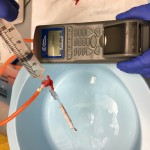
Summary: We received the dialysis tubing and were able to assemble our first working prototype. Once the prototype was built, a manual syringe pump was used to reach interluminal pressures up to 600 mmHg. We also discovered a few changes that must be integrated into our design. Reinforced clamps must be utilized at each end of the dialysis tubing/vein system to minimize leaks. Due to the varying sizes of vein samples we will be working with, we also decided to wrap parafilm around the dialysis tubing in order to customize its diameter. It is imperative that diameter of the tubing closely matches the outer diameter of the vein to prevent distension and subsequent tissue damage.



Future Tasks: We will be integrating these design changes into a second prototype. This prototype will be used to determine the effects of a range of pressures on vascular tissue, with and without the protection of the dialysis tubing sheath. Using saphenous vein tissue acquired from the Vanderbilt Medical Center, we will run 7 trials: one control and three pressures of 132 mmHg, 300 mmHg, and 600 mmHg, with and without dialysis tubing. Once the desired pressure is reached, it will be maintained for a total time of ten minutes. Then, using Evans Blue Dye, we will evaluate the damage each tissue sample has sustained during the trial. This experiment will determine if a protective sheath is able to prevent endothelial damage which has been shown to cause future blood clots.
Weekly Update #2: 11/13/15
Summary: Our dialysis tubing order was approved and submitted to Spectrum Labs. If delivery is prompt, we wish to begin the aforementioned testing of the tubing before Thanksgiving break. We also visited the lab of our postdoctoral mentor, Kyle Hocking, to examine the cannulas, clamps, and pressure release valve we will be using.
Future Tasks: Using leftover segments of harvested saphenous veins, we will begin testing the effects of pressure on the endothelial tissue. We will use Evans Blue Dye to visualize endothelial damage after subjecting the vein samples to a range of intraluminal pressures, with and without the protective dialysis tubing covering. This test will hopefully show the advantages of using the dialysis tubing as a protective barrier to prevent over-expansion of and subsequent damage to the vessel.
11/10/15
Summary: We have submitted a presentation for spending approval to order a 10 meter roll of dialysis tubing with a 100kDa MWCO from Spectrum Labs. We met with our advisor to fill out the necessary paperwork to get the tubing ordered, and to determine what other pieces we will need for our prototype.
Future Tasks: Once the tubing arrives, we will begin building our prototype and testing our design. We will use a dye to visually observe flow within and through the dialysis tubing.
Weekly Update #1: 11/3/15
Summary: We have tested the flow rate of water through 14kDa molecular weight cutoff (MWCO) dialysis tubing. Our results show that we will need a higher MWCO in order to get any noticeable flow. Off of recommendations from our adviser, we looked online for dialysis tubing at Sigma Aldrich and Spectrum Labs. We initially asked for samples to test our design but none were offered from either company. Because of this, we are creating a funding submission for a 10 meter roll of dialysis tubing with a 100kDa MWCO from Spectrum Labs.
Future Tasks: We are now in the process of finding dialysis tubing to match our design constraints with a higher MWCO. Once we get the tubing in, we can begin prototyping our design and testing the drug delivery performance in the veins.