
The novel multichannel peristaltic pump system consists of a control mechanism within a central housing that can set 24 motors at various speeds while running in parallel. The central housing (36x20x15 cm) was split into two levels in order to accommodate all of the equipment (Fig. 3). The bottom level holds the EasyDriver Motor Controllers in their respective 3D-printed cartridges. The wiring was run down the sides of the box in order to save space. The tubing was connected to the EasyDrivers in a zigzag manner in order to split the water cooling system into four parallel cooling systems. The top level holds the Arduino Unos, the Raspberry Pi and its power converter, and the 12V Power Supply on shelves. There is room along the sides of the shelves to run wires up and down the box in order to allow space for all connections.
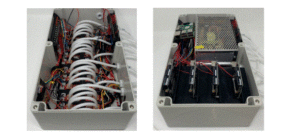
Figure 1. Left: The bottom level of the central housing contains the 24 easy drivers in their corresponding 3D-printed cartridges as well as the water tubing required to keep the drivers cool. Right: The top level of the central housing contains the four Arduino Unos, the power supply, and the Raspberry Pi and its power converter.
The central housing itself is hermetically sealed for use inside of an incubator in order to prevent biological or electrical safety hazards. The central housing has an acrylic piece that is gasket sealed to the top of the box that provides locations for motor connections as well as stop buttons in order to cut power to any set of six EasyDrivers necessary (Fig. 2). All of these D-sub connections as well as stop buttons are also gasket sealed on the box in order to prevent contamination.
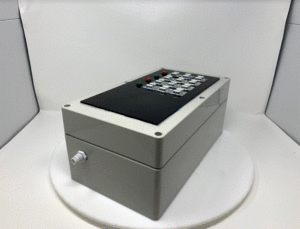
Figure 2. The central housing box that holds the novel pump control system and is hermetically sealed for use inside of an incubator.
In order to keep all of the components inside of the central housing cool, a water cooling system was put into place. Four radiators and four water pumps (Fig. 5) were included in order to provide enough cooling to our system.
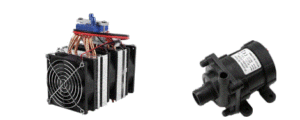
Figure 3. Left: One of the four water radiators used in the water cooling system (14.3×9.6×16.2 cm). Right: One of the four water pumps used in the water cooling system (9.1×7.6×7.1 cm).
This pumping system is designed to be more affordable, accurate, and user-friendly than current solutions. The user can specify what flow rate is desired for each peristaltic pump, and they will receive real-time feedback on the actual flow rates going to the cell cultures. The pump system is designed to allow flow rates down to 1 microliter per minute for experimentation with long-lasting duration. It is especially important in this setting to provide consistent and accurate flow rates, in order to maintain the integrity of the cells. Providing real-time feedback allows for better control than current pump systems, and it gives the user more reliable results. Since the pump system is expanded to consist of 24 motors and channels, it also allows for a large amount of cell culture experiments to be maintained inside the bioreactor for longer time periods. Additionally, the system is easily maintained and repaired, meaning individual pieces can be easily replaced if needed, instead of having to replace the whole pump system at a high expense.
A Sensirion SLI-1000 Liquid Flow Sensor can be used to verify that the flow rates that are resulting from the peristaltic pump system are accurate and precise. This flow sensor is able to provide feedback in 40 milliseconds, and it is able to read flow rates from 1 microliter per minute up to 10 milliliters per minute. With the flow sensor in place, real-time feedback about flow information on each channel can be seen. In doing so, the cell cultures will be receiving a reliable source of nutrients that can be sped up or slowed down depending on the user’s experiment.
The water cooling system used to ensure the EasyDrivers never reach their cutoff temperatures, which would potentially ruin month-long experiments, does effectively take the majority of the heat away from the drivers. This means that the temperature inside of the central housing will never be an issue.
Thus, the multichannel peristaltic pump system is effective at increasing the number of experiments that can take place at one, at reducing variability between experiments, at providing real-time feedback, and at providing increased modularity.