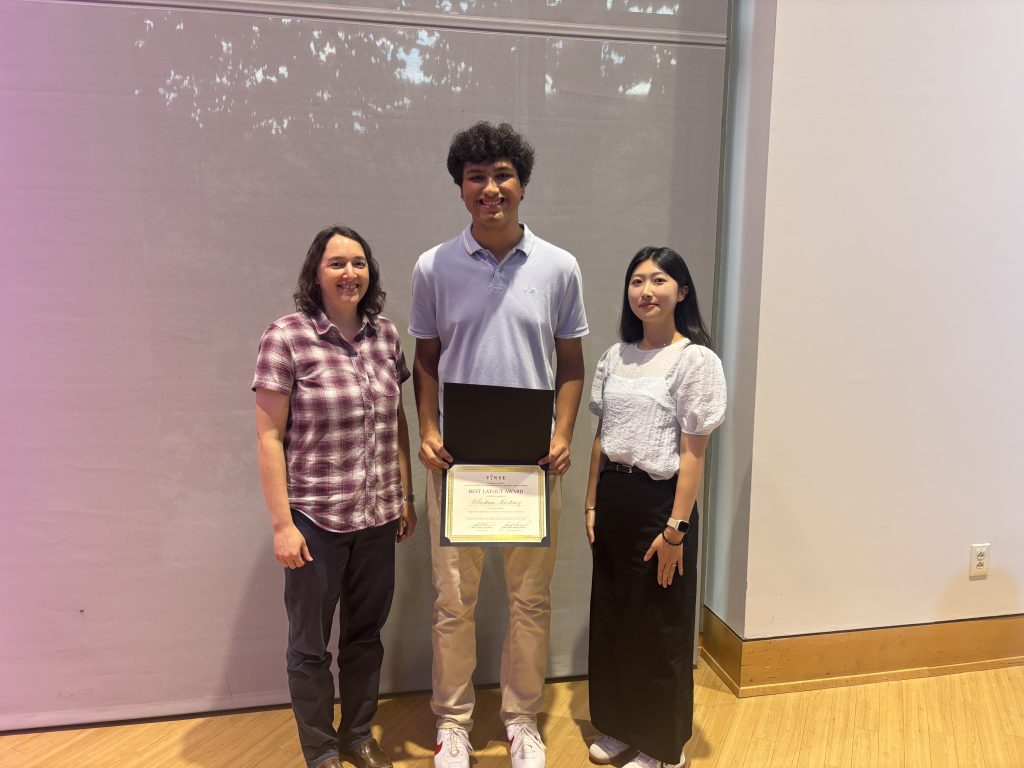
Congrats Sebastian! Best layout Award for his poster at VINSE 14th Annual Undergraduate Research Symposium
Paper Based Microfluidic Channels for Porous Silicon Biosensors
Developing low cost, highly sensitive, and accessible biosensing platforms is critical for widespread diagnostic applications. Porous silicon (PSi) is a promising material for these platforms due to its high surface area for detecting molecules, chemical and biological compatibility, and ease of fabrication. Integrating PSi membranes with paper substrates offers a pathway to creating portable, affordable diagnostic systems. However, controlling the incubation time of test solutions in PSi-on-paper sensors remains a significant challenge, limiting detection sensitivity. This project aims to create high resolution paper-based microfluidic channels that regulate flow rates and control incubation times for molecules captured in PSi-on-paper biosensors, improving their performance and reproducibility for rapid diagnostics.
We determined the most effective fabrication method for creating paper-based microchannels utilizes 3D-printed molds to rapidly prototype PDMS stamps. Microchannel stamps with various thicknesses and channel widths were inked with 100% concentration PDMS ink and tested for their ability to direct solution flow on paper substrates. Whatman filter paper and nitrocellulose paper were investigated to evaluate the effects of pore size on flow rates and incubation time.
Our results showed that 2 mm high 3D-printed molds produced durable, reproducible PDMS stamps for effective microchannel patterning. Experiments applying colored water to the paper-based microchannels demonstrated that wider channels enabled faster fluid transport and nitrocellulose paper, with smaller pores, provided more controlled flow. Preliminary integration of PSi membranes with these microchannels confirmed that narrower channels in nitrocellulose paper increased incubation times in PSi. Future work will optimize channel resolution and dimensions to achieve the desired incubation time for highest detection sensitivity of biomolecules of interest. These findings demonstrate the feasibility of integrating PSi membranes with PDMS-patterned paper microfluidics to create accessible biosensing platforms.