Self-Reflection book

Publisher’s Website – Routledge – with blurbs
AWARD WINNER: Hermes Award: Book of the Year in Phenomenological Hermeneutics, Agora Hermeneutica, The International Institute for Hermeneutics (IIH), 2021
Reviews
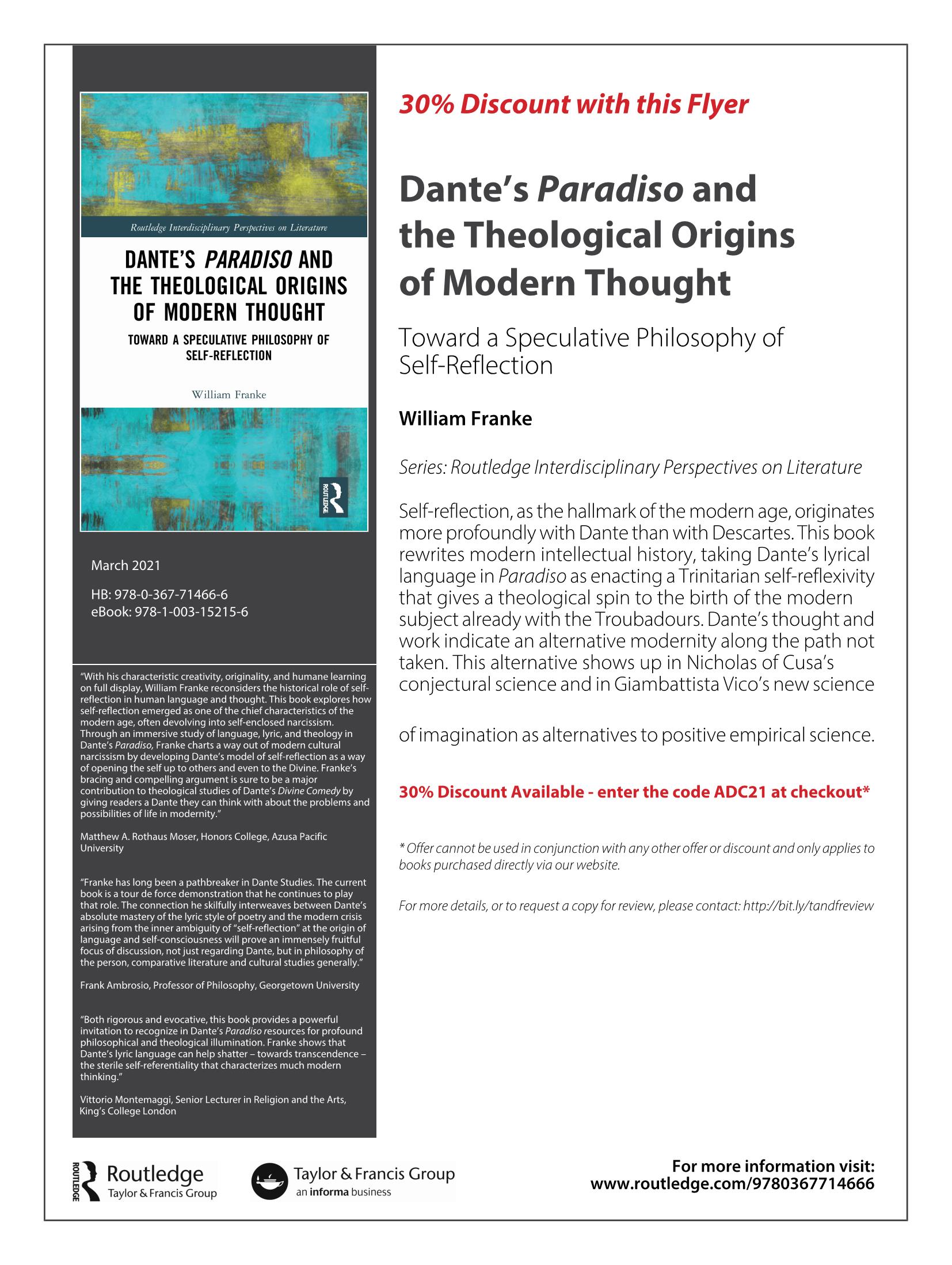
“With his characteristic creativity, originality, and humane learning on full display, William Franke reconsiders the historical role of self-reflection in human language and thought. This book explores how self-reflection emerged as one of the chief characteristics of the modern age, often devolving into self-enclosed narcissism. Through an immersive study of language, lyric, and theology in Dante’s Paradiso, Franke charts a way out of modern cultural narcissism by developing Dante’s model of self-reflection as a way of opening the self up to others and even to the Divine. Franke’s bracing and compelling argument is sure to be a major contribution to theological studies of Dante’s Divine Comedy by giving readers a Dante they can think with about the problems and possibilities of life in modernity.”
Matthew A. Rothaus Moser, Honors College, Azusa Pacific University
********
“Franke has long been a pathbreaker in Dante Studies. The current book is a tour de force demonstration that he continues to play that role. The connection he skilfully interweaves between Dante’s absolute mastery of the lyric style of poetry and the modern crisis arising from the inner ambiguity of “self-reflection” at the origin of language and self-consciousness will prove an immensely fruitful focus of discussion, not just regarding Dante, but in philosophy of the person, comparative literature and cultural studies generally.”Frank Ambrosio, Professor of Philosophy, Georgetown University
*************
“Both rigorous and evocative, this book provides a powerful invitation to recognize in Dante’s Paradiso resources for profound philosophical and theological illumination. Franke shows that Dante’s lyric language can help shatter – towards transcendence – the sterile self-referentiality that characterizes much modern thinking.”Vittorio Montemaggi, Senior Lecturer in Religion and the Arts, King’s College London
******************
“Beyond its considerable value as a thoughtful and thought-provoking study of lyric self-reflexivity and transcendence with Dante as a focal point, Franke’s book will be an important resource for scholars in a wide array of areas in literary criticism, literary theory, and philosophy.”
Gregorgy B. Stone, Joseph S. Yenni Professor of Italian Studies, Professor of French and Comparative Literature, Louisiana State University
*****************
“In Dante’s Paradiso and the Theological Origins of Modern Thought, William Franke fruitfully explores the entwined questions of possibilities and perils of self-reflection and narcissism. Narcissism becomes, in this book, the major textual clue and theoretical term for exploring the Dantean and Scotian alternatives to the pre-modern history of modern metaphysics and epistemology. Pursuing this clue, Franke begins from the thought that, if the world is nothing but a specular image of the divine, then God’s relationship to the world can be understood to some degree as fundamentally narcissistic. However, as Franke also shows, it is also possible to see in the Dantean and Scotian alternatives different ways in which human imitation of that narcissistic relationship can play out. In exploring these alternatives, Franke offers a fresh and intriguing approach to his already significant contributions to two genres of recent work in Dante Studies: work motivated by methodological commitments to contemporary critical theory and work on Dante’s theology.”
Jason Aleksander, Professor of Philosophy and Associate Dean of Faculty Success and Research, College of Humanities and the Arts, San Jose State University
***************************************
Jacob Abell complete published review of Self-Reflection book
Franke’s book offers an instructive and creative development in Dante studies, but the book’s relevance and impact stand to extend much further into contemporary philosophy of mind, theological studies, and literary history. . . . The breadth of the book’s engagement with such varied fields and scholarly traditions only sharpens the clarity of the argument. With each incorporation of a new intellectual voice, Franke’s tapestry of interlocutors enriches the details of the overarching project and its original contributions. In that spirit, Franke’s book is especially valuable as a rallying cry to take Dante seriously as a conversation partner for some of the most vital philosophical questions of our time. If Dante is indeed one of the architects of a distinctively modern form of self-reflexivity, as Franke persuasively maintains, then this book suggests how Dante can nourish contemporary reflections on how we think about our thinking, reflect upon our reflection, and look at the mechanisms by which we may discover others in discovering ourselves.
Jacob Abell, Colgate University, review in Journal of Interdisciplinary Studies 33 (2021): 175-77
“Si potrebbe discutere di quanto un fondamento teologico sia necessario a una
teoria generale del lirico come modalità del discorso, ma l’indagine di Franke è
meno interessata a proporre una teoria del lirico che a rivalutare una possibilità
che la poesia ha accolto e preservato nel momento in cui il pensiero occidentale,
almeno nelle sue linee principali, ha eletto a proprio campo l’umanamente
pensabile annullando la sua dipendenza da un piano trascendente di per sé
inconoscibile. Unendo un argomento storico sull’evoluzione di un concetto (autoriflessività) a un argomento ontologico sulla costituzione autoriflessiva dell’essere, la prospettiva di Franke si mostra fertile nel suo potenziale speculativo per riconsiderare genealogicamente una strada non presa dal pensiero e dalla tecnica occidentali e per articolare una critica radicale a una concezione del soggetto e delle sue relazioni con il mondo diventata dominante nella modernità.”(“The question of whether a theological foundation is essential for a general theory of the lyric as a mode of discourse remains open. Franke’s project, however, is less about constructing such a theory than about recovering a possibility that poetry embraced and safeguarded when Western thought—at least in its dominant currents—confined itself to what is humanly thinkable, severing its dependence on a transcendent plane inherently unknowable. By joining a historical argument on the evolution of a concept (self-reflexivity) with an ontological argument on the self-reflexive constitution of being, Franke’s perspective proves fertile in its speculative potential: it invites a genealogical reconsideration of a path Western thought and technique left untaken and enables a radical critique of the conception of the subject and its relation to the world that came to dominate modernity.”) Francesco Giusti
Pertinent Podcasts:
William Franke, talk centering on Paradiso XVIII – Madrid Vernaculars Conference
Madrid Vernaculars Conference: 20-minute presentation centering on Paradiso XVIII
Madrid Vernaculars Conference: Question and Answer (in Italian)


©2026 Vanderbilt University ·
Site Development: University Web Communications