Congrats to Adriana! Best Poster Award at VINSE 14th Annual Undergraduate Research Symposium
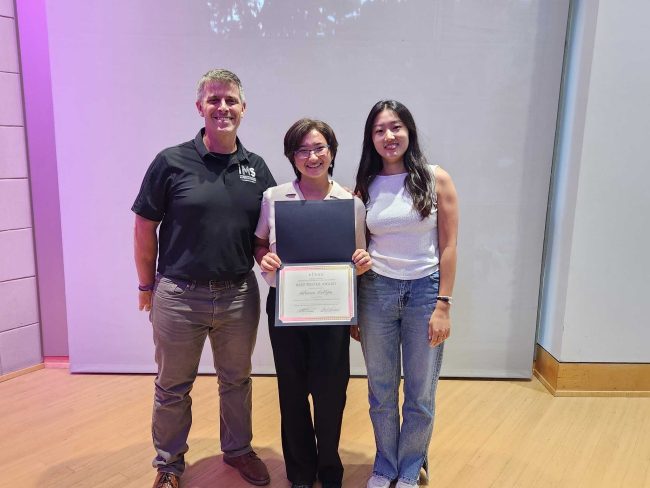
Adriana LaVopa, REU student with Caldwell Lab, won the best poster award at the VINSE 14th Annual Undergraduate Research Symposium.
“Local Control of Ferroelectric Switching for Optical Modulation in Al1-xBxN”
In the pursuit of space- and energy-efficient devices, nanophotonics offers an avenue towards controlling opto-electronic and optical signals far below the length scales of diffraction-limited technology. Key to achieving this sub-diffraction resolution in the infrared are polaritons, quasiparticles that arise from the coupled interactions between light and matter. A promising approach to harnessing polaritons for opto-electronic applications is modulating optical signals via tunable polaritonic materials. Ferroelectric materials present an opportunity to modulate polaritons via electronic bias due to their inherent polarization, which can be aligned to or reversed by an applied electric field. Aluminum boron nitride (Al1-xBxN) is one such ferroelectric material that has recently garnered attention for these uses due to its combination of suitable material properties and integrability into current device manufacturing methods. In this work, we employed local polarization switching using piezoresponse force lithography (PFL) to precisely pattern ferroelectric domains into Al1-xBxN. Piezoresponse force microscopy (PFM) and experimental and computational optical methods were applied to explore the potential of Al1-xBxN as a polaritonic material for actively modulated optical emission. PFM revealed the voltage- and composition-dependence of the polarization response in Al1-xBxN, as well as the stability of the resulting domains over time. Experimental and computational spectroscopic results indicated that the polarization of Al1-xBxN influences its interactions with infrared (IR) radiation, as well as polaritonic modes in an adjacent material, enabling control of an output signal via applied electric field at sub-second timescales. Our findings suggest that ferroelectric polarization in Al1-xBxN offers an accessible means to modulate the optical response of an emitter in the IR spectral range, opening the door to applications in the information technology, IR free-space communications, chemical sensing, and thermal management devices of the future.