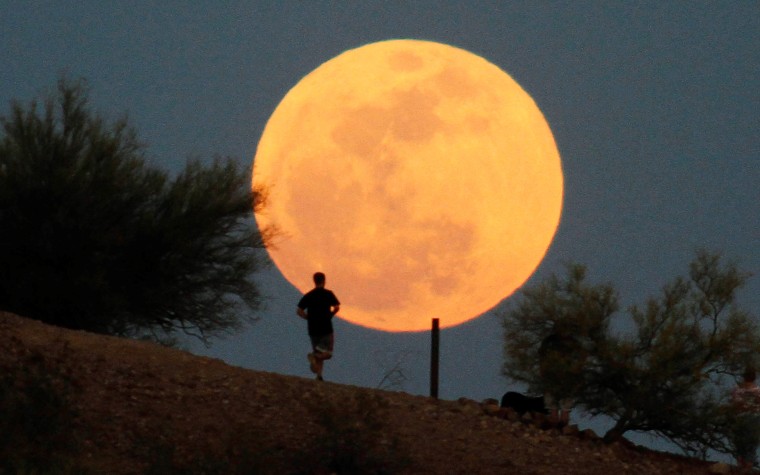
Nashville’s “Snow Moon”

Image result for supermoon
Photo of a 2012 “Supermoon” via NBC News

On the evening of Saturday February 9th, the Nashville area saw an abnormally large moon known as a super-moon. This was also a special moon because it was also known as the “snow moon.” The “snow moon” is a full or new moon of astronomical and cultural significance around the globe.

The super-moon phenomenon occurs when a new or full moon coincides with perigee which is when the Moon is closest to Earth in its elliptical orbit. This results in a Moon that appears larger than a normal new or full moon. Also, the tides associated with a super-moon are slightly more extreme due to the gravitational force between the Earth and the Moon being stronger because of a shorter distance between the two planetary bodies.

This moon was called the “snow moon” because according to the Farmers’ Almanac northeastern Native American tribes associated the moon with the large snowfall of early February. The “snow moon” is also significant in the Chinese, Jewish, and Buddhist cultures signaling the beginning and end of various holidays.

Posted in Class, Moons | Tagged , , | Comments Off on Nashville’s “Snow Moon”

The Basics of Our World

The Standard Model

The Standard Model consists of 17 elementary particles that fit into a mathematical and theoretical framework that explains matter and forces. Since last century, the model has been able to not only explain, but also to predict existences of undiscovered particles. The particles are categorized into two groups: fermions and bosons. Fermions make up matter. There are two types of fermion: lepton and quarks. Quarks make up neutron and proton, while leptons make up electron-like particles. Both groups contain six particles, which are organized into 3 pairs or “generations.” The first one is the lightest and most stable. Higher generations will not be stable and quickly decay. Bosons, on the other hand, are responsible for transferring forces. There are four types of forces in our universe: the strong force, the weak force, the electromagnetic force, and the gravitational force. Bosons can explain each one except gravity: the strong force is carried by gluon; the weak force is carried by w and z bosons; and the electromagnetic force is carried out by photon. Higgs boson explains why some particles will have mass.

The Standard Model works beautifully as an isolated mathmatical theory. However, it fails to incorporate gravity into its framework, resulting a big issue. Furthermore, the quantum theory behind this model does not seem to fit with the law of general relativity, causing a split between micro and macro world. Most importantly, scientists thought that the model might provide an answer for dark matter, which did not happen. Therefore, although this theory proposes many beautiful solutions, it also creates more mysteries that are not solved.

Posted in Class, Physics | Tagged , | Comments Off on The Basics of Our World

WFIRST: The Newest Vanguard of the Mission to Understand Dark Energy

At some point this decade, a new space observatory will be launched into orbit; one unlike any that we have seen before with extraordinary equipment and capabilities. WFIRST, the Wide-Field InfraRed Survey Telescope, could potentially revolutionize what astronomers know about our universe and how it behaves by focusing on three major categories: dark energy, exoplanet detection, and infrared astrophysics.

Artist’s Rendition of WFIRST. Source: NASA

WFIRST has two major features that make it stand out above other observatories within its niche: it has an enormously wide field of view (roughly 100 times the area of Hubble’s while maintaining the same level of resolution), as well as being equipped with a coronagraph. Coronagraphs block out the glare from a star’s corona to allow its observatory to directly observe things such as the planets that may orbit the star, and protoplanetary disks if the star happens to be younger. Coronagraphs have been utilized in the past with observatories like Hubble, but WFIRST’s coronagraph will be far more advanced and sophisticated.

Field of view of WFIRST compared to Hubble and James Webb Space Telescope. Source: American Scientist

To study dark energy, WFIRST will use its primary mirror, which has a diameter comparable to Hubble’s, as well as its wide-field instrument. With its immense imaging power, WFIRST can study the distribution of mass and matter throughout the universe and how the distributions may have changed as a result of the universe’s accelerating expansion. There are a handful of other ways in which WFIRST will attempt to study dark energy, but in short, understanding dark energy will unlock the secrets of how our universe came to be and the circumstances of its demise.

Posted in Instruments, Universe | Tagged , , , | Comments Off on WFIRST: The Newest Vanguard of the Mission to Understand Dark Energy

The Importance of Spectroscopy

Polymer Solution

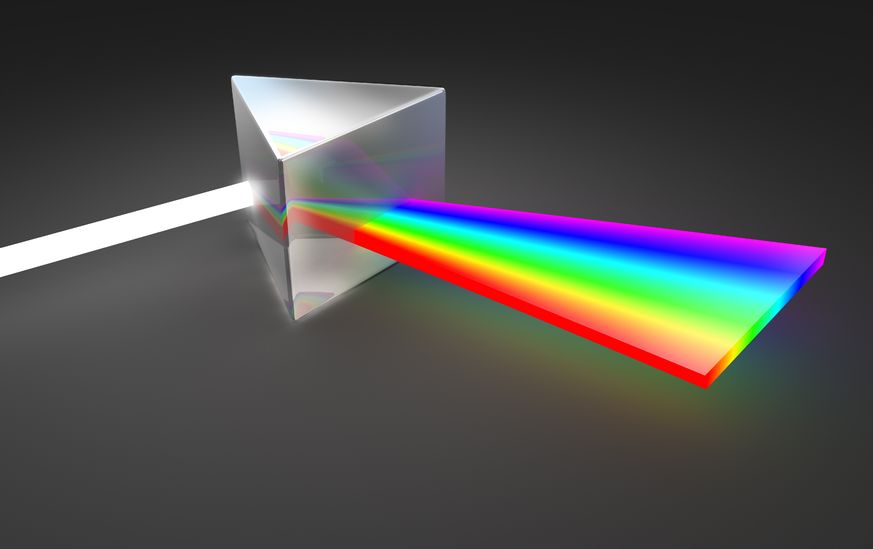
The impact that spectroscopy and light has had on the world has not been recognized enough. The discovery of spectroscopy has allowed us to know so much more about astronomy and what makes up our universe. Spectroscopy is the investigation and measurement of spectra when matter interacts with electromagnetic radiation. In astronomy, we look at how light from an astronomical source interacts with different objects to form a spectra of light. There are three different kinds of spectra, a continuous spectrum, an emission spectrum, or an absorption spectrum. In a continuous spectrum, a hot light source produces light of all visible wavelengths. The spectrum shows a smooth, continuous rainbow of light. In an emission spectrum, the atoms in a warm cloud emit specific wavelengths of light. On the spectrum, we see bright emission lines at specific wavelengths on a black background. In an absorption spectrum, light from a hot source passes through a cloud of cooler gas. Atoms in the cloud absorb some of the wavelengths of light. In the spectrum, we see dark absorption lines on a continuous rainbow background. Each spectrum of an element or molecule is unique, like a fingerprint, allowing astronomers to recognize them easily. Through studying light, astronomers are allowed to determine the chemical composition of the Sun and other stars, the temperature of an object, the color of an object, and if the object is moving towards or away from us.

Posted in Science | Tagged , , | Comments Off on The Importance of Spectroscopy

The History of Astronomy

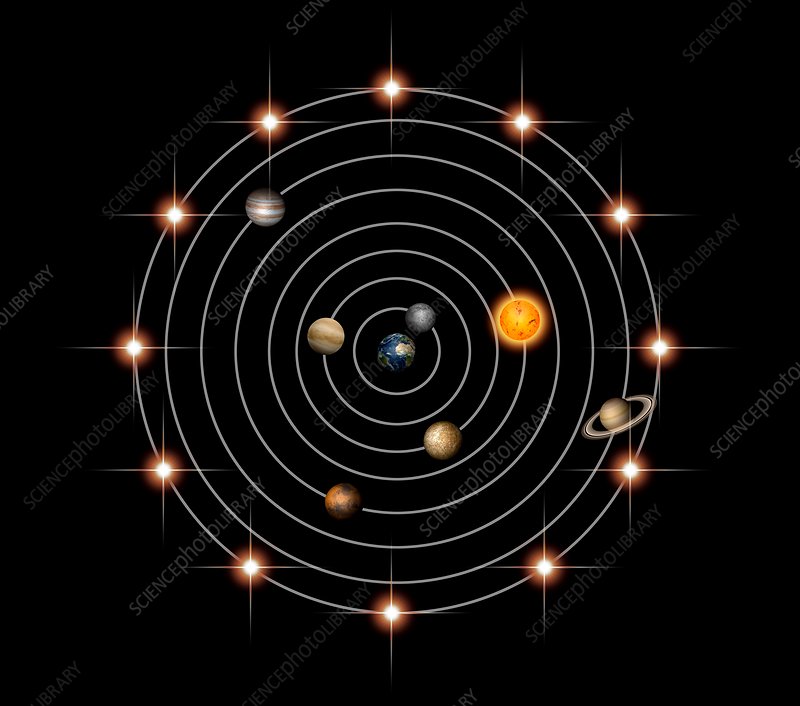
Geocentric model of the universe

Astronomy, the scientific study of the universe and of the objects that exist naturally in space, is one of the oldest natural sciences to reach a high level of sophistication. The history of this science has impressive continuity and duration, as observed changes would take thousands, millions, and even billions of years.

In 3000 BC, the Greeks became the first to interpret the heavens via models rather than spiritual concepts, and that Earth was surrounded by “spheres/rings.”  However, their proposed geocentric model could not explain the exhibited retrograde motion of a number of celestial bodies. This all changed with Copernicus, who made the jump to a heliocentric universe with planets orbiting in perfect circles in the late 1400s. This incorrect assumption was corrected by Tycho, the best naked-eye observer of his time, when his observations planted the seeds for planets orbiting the Sun, and not in perfect circles. His inability to detect parallax led him to conclude that the Earth must remain stationary, which resulted in a model that few people took seriously: the Sun orbiting Earth, and all the other planets orbiting the Sun. Then came Kepler, Tycho’s young apprentice and “diligent calculator,” who trusted Tycho’s observations enough to abandon his previous belief of circular orbits. His key discovery of planetary orbits being ellipses led to his observationally derived Three Laws of Planetary Motion, which serves as a key foundation to modern astronomy today. The Copernican model of the heliocentric universe was finally solidified by Galileo, who had the advantage of the telescopes. This not only allowed him to observe Sun spots, craters of the Moon, and all of Jupiter’s moons, but further enabled him to diffuse any remaining objections to the Copernican view.

Posted in Class, Universe | Tagged , , , | Comments Off on The History of Astronomy

What’s up with the tropics?

Latina Lista

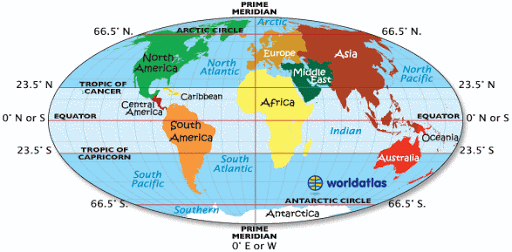
Latitude and longitude coordinates are seen everywhere; they’re immensely useful for marking geographic location and helping with navigation. The system is simple enough: latitude is distance north or south from the equator and longitude is distance east or west from the Prime Meridian. But what are the Tropics of Cancer and of Capricorn that are referenced on the map? What is the significance of these specific latitudes?

The region between the Tropic of Cancer and the Tropic of Capricorn encompasses all locations on Earth where the Sun reaches the zenith at local noon, which happens twice a year. The Tropic of Cancer is the northernmost latitude where this occurs, and the Tropic of Capricorn is the farthest south. The sun reaches the zenith at the Tropic of Cancer at the June solstice, marking summer for the northern hemisphere. Likewise, the sun reaches the zenith at the Tropic of Capricorn at the December solstice, marking summer for the southern hemisphere.

But why the references to the constellations of Cancer and Capricorn? Thousands of years ago, when the Tropic of Cancer was named, the June solstice occurred when the Sun was located in Cancer. However, due to the precession of the Earth’s rotational axis, the solstice no longer occurs when the Sun is in Cancer. The likewise is true with the December solstice and Capricorn. Although the timing of the solstices in relation to the stars has changes, it is still much easier to keep the same names rather than constantly renaming these special latitudes.

Posted in General | Tagged , , , | Comments Off on What’s up with the tropics?

Eclipses!

Magic of Eclipses

A solar eclipse occurs when the moon comes in between the path of sunlight and the Earth, casting a shadow on the Earth. Solar eclipses in general are quite rare (only a couple a year), but the moon’s shadow only covers a small portion of the Earth so seeing one is an amazing opportunity. A total solar eclipse, in which the sun is fully blocked by the moon, is even more rare occurring about every year and a half somewhere on Earth. One particular spot on Earth can expect to see a solar eclipse for just a few minutes every 375 years. The next solar eclipse will be on June 21, 2020 and can be seen in a tight strip spanning Africa and Asia. A total solar eclipse will occur on December 14, 2020 and be visible from parts of Chile and Argentina.

A lunar eclipse occurs as the Earth gets in the way of sunlight hitting the moon. The moon turns dark as the Earth’s shadow covers it up. Earth’s atmosphere can make the moon appear red during the eclipse as other colors are absorbed. Lunar eclipses are also very rare due to the tilt of Earth axis causing the Earth, sun, and moon to not line up perfectly every month. Penumbral lunar eclipses are more common than total lunar eclipses and occur when the moon crosses through the large and faint outer part of Earth’s shadow. The next lunar eclipse will be visible from June 5-6, 2020 across Asia, Europe, Africa, and Australia. A total lunar eclipse will be visible on May 26, 2021 in parts of the western US, western South America, and south-east Asia.

Posted in Class, Observables, Sun | Tagged , , | Comments Off on Eclipses!

Light: It’s More than We Think

The emission and absorption spectrum for the most abundant element in our Universe: Hydrogen.

Flip a switch. Turn a knob. Push a button. Look in the sky in the day or at night. Each of these actions will allow you to see light, and most people see light as nothing more than an illuminator. Its purpose in the field of astronomy is much more than illuminating the Universe for us to see. Light is the most significant means of measuring just about everything out there. One specific application is figuring out the composition of objects we are looking at.

This is done through spectroscopy, or getting information from spectra, pictured above. An emission spectrum is obtained when a hot, low-density cloud is shone through a prism. Conversely, an absorption spectrum is obtained when a hot light source is shone through a cooler gaseous cloud through a prism. Analyzing the spectra, we see colored lines on a black background or black lines on a continuous spectrum. What does this tell us?

The presence/absence of colors represent a “fingerprint” of an element. In the picture shown, the spectra represent the “fingerprint” of hydrogen. It may seem simple for us then to analyze the composition of objects in the Universe, but the trick comes when objects are made of multiple elements. The spectra would have colored/black lines all over and we’d have to decipher it. Luckily, computer programs aid in this endeavor but nonetheless, it is an application of using light as measurement.

So next time you flip a switch or look at the stars at night, you can think about what elements are present to emit the light you’re seeing. Impossible is the task of knowing, but interesting enough to wonder about.

Posted in Light, Science, Universe | Tagged , , | Comments Off on Light: It’s More than We Think

Gravity in Space

An intriguing phenomenon that took millennia for the modern human to explain is gravity. First explained by Sir Isaac M. Newton, gravity as a force as a function of mass is a difficult one for many to wrap their heads around. The reason many non-scientists struggle to understand the basics of gravity is because it only comes into play with extremely massive bodies. For example, electrostatic and magnetic forces can move even tiny atoms, but gravity does not begin to have a noticeable effect on bodies until they are massive. Furthermore, even the “weak” nuclear forces that hold atoms together are 10 to the 25th times more powerful than gravity [read more here].

How, then, does our planet orbit a sun 90 million miles away from us if it’s only bound by gravity? The answer lies in physics. The force due to gravity between two objects can be described by a single equation: F = G*(m1m2)/r^2, where G is a constant, m1/m2 are the masses of the bodies, and r is the distance between the two bodies. Analyzing this formula reveals a very delicate balance between mass and distance. As the two objects separate, the force due to gravity becomes exponentially smaller. But as the objects’ masses increase linearly, the total force due to gravity increases exponentially. This helps to explain why our planet, though so far away from the Sun, is still tethered to the sun–because both the sun and the Earth are incomprehensibly massive.

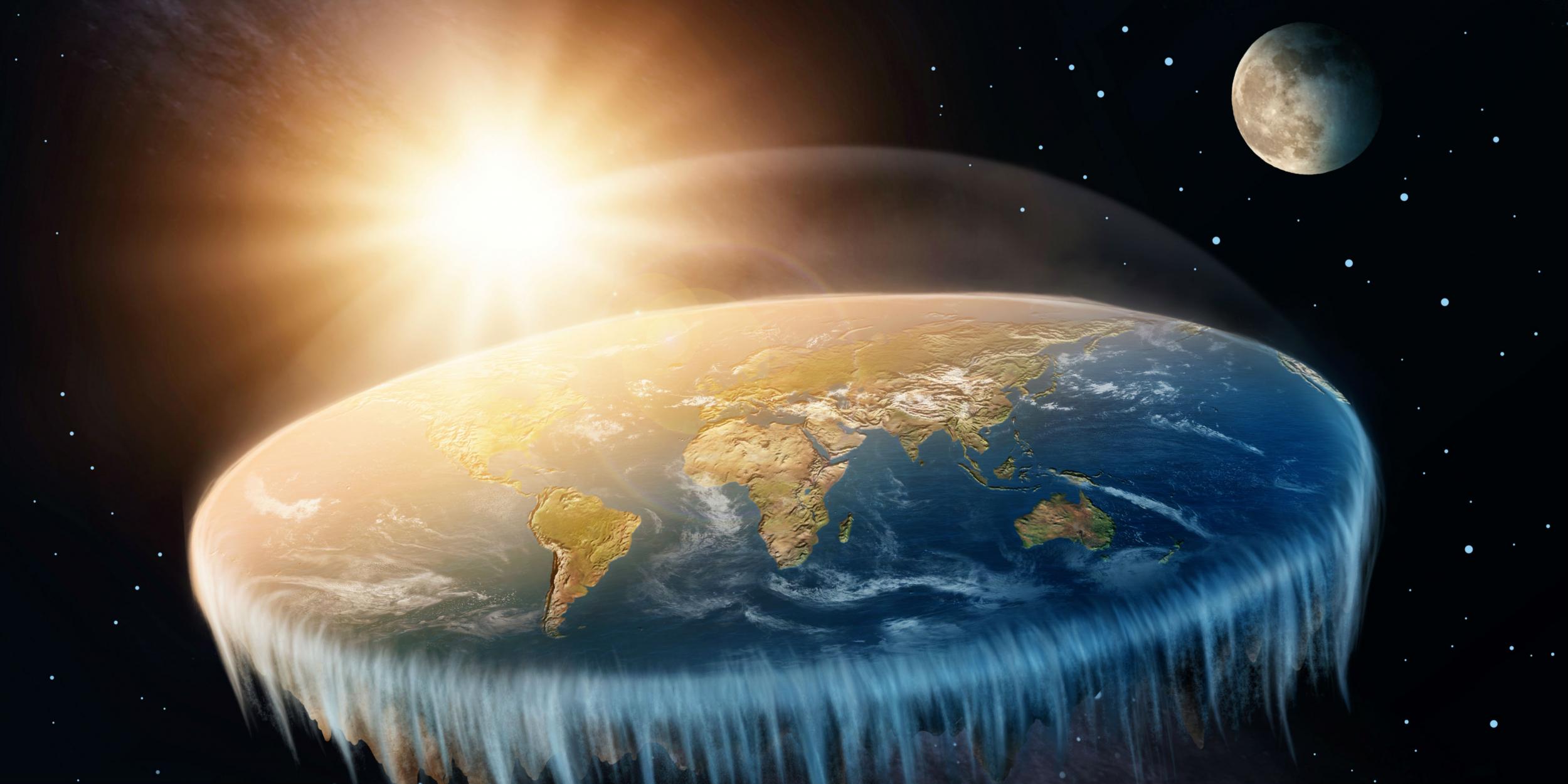
Here is a photo depicting the “flat Earth” conspiracy theory, one that is completely inconsistent with gravity and most other scientific findings. Independent.co.uk

Posted in Class, Physics | Tagged , | Comments Off on Gravity in Space

Blog 0

ABC 8

RIP Kobe. He was an inspiration to countless people and was part of the reason I started watching basketball.

Posted in Class | Tagged , | Comments Off on Blog 0