The Voyager Golden Record


the_sounds_of_earth_-_gpn-2000-001976
The Voyager Golden Record (Source)

The Voyager Golden Record was a disc of sounds and images included with both Voyager 1 and Voyager 2, both designed to study Jupiter and Saturn. Voyager 2 went on to study Uranus and Neptune, and is the only spacecraft to have visited them. However, these spacecraft are still gathering and emitting data even today. Recently, Voyager 1 left what is formally known as the “solar system” and is in interstellar space. Both will continue to operate until around 2025 when they run out of power. Although these were designed to observe the giants, they have another purpose: to leave a fossil of human civilization. On both Voyager 1 and Voyager 2, a golden record with sounds and images was included with the scientific instruments. This record included spoken greetings from over 50 languages, several “sounds of earth”, and music from all over the world. The music section includes famous songs such as “Beethoven’s 5th symphony” and”Johnny B. Goode” by Chuck Berry, as well as traditional songs from countries such as Peru and New Guinea. The famous astrophysicist Carl Sagan, who led the committee responsible for choosing the sounds and music, wanted to include The Beatles’ song “Here Comes the Sun” (a personal favorite of mine), and while The Beatles were okay with it, the record company EMI was not. Also included was over 100 images, including scenes from Earth and information on things like our numbering system and how to locate our solar system. These were all placed onto the two spacecraft so that if an alien civilization were to find them, they could learn about our culture. Do you think it was a good idea to send out the record with the probes? If you were to send out the record today, what would you put on it?


Posted in Instruments | Tagged , , , , , , | Comments Off on The Voyager Golden Record

Super-Earth(s)?

The idea of discovering new “Earth-like” planets has always intrigue me! I mean, they could be habitable planets that we can ACTUALLY live in? Just like in Terra Nova (I’ll explain more about that series in the end of this post!). Super-Earth, in short, means exoplanets in which their masses are higher than Earth’s, extra points if they are in habitable zones! For now, I am just going to focus on one habitable zone which is Kepler-62. Before that, hats off to those who guess why the zone’s name is Kepler! KEPLER is the name of NASA’s spacecraft in which its job is to find Earth-size planets orbiting another star AND it is also named after Johannes Kepler, world’s renowned astronomer.

Kepler-62f_with_62e_as_Morning_Star
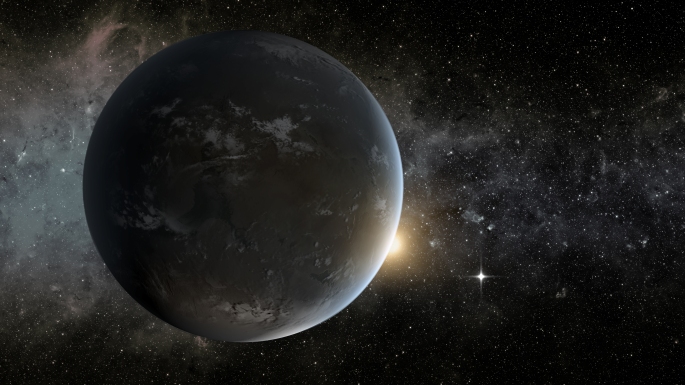
The illustration shows Kepler-62f (in front) and Kepler-62e (the twinkle on the right) orbiting Kepler-62 star. SOURCE

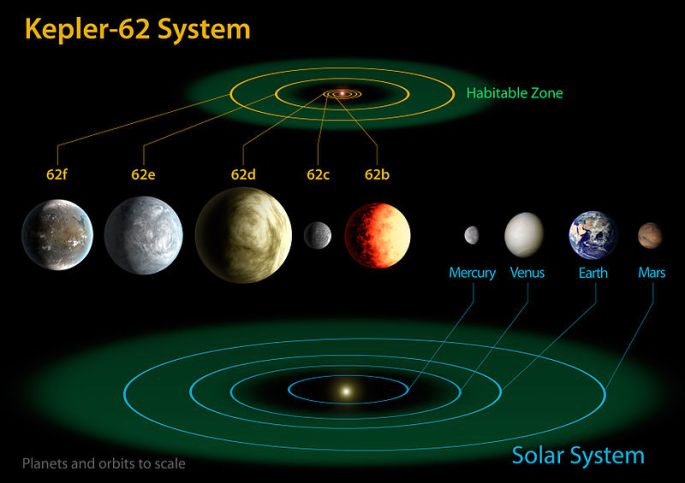
Kepler-62 is the name of a star in Lyra constellation (somewhat cooler than our Sun). It is the smallest habitable zone found and hosted about five exoplanets. There are two main planets in Kepler-62 zone which are Kepler-62e and Kepler-62f.

Most likely to be a water world, Kepler-62e is an exoplanet with 1.6 times the size of Earth. It orbits the red dwarf star once every 122 days. The planet is roughly 1200 light years from Earth and is believed to be more gaseous than rocky, thus called mini-Neptune. Another exoplanet orbiting the same Kepler-62 is called Kepler-62f. This planet is a bit farther out compared to Kepler-62e, seeing as its orbital period is 267 days. It is 1.4 times bigger than Earth and its equilibrium temperature is close to Mars’. Through estimation of its mass, Kepler-62f is most likely to be a rocky planet.

800px-The_diagram_compares_the_planets_of_the_inner_solar_system_to_Kepler-62
The Kepler-62 system with its habitable zone in compared to our Solar System. Only two planets are in the zone which are Kepler-62e and Kepler-62f. SOURCE

After further research, it was found that both of the planets are similar to Earth but slightly bigger. It was also discovered that both planets are likely dominated with ocean. Any chances that there are life on those planets? Follow-ups exploration and research are being done to find out more about the habitable zones and other exoplanets. Are there any more habitable zones out there? YES. In fact, there was another zone found in 2013 and was named Kepler-69 and there are actually many more out there!

Now, there is one TV show that I would recommend you guys to watch. Titled Terra Nova, it tells us about the life of a family in far future, where Earth is no longer fit for living due to overpopulation and declining air quality. So, they have to move to another world called Terra Nova where in that world, it was as if Earth was pulled back to the past (means dinosaur still exist!) and they have to fight to survive. Quite a good series, seeing that I am into science fiction. Give it a chance, if you have some time! (It’s on Netflix, btw)


Posted in Class, Exoplanets | Tagged , , | Comments Off on Super-Earth(s)?

Life: A Love Story

Screen Shot 2017-03-28 at 10.18.21 AM.png
Cover Photo courtesy of NASA. 

Sitting in my late-night astronomy lab last night, we watched a computer simulation (based completely on real, observed data) take us out as far into the universe as our understanding has gone. Starting in the Himalayas, Tibet, then Planet Earth, and rapidly, sooner than I thought possible, we were so far out of my realm of understanding, it made my heart race.

There is no way that I can look out at the tiny speck of dust which the Earth is, and the even tinier speck of dust upon it which our little school is, and think that we are special. Can it be coincidental, the collision of all the right materials, mixed with the right distance from the sun, the right temperature? The more we advance technologically, the easier it becomes to see across the dark void that is our Milky Way, our universe. And the more we see, the more we know, reading the spectra of other planets orbiting other stars, knowing that as we are made up of star stuff, our neighbors are as well. And our neighbors looking back at us, they too will see the fingerprint of our society’s addiction to fossil fuels and the burning of hydrocarbons. Will they look at us, millions of years more advanced, living sustainably perhaps, and see a glimpse into their own past? Could the evolution which turned us into who we are, have turned them into something else? We are looking out into the haystack as a needle, looking for another, who may or may not be looking for us too.


Posted in Aliens, Class, Exoplanets, Universe | Tagged , , , , | Comments Off on Life: A Love Story

Pluto the Dwarf Planet

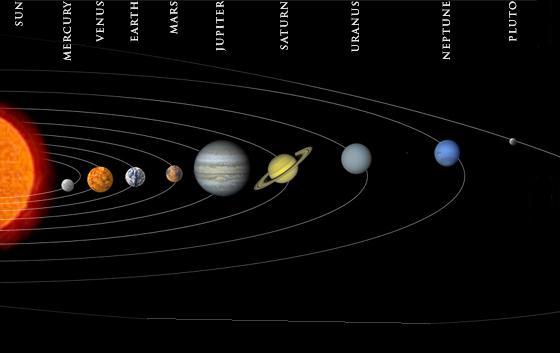
planets
Back When Pluto Was a Planet

Many of us remember Pluto as the used-to-be 9th planet in our solar system that was demoted to a dwarf planet.  So what makes Pluto a dwarf planet and not a planet?  What is interesting about Pluto, and, if it was so small, how exactly was it discovered earlier than other dwarf planets?

In 1930, American astronomer Clyde Tombaugh discovered Pluto after astronomers found small discrepancies between observational data and predictions for Uranus’ orbit.  Astronomers believed this indicated a 9th planet and set out to look for this new world.  Tombaugh found Pluto pretty close to where astronomers predicted it would be.  However, Pluto was much smaller than expected, too small to affect Uranus’ orbit.  In addition, there may have been erroneous calculations when determining the discrepancies of Uranus’ orbit.  It now seems that Pluto’s discovery was a coincidence, and if the errors had not been made, Pluto might have not been discovered until much later.  A fun fact about Pluto – while Tombaugh discovered this “9th planet”, later that year an 11-year-old girl from England named Venetia Burney named it Pluto.

Pluto became a dwarf planet after the discovery of other objects about the same size, like Ceres, Eris, Makemake, and Haumea.  These planetary objects orbit around the Sun just like planets, but they are too small to be considered planets.  Instead, they are classified as dwarf planets.  Pluto is actually only half as wide as the United States, much smaller than our own Moon.  It is mostly rock (about 2/3), with the rest of the mass being ice.  Since Pluto is so far from the Sun and only has a temporary atmosphere, the temperature on Pluto is freezing, with an average of 40K (-387.67 °F).

In 2015, the New Horizons spacecraft did a flyby study of Pluto and provided a lot more information about Pluto and its five moons.  Pluto’s largest and closest moon, Charon, is like most other moons in the inner solar system.  Charon keeps one face pointed toward its central planet all throughout its orbit.  However, the other four moons, Styx, Nix, Kerberos, and Hydra, behave like spinning tops, showing all faces to Pluto multiple times throughout their orbits. See here for the video.  New Horizons also provided us with details about Pluto’s surface.  There is an area called Tombaugh Regio composed mostly of solid nitrogen ice.  Vast regions on Pluto lack craters, which means some activity has erased them.  There are also mountains that are several kilometers tall, which is about the height of the Rocky Mountains.

We are still learning a great deal about Pluto, but it is a fascinating dwarf planet that has provided us with many mysteries about how the different features were formed.  The New Horizons spacecraft’s data has given us a much better insight into Pluto, but there is still much to be discovered.

Sources:

The Cosmic Perspective: The Solar System by Bennett, Donahue, Schneider, and Voit

NASA: What is Pluto?

(featured image)


Posted in Class, Dwarf Planets, Historical, SolarSystem | Tagged , , , , | Comments Off on Pluto the Dwarf Planet

Naming the Moons

Screen Shot 2017-03-27 at 4.39.21 PM
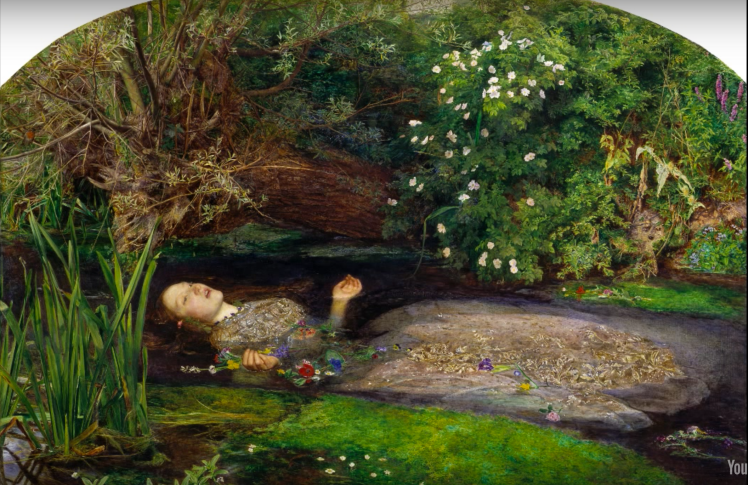
Ophelia by Sir John Everett Millais (1851-1852)

For my mother’s 50th birthday, we bought her a star. Though arbitrary, I remember the immense amount of pressure that I felt when I was trying to give the star a name, knowing that (at least in our household) I was participating in the excavation of the final frontier, putting a little mark in my mother’s honor on outer space. Eventually, we just called it Ellen, in honor of my mother as well.

This is partially why I was so drawn to the names of the moons, aside from their obvious creativity and originality; how did they (whoever they were) choose? What did these names mean? Particularly the Jovian moons, and particularly, the moons of Uranus. William Shakespeare penned carefully the plays which inspired the names of Uranus’ moons, but what about these characters did the astronomers find so apt as to name the moons after them? We may never truly be able to know the answer to that question, but it is certainly interesting to look at the figures that they chose. Cordelia, Ophelia, Desdemona, and Juliet are all women who die for/at the hands of a man who they love, who has wronged them. The feminist in me takes pause at this, with the male Uranus (God of the Sky) and his fragile, female moons. I appreciate the reference, but am not sure I agree with the characterizations. In fact, of the many moons of Uranus, only a few are men. And those men are strong, mischievous, and full of their own sort of fire. Again, the feminist takes pause. Perhaps it is the overwhelming prevalence of men in the sciences, or perhaps it is an inherent and historical consideration of the feminine and delicate nature of the moon which should be questioned; regardless, whether it has to do with William Shakespeare or NASA, it is interesting to think about who was chosen, and why.


Posted in Class | Tagged , , , , , , | Comments Off on Naming the Moons

The Solar Wind: Seeing with Eyes Shut

Screen Shot 2017-03-27 at 4.10.29 PM
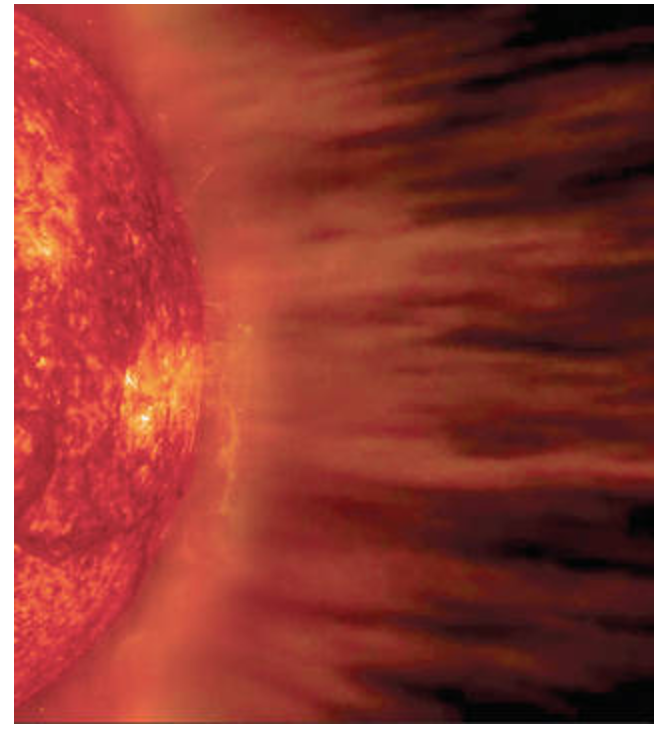
Computer generated image of the constant flow of solar wind streaming outward from the sun added to an actual image of the sun’s chromosphere from SOHO. Credits: ESA&NASA/SOHO

When thinking about outer space at a much more basic level, I remember being taught to think of the word “vacuum.” And as the narrator says in the video I watched, the space between planets is far from empty. A unique aspect of the sun’s weather known as the solar wind fills up some of the space between the planets, and has extremely interesting physical elements and attributes. NASA’s website explains some elements of the solar wind including its unbelievably fast speeds but relative weakness compared to the winds produced within our atmosphere. That, to my relatively inexperienced understandings of strength and power in the universe, is surprising to me, as I probably would have guessed that anything emitted from the sun would be stronger than any counterpart emitted by the earth. Most interesting (and perhaps alarming) about the solar wind, though, is the comments made in the video regarding the ability to see the solar wind only with one’s eyes shut. Astronauts interacting with the solar wind cannot see it when they have their eyes open, but when they shut their eyes, the energetic particles interact with the fluid in their eyes and produce little sparks of light every few minutes, which can only be seen when one is awake with their eyes closed. This is just one small enumeration of the wonders of space, and the phenomenal universe which can create something which can be seen with eyes shut.


Posted in Class, Sun | Tagged , , , | Comments Off on The Solar Wind: Seeing with Eyes Shut

Blog 6- Trump Budget and Science

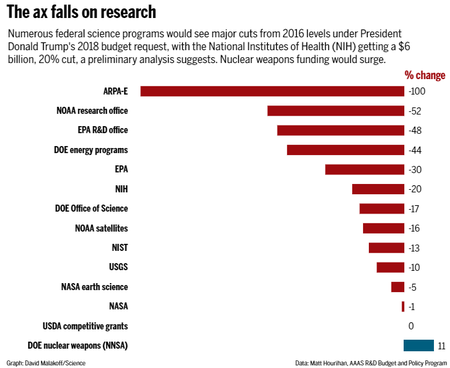
While not directly related to Astro 2110, I think that it is important to touch on the potential ramifications of the President’s recently released budget for the scientific community.  While it is unlikely that this exact budget will be passed, I think that it is nonetheless important to analyze.  It seems as though while the Trump administration is keen on revitalizing NASA’s space exploration program, it will also prioritize slashing the Earth sciences program.  The budget calls for a $102 million cut to the Earth sciences program, and the end to four programs that were designed to observe the Earth from space (source).  Conversely, the Orion crew vehicle and the Space Launch System are specifically endorsed (source).

Taken with the fact that the EPA budget is supposed to be slashed dramatically under this budget proposal, I am concerned that President Trump wants to redirect public attention from the Earth to space exploration.  Space exploration is more intriguing to the general population than Earth science research, but with mounting concerns about climate change from the scientific community, it seems as though this is arguably a diversion to refocus attention away from an incredibly pertinent issue.  One could argue that space exploration- such as the race to the moon in the 60’s Cold War climate- has historically been used to manipulate public opinion in a similar way.  I hope that the scientific community has the platform to continue to fight against climate change over the next four years.


insider_bar_updated
Source

Posted in Class, Public Policy | Tagged , , | Comments Off on Blog 6- Trump Budget and Science

Blog 5-Jupiter’s Great Red Spot

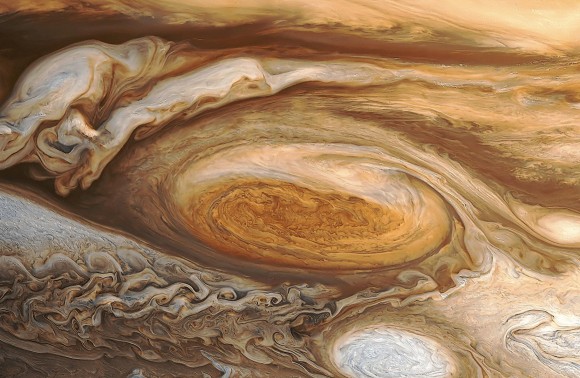
Jupiter’s Great Red Spot- a huge storm in Jupiter’s atmosphere- has been ongoing for seemingly as long as people have pointed their telescopes toward the planet; this means that the storm has continued for at least approximately 400 years, and most likely more.  The storm itself is twice Earth’s size.  It is known that storms on Jupiter are significantly more intense than storms on Earth.  This can be explained by the fact that since Jupiter’s surface consists of a “liquid ocean of hydrogen”, there is no solid surface that can work to decrease the severity of storms, as there is on Earth (source).

Jupiter’s atmosphere consists primarily of Hydrogen and Helium, with a small amount of water, ammonia, and ammonia hydrosulfide (source).  It is believed that the ammonia compounds color the Great Red Spot. However, scientists are perplexed by the fact that the Great Red Spot has so much color, when ammonia and ammonia hydrosulfide only make up a very small percentage of Jupiter’s atmosphere.  To find out more about this issue, scientists at Goddard have conducted experiments about whether cosmic rays or UV radiation from the Sun react with ammonia compounds in a way that could explain the colorization of the Great Red Spot.  Ultimately, while some studies have been conducted, it will be imperative to design experiments that more closely mimic conditions on Jupiter if we want to learn more about this intriguing, and enduring, storm system.  This could be valuable, as learning more about the atmospheric conditions of Jupiter could help the scientific community in their future studies on different extrasolar planets.

UT-from-space-probe-greatredspot-580x378
Source


Posted in Class, SolarSystem | Tagged , , | Comments Off on Blog 5-Jupiter’s Great Red Spot

Blog 4- Voyager Missions and Chuck Berry

Music fans around the world mourned the loss of Chuck Berry after his death on March 18th.  Credited by many as the original rocker, his use of the double stop, his stage presence, and masterful songwriting skills came to define what a rocker should aspire to emulate.

When the Voyager Program was officially kicked off in August, 1977, Berry was already a living music legend.  The Voyager Program was initially launched in 1977 so as to explore the Jovian planets efficiently; Jupiter, Saturn, Uranus, and Neptune were favorably aligned at this time.  The data collected from the Voyager missions has been very important;  their proximity to the outer planets has allowed the science community to more efficiently collect data about them, and map their features in ways that were previously impossible through only earth-based examination.  Their studies of Jupiter, Saturn, Uranus, and Neptune have proved invaluable.

The Voyager story did not end with an exploration of the outer planets.  They have continued their journey, and are now exploring interstellar space, which is the space in between star systems in a galaxy.  The Voyager probes have traveled farther than any other spacecraft launched from Earth.

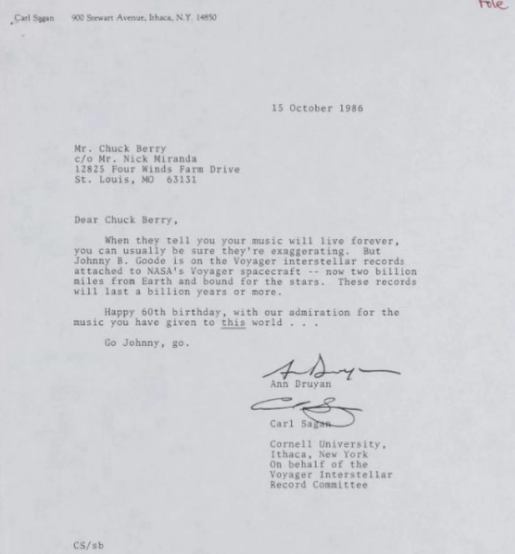
To bring this back to Chuck Berry: When the Voyager probes were launched, a “Golden Record” was included, which had songs that were considered to be important and would be played if the probe ever encountered intelligent extra-terrestrial life.  On this record was “Johnny B. Goode”.

Below is the letter that Carl Sagan wrote to Chuck Berry on his 60th birthday.

Screen Shot 2017-03-22 at 3.24.16 PM
Source

Posted in Historical, SolarSystem | Tagged , | Comments Off on Blog 4- Voyager Missions and Chuck Berry

Formation of the Solar System

orion_nebula-browse-640x350
The Orion Nebula

Approximately 13.8 billion years ago, an interstellar cloud of gas known as the solar nebula collapsed under its own gravity due to some cataclysmic event, such as a supernova.  This roughly spherical cloud of cold, low-density gas shrank as gravity pulled everything inward.  The cloud’s gravitational potential energy was converted to kinetic energy, which in turn was converted to thermal energy, heating the cloud of gas.  The Sun formed in the center, where the temperature was hottest and the density was highest.  The cloud rotated faster and faster as it shrank and eventually flattened into a disk.  Thus our solar system was born.

The planets formed from the materials swirling around the Sun.  Close to the Sun, the temperature was too hot for any of the materials to condense.  Beyond a certain distance, called the rock-metal condensation line, rocks and metals were able to condense and clump together to form Mercury, Venus, Earth, and Mars: the terrestrial planets.  Further out, temperatures were even cooler, which allowed the asteroid belt to form.  Beyond a distance called the frost line, temperatures were cold enough for hydrogen compounds to condense into ice.  Small clumps of rock, metal, and ice formed and, with the hydrogen and helium gas they captured, became Jupiter, Saturn, Uranus, and Neptune: the jovian or giant planets.  Beyond Neptune, icy comets formed Kuiper belt.  At the outermost edge of our solar system, a rough sphere of icy objects formed the Oort Cloud.  Most of the material in our solar system remained as hydrogen and helium gas, unable to condense.

chondrulesMAIN
Accretion of Planetesimals

The terrestrial planets were formed by a process called accretion.  Particles that condensed from the gas of the solar nebula began to stick together and grew larger.  Soon they were able to attract other particles through gravity to form planetesimals.  Gravitational encounters between planetesimals formed the planets and set their orbits.  The jovian planets also started out as planetesimals, but these ones captured some of the hydrogen and helium gas.  As they captured gas, they became more massive, which allowed them to gravitationally attract more gas.  Therefore, most of the composition of the giant planets is gas rather than condensed rock or metal.

Moons generally formed from material orbiting planets or from objects that became trapped by a planet’s gravity.  A major exception is Earth’s moon, which formed from a giant impact between Earth and a huge planetesimal called Theia.

moon_collision
Formation of the Moon

Finally, the majority of the hydrogen and helium gas (that which had never become part of a planet) was cleared from our solar system.  The gas was cleared by high-energy radiation and solar wind – a stream of charged particles that the Sun continually blows outward.  After this, our solar system became basically what it is today as the terrestrial planets began to form atmospheres and Earth gained its unique characteristics that allowed life to be created.

02-solar-system-nice-model-990x743
The Solar System

Sources:

The Cosmic Perspective: The Solar System by Bennett, Donahue, Schneider, and Voit

(featured image)


Posted in Class, Historical, Jovians, SolarSystem, Sun, Terrestrials | Tagged , , | Comments Off on Formation of the Solar System