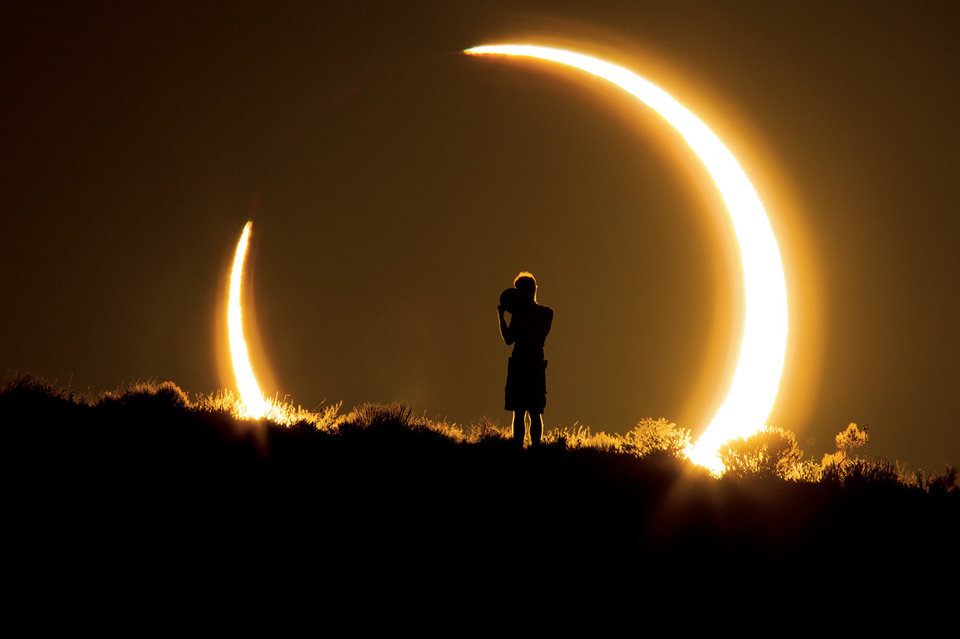
“Ring of Fire” to appear over South Africa

1tb-eclipse2-superjumbo-v2
©2017 New York Times

The appearance of an impressive annular eclipse is slated to take place later this month, Sunday the 26th, in the southern half of the world. The eclipse is scheduled to appear west of Southern Chile, with the best viewings possible from Angola, the Democratic Republic of Congo, and Zambia.

An annular solar eclipse occurs when the Moon positions itself between the Earth and the Sun, obscuring all of the solar disc save the outer ring (the annulus), which is then visible from Earth. Due to the position of the Moon and Earth on the ecliptic (the Earth’s path around the Sun), varying degrees of eclipse completion may occur. While the Sun is obscured, viewing with the naked eye still holds the potential to do retinal and corneal damage, and as such special filtered lenses are still required.

You can find a video of the eclipse’s path here, along with safety tips for future solar eclipse viewings.


Posted in Class, General, Observables | Tagged , , , | Comments Off on “Ring of Fire” to appear over South Africa

New technologies in mapping space weather

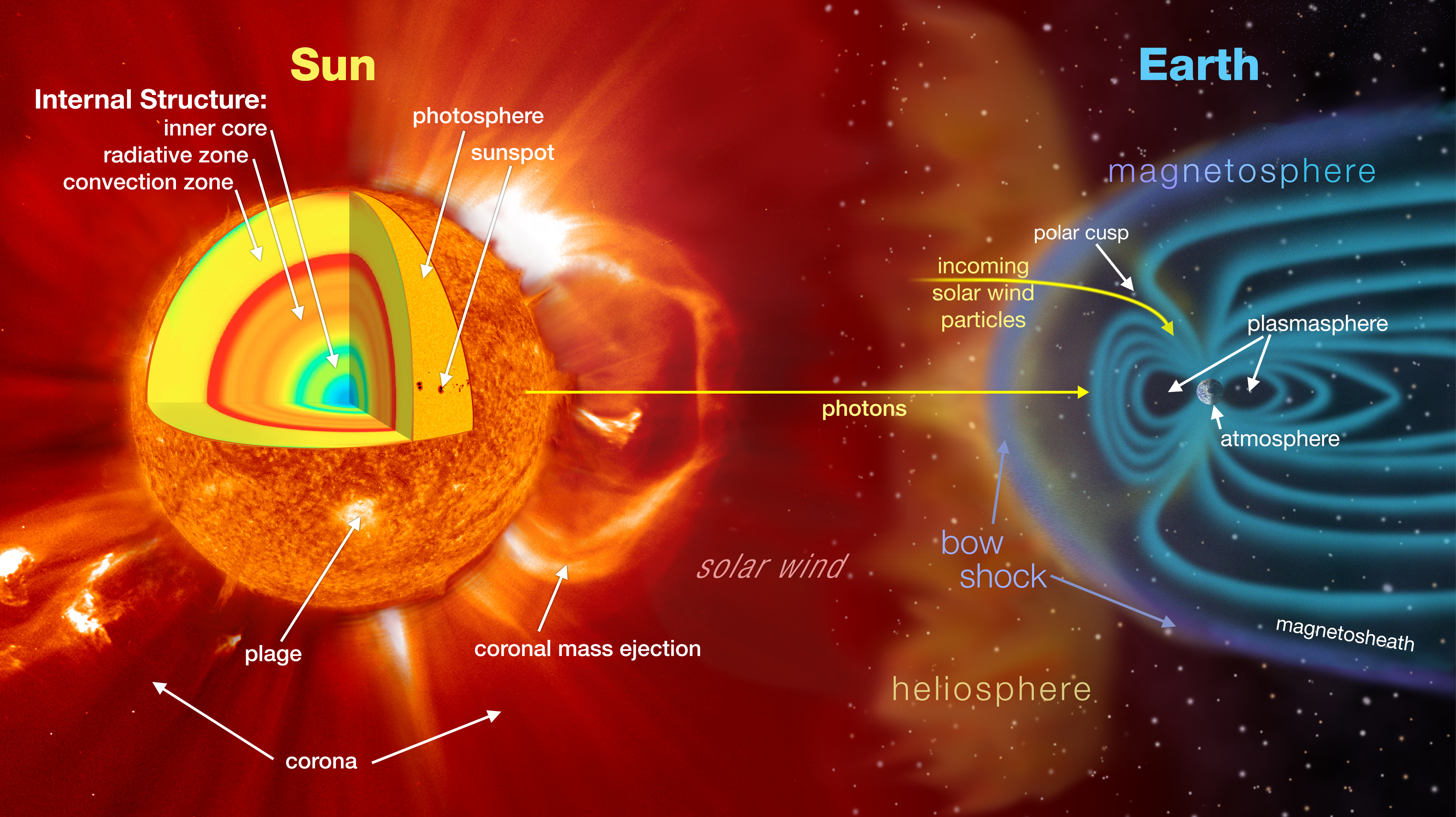
One of the fundamental concepts in the study of astronomy is the dependency of Earth and every other planet in the solar system on the  characteristics of the Sun. From emissions of hot gas to violent space wind to bursts of extra energy (via solar flares), the behavior  of the Sun, dubbed as space weather, is crucial in determining the changes of Earth’s environment. Solar weather can affect various aspects of our daily life, from damaging communications and satellites to exposing orbiting space crafts to large amounts of radiation. For example, when solar wind shoots large amounts of high-speed particles into space, navigation satellites lose their magnetic perspective and deliver incorrect directions via GPS. Larger instances of extreme space weather can have more devastating consequences. In 1859, the last time a solar flare occurred in the direction of Earth, telegraph systems were disrupted and shut down for days worldwide.

earthsunsystem_hw
Illustration of Space Weather

As such, the ability to predict such occurrences in space weather is critical, especially with modern communication systems. One long-known phenomenon for this was the solar cycle, which demonstrated how the Sun’s behavior changed every 11 years. Modern technology, in turn, is attempting to take predictions of space weather to the next level. NASA has developed a new tool called the Eruptive Event Generator (Gibson and Low) (EEGGL) that illustrates the paths of activity such as solar flares before they can affect Earth’s magnetic field. The model is designed upon the physical observations of the solar flares and then manipulated with fundamental laws of electromagnetics to estimate the movement through space. This open-source tool is the next step in the prediction of such impactful solar activity and can help prevent vast damage to our interconnected systems.


Posted in Class | Tagged , , , , | Comments Off on New technologies in mapping space weather

Why is the Moon so Crater-y?

moon
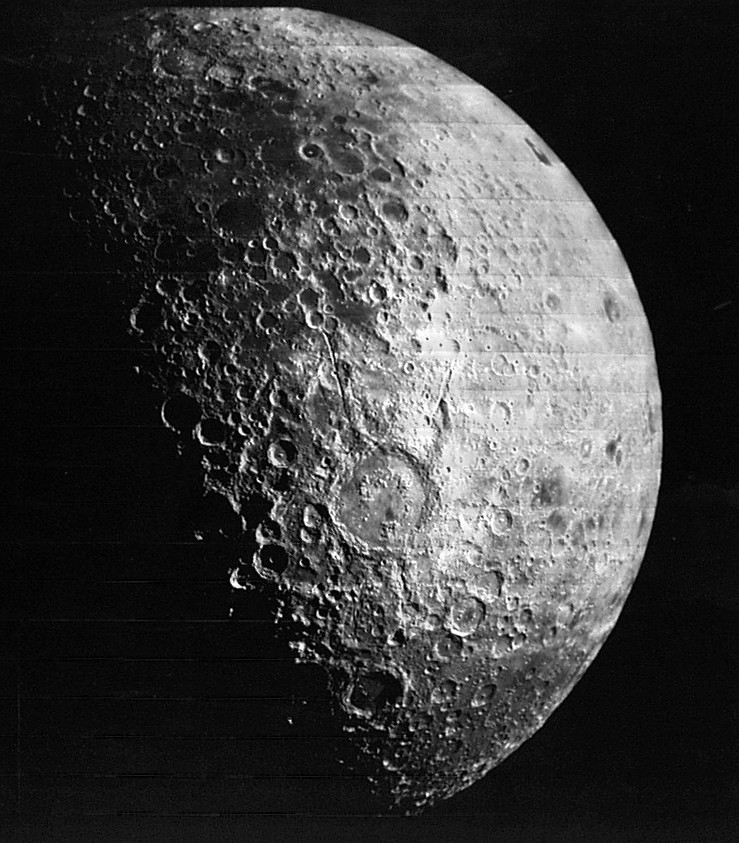
Photo of the moon with its topographic features highlighted by the low angle sunlight

Have you ever wondered why the Moon is full of so many craters?  The surface of the Moon is so textured that many of its topographic features are visible from Earth with the naked eye. Most people would say that all of the crater scars on the Moon’s surface are a result of meteor impacts. If this is the case why aren’t these craters also covering Earth’s surface? Did the meteors miss our planet?

Well, the Moon, along with all of the planets in our solar system (including Earth), were bombarded by comets and asteroids about 4 billion years ago in an event known as the Late Heavy Bombardment. There is no scientific consensus on where all of these fragments of rock came from, but the fact of the matter is that Earth was not immune to this bombardment. In fact, the Earth probably got hit by more comets and asteroids than the Moon did because it is much larger.

So why does the Moon look like a holy Swiss cheese while the Earth looks more like a smooth cheddar? Well, there are two short answers: plate tectonics and atmosphere. On the Moon, there are no plate tectonics and no atmosphere. This means that no mountain building, erosion, or transport of sediment occurs. The features that we see on the Moon today formed billions of years ago and have remained constant. On Earth however, plate tectonics drives the rock cycle in which, over geologic time, rock material is constantly subducted into the hot mantle, melted, and lithified back into rock. This, along with our atmosphere which drives erosion processes like wind transport of sediment, have erased signs of any craters that may have formed during the Late Heavy Bombardment. So, don’t feel bad for the Moon, Earth had just as tough of a time during this bombardment billions of years ago.


Sources:

BBC Earth

Lunar and Planetary Institute


Posted in General | Tagged , , , | Comments Off on Why is the Moon so Crater-y?

Tides Explained

High Tide vs. Low Tide

Tides are the rise and fall of the sea levels. The above image captures this very normal phenomenon that we can all observe for ourselves if we go to an oceanside beach. Whenever I went to the beach as a young kid, I was always hoping the tides would be high. Since I knew they would be higher the later it got into the evening, I was always determined to stay as late as possible. But why does this happen? This is tides explained.

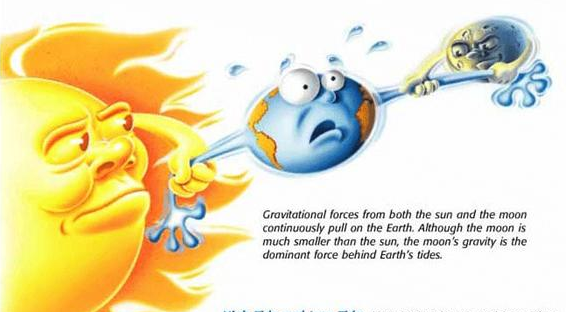
The Moon’s gravitational influence is responsible for tidal flows of water. It is common knowledge that the Moon feels the gravitational pull from the Earth, which explains why the Moon orbits the Earth. However, many people may not know that the Earth feels a gravitational pull from the Moon too.

Earth, Moon, and Sun Cartoon

The closer an object is to a massive object, the stronger that massive object’s gravitational pull is on that other object. Likewise, the further away an object is from a massive object, the weaker that massive object’s gravitational pull on that other object is. Therefore, the side of the Earth facing toward the Earth feels a much stronger gravitational pull from the Moon facing away from it does. This explains why if you were to go the beach at midnight when the Moon is in the sky, the tidal waves would be much higher than if you were to go to the beach at noon when the Moon isn’t in sight.

However, local geography also has an effect on how high the tides are. A location in which water does not flow completely freely will experience later high tides than locations in which water does flow freely.


Posted in Class | Tagged , , , , , | Comments Off on Tides Explained

Timeline of space exploration

Astronomy is the the oldest of the natural sciences! Back in antiquity, it also contained Astrology, but they were separated to two different sciences during the Renaissance period. Also, Astronomy contained Astrophysics, Cosmology, and other “pieces” which became independent sciences in the 20th century.

Astronomy started many-many years ago in ancient countries such as Egypt, China, India and Greece, eventually spreading to other parts of the world – Central America, Australia, and later Europe. Every country had its own theories, facts, views on the Universe. Eventually all their works became irrelevant, because of technical progress.

Space science got a big push forward towards exploring the cosmos during the Renaissance period in Europe and an appearance of great scientists such as Georg von Peuerbach, Nicolaus Copernicus, Galileo Galilei, Johannes Kepler, Isaac Newton, and many others.

In the 19th century scientists established many observatories in Europe. Also, they tried to improve telescopes’ mechanisms – make them larger and more powerful. For example, William Parsons built a 2-meter reflecting telescope in 1842.

The real space exploration started in the 20th century. The first successful orbital launch was made by Soviet Union on October 3rd 1957, their satellite was called Sputnik-1 (Satellite-1 in Russian). The first successful human flight to the space was also made by the USSR on April 12th, 1961. The cosmonaut’s name was Yuri Gagarin, his spacecraft completed one orbit around the Earth. The first woman in space was Soviet Valentina Tereshkova, she made 48 laps around the globe (June 16th 1963). The first artificial satellite on the Moon was also made by the Soviet Union in 19 and was named Luna-2.


Posted in Class | Tagged , , , | Comments Off on Timeline of space exploration

Hubble’s Law and a Window to the Past

Hubble’s Law is one of the most fundamental observations in cosmology – that objects far off in space are almost exclusively traveling away from us, and that the farther the object is from us, the faster it is moving away. Within a certain limit, the relationship is linear, and can be described by:

v = Hr

Here, v is the velocity the object is moving away from us, r is the objects distance from us, and H is Hubble’s constant – a constant of proportionality describing how fast the velocity changes with distance. This law is an important basis for establishing the expansion of the universe.

One interesting consequence of Hubble’s Law is that, if we can measure an object’s velocity relative to us using spectroscopic method, we can estimate how far away it is. If we know how far away it is, we can calculate how long it took the light we see to traverse that distance. Since the farthest, fastest (and therefore higher redshift) objects take the longest to emit light to us, we can essentially observe the universe at older and older time periods by observing higher and higher redshift galaxies, obtaining a kind of history of the universe. Astronomers and physicists use this in order to help learn more about phenomena such as how galaxies tend to form and evolve over time.

darkages
An illustration of how looking at higher redshifts allows us to observe the history of the universe

Posted in Galaxies, Light, Universe | Tagged , , | Comments Off on Hubble’s Law and a Window to the Past

James Webb Space Telescope

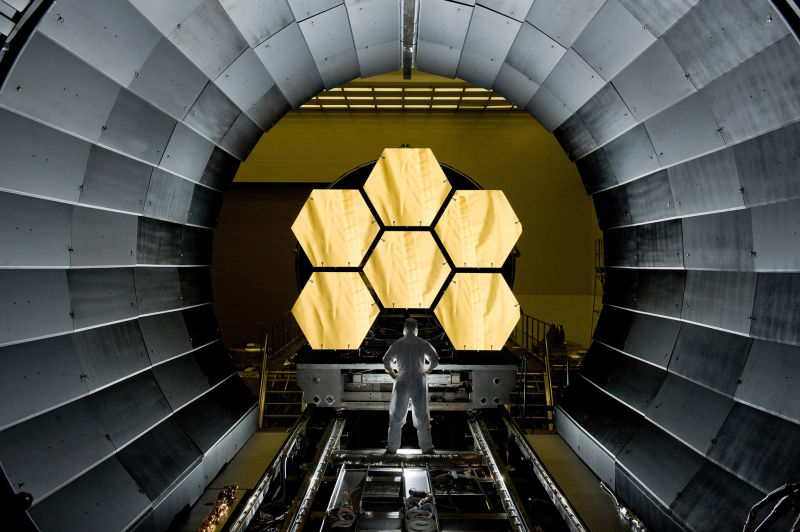
The James Webb Space Telescope (JWST) is the long awaited successor to the Hubble Space Telescope from which we have received numerous wonderful and famous images of far away stars, galaxies, and other celestial bodies. As the successor to the Hubble, there are, of course, some improvements over the Hubble that are being made with the JWST. These improvements are primarily concerned with seeing more, rather than seeing what we can already see better. The resolution of the JWST, then is less important than on the Hubble, and is in fact significantly worse. The JWST, however, will be able to see things that the Hubble was and is unable to. Its mirrors will have a diameter of 6.5 m, more than twice the diameter of the Hubble’s, and giving them more than 6 times the area of the Hubble’s mirrors. This increased surface area allows for a much  greater amount of light to be taken in by the telescope.

avqdd7ctb19lipuakcan
A NASA Engineer stands in front of 6 of the primary mirrors on the JWST [Source]

The telescope is also to be fitted with infrared instruments that are able to detect light in a wider variety of wavelengths than the Hubble telescope. The hope is that this improved light range will allow us to learn more about the beginning of the Universe.

The telescope is planned to have a life of at least 5.5 years, although the hope is that it will last for more than 10. This telescope will be at a greater risk to failure than the Hubble as well due to the nature of its orbit. The Hubble orbits the Earth, and only at a height of about 400 miles. The JWST, on the other hand, will orbit what is called the Sun-Earth Lagrange point, and will be approximately 1 million miles from the Earth. This means that, unlike the Hubble, the JWST will not be serviceable. So, if something goes wrong, as it did with the Hubble, there will be no way for any recovery efforts to be made. This is part of the reason, along with cost, that the JWST has been delayed, so that NASA can ensure that the telescope will operate properly for its entire planned life.


Posted in Class, Instruments | Tagged , , | Comments Off on James Webb Space Telescope

Blog #3: PSR J1719-1438 b

PSR J1719-1438 b is a really cool planet.

It’s small and massive, and oh yeah, it’s made of diamonds.

diamond_planet2.jpg


PSR J1719-1438 b orbits around star PSR J1719-1438, which is a neutron star and a pulsar. Basically, because the star’s magnetic field is so great, it sends off waves of radiation. The relationship between the star and planet is such that scientists believe the star has essentially eroded away layers of what once was an orbiting star so that only its core remains.

PSR J1719-1438 b has a core of oxygen and carbon and with the right conditions, the core hardened and crystallized into diamond.

Talk about serious bling.

Source: Futurism


Posted in Class, Exoplanets, Stars | Tagged , , | Comments Off on Blog #3: PSR J1719-1438 b

Blog #3

h1cxgjk1bofqw-plqpx009v5qejcc7-btv0ipdj5lf4-yiwkkfiktaiy4caeyillpelenggvble-a3lgm47k44__1240x600_q85_subsampling-2
The Layer of Rock Where the Fossil Bacteria was Found

The Earth is around 4.5 billion years old. The first half of the Earth’s existence (prior to the Great Oxidation Event which essentially introduced free oxygen (dioxygen) into the Earth’s atmosphere) was characterized by the presence of certain types of bacteria, although evidence of this existence on our planet is limited. However, last year, researchers from the University of Cincinnati found evidence for this kind of bacteria in fossils found in South Africa. The fossil sulfur bacteria found in South Africa are the oldest known of their kind. The importance of finding such a rare bacterial fossil from this time period (2.5 billion years ago) is that it demonstrates some of the possible ecosystem diversity that may have characterized the Earth’s existence before the GOE. Scientists have previously hypothesized that a supercontinent called Vaalbara may have existed before the splitting up of the tectonic plates of the Earth’s surface. The continent would have included land that now makes up South Africa and Western Australia. This would make sense because it corresponds to where sample fossils of this time are typically found. This particular fossil, according to the University of Cincinnati researchers, may have formed in this supercontinent in a seabed that contained sulfate.

Source: 2.5 Billion-Year-Old Bacteria Fossils


Posted in Science | Tagged , , , | Comments Off on Blog #3

Blog #2

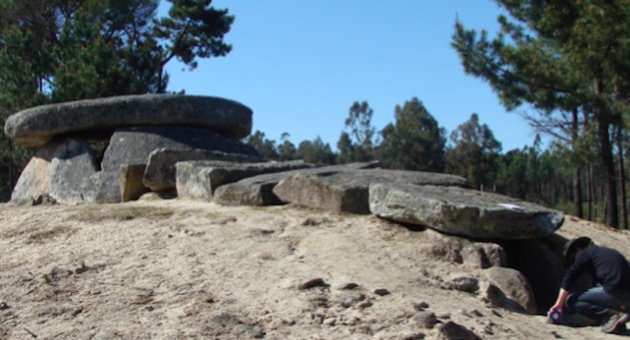
54bec6f0f
Image of Dolmens

For most contemporary scholars, the modern telescope owes its existence to Enlightenment thinkers who crafted the device to enhance their own stargazing endeavors. However, observing the night sky is hardly a practice that has been limited to the past few hundred years.  Thus, it seems likely that there may have been telescopic structures created much before the Enlightenment. For example, there are scholars who believe that the prehistoric Stonehenge in England was designed as a “celestial observatory.” In June of 2016, the Royal Astronomical Society announced that they may have found evidence for stone tomb structures in Carregal do Sal, Portugal that were built six thousand years ago, perhaps for telescopic purposes (specifically stargazing).  The tombs (called dolmens) operated by featuring long, but slender, entrances that functioned to “zoom” in on celestial bodies that were not visible by simple, unaided, visual observation. According to the Royal Astronomical Society, it appears that the tomb structures may have been built by prehistoric humans to focus in on the star Aldebaran (part of the Taurus constellation of stars).

Source: The 6,000-Year-Old Telescope


Posted in Historical, Instruments, Observables, Science | Tagged , , | Comments Off on Blog #2