Stonehenge is commonly known as a collection of large stones in Wiltshire, England, but even after much research and investigation, we still don’t know who built it, when it was built, or exactly what it was used for. We speculate that it could have been used as a burial ground or even an astronomical observatory. What is particularly interesting about this sight is its alignment with the summer and winter solstices. As seen in this Stonehenge reconstruction, as the sun sets rises on the summer solstice and sets on the winter solstice, the sun is perfectly aligned with opposite sides of the monument. It is commonly believed that the monument was built between 3000 and 2000BCE, which leads us to wonder how important astronomical observations were to ancient societies. Another interesting potential use for Stonehenge is to predict eclipses. Some questions that may spur from these potential uses are: Why did the creators of Stonehenge align it with the path of the sun? Why would they want to predict the timing of eclipses?
POOF! And there goes the first phylum! GIF by GIPHY
Ever wonder how kingdoms of animals ever started? What causes them? When? And ultimately, HOW? It’s CAMBRIAN EXPLOSION!
Cambrian Explosion is a relatively rapid appearance of animal kingdoms or known as phyla – a taxonomic term which means the primary kingdom of animals – which happened around 530 million years ago and lasted about 54 million years. If I were to fit the entire creation of universe in a year, then the Cambrian Explosion would happen during December 15th. When Cambrian explosion (or radiation, some might say) occurred, vast diversity of animals took place and rapid animal evolution happened, be it aquatic of land. Additionally, many scientists also believed that most animals that existed today originated from the explosion.
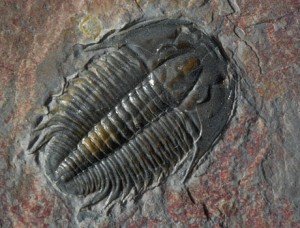
The dominant animals that lived during the period was aquatic, given that the Earth was practically ocean and land was hardly to be seen. Trilobites were assumed to be the dominant organisms but after future research, it was proven wrong and replaced with arthropods which was mainly dominant as aquatic organisms. It was later known that trilobites were a small part of arthropods family, which demonstrate their similar structure.
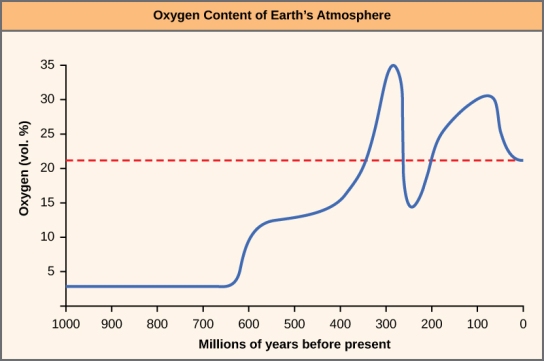
Many had voiced out their theories as to how the explosion happened but the cause of it is still unknown. Many scientists believe that it was the sudden elevation of oxygen level and concentration of calcium in water that boost the evolution.
Theories like the environmental and ecological changes on Earth and how lagoons and islands are formed were also debated. The lagoons was said to provided shallow pools as the habitat to live in and necessary food for the animals, thus creating the rapid appearance of animals. Some other theories claimed to have genetic reasons as to why the explosion happened. There are still many unresolved questions and remarks about the period, and scientists are still muddled as to how the evolution and diversification could have happened in such a short amount of time. Those questions aside, the Cambrian period had definitely marked such an impactful event in the timeline of our universe.
The visible universe-including galaxies,stars and planets only make up 4 percents of the universe (REALLYYYY). What about another 96 percents of it? In reality, another 96 percents consists of the thing that is unseen. Besides, we can’t really identify or perhaps understand what that 96 percents is made up of. From the perspective of the scientists, they called it as a dark energy or dark matter. Why is it called as a dark matter/dark energy? (Say yes if you want to know more…kidding)
Dark matter is an unidentified type of matter and it does not interact with electromagnetic radiation (i.e. light), hence make it invisible to the electromagnetic spectrum. On the other hand, dark energy is basically an unknown form of energy which is have a direct relation with the accelerating rate of expansion of universe. However, it still remain as a hypothesis for the scientists.
According to the standard model of cosmology, dark energy contributes 68.3 percents of the total energy in the present observable universe. The mass–energy of dark matter contributes 26.8 percents while ordinary matter contributes 4.9 percents. If I were to explain these dark matter and dark energy,it is going to take forever….(I’m not even a scientist but probably will).
How do the dark energy have impact on the acceleration rate of the expansion of the universe? Dark energy has a unique property which is it has negative pressure which is distributed relatively homogeneously in space.
From this equation, it yields out a constant value for w (cosmic acceleration) thus prove that the universe is expanding with an accelerating rate. The derivation of this acceleration is shown in the link below.
The main point is we can work through a lot of mathematical formulas and do some estimation on the gravitational pull of these entities. However, there is no guarantee of proving what the unseen or so called invisible part of our universe is made up of but we do know that they are exist. Although it still remain as a hypothesis, the majority of the universe may still remain as a mystery. I provided a video in the link below which help to explain the dark matter and dark energy in a more intuitive way.
Up until about two years ago, gravitational waves were rarely discussed outside of the scientists who based their careers on its discovery. To the public, the entire phenomena was unknown. However, that quickly changed on September 14, 2015 when the Laser Interferometer Gravitational-Wave observatory directly detected gravitational waves. As this news spread across the globe, many people were left asking questions rather than celebrating. What are gravitational waves? Where do they come from? And how in the world did we manage to detect one?
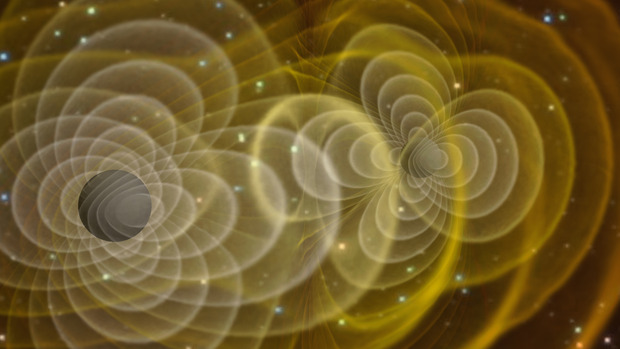
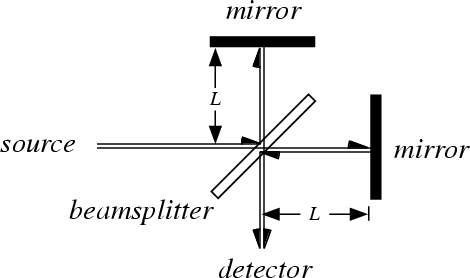
Gravitational waves were first postulated by Albert Einstein as a direct result of general relativity. His work showed that large, accelerating objects can disturb the fabric of space-time so much that waves emanate from the source, rippling through space. Although these waves can be an indication of the release of massive amounts of energy, they appear to be harmless by the time we receive them on Earth. The sources of these gravitational waves can vary, but they all tend to be situations in space where massive amounts of energy are given off. For a more comprehensive list of sources, please click on the link provided below. Finally, direct detection of gravitational waves on Earth proved to be very difficult indeed. LIGO was able to detect these tiny gravitational waves through the use of an interferometer, similar (although much larger) to the one used by Michelson and Morley in their famous experiment (As discussed in my previous blog post). This interferometer is so precise that it was able to detect graviational waves thousands of times smaller than a nucleus. One thing is for certain, much can be learned from these gravitational waves, and scientists will continue to study them for decades to come.
Before discussion the Special Theory of Relativity. Two observations must be understood; one that the speed of light is constant and two one cannot distinguish a state of rest from a state of constant velocity. The idea that the speed of light is constant has never been truly proven, but can be verified with experimentation. Galileo’s principle of reality discusses how inertial beings, those beings experimenting inertia, could not tell whether they are moving with a constant velocity or at rest.
In space the only concept which is constant is light; space and time become relative. The special theory of relativity states that as an objects velocity increases it measures a shorter distance, until the point it reaches the infinite limit of speed, speed of light, distance stops existing. This theory also states that if as the velocity of a running clock increases its time slows down until a point, once it reaches the speed of light, the clock stops running altogether. The last idea which is presented by the theory of relativity is that as an objects velocity increases its mass will increase until it becomes infinite when the speed is equal to the speed of light.
The reasons we in our everyday lives can not see these ideas being expressed is because we never have large enough differences in speed to see the the differences in distance, time, and mass. As an object approaches the speed of light the more warped its measurements of mass, distance, and time are.
The most exciting part of this theory is that it potentially leads to a way and understanding of how to time travel. If time stops when one reaches the seed of light, a connection can be easily drawn that by going faster then the speed of light we could go back in time.
Before Einstein’s revolutionary ideas changed the landscape of physics, very little was known about the speed of light. The fact is that, at the time, light was an anomaly; it had characteristics unique to anything else we experienced in the world. For example, was light a particle or a wave? And more importantly, if light is a wave, then what medium does it travel through? While we know the answers to these questions today, they were issues of great debate throughout the scientific community. Rather than answer the first question, we will focus on the supposed medium that light must travel through.
Since all waves known at the time traveled through a known medium (i.e. sound in air), it was proposed that light must also travel through a medium. But this medium must be something completely new and unseen since light also travels throughout space, evident due to the fact that we can see light from the surrounding stars. Therefore, this proposed medium was known as the ether. But, like all scientific theories, the mere development of an idea is not enough; it must be tested and agree with current observations. Along came Albert Michelson and Edward Morley.
Michelson and Morley set out to test whether the ether existed by measuring the speed of light in different directions. The idea was that, since the Earth is moving through space and therefore moving relative to the ether, measuring the speed of light in different directions would yield two different speeds. However, when the experiment was performed, Michelson and Morley found no difference in the speeds. They were forced to conclude that there is no ether for light to move through.
Today, we know their results to have been true. There is no ether acting as the medium for light to travel. Although this experiment did a great job of negating a faulty theory, it did very little to construct something new. However, this would come later when Einstein formulated his theory of special relativity, claiming that light travels at the same speed for all observers.
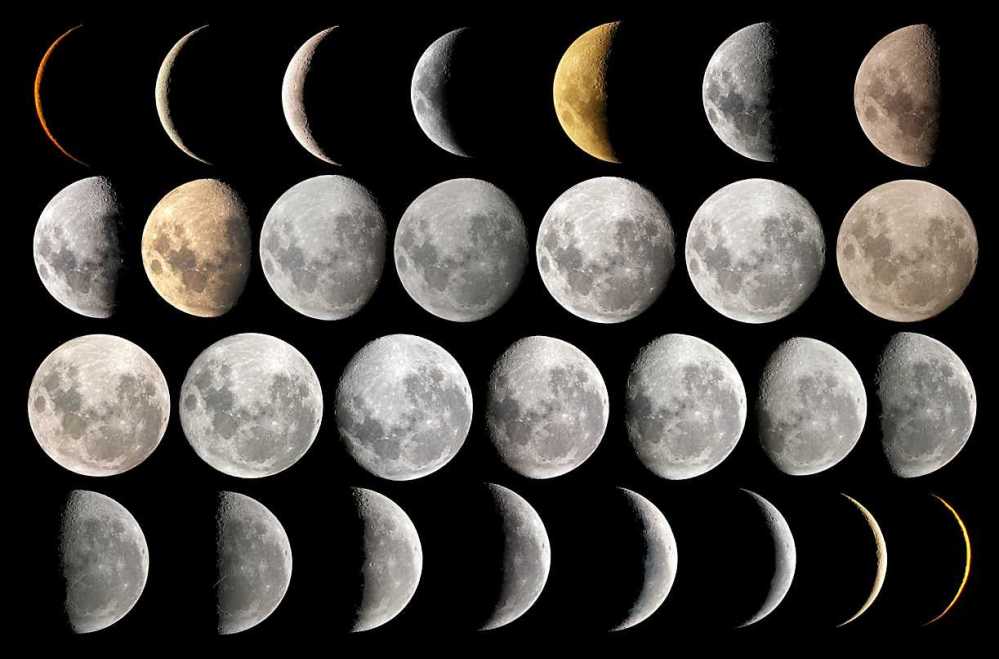
Moon, the beautiful silver disc hanging in the night sky, always gives me a sense of mutability and mystery. Have you ever looked up the sky and have a careful observation of the Moon? Have you ever had this question: “Why does the Moon look different every night? Do these changes follow particular patterns?” With such questions, I am ready to explore the science behind it and learn the interesting knowledge about Moon Phases.
According to the Wikipedia, the lunar phase or phase of the moon is the shape of the illuminated portion of the Moon as seen by an observer on Earth. The lunar phases change cyclically as the Moon orbits the Earth, according to the changing positions of the Moon and Sun relative to the Earth.
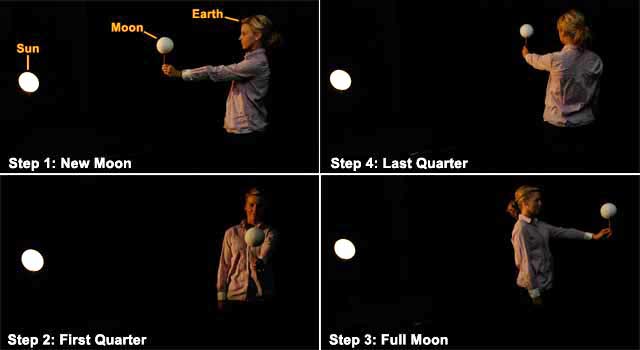
One easy way to understand the moon phase is through an easy and interesting Moon Phase Demonstration Activity! Simply imagine a light source (a lamp) as the Sun, a ball that you will hold in your hand as the Moon and yourself as a observer standing on Earth. Hold the Moon ball out level with you head and try turning you body according to the position of the lamp. Then you will see the changes in the illuminated portion of the ball and get to know how will each moon phase happen.
At the time I am editing this blog post, the Moon is in a Waning Gibbous phase, which is the first phase after the Full Moon occurs. If you are curious about what phase the moon is in at the time you read this blog, exploring Today’s Moon Phase at the Moongiant Website.
It is very exciting to find out that we just had a Full Moon on Feb 11th, 2017, which is the day before yesterday!
The red planet is orbited by two moons, Phobos and Deimos (Greek for Fear and Panic respectively), and given the predicted fate of Phobos, the small moon has good reason to be afraid. Both moons may have originally been asteroids that were captured by Mars’ orbit, however in time, Phobos may become a ring around the planet.
Phobos orbits incredibly closely to the surface of Mars, which led to the hypothesis that Phobos would eventually collide with the surface. Given time and more images of the moon however, it can now be seen that there are large grooves across the surface of Phobos. These are potentially caused by a significant difference in gravitational tidal waves on opposite sides of Phobos, which may be causing the moon to gradually pull apart. The more recent hypothesis to this is that Phobos will be gradually torn apart into a ring of debris surrounding Mars.
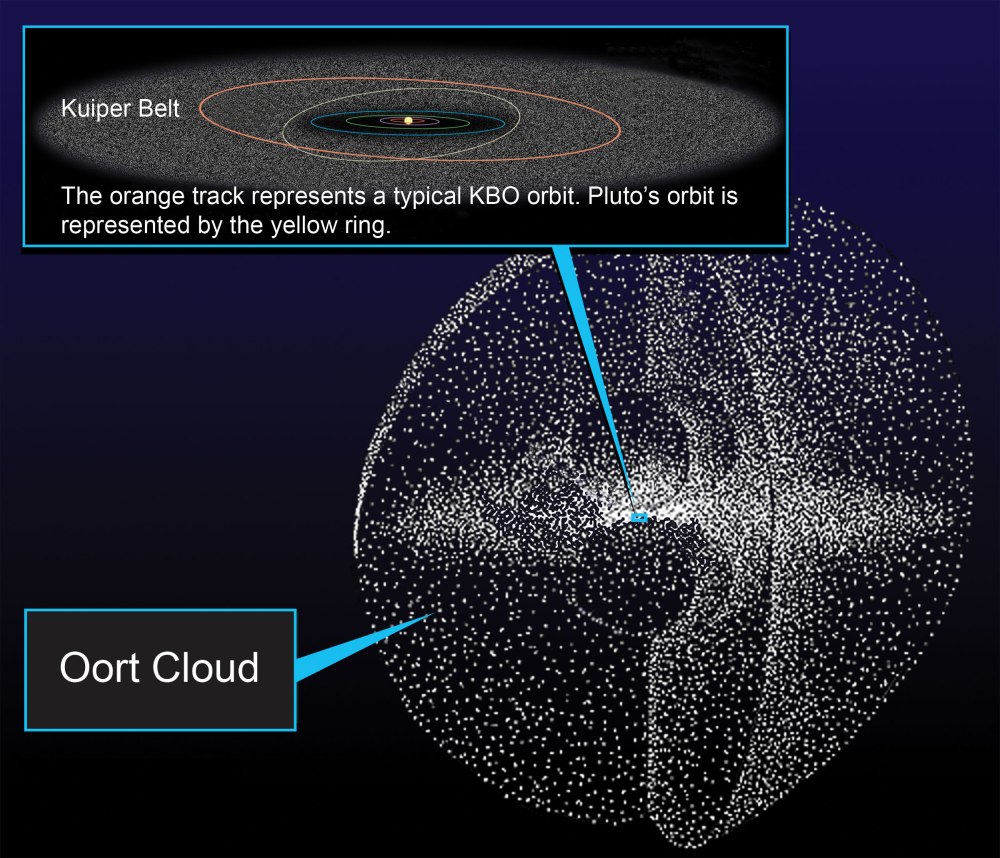
The Oort Cloud is a theorized “shell” of comets and other objects that are on the edge of our Solar System. It is much harder to observe than other objects in and around our solar system like the Kuiper Belt, so it’s existence is only theorized, but it is the best way for us to explain the origin of long-period (longer than 200 years) comets. The Cloud itself is thought to be comprised primarily of ice and rock, the remnants of a disk of material that originally formed our planets and our Sun, and it is thought to exist between 10,000 AU and 100,000 AU away from our Sun. This distance means that the objects in the Cloud are very loosely bound to our Solar System, so they are often affected by the gravitational pull of passing stars and these gravitational effects can pull those objects in different directions and can even pull these objects out of the shell and the may begin “falling” toward our Sun. Information on the Oort Cloud is still fairly scarce since it is very difficult to observe and its very existence is still only theorized. There is a great deal of evidence for it, including, as stated previously, a number of comets as well as the planetoid Sedna, which is thought to be on the edge of the Cloud. It is thought that there are trillions of objects in the Cloud, so more evidence is discovered quite frequently.
An image that captures the scale of the Oort Cloud [Source]The scale of the Oort cloud can be better seen here. To put things in even further perspective, one can consider the Voyager I space probe. ” At its current speed of about a million miles a day, NASA’s Voyager 1 spacecraft won’t reach the Oort Cloud for about 300 years. And it will take about 30,000 years to reach the other side.” [NASA].
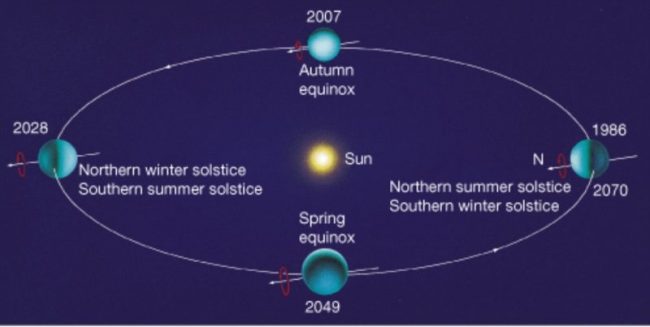
Typically when we think of seasons we think of those we experience on Earth, lasting around 3 months, and having unique characteristics as far as temperature and weather go. Things are a bit different on Uranus, due to a huge impact that the planet experienced billions of years ago. This impact knocked the axis of the planet on its side in its plane of orbit around the sun, and now the seasons on Uranus are quite extreme. With an orbit of 84 Earth years, each hemisphere (North and South) of Uranus will spend 1/4 of its orbit, or 21 straight years bathed in sunlight, followed up later by 21 years of total darkness. The image below shows the orbit of Uranus around the Sun, with its rotational axis labeled.
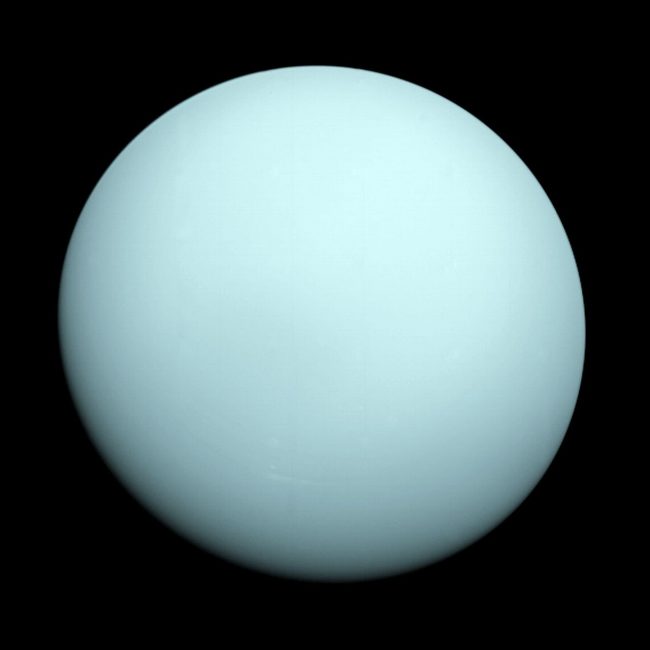
Depiction of Uranus’ Orbit around the Sun [Source]This unique tilt creates some odd weather patterns. In 1986 the Voyager 2 probe took photos of Uranus during one of the planet’s 21-year long solstices. The image below, taken from the satellite, shows a peaceful image of Uranus, with gentle uniform coloring throughout.
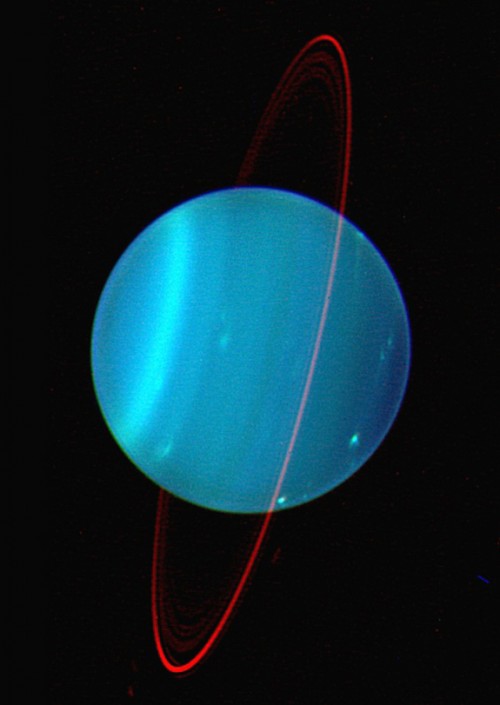
Image of Uranus taken from the Voyager satellite [Source]18 years later, in 2004, images of Uranus were taken through various telescopes, and a much different picture of the planet appeared. The surface of the planet was covered in storms and the weather seemed erratic and harsh. The change from 21 years of sunlight, or 21 years without, to what we think of as a normal day-night cycle (although Uranus’ is only about 17 hours) proves to be chaotic for Uranus’ atmosphere.