This is a photo from my summer trip to the Snowmass Club in Colorado.


Hi!
My name is Maria Bulanova. I’m 18, was born and raised in Moscow, Russia.  Currently studying Computer Science at Vanderbilt University in Nashville, TN. Representing Commodores as a part of Vanderbilt Women’s Bowling Team.
– Maria ☺
Picture by Commodore Athletics


Hey guys!
This is my first blog post for my Astronomy 2110 class. Me and my class!
My name’s Jake Sindelar and I’m a freshman here at Vandy. I live in Omaha, Nebraska and am the oldest of 7!! I have just discovered how fascinating the field of astronomy last semester after taking Astronomy 1010 and the lab with Dr. G! I find it amazing how far humanity has come in terms of cosmic exploration. Less than 100 years ago, scientists were still unsure whether or not creatures lived on THE MOON! Anyway, I will be posting astronomy info of (my) interest and other awesome finds!

The History of Solar System Explorations (above).
NASA’s picture of the day (Awesome and informative daily space pictures)


Hi, I am Victoria Morehead, and this is my blog for my astronomy class. I am a sophomore at Vanderbilt University, and I am majoring in History.
Here is an article that I believe may interest the class. There has been a recent discovery about the Moon being older than previously thought. You can check it out at the link below:
The Moon is Older than We Thought, says New Study- Universe Today
Picture: Taken in front of the Parthenon at Centennial Park by me


If you’re in my 2017 Solar System class, please put a comment here showing that you’ve found my blog and that you’re following it :) Please include your first name and last name initial. Note that you MUST be logged in to your own WordPress blog when commenting or else you’re doing it wrong!
Also make sure you have bookmarked the big class blog aggregator: Astro2110 – The Solar System. From there, you can follow everyone or specific classmates if you like (when I post them).


Space voyagers searching for intelligent life finds a race that has been trying to make contact for one hundred of its years – however, this species is so unlike anything these voyagers have ever contacted that they refuse to believe it’s even intelligent. When one of the voyagers convinces the other that the species is, in fact, intelligent, they mutually decide that the best course of action to take is none. They would rather ignore and obfuscate the existence of such a species than deign to make contact with such a grotesque species. After all, who wants to talk to meat?
The creatures in Terry Bisson’s “They’re Made Out of Meat” refuse to make contact with humanity because the idea of a species of intelligent meat is too bizarre for them to stomach – something they’ve never encountered before. And yet, because life on Earth is all we have to go off of, here we are. Looking for more intelligent meat.
A tardigrade, a famous extremophile.
As NASA astrobiologist Tori Hoehler says in “Is Anybody Out There?” (from our assignment Homework #14; published in Discover), “I want there to be life elsewhere, and I want it to be weirdly different from us. With that said, the more you look into the details, the more our kind of life, broadly categorized, seems to do a lot of things that would be difficult to do in other ways. But what’s significant is that there is virtually nothing that you would look for or detect that is specific to one kind of life… instead, you look for what life is doing” (49). That might explain why Bisson’s space travelers were able to find us strange meat creatures even though we are so different from their orfolei or weddilei species – we might not be like any life they’ve ever seen, but we’re still giving off detectable signs of life. In our own astrobiology surveys, keeping an open mind for what might be found may help if we encounter something unlike anything we have on Earth.
And while we turn to life on Earth to imagine where and how creatures might live in different environments (newly-discovered extremophiles are constantly turning up on Earth in increasingly unexpected places), some suggest that we might have aliens right here on Earth with us. Not little green men and not newcomers sewn through recent panspermia but organisms that evolved right here on Earth alongside our lineage – just with a different origin. As far as we know, all life on Earth evolved from a common ancestor. However, some scientists hypothesize that a “shadow biosphere” of microbes with different ancestry – and thus radically different biochemical processes – might have emerged on Earth.
In our strand of life, key amino acids are always “left-handed” (think chirality) while sugars are “right-handed.” Chemical mixtures that are not alive tend to contain equal amounts of left- and right-handed molecules. If life emerged on Earth multiple times, maybe there are some microbes with different ancestry that evolved to utilize right-handed amino acids and left-handed sugars. These “mirror microbes” could be living right alongside us – NASA is conducting experiments on Earth in an attempt to discover them. If life arose on Earth more than once, then we can be a little more certain that life may have arose in other worlds as well – even if it’s nothing like us. As Bisson’s space travelers observe, “Imagine how unbearably, how unutterably cold the Universe would be if one were all alone ..”


As Arthur C. Clarke once famously said, “Two possibilities exist. Either we are alone in the universe or we are not. Both are equally terrifying.” This quote is relates in a very basic way to the Fermi Paradox. The paradox is that through the Drake Equation and the sheer size of the universe, there should be other alien lifeforms, however we have no good evidence of their existence. There are a few solutions to this that we have studied, and that is either we are truly alone, there are other lifeforms out there that have purposefully remained hidden from us, or other civilizations destroy themselves too quickly to communicate with other civilizations. While these three are probably the most likely scenarios, I have a more interesting explanation.
I personally believe that there is life out there, there just has to be based on how large our universe is. However, I believe that these lifeforms are much more advanced than we are, as they have probably been around longer than we have. Because of this, I believe that a solution to this paradox is that there are other lifeforms in existence, but we will never find them because they created us, and are studying the development of basic life on a perfectly placed planet in a solar system through an advanced simulation. They created this sandbox universe for us to see how long it takes for a civilization like their own to develop, with no other interference from alien life forms. They are simply using us as a science experiment to study the formation of life, and have purposefully made us the only ones in the universe, for now. While this may seem crazy, I doubt there’s any evidence that can disprove this theory, and personally I just think it’s a cool way to explain why we are alone in the universe (Source of information: Wikipedia).


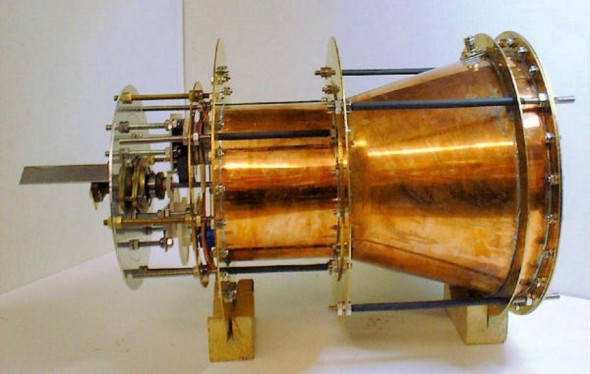
One of the greatest difficulties interstellar, or even just interplanetary, travel faces today is the problem of fuel storage. In order to accelerate to fast enough speeds to travel between planets in a reasonable amount of time, as well as to later decelerate, ships would need to hold a tremendous amount of fuel, which would then cause it to need even more fuel because of the higher mass.
The EmDrive will potentially solve this problem. Introduced in 2001 by a researcher named Roger Shawyer, the device seems to be able to create thrust without any propellant. The EmDrive went largely ignored by scientists at first because of the impossible contradiction it would make with the laws of physics if proven true. However, several independent labs have since recreated the drive and reported the same results as Shawyer: that it does, in fact, create thrust.
At first, researchers blamed the creation of thrust on some kind of measuring mistake, but even after extensive testing, they have still been unable to disprove the existence of thrust. It remains to be seen what actually causes the thrust, but if the thrust is actually caused by some kind of physical phenomena, it would mean a revolution in both the study of physics and in space travel.


One of the greatest difficulties interstellar, or even just interplanetary, travel faces today is the problem of fuel storage. In order to accelerate to fast enough speeds to travel between planets in a reasonable amount of time, as well as to later decelerate, ships would need to hold a tremendous amount of fuel, which would then cause it to need even more fuel because of the higher mass.
The EmDrive will potentially solve this problem. Introduced in 2001 by a researcher named Roger Shawyer, the device seems to be able to create thrust without any propellant. The EmDrive went largely ignored by scientists at first because of the impossible contradiction it would make with the laws of physics if proven true. However, several independent labs have since recreated the drive and reported the same results as Shawyer: that it does, in fact, create thrust.
At first, researchers blamed the creation of thrust on some kind of measuring mistake, but even after extensive testing, they have still been unable to disprove the existence of thrust. It remains to be seen what actually causes the thrust, but if the thrust is actually caused by some kind of physical phenomena, it would mean a revolution in both the study of physics and in space travel.
One of the greatest difficulties interstellar, or even just interplanetary, travel faces today is the problem of fuel storage. In order to accelerate to fast enough speeds to travel between planets in a reasonable amount of time, as well as to later decelerate, ships would need to hold a tremendous amount of fuel, which would then cause it to need even more fuel because of the higher mass.
The EmDrive will potentially solve this problem. Introduced in 2001 by a researcher named Roger Shawyer, the device seems to be able to create thrust without any propellant. The EmDrive went largely ignored by scientists at first because of the impossible contradiction it would make with the laws of physics if proven true. However, several independent labs have since recreated the drive and reported the same results as Shawyer: that it does, in fact, create thrust.
At first, researchers blamed the creation of thrust on some kind of measuring mistake, but even after extensive testing, they have still been unable to disprove the existence of thrust. It remains to be seen what actually causes the thrust, but if the thrust is actually caused by some kind of physical phenomena, it would mean a revolution in both the study of physics and in space travel.