God the Engineer of Life?

In Lawrence M. Krauss’s piece in the New Yorker, No, Astrobiology Has Not Made the Case for God, he responds to an article entitled Science Increasingly Makes the Case for God published in the Wall Street Journal by Eric Metaxas. In Metaxas’ piece, he writes about how miraculous and statistically infinitesimal the likelihood that life would have arose on Earth. Metaxas then cites God or some other supernatural, eternal, and intelligent being as the reason for our creation. In other words, the perfect conditions that allow us to live are so perfect in design, and so unfathomable, that all of this must be the result of some greater plan. For Metaxas, the recent findings in astrobiology, that there are more than “200 known parameters necessary for a planet to support life,” make it evident that the more that we know, the more likely we will begin to understand that life was created by design.

Krauss, a theoretical physicist and cosmologist finds issue with many of the premises of Metaxas’ argument. Namely that “many routes could have led to the same result.” This is true when we think about the possibility of life on Europa or the Moons of “hot Jupiters” orbiting distant planets. Moreover, there is an abundance of types of life, in drastically different environments, and there is a propensity for the universe to create the right conditions for life to thrive. Therefore, one cannot assert that all of these specific “parameters” must be met perfectly, but rather one must look into how versatile, dynamic, and abundant life is on our planet and maybe even the universe as a whole. Krauss responds to many assertions that are posed by Metaxas, namely how astrobiology seems to pose more questions than it answers. Krauss believes that these arguments are specious on the grounds of causation, citing how life is a reaction to the conditions that the universe has set forth, not that the universe must have all of these conditions in order for life to have existed. In many ways, Krauss uses a lot of the material we have covered in the last few weeks to argue that life must exist elsewhere, and the natural laws of physics promote life, rather than life on earth being completely anomalous. One interesting addition that Krauss asserts is that “when driven by an external source of energy, matter will rearrange itself to dissipate this energy most efficiently. Living systems allow greater dissipation, which means that the laws of physics might suggest that life is, in some sense, inevitable.” This may answer the question I was left with at the end of our course, which is why life exists in the first place.

The dialogue between the TV host Metaxas and the cosmologist Krauss speaks to where we exist presently in our debate of how the universe was created. After studying the drake equation, it seems that it poses paradoxical arguments for how obvious it is that life must exist elsewhere in the universe, but also how unlikely it is based on how small the fractions of each variable can become. Our textbook began with the assertion that we should focus on how specific the constant of gravity is, if it were any smaller things would not be able to come together and if larger, things would not be able to come apart. There are an infinite amount of variables that have led to the creation of our universe, and this leads me to both agree and disagree with both writers. While I am an optimist that life certainly exists elsewhere and that we are probably not too special in the realm of our universe, the question for me is still why? Yes, maybe life as a whole might adhere to properties of energy efficiency, and maybe we can explain how we were created in the near future, but we are still nowhere near understanding the complexity of the brain. What purpose could our feelings of freedom, power, wonder, hope, and sense of self serve for the physical laws of the universe? Why was the universe created in the first place and what came before? Is our universe all that there exists or is it just one reality amidst many? Indeed Socrates would approve of cosmology as an incredible platform to promote dialogue!


Posted in Aliens | Tagged , , , , | Comments Off on God the Engineer of Life?

Blog 9 (The Unlikelihood of Intelligent Life)

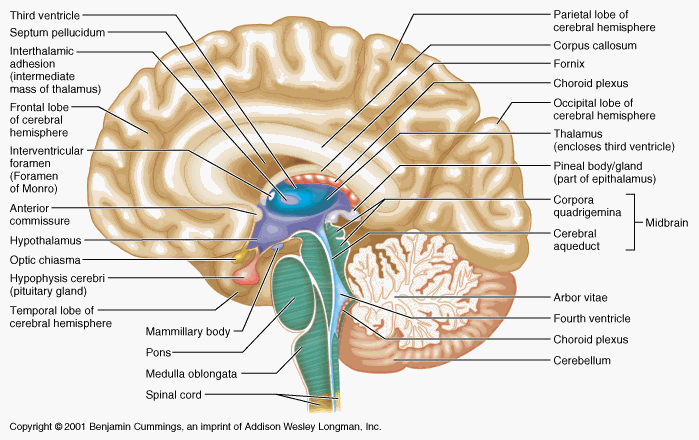
Based on current scientific evidence, asteroids could have spread organic molecules to Earth and many other planets throughout the universe. In all likelihood, there are many organic molecules on most of the planets in the habitable zones of their galaxies, and it definitely seems possible that with all these organic molecules, some kind of primitive life is pretty common. However, how much of that life is intelligent is a point of contention in the parameters of the Drake Equation and in general discourse. In class, there were many different perspectives on how much of the simple life in the universe could have become intelligent. I would argue that intelligent life is probably not common in the universe, despite the massive amount of opportunities it would have to arise. The evolution of intelligent life on Earth started with prokaryotic cells. Then, eukaryotic cells eventually formed–probably through endosymbiosis, and multicellular organisms followed. Eventually, modern humans arose. However, the utter complexity of the human body seems to be an extremely unlikely thing to be replicated in other parts of the universe. We have a complex set of organs with different functions, we have a multi-faceted immune system that protects our bodies from disease, and we have genetic information efficiently stored by nitrogenous base pairs in DNA. Most importantly, we have an extremely complex brain with a massive prefrontal cortex that is able to solve mathematical problems, reason through morality, and create artistic achievements that we all marvel at. The idea that, retrospectively, a group of organic molecules that formed into a cellular shape could produce such advanced and coordinated control of a complex set of body systems is almost hard to believe. On a more philosophical level, it has yet to even be explained how chemistry actually produced life or consciousness. Yet, leaving those questions aside, the sheer complexity of the human body and brain suggests that humans may in fact be unique. In contrast to Sagan’s point from the video today, I think that Earth and humanity are quite significant because, in all likelihood, they will contain the only intelligent life we will ever know of–and possibly the only intelligent life that exists anywhere.

human-brain-anatomys

(Human brain)


Posted in Class, Universe | Tagged , , , | Comments Off on Blog 9 (The Unlikelihood of Intelligent Life)

The Drake Equation


The Drake Equation has been one of the most interesting things that I have learned about so far in this course. The video I have linked above does a very good job summarizing the different parts of the Drake Equation and how they are calculated. Towards the end of the video, it also talks about some of the weaknesses of the Drake Equation. One of the most persuasive cons that the video mentioned was that radio waves may be “like smoke signals” to other civilizations – that is to say, they might view radio waves as a very outdated form of communication.

The Drake Equation does not provide us with a definite answer to how many communicating civilizations exist in the universe. However, it is still vital to astronomy because it provides us with a way to ask important questions about life in the universe. By continually asking questions, we can slowly get closer towards a more reasonable estimate.

Hopefully, we just find aliens soon and then we can stop guessing.

Thanks for a great semester all!


Posted in Aliens, Class, Universe | Tagged , | Comments Off on The Drake Equation

The Drake Equation


The Drake Equation has been one of the most interesting things that I have learned about so far in this course. The video I have linked above does a very good job summarizing the different parts of the Drake Equation and how they are calculated. Towards the end of the video, it also talks about some of the weaknesses of the Drake Equation. One of the most persuasive cons that the video mentioned was that radio waves may be “like smoke signals” to other civilizations – that is to say, they might view radio waves as a very outdated form of communication.

The Drake Equation does not provide us with a definite answer to how many communicating civilizations exist in the universe. However, it is still vital to astronomy because it provides us with a way to ask important questions about life in the universe. By continually asking questions, we can slowly get closer towards a more reasonable estimate.

Hopefully, we just find aliens soon and then we can stop guessing.

Thanks for a great semester all!


Posted in Aliens, Class, Universe | Tagged , | Comments Off on The Drake Equation

How did life get started on Earth?

life on earth.png

Well unfortunately no one knows for sure. The most prehistoric life that has ever been discovered, called stromatolites in Australia, can be dated back to 3.4 billion years ago. This life however is fairly evolved; it has cell walls and DNA (the more evolved version of RNA which still transmits the software for life today). This leads scientists to believe that life began approximately 3.8 billion years ago, less than a billion years after the planet began to form. But there are even theories that suggest that life didn’t even begin on earth at all. This theory dubbed, panspermia hypothesizes that life exist through the universe and can travel these long distances over what to us would be eternities in the form of extremophiles that can survive these journeys. On earth today there are such species like the Tartigrade or Water Bear that can even survive in the vacuum of space. These extremophiles, named so due their suitability to survive in extreme conditions serve as proof of concept for this idea seemingly radical idea. Other scientists believe that early Earth could have served as the perfect breeding ground for life. In their paper in Nature scientist from Cambridge’s MRC Laboratory of Molecular Biology proved that all the necessary ingredients for creating amino acids, which could have been the precursor to RNA, are producible in an environment similar to a young Earth. If a simple self-sustaining chemical reaction was able to continue long enough and ultimately develop in to what we know as RNA today, we may have discovered the origin of life on Earth. While this is in theory possible it is once again yet to have been proven in a lab or any other setting. That is why this question remains as one of nature’s biggest mysteries.

Source

Comment


Posted in Class | Tagged , , | Comments Off on How did life get started on Earth?

Psychrophile Style

Narwhals_L
Cool Anarctica

Among the many types of extremophiles that can live in extreme conditions, psychrophiles are microorganisms that thrive in cold environments. We actually have a lot of psychrophiles in a variety of landscapes throughout Earth, including Anthrobacter, a bacteria found in soil, and Psychrobacter, which can live in many sets of conditions and can cause human ailments.

I find psychrophiles particularly interesting because there are actually a number of large organisms on Earth that thrive under similar conditions. Other extremophiles, like anaerobes, don’t have many multi-cellular peers, but psychrophiles have something in common with the many larger cold-loving creatures on Earth.

One of my favorite large cold-loving creatures is the narwhal! Narwhals each have a giant tusk and live in Arctic waters. It’s amazing that they can thrive in such extreme conditions, as can numerous other Arctic creatures. I wonder if there could be alien narwhals in the subsurface oceans of other worlds!


Posted in Aliens, Class | Tagged , | Comments Off on Psychrophile Style

Living the fast life: Kepler-70b

The Kepler spacecraft (which was feared lost earlier this week) has discovered a veritable treasure trove of exoplanets over its seven year mission. Some of these planets may even be habitable.

Kepler-70b is decidedly not one of them.

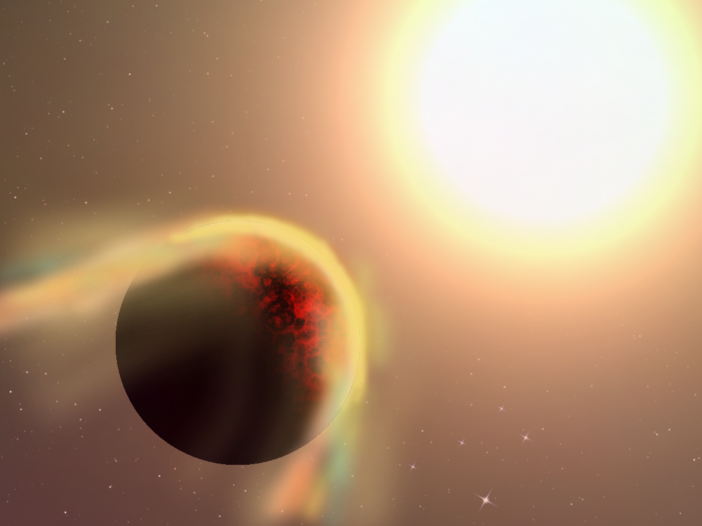
Kepler-70b is the closer of two terrestrial planets to KOI-55, a subdwarf star which was once a red giant. Its radius is approximately three quarters of Earth’s radius. However, that may be where the similarities end.

The planet is remarkably close to its parent star, and thus has one of the shortest recorded orbital periods: 5.76 hours. Being so close, it is almost certainly too hot and irradiated to be habitable. How is a terrestrial planet so close to a star which was once a red giant? Astronomers postulate that Kepler-70b was once a gas giant, but was enveloped as its parent star grew, evaporating most of its gas and leaving only the rocky core behind. It is also speculated that Earth too will someday be swallowed by the Sun, but it isn’t thought that the planet will survive in any form.

Read what I read!

Universe Today

Exoplanet.eu

kepler-70b
Artist’s impression of Kepler-70b. Source

Posted in Exoplanets | Tagged , , , | Comments Off on Living the fast life: Kepler-70b

The Largest Structure in the Universe

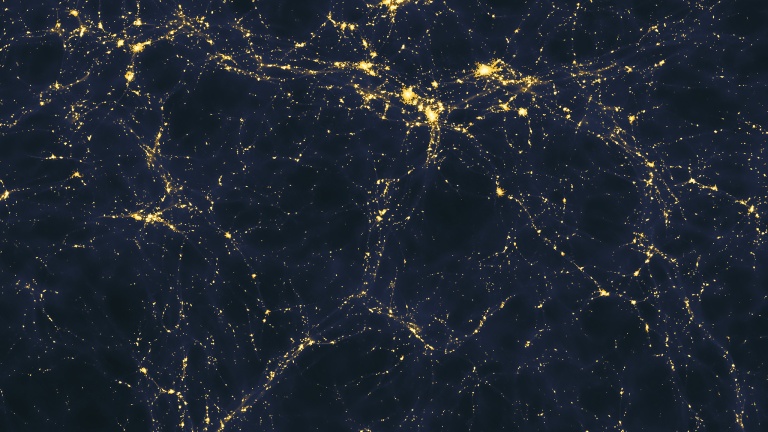
light-structure_2048x1152

Through our studies of the solar system this semester, we have focused particularly on the scale of the universe. Throughout the cosmos, there are countless structures that are far more massive than any we perceive. Our galaxy is held together by gravity, forming a cluster. We can also observe clusters being held together by gravity to form superclusters. Astronomers have determined that our own Milky Way Galaxy is a part of a supercluster called Laniakea.

However, some controversy exists over the definition of a stellar “wall.” There are no observable forces that bind them together – leading some astronomers to question their existence.

More recently, astronomers have discovered what they believe to be the largest structure in the observable universe – the BOSS Great Wall. This wall most likely contains over 830 galaxies and measures over a billion light years long. Furthermore, it is likely over 10,000 times the mass of the Milky Way.

Source

Image Source


Posted in Class, Universe | Tagged , , , , | Comments Off on The Largest Structure in the Universe

Speaking of Big Craters…

Chicxulub-Anomaly
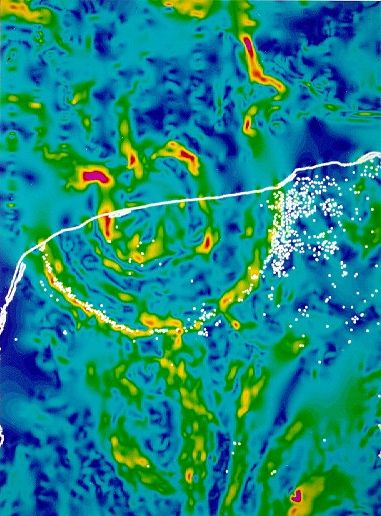
Gravity anomaly map of the Chicxulub crater. Source: Wikipedia

The Chicxulub crater is a crater buried underneath the Yucatan Peninsula which is suspected to be the location of the impact of the meteor which wiped out the dinosaurs. The crater is more than 180km in diameter and 20km in depth. Estimates place the size of the impacting meteor to be at least 10km in diameter. Although there exists craters that are larger than the Chixculub crater, this particular crater is estimated to have impacted the Earth at a time similar to when the dinosaurs are thought to have roamed the world.

The crater was actually discovered by geophysicists Anotonio Camargo and Glen Penfield, who had originally been looking for petroleum in the late 1970s.  They had originally been unable to obtain evidence that it was an impact crater, but were later able to find gravitational anomalies and shocked quartz which hinted at it being one. The crater now stands as one of the largest pieces of evidence that the dinosaurs were wiped out by a meteor impact.


Posted in Historical | Tagged , , | Comments Off on Speaking of Big Craters…

Speaking of Big Craters…

Chicxulub-Anomaly
Gravity anomaly map of the Chicxulub crater. Source: Wikipedia

The Chicxulub crater is a crater buried underneath the Yucatan Peninsula which is suspected to be the location of the impact of the meteor which wiped out the dinosaurs. The crater is more than 180km in diameter and 20km in depth. Estimates place the size of the impacting meteor to be at least 10km in diameter. Although there exists craters that are larger than the Chixculub crater, this particular crater is estimated to have impacted the Earth at a time similar to when the dinosaurs are thought to have roamed the world.

The crater was actually discovered by geophysicists Anotonio Camargo and Glen Penfield, who had originally been looking for petroleum in the late 1970s.  They had originally been unable to obtain evidence that it was an impact crater, but were later able to find gravitational anomalies and shocked quartz which hinted at it being one. The crater now stands as one of the largest pieces of evidence that the dinosaurs were wiped out by a meteor impact.


Posted in Historical | Tagged , , | Comments Off on Speaking of Big Craters…