Exoplanet HD 189733b

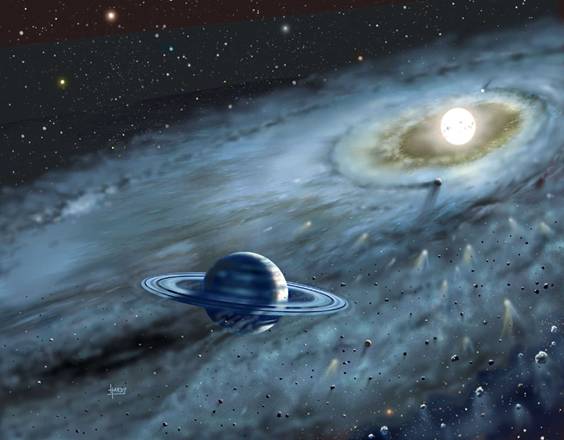
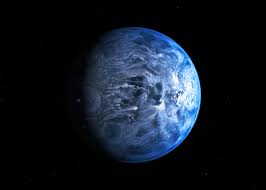
Around 63 light years away form Earth sits the exoplanet HD 189733b. The planet has a mass of 1.13 Jupiter masses and orbits its star closer than Mercury orbits the Sun. Seen from afar, this planet is blue in color and has bands of white haze in its atmosphere that resemble clouds. Though HD 189733b might look similar to Earth, it is in no way habitable to life as we know it.
imgres.jpg

(Exoplanet HD 189733b)

Although the planet is close to its star, it is actually a gas planet and can be classified under the category of “Hot Jupiters.”  Since HD 189733b is so close to its star, its average temperature is roughly 1800 degrees Fahrenheit. Furthermore, the planet is gravitationally locked. Since one side of the planet is so much hotter than the other side, extreme winds whip across the planet at 4,000 miles per hour. These, however, are not even the planet’s deadliest attributes. Due to the immense pressure of the atmosphere, glass is created in the planet’s atmosphere. Due to the winds, glass constantly flies sideways around the planet at around 4,0000 miles per hour, which is faster than the speed of a bullet. To put it simply, the prospect of life on this planet is grim at best.


Posted in Exoplanets | Tagged , , , | Comments Off on Exoplanet HD 189733b

Something like acid rain, but a lot worse

captain’s blog, Stardate 69741.0

So we’re spending a lot of time talking about moons lately. If I weren’t so well-educated in the astronomy of our Solar System I would maybe think: “you’re just learning about moons, isn’t that kind of boring?” But I AM so well-educated in the astronomy of our Solar System and know that moons can be just as varied and exciting as planets!

Cassini-Titan-summer-2013
Figure A – Titan
Greek-Titan
Figure B – a titan

Now, if you’ll direct your attention to Figure A, you’ll see a picture of one of the most interesting places in the Solar System. Titan is Saturn’s largest moon and the largest moon in the Solar System. Thanks to the Cassini spacecraft, we actually know a lot about this world. The most interesting thing about Saturn to me is the presence of liquid methane and ethane on the surface.

454587a-f1.2
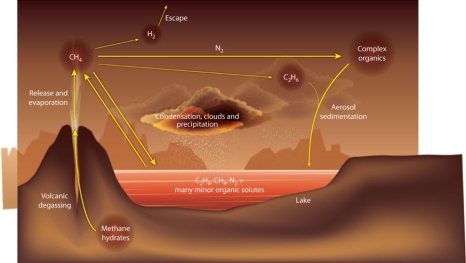
Figure C – The Methane Cycle on Titan

In fact, as Figure C illustrates, the liquid methane/ethane collects and cycles just like water does here on Earth. I think this is so interesting to me because this is an example of planetary geology that I can relate to at least a little bit, because I have some experience with a precipitation cycle.

In fact, Figure C also shows us that the collecting of liquid methane creates a multitude of organic solutes on the surface………………

Bug-eyed-alien-sculpture

Also, I can’t help but wonder what liquid methane feels like. I have no idea why but I think it would hurt or like burn or something. Something like acid rain, but a lot worse.


Posted in Aliens, Class, Moons | Tagged , , , , | Comments Off on Something like acid rain, but a lot worse

Pluto’s Kind Heart

p_color2_enhanced_release
Via WIRED (Article) Direct Link to Picture


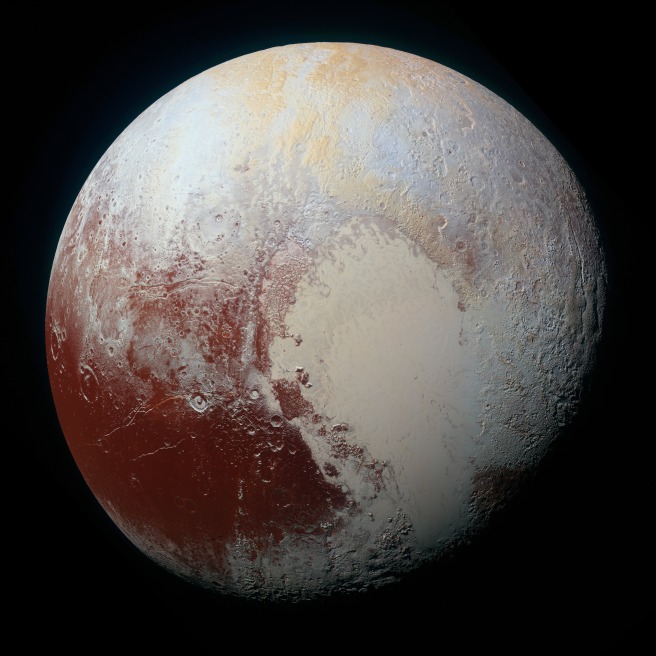
Pluto has been a topic of fascination for astronomers for a long time now. With the recent flyby of the New Horizons Spacecraft, a new image of Pluto has captivated the world. Pluto has a heart. Well not actually a heart but a region that looks like a heart! I guess Pluto is really trying to send its love to us so we can let it be a planet once again. I mean come on, why do we need to be demoting Pluto to dwarf-planet status? What has it done to us to deserve this demotion especially with the love it’s trying to show us!

On a more serious note, “Pluto’s Heart” is a region called the Tombaugh Regio. Alan Stern, who is the New Horizons Principal Investigator, believes that part of this region know as Sputnik Planum was created from a massive impact with an asteroid 10 kilometers across. To put that in perspective, that’s an asteroid the size of Manhattan smashing into the earth. Moreover, they have found evidence of glacial flows around the edges of this basin, which may provide evidence that Pluto, which was thought to have no internal heat, may have geological activity and thus possibly internal heat! A lot of questions are still to be answered but this evidence is some of the first that shows there is more to Pluto than what meets the eye.

More information can be found here:


Posted in Class, Dwarf Planets, General, Science | Tagged , , , , , , | Comments Off on Pluto’s Kind Heart

Uranus

uranus

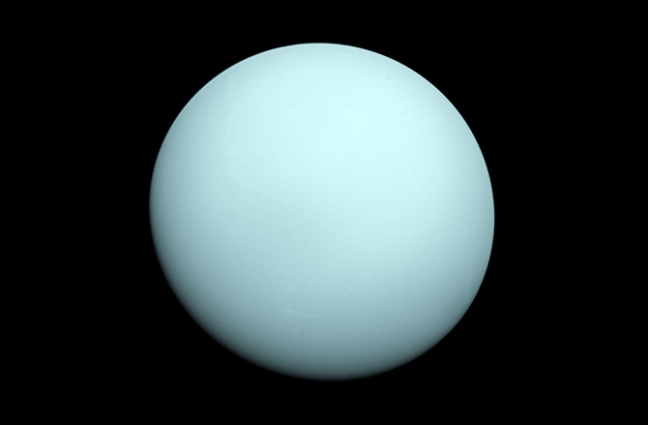
Uranus the most mysterious of the gas giants, in its form, orbit, and rotation. It is a widely known fact that Uranus rotates on its side, but its strange tilt also means that its magnetic field is skewed, so that its magnetic north and south are vastly different than its polar. In addition, the storms happen during strange periods of time. When Uranus approached Earth, scientists noticed that more-than-anticipated storms were occurring on the planet’s surface. Uranus is also the coldest planet in the solar system, despite not being the farthest, due to its lack of its own internal heat source.

In short, Uranus is just crazy weird.


Posted in Class, Space Travel | Tagged , , , | Comments Off on Uranus

Fun Facts about Titan

titan_moon-e1364866302988

Out of all the moons in our solar system, my favorite one would have to be Titan. Titan is the second largest moon in our solar system, second only to that fat piece of lard Ganymede. However, Titan, has something that Ganymede doesn’t and that is an “earth like cycle of liquids flowing across its surface.” In fact Titan is the only place other than Earth in our solar system that is known to have flowing liquid on its surface. Titan has seas on liquid methane which were proven to exist by the Cassini-Huygens probe in 2005. This mission also discovered that Titan has internal oceans of liquid water.  The main reason I love Titan is because of its name. According to NASA, the name Titan comes from the “generic term for the children of Ouranos (Uranus) and Gaia in ancient Greek mythology” (NASA). Titan is very cold (-289F) and has a very thick layer of hazy clouds. Because Titan is so cold, “chemical processes take longer to unfold, leaving the chemistry of the moon’s atmosphere in a state of deep freeze” (NASA). This tickles astronomers’ fancy because this could be similar to how Earth’s atmosphere was before life existed (NASA).

Got all my info from here

Picture here


Posted in Moons, Small SS Objects | Tagged , , | Comments Off on Fun Facts about Titan

Sleipnir Fossa, Pluto’s “Giant Spider” Fracture

Pluto may have had its planet status revoked, but astronomers are still studying its surface through images captured by the NASA New Horizon’s spacecraft. In the last week, images and information about one of Pluto’s most recently discovered features was released.


975003_1_040920-20pluto_standard

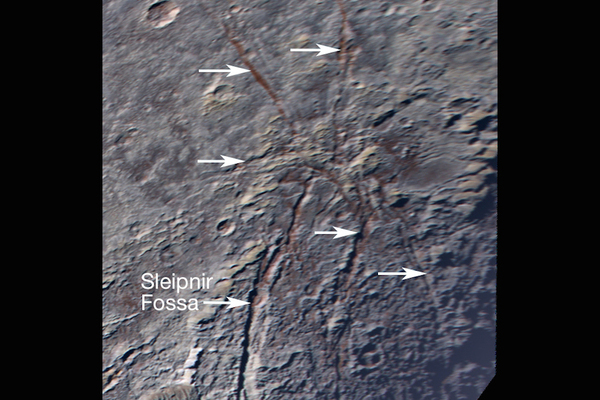
Sleipnir Fossa and related fractures in an image captured by New Horizons on 14 July 2015.


This formation, which many articles have said bears resemblance to a “giant spider,” appears to be at least six fractures in the surface. The longest of these fractures, informally named Sleipnir Fossa, is more than 360 miles long. Though fractures have been spotted on Pluto’s icy surface before, Sleipnir  Fossa and its related fractures are unique because of the red material that they expose. According to NASA, that the fractures radiate from a central point indicates possible “material welling up from under the surface,” but what this red material is has not yet been determined.


Posted in Class, Dwarf Planets | Tagged , , , | Comments Off on Sleipnir Fossa, Pluto’s “Giant Spider” Fracture

Comets and stuff

parts-of-a-comet

For blog 7 I’ve decided to write about comets. Comets, according to space.com is “an icy body that releases gas or dust”(space.com) Astronomers believe that comets are leftovers of the gas, dust, ice, and rocks that originally formed our solar system. It is believed that comets carried some of the water and organic molecules that now make up life to Earth (space.com).  In order to prove this, the Rosetta mission, sent a probe to land on a comet and is studying how the comet is effected as it approaches the sun. Most comets are believed to inhabit the Oort cloud which makes up the space way outside of Pluto.

As the picture above shows, there are many parts to a comet. The nucleus of the comet is the solid core. This part is mainly made of ice and dust, with some organic material covering the surface of it (space.com). The coma of the comet is formed as a result of the comet getting closer to the sun it is orbiting. As the comet gets closer to the sun, the comet heats up and its surface begins to turn into gas.  The gas particles are then pushed away from the comet by the sun’s radiation causing the dust tail to form. Some charged particles from the sun can also ionize some of the comets gases causing the ion tail to form.

Picture can be found here


Posted in Small SS Objects | Tagged , , | Comments Off on Comets and stuff

Stop! In the Name of…

Gravity?  We’ve heard a lot about exoplanets lately. To me, one of the more fascinating classes is the “Hot Jupiter” class (of which the first exoplanet to be discovered orbiting a main sequence star- 51 Pegasi b- is considered to belong). So what makes an exoplanet a Hot Jupiter and why are they interesting?

clear_to_cloudy_hot_jupiters
Artist’s rendition of 10 Hot Jupiters-done to scale relative to each other. Bottom Left is the size of Jupiter (Wikipedia)

Hot Jupiters generally:

  • Have a mass that is greater than or equal to that of Jupiter
  • Have high surface temperatures
  • Caused by their close orbits to their stars (they average a distances in the range of 0.015-0.5 AUs from their parent stars)
  • Interesting to note, there are generally low differences between the day sides and the night sides because high speed winds distribute the heat across the surface.
  • Have highly circular orbits (because of tides)
  • Migrated to their current position because there would not have been enough material to form in their current locations

It is this last characteristic that makes Hot Jupiters so interesting. Not only are we not entirely sure how they get their current locations, but also why aren’t they eaten by their parent star? One theory is that the planet star’s gravitational forces stabilize the orbit before this can happen.

Exoplanets are an exciting field leading us to confirm or question what we think we know about space!

Further Reading:


Posted in Jovians, Science | Tagged , , | Comments Off on Stop! In the Name of…

Leonids

1966

image source

The Leonids is a meteor shower associated with the comet Tempel-Tuttle. It gets its name from the location of its apparent radiant in the constellation Leo and has been famous for its most spectacular meteor storms since its identification in 1833. Since comet Tempel-Tuttle is a periodic comet with an orbital period of 33 years, people on Earth are expected to see such magnificent astronomical phenomenon only once every 33 years. The superlative strength of the Leonids, which is approximated to be over one hundred thousand meteors an hour, forced scientists to revise their previous ideas that meteors were only atmospheric phenomena. Although most Leonids are only 10mm across with a mass of half of a gram, they are able to generate bright meteors due to their fast moving streams when encountering the path of the Earth (up to 72km/s, which is 100 times faster than that of a bullet). And according to what we learn in the class, the high speed of the Leonids may pose a threat to artificial satellites and spacecrafts orbiting the Earth. And in the case of meteor storms that happens once every 33 years, long-distance telecommunication may also be severely disrupted.


Posted in Class | Tagged , , | Comments Off on Leonids

Extrasolar planets

planets

image source

In the class, we learn about the astrometric technique, Doppler technique and direct imaging used to detect extrasolar planets. And in this blog, I’d like to introduce some other planet-hunting strategies that have proved to be applicable. The first method is called gravitational microlensing. A gravitational microlensing occurs only when two stars are almost exactly aligned and lasts for several days, during which time the gravitational field of a star will act like a lens to magnify the light of a background distant star. And if the foreground star has an orbiting planet, the contribution of the planet’s gravitational field to the lensing effect can also be detected. Since the center of our galaxy can provide huge amounts of background stars, the method is most useful for detecting planets between Earth and galactic center. The second method is called polarimetry. The light given off by a star is unpolarized, but when the light is reflected off the atmosphere of a planet, it will become polarized. Since polarimetry is not limited by the stability of Earth’s atmosphere, such measurements can be made with very high sensitivity and allow scientists to determine the composition of extrasolar planet’s atmosphere. However, planets with no atmosphere can never be detected by such method.


Posted in Class | Tagged , , , | Comments Off on Extrasolar planets