Extrasolar planets

planets

image source

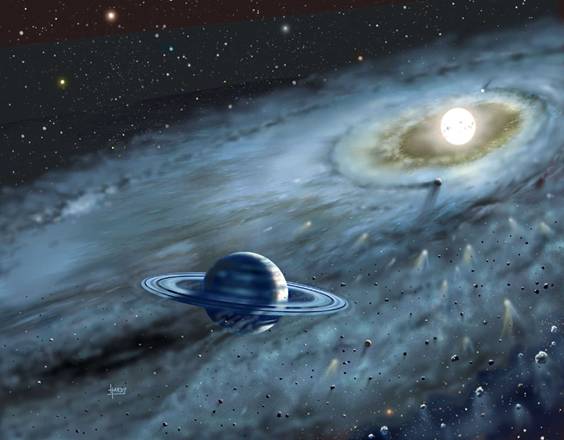
In the class, we learn about the astrometric technique, Doppler technique and direct imaging used to detect extrasolar planets. And in this blog, I’d like to introduce some other planet-hunting strategies that have proved to be applicable. The first method is called gravitational microlensing. A gravitational microlensing occurs only when two stars are almost exactly aligned and lasts for several days, during which time the gravitational field of a star will act like a lens to magnify the light of a background distant star. And if the foreground star has an orbiting planet, the contribution of the planet’s gravitational field to the lensing effect can also be detected. Since the center of our galaxy can provide huge amounts of background stars, the method is most useful for detecting planets between Earth and galactic center. The second method is called polarimetry. The light given off by a star is unpolarized, but when the light is reflected off the atmosphere of a planet, it will become polarized. Since polarimetry is not limited by the stability of Earth’s atmosphere, such measurements can be made with very high sensitivity and allow scientists to determine the composition of extrasolar planet’s atmosphere. However, planets with no atmosphere can never be detected by such method.


Posted in Class | Tagged , , , | Comments Off on Extrasolar planets

What’s in a Name?

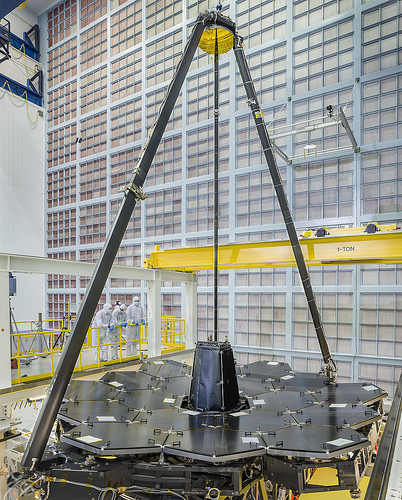
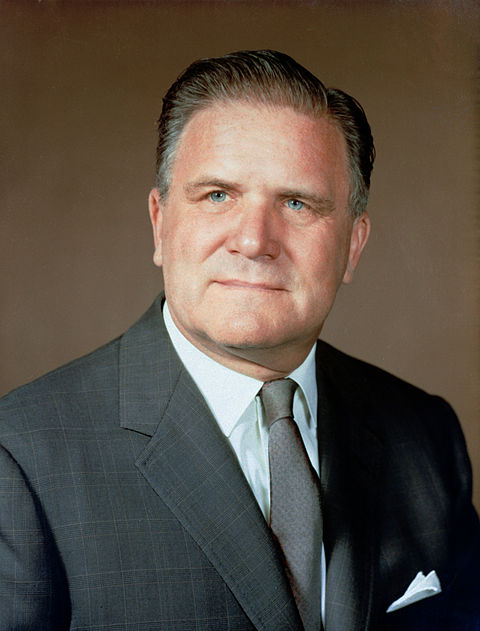
The Hubble telescopes famous successor was not always called the James Webb Space Telescope (JWST). The telescope, initially dubbed the Next Generation Space Telescope, was rechristened in 2002 to pay homage to the celebrated James Webb, NASA’s second administrator. Webb ran NASA from 1961-1968, a time when the emergent agency was still trying to define its purpose and aims and when space was highly politicized. Webb’s commitment to a balanced space program that would focus on both JFK’s proclaimed moon landing and advances in science set NASA up for decades of success.

NASA Administrator Webb
NASA’s 2nd Administrator, James Webb


In his recorded conversations with Presidents Kennedy and Johnson, Webb made it abundantly clear that he would oversee a balanced NASA. He wanted NASA advancements to contribute to strengthen the work of US universities and aerospace industry. By the time Webb retired, NASA had undergone over 75 space science missions to study the stars and galaxies, Earth’s own upper atmosphere, and our Sun. When NASA Administrator Sean  O’Keefe announced in 2002 that the Next Generation Space Telescope would officially be called the James Webb Space Telescope, he remarked:

“It is fitting that Hubble’s successor be named in honor of James Webb. Thanks to his efforts, we got our first glimpses at the dramatic landscape of outer space. He took our nation on its first voyages of exploration, turning our imagination into reality. Indeed, he laid the foundations at NASA for one of the most successful periods of astronomical discovery.”

JWST
Mirror installation on the JWST

Posted in Historical | Tagged , , , , , | Comments Off on What’s in a Name?

Carl Sa(vior)gan

We read about them in our textbooks. They’re the giants with discoveries that make our understandings of moon phases and seasonal changes seem minuscule and insignificant. We stand on their shoulders when we learn about atmospheric conditions on different planets. We hold their hands while launching expensive equipment into the hardly-known (space). We sometimes name this equipment after them.

Galileo. Copernicus. Hubble. James Webb.

Carl Sagan.

The former names have been turned into enterprises, garnering funds for missions unlike past endeavors into space – names often including a lot of propaganda. While of great importance (and enough to geek any somewhat educated person out), the latter, Carl Sagan, has remained a humble reminder of the passion that is astronomy.

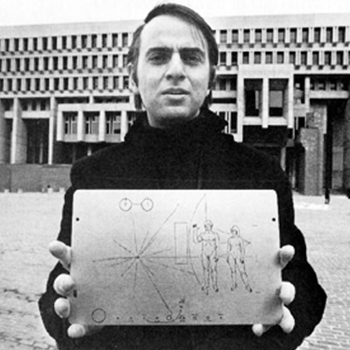
Sagan pushed the limits of astronomical discoveries, disregarding the status quo when it came to studying space. He’s been an advisor to NASA since the birth of its missions around 1950. For example, he advised the Apollo mission and its astronauts, and he has been a part of the Mariner, Viking, Voyager, and Galileo missions. His work has even extended into more recent endeavors, like the pursuit of understanding why Venus’s conditions are so hot.

carl-sagan
Carl Sagan


This American astronomer put much of his focus on the communication of science. He published several works, was decorated with several awards (i.e. NASA’s “Apollo Achievement Award” and the John F. Kennedy Astronautics Award of the American Astronautical Society), and was even a Pulitzer Prize winner. Sagan didn’t have reservations about his musings about life on other planets, somewhere out there in the vastness of space. Aside from his publication about the progression of human intelligence, “The Dragons of Eden,” he even went so far as to send the song “Dark Was The Night” by Blind Willie Johnson into the great unknown, hoping for some kind of communication between life forms (if another were out there).

His ambition and paramount success, though it seems impossible, are surpassed – surpassed by his deep love for astronomy and the possibilities of information we can’t yet understand. He was a pioneer in developing and communicating spatial discoveries, as well as sparking curiosity among scientists and civilians alike.


Posted in Class, Science | Tagged , , , , | Comments Off on Carl Sa(vior)gan

Halley’s Comet

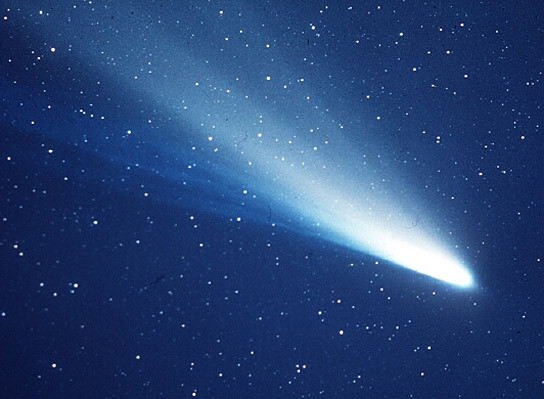
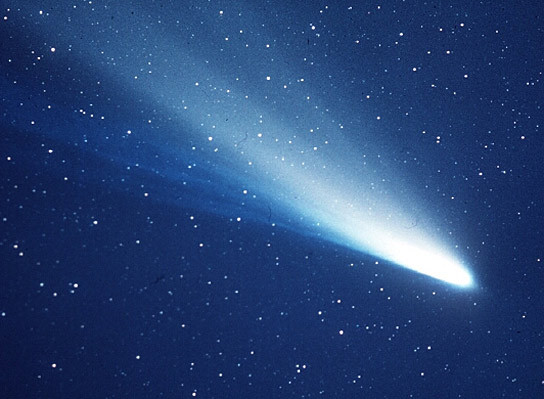
Halley’s Comet is visible from Earth every 75-76 years. It is the only known short-period comet (a comet that has an orbital period of less than 200 years) that is visible to the naked eye. Halley most recently visited the inner parts of the Solar System in 1986, which means it will return in 2061.

Halley’s presence has been observed and recorded by astronomers for thousands of years. Records of the comet’s appearance were made by Chinese, Babylonian, and medieval European astronomers. However, it was not until the 18th century that astronomers were able to determine that it was the same object returning repeatedly. Edmond Halley, who was Issac Newton’s friend and editor, used Newton’s laws to calculate the gravitational effects of Jupiter and Saturn on cometary orbits. Combining these calculations with historical records allowed him to conclude that the orbital elements of several recorded comets were identical to those that had been observed recently. Halley was thus able to predict the comet’s return and show that objects besides planets orbit the Sun. It was one of the first successful tests of Newtonian physics.

As mentioned, Halley’s orbital period is approximately three quarters of a century. Its orbit is highly elliptical (eccentricity of 0.967). It perihelion is 0.6 AU (between the orbits of Mercury and Venus). Its aphelion is 35 AU (approximately the distance of Pluto). Additionally, Halley’s orbit is retrograde and has a mean diameter of 11km.


Posted in Class, Small SS Objects, SolarSystem | Tagged , , | Comments Off on Halley’s Comet

Pluto – A Dwarf Planet

Pluto is a Dwarf planet in the ring of objects beyond Neptune called the Kuiper Belt. Similar to other objects in the Kuiper Belt, Pluto is composed of rock and ice. Its orbital period is 248 Earth years, and has an inclined orbital path compared to all the planets whose paths lie in the ecliptic plane.

Pluto was the first Kuiper Belt Object (KBO) to be discovered in 1930 by Clyde Tombaugh, and was long classified as a planet although it was smaller than all the others. Pluto is about one-sixth the mass of Earth’s moon and one third of the moon’s volume. In 2005, another KBO, Eris, was discovered. Eris is about 27% more massive than Pluto, so it required the International Astronomical Union (IAU) to formally define what is a planet. According to the IAU, a planet must meet three conditions:

  1. The object must be in orbit around the Sun.
  2. The object must be massive enough to be rounded by its own gravity. More specifically, its own gravity should pull it into a shape of hydrostatic equilibrium.
  3. It must have cleared the neighborhood around its orbit

Pluto, Eris, and the other KBO’s were reclassified as dwarf planets because they did not meet the third condition. Pluto’s mass is only 0.07 times the mass of the total other Kuiper Belt objects in its orbital distance. Earth, for example, is 1.7 million times the mass of the other objects in its orbit.

A spacecraft named New Horizons accomplished a fly-by of Pluto in July of last year. After a 3,462 day (9.5 year) journey across the solar system, New Horizons captured the best images yet of Pluto, taken from a distance of 4.2 billion kilometers. Those images of Pluto can be here.


Posted in Class | Tagged , , , , | Comments Off on Pluto – A Dwarf Planet

Let’s Talk About Carl Sagan (Remix)

“If you wish to make an apple pie from scratch, you must first invent the universe.” These are the only words I really remember of Carl Sagan’s Cosmos series when I watched it in high school physics class. However, Carl Sagan left a much greater legacy than his musings on apple pie. Carl Sagan inspired an entire generation to look to the universe and study the phenomena outside of our own world.

An Oh So Short Biography

Earning his PH.D. in physics from University of Chicago, Sagan went on to become a professor at Harvard and Cornell (moving to Cornell after he was denied tenure…c’mon Harvard).

Sagan was involved with NASA and the space program from the 1950’s onward, from briefing the astronauts of the Apollo mission to crafting messages to extraterrestrial life on Pioneer and Voyager missions. As a professor, Sagan published over 600 papers, largely focusing on fringe science topics, such as extraterrestrials and terraforming.

Carl Sagan may be best known for his books (both fiction and non-fiction) and his TV series, Cosmos. These works of his brought science to everyday people much like Bill Nye brought science to children in the millennial generation. Neil deGrasse Tyson would go on to host a reboot of the Cosmos tv series, and the quote above were his tribute to Carl Sagan in the first episode of that series:

“I was just a 17-year-old kid from the Bronx with dreams of becoming a scientist, and somehow, the world’s most famous astronomer found time to invite me to Ithaca in upstate New York and spend a Saturday with him.”

A Less Sappy And More Hip Tribute To Carl Sagan

Neil deGrasse Tyson’s words are touching, and Sagan’s influence extending far beyond himself. However, others have joined in voicing how Carl Sagan influenced him. Perhaps my favorite is Youtube channel melodysheep’s remix of Carl Sagan’s Cosmos series. Check it out below. You won’t regret it.

Video Courtesy of melodysheep

Featured Image courtesy of MN Artists – “Carl Sagan Eating Apple Pie” by Gail Marie Kern


Posted in Historical, Physics, Science | Tagged , , , | Comments Off on Let’s Talk About Carl Sagan (Remix)

Quantum Entanglenment

Quantum-Entanglement
Quantum Entanglement


Quantum entanglement is a central principle of quantum physics that says some particles, like photons or electrons, are linked together so that the state of one particle cannot be described independently of the other. Another central principle of quantum theory is that before a particle is measured, it doesn’t have a definite state but is rather in a superposition of all possible states. This is modeled by Schrodeinger’s Cat, where the cat is dead and alive before the box is checked.

You could think of it this way: if two electrons are (quantum-ly?) entangled and you smack electron A, which is on the far left side of the universe, some invisible force crosses the entire universe to wherever electron B is and electron B gets that exact same smack at the exact.same.time. Which means that this invisible force traveled way faster than the speed of light, which isn’t possible, I think..

This is such a puzzling idea that Einstein called it a “spooky action at a distance”. Scientists at the Delft Institute of Technology in The Netherlands proved that quantum entanglement actually does happen by doing some crazy stuff with electron beams and supercooled diamonds. They shot an electron into 2 of these diamonds which acted as mini prisons, and as they affected the spin rate of 1 electron, the spin rate of the other was also affected. If we are ever able to figure out how this actually works, could it lead to time travel or teleportation? Would we be able to send people somewhere in the Universe in an instant?

Here is a funnier explanation in layman terms from a non-scientific website: “if two electrons are created together, they are forever entangled, much like you and your high school sweetheart according to some [sorry] poems you wrote in tenth grade. And, also like you and your ex-love, regardless of the distance between the two electrons, a change in quantum spin in one electron will immediately cause the other electron to change spin as well. So like, when she [hooks up] with Bob Feeney, the teams QB after the first date, even though youre home alone playing Tetris, your heart will ache with a sudden and unmistakable pain. Thats the pain of entanglement, my friend.”


Posted in Physics | Tagged , , | Comments Off on Quantum Entanglenment

Another Step Toward the Stars

musk

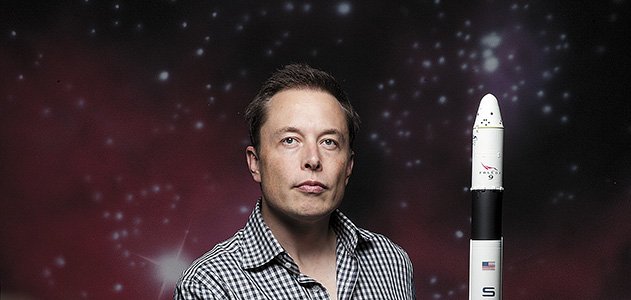
Unless you missed it somehow, you’ll know that today Elon Musk’s company Space X successfully landed a reusable rocket on a drone ship in the ocean. This rocket returned from space immediately after detaching from the supply ship headed toward the International Space Station. This is an important feat since it means so much less money will be wasted on rockets that destruct rather than returning to Earth to be used again. Musk calls these reusable rockets “another step toward the stars.” The cost alone is significant, since budgetary concerns so often factor into space exploration. The cost of launching a reusable rocket is $200,000 to $300,000, while the cost of a rocket that will never be used again is a staggering $60 million. Another company, Blue Origin, has also successfully launched and landed a reusable rocket three times now. However, the Blue Origin rocket only reaches suborbital space, while Musk points out that his Falcon 9 rocket can reach greater speeds and altitudes before coming back to Earth.

You can see a video of the landing here, and read this article for more information on today’s successful and groundbreaking landing.

Posted in Science, Space Travel, Universe | Tagged , , , , | Comments Off on Another Step Toward the Stars

Another Step Toward the Stars

musk

Unless you missed it somehow, you’ll know that today Elon Musk’s company Space X successfully landed a reusable rocket on a drone ship in the ocean. This rocket returned from space immediately after detaching from the supply ship headed toward the International Space Station. This is an important feat since it means so much less money will be wasted on rockets that destruct rather than returning to Earth to be used again. Musk calls these reusable rockets “another step toward the stars.” The cost alone is significant, since budgetary concerns so often factor into space exploration. The cost of launching a reusable rocket is $200,000 to $300,000, while the cost of a rocket that will never be used again is a staggering $60 million. Another company, Blue Origin, has also successfully launched and landed a reusable rocket three times now. However, the Blue Origin rocket only reaches suborbital space, while Musk points out that his Falcon 9 rocket can reach greater speeds and altitudes before coming back to Earth.

You can see a video of the landing here, and read this article for more information on today’s successful and groundbreaking landing.


Posted in Science, Space Travel, Universe | Tagged , , , , | Comments Off on Another Step Toward the Stars

Creation of the Kuiper Belt

kuiper-belt
The Kuiper Belt

Recently in class we’ve been talking about the outer portion of our Solar System. Beyond Neptune lies the Kuiper Belt, the disc-shaped region that begins at about 30 AUs and ends around 55 AUs. The Kuiper Belt is home to hundreds of thousands of icy bodies, an estimated trillion or more comets, and Pluto, according to NASA (I never realized Pluto was actually part of the Kuiper Belt).

The idea of the Kuiper Belt was proposed in 1943 by Kenneth Edgeworth who suggested that there were comets and larger bodies beyond Pluto. In 195, Gerard Kuiper predeicted there was a belt of icy objects beyond Neptune. While Pluto was discovered in 1930 by Clyde Tombaugh, the first “original” Kuiper Belt Object (KBO) was discovered in 1992 by Dave Jewitt and Jane Luu after 5 years of searching the skies. Using the University of Hawaii’s 2.2 m telescope, they found 1992 QB1, which they wanted to name “Smiley”. In 2002, Quaoar, the first large KBO hundreds of km in diameter was found by scientists at the Palomar Observatory (Quaoar was actually photographed in 1980 but wasn’t noticed). Sedna was discovered in 2004 using the same 48-inch Oschin telescope used at the Palomar Observatory. In 2005, Eris was discovered and in 2008, 2005FY9 (aka “Easterbunny”) was recognized as a “dwarf planet” and renamed Makemake. Two months later Haumea, or 2003EL61 or “Santa”, was classified as a “dwarf planet”.


Posted in Observables | Tagged , , , , | Comments Off on Creation of the Kuiper Belt