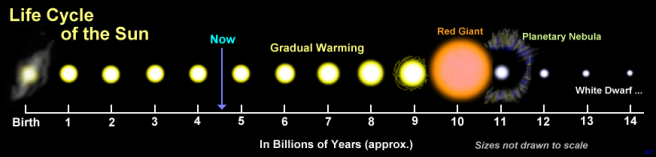
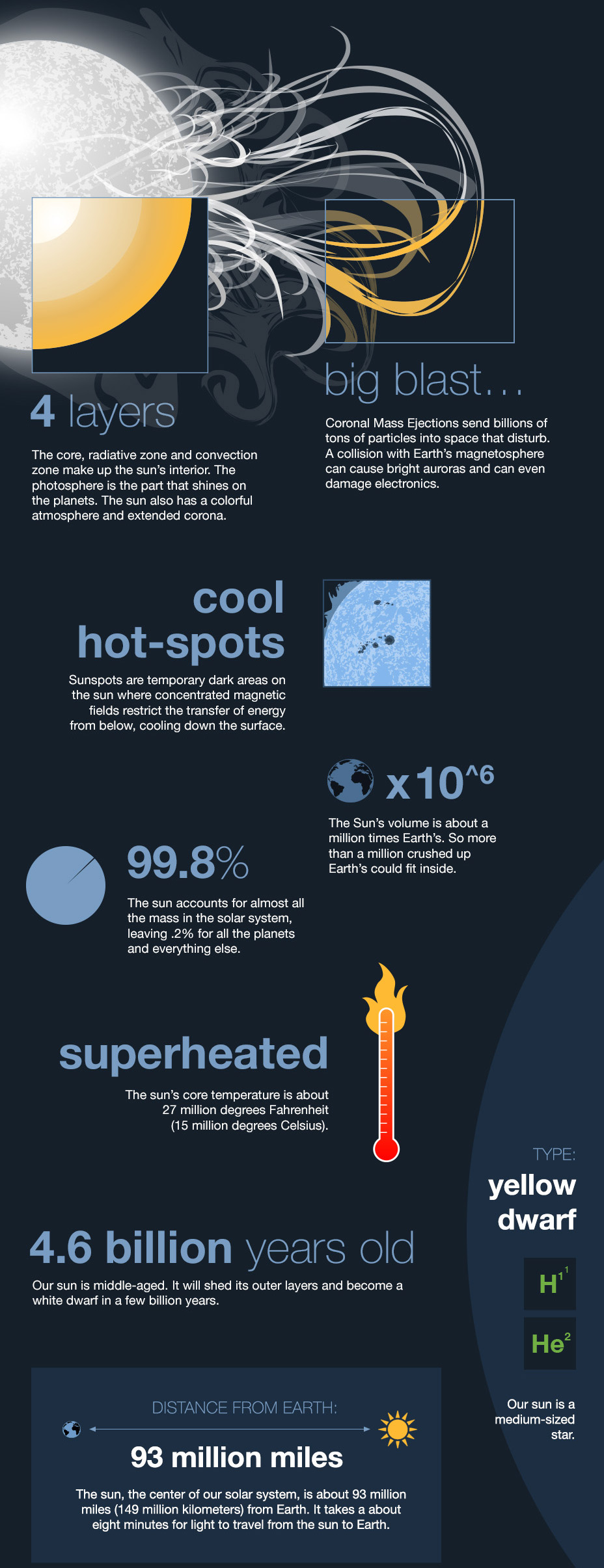
Currently, our nearest and dearest star is at the ripe middle age of about 4.5 billion years old. This means that the Sun is a “main sequence star,” so it converts the hydrogen in its core to helium. However, about 4 billion years from now, the Sun will being to transition to a red giant, at which point it will consist of mostly helium. The core of the Sun will compress, allowing the rest of the Sun to expand to the size of the orbit of Mars. Of course, once this happens, the Earth will be close enough to the now-ginormous Sun for it to be pulled into the fiery mass because of its increased gravitational pull. However, the Earth is destined to reach its demise far before this can happen.
The Sun undergoes a 10% increase in luminosity every billion years. Well before the Sun becomes a red giant, Earth’s oceans will evaporate and the planet will no longer be habitable. It’s uncertain when exactly this will occur, but most say it will happen in 1 billion years or later. So we won’t have to worry about Earth turning into a bone-dry desert anytime soon.
Currently, our nearest and dearest star is at the ripe middle age of about 4.5 billion years old. This means that the Sun is a “main sequence star,” so it converts the hydrogen in its core to helium. However, about 4 billion years from now, the Sun will being to transition to a red giant, at which point it will consist of mostly helium. The core of the Sun will compress, allowing the rest of the Sun to expand to the size of the orbit of Mars. Of course, once this happens, the Earth will be close enough to the now-ginormous Sun for it to be pulled into the fiery mass because of its increased gravitational pull. However, the Earth is destined to reach its demise far before this can happen.
The Sun undergoes a 10% increase in luminosity every billion years. Well before the Sun becomes a red giant, Earth’s oceans will evaporate and the planet will no longer be habitable. It’s uncertain when exactly this will occur, but most say it will happen in 1 billion years or later. So we won’t have to worry about Earth turning into a bone-dry desert anytime soon.
There’s a spectacular light show every year at the Opryland Hotel in Nashville, Tennessee. The grand venue boasts thousands and thousands of lights each year around Christmas. Yet, you don’t have to find a $30 parking spot at a debatably overrated hotel to see a grand, sparkling event.
In fact, there’s a place giving light shows as often as several times a day (or in slow periods, a couple times a week).To see it, you can be anywhere in the world – all you have to do is look up.
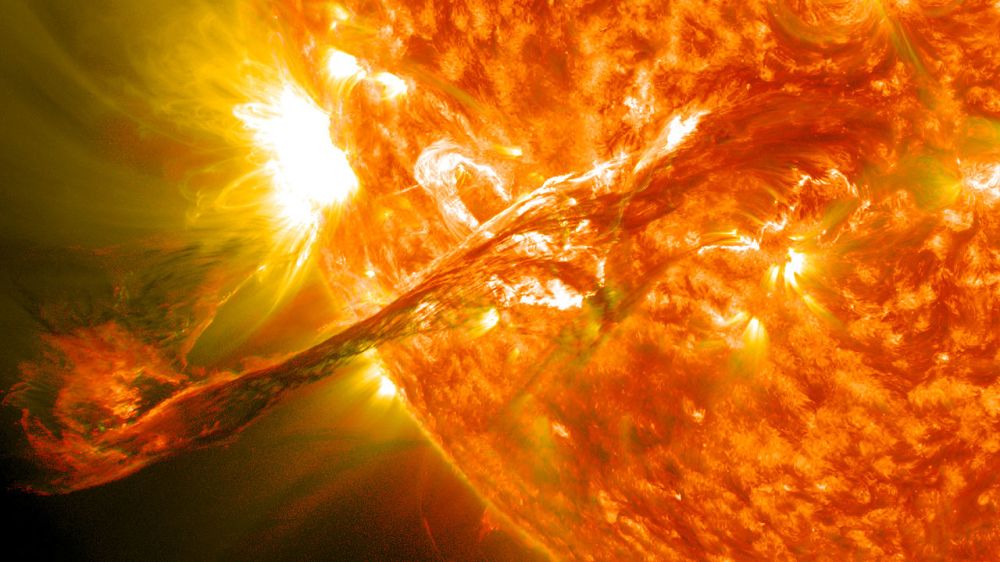
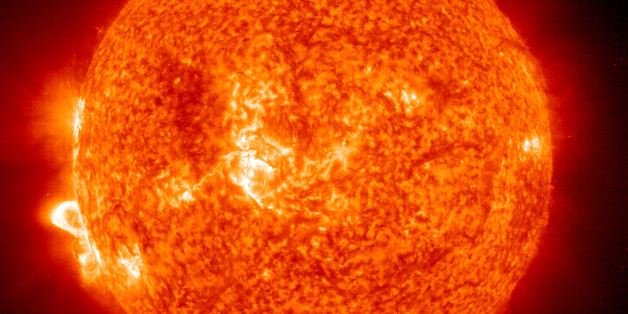
The Sun is essentially a collection of boiling, rolling matter. Its surface can reach temperatures anywhere around 6000 degrees, though its core is much hotter. Additionally, just like Earth, it also has a magnetic field. We see phenomena, called “solar flares” occur in what look like patterns along these magnetic lines.
In the photo above, you can see the Sun’s matter flowing in an arc-like shape outward from its surface, or corona. The shape seems to follow the lines of a magnetic arc. The sheer mass of energy is spectacular, and it sends these “flares,” or brief shoots of matter, out above the corona until it falls back to the surface. The seemingly tiny outbursts – that can occur several times per day – each require 160 billion megatons of TNT. That amount of fuel seems unreal and attests to the star’s sheer size. I can’t imagine what 160 billion tons of TNT looks like, much less 160 billion megatons.
We get it.
The Sun has power it sometimes decides to spare. But all that energy has to go somewhere, and solar particles are often thrust into space during these spectacular shows. Particles like protons and x-rays are often swung off these flailing arms of the Sun; however, Earth’s atmosphere is much too thick for x-rays to pass through and harm our bodies. Even still, these bursts of energy can interact with and disrupt our communication devices (including orbiting satellites) here on/around Earth.
The Sun likes to show off, and with all that energy and its beautifully boiling rivers, it certainly has merit in doing so. Yet, as with life on Earth, too much arrogance can cause damage. The Sun hasn’t let us down yet.
I was recently reading a book in which humanity had terraformed all of the Terrestrial planets (and also some gas giant moons) in the solar system, and it got me thinking: could humanity ever actually terraform a planet. And if so, which planet? After researching this question, Venus seems the most likely candidate for a human-induced terraforming transformation.
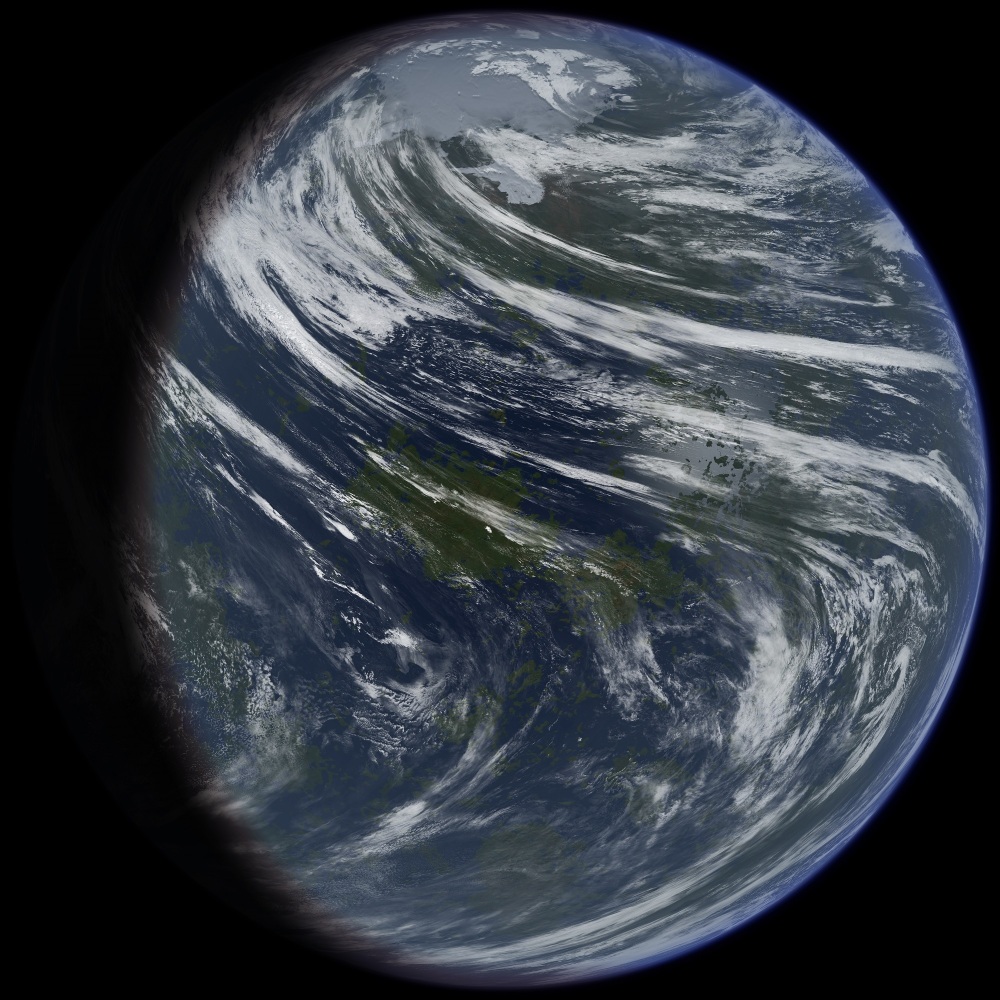
Venus is essentially as close as Earth can get to a twin-sister in our Solar System . It has a similar size, composition, and mass, and the two planets are close enough together that they both orbit in the Sun’s “habitable zone.” The prospects of turning Venus into a future vacation spot for weary Earthlings who need a break–or a refuge for those who actively flee in the case that Donald Trump wins the Presidency in 2016–are extremely interesting to think about. Although terraforming the planet to be habitable for humans is a long way off, the prospects of a terraformed Venus are exciting. What are some challenges that stand in the way of a vacation on Venus, and how could we combat these issues?
One thing standing in the way of a vacation to Venus is the immense heat present on the surface. Although Venus is not as close as the Sun as Mercury, its average temperature is about 300K hotter than Mercury’s (about 735K). This is due to the fact that Venus has a thick, dense atmosphere around the planet, around 91 times greater than Earth’s. This causes Venus to have an absolutely huge greenhouse effect, warming the planet much more than it would be without its atmosphere.
In addition the heat and the crushing atmospheric pressure, there is no oxygen on Venus, which would make it pretty difficult to breathe on your vacation). It also rains sulfuric acid, which would definitely damper any possibility of soaking up some sun ray’s from a beach chair.
So the challenges to terraforming the planet are definitely difficult, but what would need to happen for future scientists to terraform the planet? First off, they would need to find a way to decrease the temperature of the planet immensely. Secondly, planetary engineers would need to decrease the atmospheric pressure on the planet. Third, we would need to create breathable air. These challenges seem daunting, but the best news for future planet shapers is that all of these factors are interconnected.
Some methods of terraforming Venus have been introduced by various scientists, including Carl Sagan. Carbon sequestration by adding chemicals that would react with C02 in the atmosphere has been suggested. Pumping various chemicals or other molecules that could react with the C02 and cause it to break apart would lessen the atmosphere.
In addition, cooling down the planet (and I mean really cooling down the planet) by using “solar shades” or large mirrors would cause some of the CO2 in the atmosphere to freeze and fall out of the atmosphere, decreasing the atmospheric pressure and cooling the planet down even more. One way to do this would be to use a giant mirror or other device to artificially block and reflect the sunlight back into space.
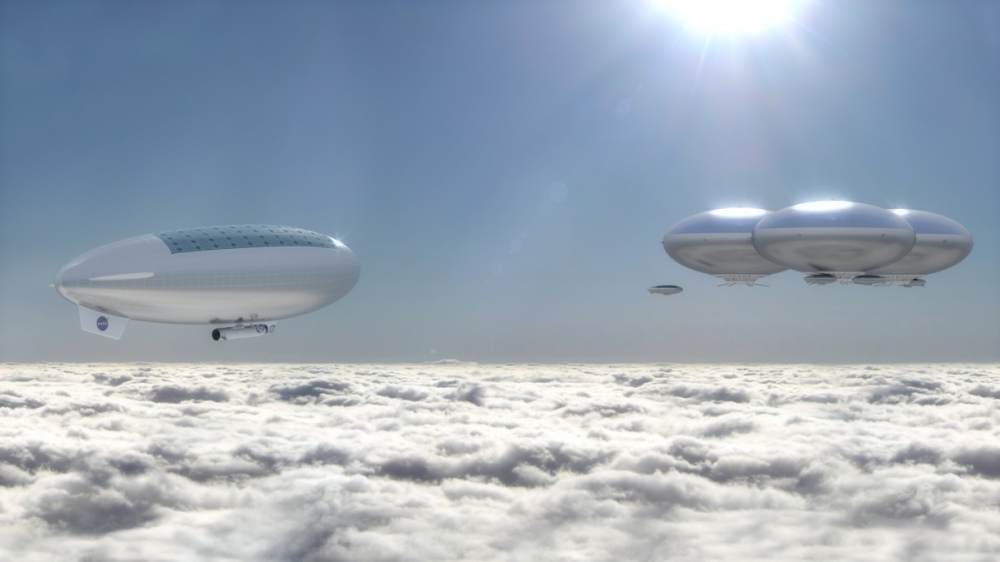
A combination of these methods has been proposed by NASA in their High Altitude Venus Operational Concept (HAVOC) Plan. In this plan, large floating cities could be built above Venus’s clouds which would block sunlight as well as work to process and break down C02 in the atmosphere.
A theoretical representation of the HAVOC plan in action above Venus’s thick atmosphere
These concepts could deal with Venus’s atmosphere and heat, but a day on Venus lasts approximately 121.5 Earth Days, more than enough time to get a good tan. Such a slow rotation rate means that plants and animals would have a hard time adjusting to life on Venus. Therefore, it becomes important to increase the rotation speed. One proposal involves hurling asteroids or other objects at Venus’s surface or by forcing close fly-bys which would transfer some angular momentum from the objects to Venus.
All of these methods are not without challenges, but they provide some insight into possible ways to terraform Venus. A terraformed Venus would unlock multiple benefits fro life on Earth. From the harvesting of resources to the creation of a “back-up” Earth, terraforming Venus would be a huge benefit to humanity. It won’t be easy, but I am sure that some day–even if not within our lifetimes–we will be able to vacation on Venus.
For a neat video, as well as more information on terraforming Venus, visit the Universe Today website.
What do you think about terraforming Venus? What are some challenges that you can see with some of the approaches? Can you think of any other ways to alter Venus’s surface? Let me know in the comments below.
The Juno spacecraft is on its way to Jupiter, getting closer and closer as the years go by. Having left in August of 2011, five years later, Juno is due to arrive in July of this year. It is going to be the first solar-powered spacecraft to reach as far as Jupiter. Its mission is to study the planet, in search of evidence of a solid core, understand its origin, to detect and measure its magnetic field, detect signs of water and ammonia in the atmosphere, and etc.
The distance between Earth and Jupiter is astounding, seeing as it is taking five years for Juno to reach Jupiter. Additionally, since Juno is only supposed to orbit around Jupiter for one year after travelling for so long, it will be really interesting to see what information the probe will gather.
The Sun serves at the central focus of our Solar System, our source of heat and light. However, sometimes things tend to ~flare up~ on this Sun that can disrupt things here on Earth. Eruptions of hot gas on the Sun (or solar flares) can cause shock waves that produce radio waves that worm their way into Earth’s atmosphere. These radio waves can cause dropped cell phone calls, interference with your GPS, radio blackouts, and other technical difficulties. Intense solar activity like these flares has also been known to allow aurora to be seen in unusual places, like Northern Ireland. Although we can’t peak out our windows and check the weather on the Sun, NASA has created a handy dandy guidebook to weather in space that allows phone or power companies to be prepared. You can check up on space weather yourself here!
The size of the Sun is difficult to comprehend. With a diameter of 865,000 miles, The Sun has the volume of 1.3 million Earths. If we were to place the Earth next to the Sun, we would simply see a tiny spec next to the Sun. However, the Sun is not even close to the biggest star in the universe.
About 3 kilo parsecs away from Earth sits UY Scuti, a red supergiant that has a diameter of roughly 1.5 billion miles. If this star were placed at the same location as our Sun, it would fully encompass Saturn’s orbit and almost encompass Uranus’s orbit. Furthermore, UY Scuti has the volume of over 5 billion Suns. To put the size of the Earth, the Sun, and UY Scuti in perspective, if the Earth were the size of a beachball, the Sun’s diameter would be about the height of a seven story building and UY Scuti’s diameter would be over four times the height of Mount Everest (Rebern).
UY Scuti, however, is simply the biggest star that we know about. It is very possible that another star exists that dwarfs even UY Scuti. Wrapping our head around the size of this hypothetical star would be even harder.
In order to power the Mars Rover, scientists decided to use a radioisotope thermoelectric generator. Thermoelectric generators use differences in temperature to generate energy. The Mars Rover uses plutonium-238, a radioisotope that decays overtime and generates heat. This heat is used by the thermoelectric to generate energy for the rover. There are several benefits to this method of obtaining energy. The Rover doesn’t rely on the sun or any other outside resources to gain power. This type of power also lasts a long time. Radioactive decay may also be used for other spacecraft in the future.
What’s going on under the surface of pluto? The New Horizons probe passed Pluto just last year, after a nine year journey to the Kuiper Belt. Over the last few months, images from the probe have been being received back here on Earth. These images are the most high quality photos of Pluto we have ever seen. In this article, Nasa explores why it appears that part of Pluto is “disappearing” in front of our own eyes. What’s going on?
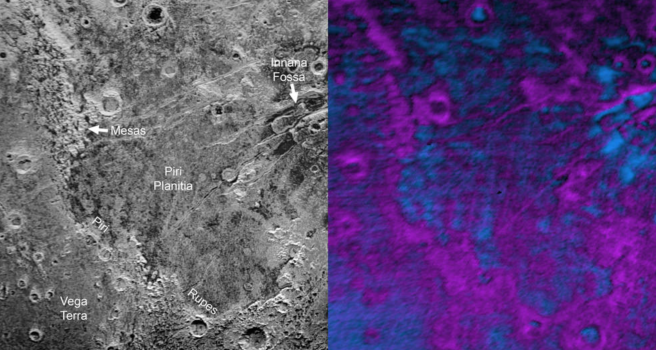
Scientists think it is a process called sublimation, which means that parts of the surface is converting into gas. The surface of Pluto is rich in Methane, and scientists believe it is this Methane that is evaporating into the atmosphere of the dwarf planet. In the attached, image, one can see the cliffs and valleys that have been created as a result of sublimation.
Scientists have also detected a later of ice-like material under the rock bed of the planet. The surface is so cold, however, that it is immobile. More inferences will be made as more images are received from the New Horizons probe.
While I was looking up random astronomy stuff, I came across an article that lists the top ten biggest things in the universe. Here are a few of the gigantic things that made the list:
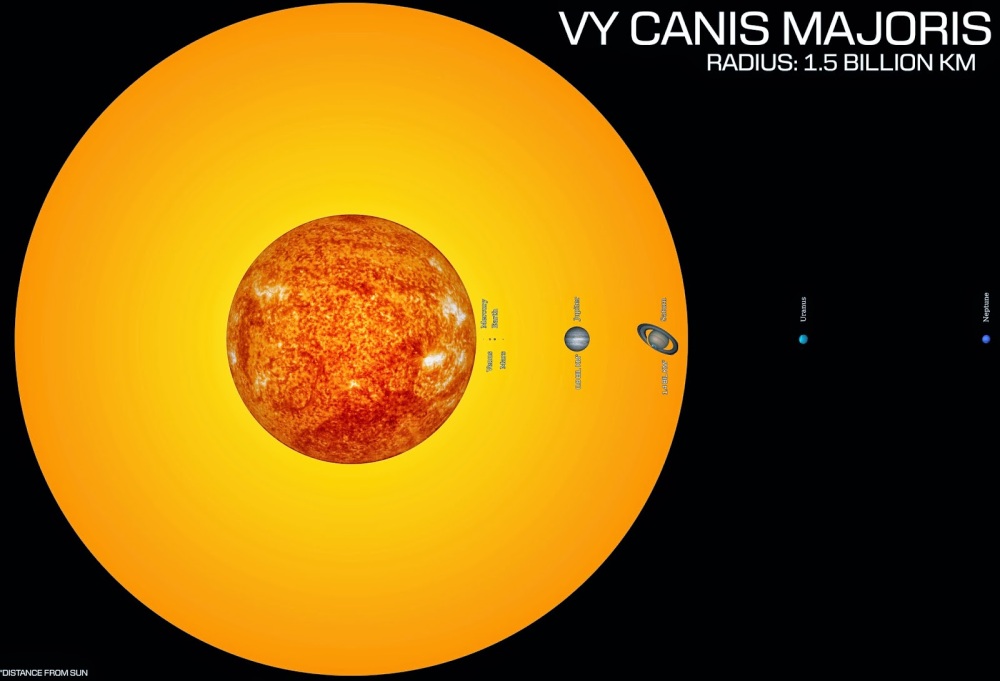
Biggest Star – VY Canis Majoris
VY Canis Majoris is the largest star that we know of; it has a radius 1420 times larger than our sun’s. To put this sun’s size into perspective, if you put VY Canis Majoris where our sun is, it would extend past Saturn. That’s pretty big.
Biggest Planet- TRES4
TRES4 is located in the constellation Hercules, and is about 70 percent larger than Jupiter, however, it only has about 80% percent of the mass of Jupiter. This is because of how close the planet orbits its sun. It is believed that the intense heat that it receives causes the gases that make up the planet to expand.
Biggest Black Hole-QJ287
QJ287 is the largest black hole that we have spotted. It is believed to be about 18 billion times the mass of our sun and is a supermassive black hole in the center of a universe. The crazy thing about black holes is that there is no theoretical limit to how big they can get so there could be way bigger ones.
This article goes on to talk about some even crazier stuff that’s so big I can’t even comprehend, (e.g. the cosmic web, the Huge LGQ etc) so if you want to read about some more big stuff check out the article here. Picture can be found here.











 While I was looking up random astronomy stuff, I came across an article that lists the top ten biggest things in the universe. Here are a few of the gigantic things that made the list:


.png)
