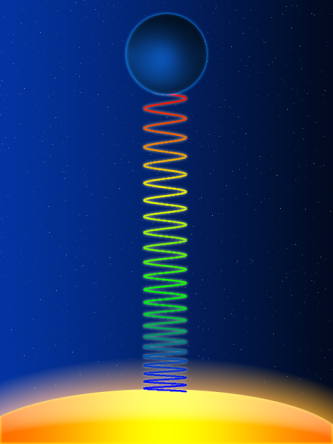
It is astonishing the extent that gravity and light interact with one another. This is of course very fortunate for us humans when trying to understand the basic force that is known as gravity. After Isaac Newton proposed his Law of Universal Gravitation in 1687 is was generally thought that gravity was understood even though there were a few holes in the theory, like Mercury’s strange orbit around the Sun. It wasn’t until 1916 when Einstein released his paper on General Relativity that Newton’s model was under serious attack. General Relativity is basically that around objects with large mass, both space and time (spacetime) are warped by the gravity of the objects. So light can bend around large objects and time will move slower. The theory was first tested in 1919 by taking pictures of a total solar eclipse and measuring the position of the stars nearby. But the theory also predicted the existence of “redshift” and “blueshift” of light as an object moves toward or away from Earth. This phenomenon allows scientists to approximate the relative velocity of distant objects based on the relative shifting of the light. It was also used by Edwin Hubble to conclude the universe was expanding at an exponential rate due to the extreme redshift of distant galaxies.
The model of General Relativity has withstood countless tests including the most recent discovery of gravitational waves. It has been used to predict the existence of black holes. It is used by GPS satellites to correct their clocks due to the difference in time far from the Earth’s surface. If light and gravity did not interact who can say if humans would have ever come up with a model as accurate as General Relativity.