The Gravity Slingshot

Recently we discussed a maneuver called the gravity assist. NASA uses this technique frequently, most notably with the Voyager probe during flybys of Jupiter and Saturn. In simplest terms, a gravity assist changes a spacecraft’s velocity by going through a planets gravitational field. To accelerate, the spacecraft flies with the movement of the planet picking up some of its orbital energy. Gravity assists are used to save time and money.

Despite being a real maneuver that is used by NASA, many people might think that the technique is a concept straight out of a science fiction movie. In fact, the maneuver’s inclusion in recent movies (Interstellar and The Martian) made it seem fictionalized. Specifically, in The Martian, Donald Glover’s character had to describe what a gravity assist was to the director of NASA. This discussion makes the technique seem complicated; however, in reality, everyone in NASA should be aware of the gravity assist.

It is cool to think about the advances that NASA has made. Things that sound fictional are actually being used to help us explore our solar system.


Posted in SolarSystem, Space Travel | Tagged , | Comments Off on The Gravity Slingshot

Blog #3 James Webb Space Telescope

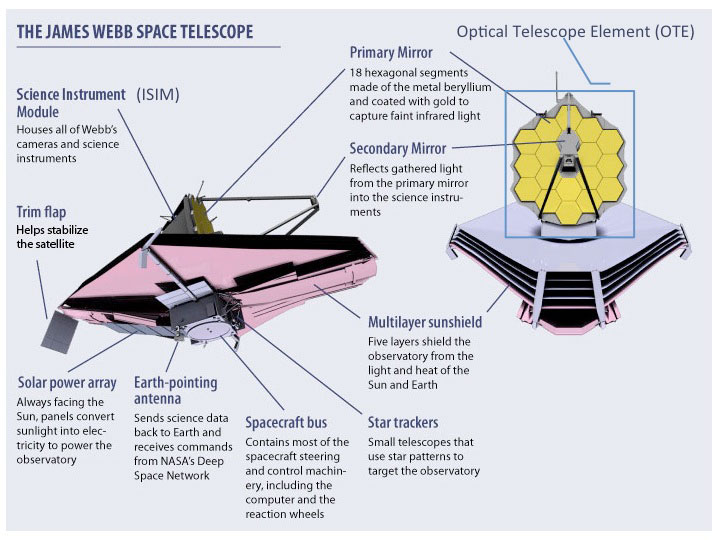
labeledspacecraft
JWST Array and Hardware

The flagship of the next generation telescopes launches in October 2018. The James Webb Space Telescope is an infrared telescope with its focus on the very first light from the Big Bang. With its 6.5 meter primary mirror and various cameras and spectrometers, the JWST will study the boundaries of the observable universe as well as other solar systems with life-sustaining potential. The mirror is composed of 18 beryllium gold-coated panels, with the last one recently assembled in the NASA Goddard Space Flight Center. The manufacture of JWST is a joint venture of Northrop Grumman Aerospace Systems for NASA, ESA, and CSA. The James Webb Space Telescope and the Space Telescope Science Institute will provide incredible observation opportunities for astronomers in the years to come.


Posted in Instruments, Light | Tagged , , , , , | Comments Off on Blog #3 James Webb Space Telescope

The Hubble Space Telescope

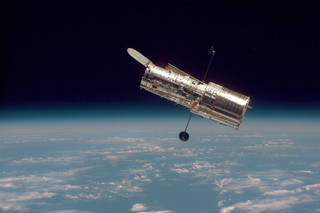
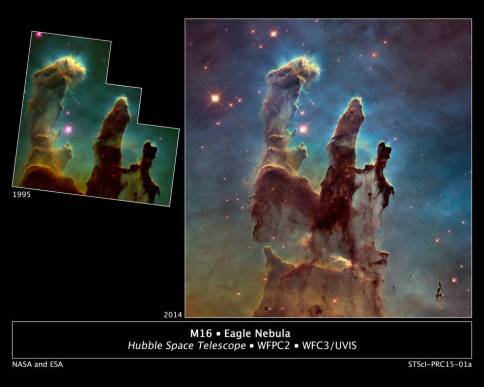
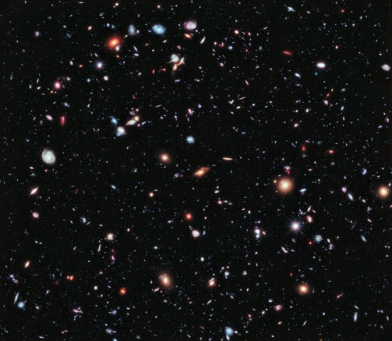
Until this past September when LIGO heard gravitational waves, our knowledge of the universe has come from visual observations. When Galileo began using his telescope in the early 1600s, our notion of the natural world completely evolved. Today, we have telescopes whose size, complexity, and power allow us to observe the most distant stars and galaxies. NASA’s Hubble Space Telescope is among the most well-known scientific instruments in history. People who know nothing about astronomy have still probably at least heard of the Hubble. Launched in April 1990, the Hubble Space Telescope has achieved this fame for incredible breakthroughs and discoveries that have changed how we view our place within the universe. Among the more famous discoveries include: allowing astronomers to determine the precise age of the universe; the pillars of creation image; and the deep field/ultra deep field images.

345535main_hubble1997_hi

The Hubble Space Telescope

p1501ay_0

“Pillars of Creation”

690957main1_p1237a1-673

eXtreme Deep Field


Posted in Instruments, Light | Tagged , , , | Comments Off on The Hubble Space Telescope

The Tidal Forces

Tides are a well known and commonly occurring natural phenomenon that most people have witnessed. While many people just accept tides and don’t really think much about them, they are prime examples of how much of an impact other objects in our Solar System have on seemingly normal occurrences.

nai-harn-beach

The tides on a beach like the one pictured above are due primarily to the gravitational pull of the Moon, and to a lesser degree the gravitational pull of the Sun. The reason why the Moon has a stronger influence on the water is because the difference in gravitational forces on one side of the planet compared to the other is more significant than the difference between the gravitational force of the Sun on either side of the planet. While the Moon is only high in the sky for one part of the Earth every 24 hours, there are still two high tides and two low tides. This is because tidal forces act like rubber bands. When you pull one side, the other side has to be pulled as well. This means that it is high tide at the same time for opposite sides of the planet, likewise with low tide. Every day the timing of high and low tide gets pushed back one hour (moves later in the day) because the Moon’s orbit takes about 24 hours and 50 minutes, which is obviously longer than one Earth day. While the effect of gravitational forces is quite evident in water, tidal forces are present in land masses as well, but are not as easily noticeable. Overall, tides are an incredible example of how objects hundreds of thousands of miles away can affect life on Earth without any of us really noticing.


Posted in Physics, Terrestrials | Tagged , , , , , | Comments Off on The Tidal Forces

Zero Gravity on Earth

OK Go, a band famous for their awesome music videos, just released the music video for their newest song. And the whole thing was filmed in zero gravity! However, the music video wasn’t filmed in space and the band wasn’t in orbit. So how did they achieve this feat?

There are types of planes called reduced gravity aircrafts. These are fixed wing planes that fly in an elliptic pattern relative to the center of the Earth. When the plane reaches a certain point in its flight path, the plane no longer exerts a ground reaction force on its passengers and they are able to achieve the same kind of free-fall that astronauts experience while in orbit. In fact, these aircrafts are often used during an astronaut’s training so they can get used to the sensation of weightlessness.

If you so desire, there is a company in the United States that operates these planes for use by the general public. The Zero Gravity Corporation has been in operation since 2004 and has catered to a number of notable passengers: Stephen Hawking, Buzz Aldrin, the Mythbusters, and Martha Stewart.

Oh, and the price for a single flight is $4,950 plus tax.

I think I’ll stick with gravity for now.


Posted in Class | Tagged , , | Comments Off on Zero Gravity on Earth

The Gran Telescopio CANARIAS

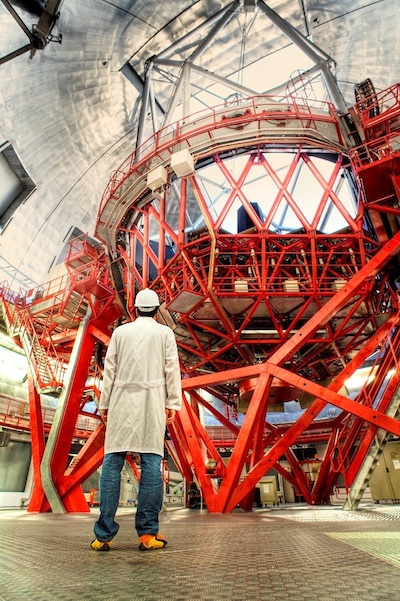
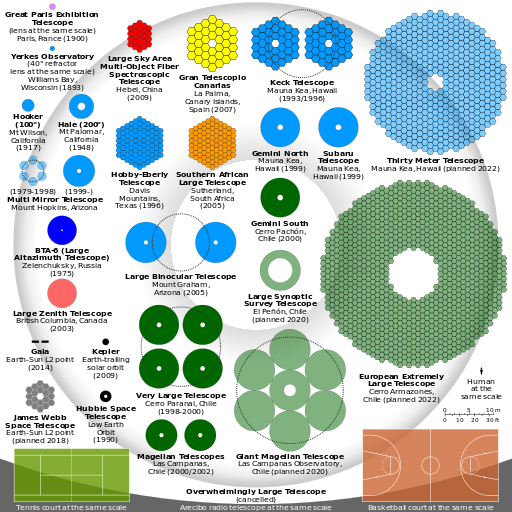
When it comes to reflecting telescopes, bigger can mean better. The Gran Telescopio CANARIAS (GTC), located on the island of La Palma in the Canaries, Spain, is currently the largest single-aperture optical telescope in the world. Its primary mirror surface is made up of thirty-six hexagon segments; together these segments function as one primary mirror with a diameter of 10.4 meters – a length about half a tennis court! Overall, it has a light-collecting surface of about 75.7 square meters. Because of the size of its primary mirror, the $180 million GTC can collect light more quickly and observe fainter lights than other telescopes. Its location at the Roque de los Muchachos Observatory, 2300 meters above sea level, is also crucial to the high quality of its observations because of the cloudless skies, low atmospheric turbulence, and lack of light pollution that this location provides.

telescope

Inside the GTC.

The GTC has been put to work observing extrasolar planets, studying stars and galaxies forming in the early universe, and dark matter and energy. However, its claim to fame as the largest reflecting telescope  is not likely to last – the Thirty Meter Telescope to be located on Mauna Kea, Hawaii, and the European Extremely Large Telescope to be located at Cerro Armazones, Chile, are both planned to open in 2022 and are both significantly larger than the Gran Telescopio CANARIAS.


512px-comparison_optical_telescope_primary_mirrors-svg

Size comparison of many notably large optical telescopes. 

Featured image.


Posted in Instruments, Light | Tagged , , | Comments Off on The Gran Telescopio CANARIAS

The Sun and the Missing Neutrinos

First of all, what is a neutrino?  It’s an elementary particle, like an electron or a photon, but it hardly interacts with matter.  In fact, billions of neutrinos pass through you every second, but you don’t feel them.  This characteristic makes them hard to detect.  It’s no wonder that, in recent history, scientists thought some neutrinos were missing.

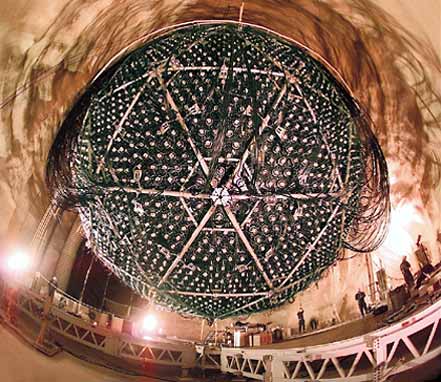
Now, what do neutrinos have to do with the Sun?  The theorized process of nuclear fusion that takes place in the Sun had to be proven experimentally.  Because of conservation of matter, charge, and spin, the process was thought to produce 2 neutrinos, each time 4 protons fused together.  Since this process occurs plenty of times each second, we thought we could detect them and expect a certain number of them each time we took a measurement.  However, for many years, we only detected a small portion of the neutrinos that we expected.  This was because the neutrinos changed flavors as they approached Earth.  We were only detecting one of the three flavors when we began our experiments.  After many decades and advancements in our detection technology, we found the missing particles.  The device that detected all three flavors is in Sudbury, Ontario.

If you’d like any more information on this mystery in physics and astronomy, please click on the sources below:

Nova

Nobel speech


3
Sudbury Neutrino Detector


Posted in Observables, Stars, Sun | Tagged , , | Comments Off on The Sun and the Missing Neutrinos

Newgrange, Archeoastronomy Before Stonehenge

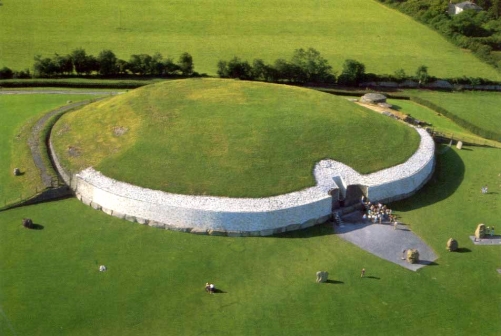
Although Stonehenge is the most famous ancient astronomy site in Europe, it isn’t the oldest.  While Stonehenge was built around 3000 BCE, Newgrange, a tomb in Country Meath, Ireland, was built around  3200 BCE.

Newgrange_from_air
Newgrange

At first glance, this tomb doesn’t seem to have much to do with astronomy; there is no telescope, nor is there a spire to cast a shadow like a sundial.  However,  there is an opening above the entrance that lets in sunlight two weeks before and after the winter solstice.  This opening is no coincidence.  Clearly, the people who built this tomb had the cyclical nature of the Sun in the night sky in mind.  It makes one wonder how long people have been tracking the cosmos.  Most likely, before we had the capabilities to construct this tomb.


Posted in Historical, Observables | Tagged , | Comments Off on Newgrange, Archeoastronomy Before Stonehenge

What Happens in Space…

Doesn’t necessarily stay in space. Humans have been traveling to space since the first orbits about the Earth in the 1960s, we’ve gone to the Moon, but what keeps us from going further out into our solar system or even beyond it? Well, the obvious answers would include our technological limitations and how we can’t travel anywhere fast enough, but another limiting factor is the effects that space has on the human body and how quickly they occur.

A postmenopausal woman will lose 1-1.5 percent of the mass of her hip bone in a year if she isn’t being treated for bone loss-it only takes an astronaut 1 month to lose the same amount. If it take 260 days to get to Mars (approx. 9 months), an astronaut would lose as much as 13.5 percent of their bone mass!

And bone loss isn’t the only problem. Astronauts also lose blood (as a reaction to the bodily fluids moving towards the head- which also results in swollen faces and skinny legs), when the are under the influence of gravity again, this decrease in volume of blood can lead to a decrease in blood pressure and cause them to pass out.
space_fluid_shift
How fluid travels in the Human Body in space (Wikipedia )

Space also has effects on the immune system that cause dysregulation and depressed function.

Further Reading

Interactive NASA website (Videos included)

Human Spaceflight

Effects of Spaceflight on the Human Body

How long would it take to travel to Mars?


Posted in Class, Space Travel | Tagged , , , | Comments Off on What Happens in Space…

What’s the deal with black holes?

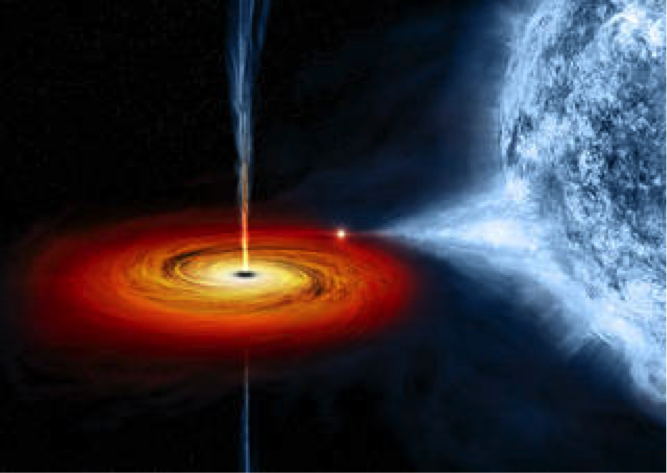
blackhole eating.png

(Artist’s depiction of a black hole “stealing” mass from a nearby star)

What are black holes? Black holes are supermassive cosmic objects. They can be very large or as small as an atom. These atom-sized black holes are so massive that, if on Earth, they could have the same mass as a large mountain. Super massive black holes are the largest type of black holes. They can have as much mass as one million suns. Black holes can be created in a number of ways. Small black holes were likely created at the beginning of the universe. Medium black holes are created from the death of a large star. Supermassive black holes are created at the birth of the galaxies in which they exist. These objects are named black holes because they are so massive that light cannot escape their gravity. Therefore they admit no light and their existence can only determined by their effect on light and objects, such as stars and gas, near them. The closest supermassive black hole can be found at the center of the Milky Way galaxy, a safe 27,000 light-years away.

Comment

Picture and info Source

Categories: Physics, Class

Tags: Astro2110, Blog4, Black holes, scary awesome science


Posted in Class | Tagged , , , , | Comments Off on What’s the deal with black holes?