Information About Eclipses

Here are some of my favorite sites for learning about eclipses (including the upcoming Great American Eclipse!):

moonslide_seip_c800-APOD

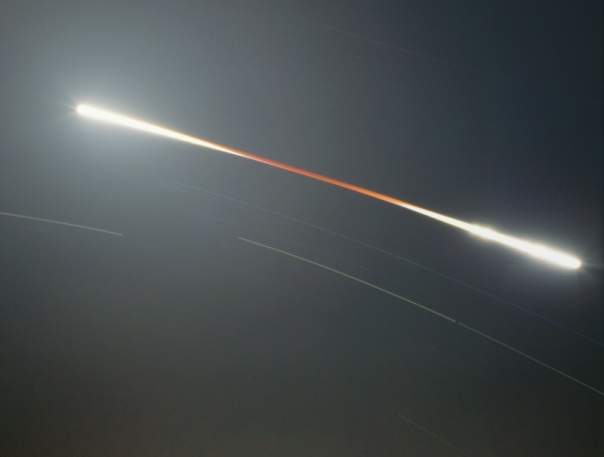
“Moon Slide (slim)” from Astronomy Picture of the Day. This “Moon-trail” by Stefan Siep was created by just opening the shutter and keeping it open for about 3 hours. Note the brightness difference between full and eclipsed :)


Posted in Observables, SolarSystem | Tagged , , | Comments Off on Information About Eclipses

magic

“Any sufficiently advanced technology is indistinguishable from magic.” – Arthur C Clarke’s third law.

I stumbled on a little thing I had posted some time ago, early in September when friendships were still tentative and the air was still crisp. -We spent the weekend in a cabin four dirt trails off the everyday. At night we cracked open beers and harmonized to loud electronic dance music and jazz. At one point my gaze drifted a little upward and I realized we were completely outside the belly of Nashville light pollution. The sky danced with playful glitter. In a moment of personal triumph I was reminded why I loved the night sky so much I had pledged to study the science that governs it. Amidst the thumping music in a moment of serenity I found a sliver of purpose again. The night sky in Nashville is purple smeared, bruised, unglamorous. I forget there is magic out there still-

I love looking up at the sky. Back home in Beirut, the sky was full of possibilities. But mostly smog, dark clouds, light pollution. One month, in 2006, drones. Then the sky became a place of fear, and anguish, and loss, and grief. It stopped giving sunlight, rain, wispy cloud, but only bombs. Where was the human endeavor? Where was the space race, national pride, stretching onto the rubber band of impossibility? Space travel, exploration, discovery?

Then it stopped. I was on a plane that shot up into the sky. Opportunity. The atmosphere was still my ceiling. I was still under all this evil. But now I was in the land of opportunity, and the sky opened up for me once more.

5156-a-jet-fighter-flying-in-the-sky-pv
The sky gives many things.

Posted in Class, Stars | Tagged , , , | Comments Off on magic

The Cosmic Calendar

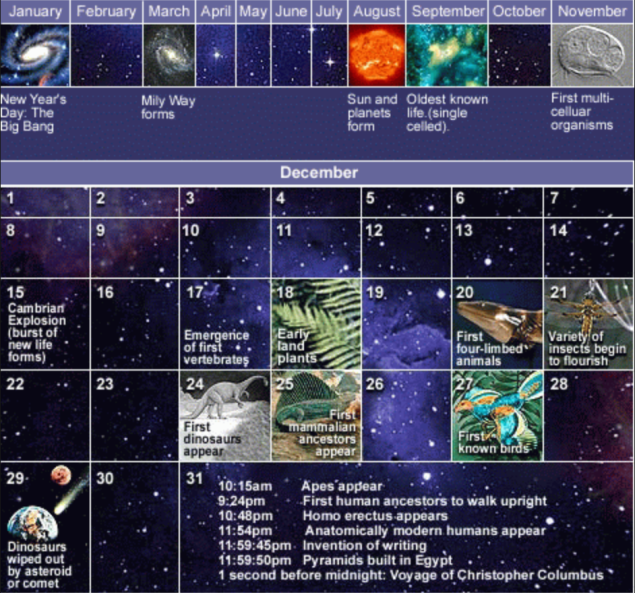
If you ever feel old, take a quick look at the cosmic calendar. We are young. Very young. Even our grandparents and young. You may disagree with me- but allow me to explain. The cosmic calendar puts everything that has happened in the history of our universe onto a gregorian calendar (what we use today). So, in the cosmic calendar, The Big Bang took place on January 1. Using this scale, humans would not come onto Earth until 11:58pm on December 31. That’s two minutes before New Years. Not impressed yet? The average college student would not be born until 11:59:59.95 (.05 seconds ago).

We sometimes forget just how long the Universe has been in existence. We as humans are just a small act in a much larger play. Consider everything that happened before we got here. Our galaxy had to form, then our planet, and then, millions of years later, life BEGAN to form. We are talking single cell organisms. Millions of years later we had real creatures, like dinosaurs. Finally, 65 millions years later, we arrive to where we are today. In short; you are young. I am young. We’re all really young. Don’t fool yourself!

Screen Shot 2016-01-26 at 6.57.55 PM
Full Cosmic Calendar


Posted in Historical | Tagged , , | Comments Off on The Cosmic Calendar

The Cosmic Calendar

If you ever feel old, take a quick look at the cosmic calendar. We are young. Very young. Even our grandparents and young. You may disagree with me- but allow me to explain. The cosmic calendar puts everything that has happened in the history of our universe onto a gregorian calendar (what we use today). So, in the cosmic calendar, The Big Bang took place on January 1. Using this scale, humans would not come onto Earth until 11:58pm on December 31. That’s two minutes before New Years. Not impressed yet? The average college student would not be born until 11:59:59.95 (.05 seconds ago).

We sometimes forget just how long the Universe has been in existence. We as humans are just a small act in a much larger play. Consider everything that happened before we got here. Our galaxy had to form, then our planet, and then, millions of years later, life BEGAN to form. We are talking single cell organisms. Millions of years later we had real creatures, like dinosaurs. Finally, 65 millions years later, we arrive to where we are today. In short; you are young. I am young. We’re all really young. Don’t fool yourself!

Screen Shot 2016-01-26 at 6.57.55 PM
Full Cosmic Calendar


Posted in Historical | Tagged , , | Comments Off on The Cosmic Calendar

Are we at the center of the Universe?

It’s not surprising that at first, humans believed in a geocentric universe. When you look up at the night sky while standing on earth, it appears as though the sun, moon, and stars are moving around the earth. Now of course we know that this effect is actually due to the rotation of the earth and the tilt of its axis. Still, it’s a bit hard to conceptualize the earth rotating when we’re standing on it and the ground is really our only point of reference. That’s why I want to show you all this SUPER AWESOME GIF!!! This is a long exposure shot of the milky way galaxy, but instead of seeing the stars move like we’re used to the gif has been stabilized with respect to the stars. With this stabilized view we can actually see that the earth is rotating and the view of the stars is stable. This really helps conceptualize the earth’s rotation and clearly shows that we are not at the center of the universe. Isn’t that super awesome?


Posted in Class, Stars | Tagged , , , , , | Comments Off on Are we at the center of the Universe?

Are we at the center of the Universe?

It’s not surprising that at first, humans believed in a geocentric universe. When you look up at the night sky while standing on earth, it appears as though the sun, moon, and stars are moving around the earth. Now of course we know that this effect is actually due to the rotation of the earth and the tilt of its axis. Still, it’s a bit hard to conceptualize the earth rotating when we’re standing on it and the ground is really our only point of reference. That’s why I want to show you all this SUPER AWESOME GIF!!! This is a long exposure shot of the milky way galaxy, but instead of seeing the stars move like we’re used to the gif has been stabilized with respect to the stars. With this stabilized view we can actually see that the earth is rotating and the view of the stars is stable. This really helps conceptualize the earth’s rotation and clearly shows that we are not at the center of the universe. Isn’t that super awesome?


Posted in Class, Stars | Tagged , , , , , | Comments Off on Are we at the center of the Universe?

Fuller-Mooning in the Winter

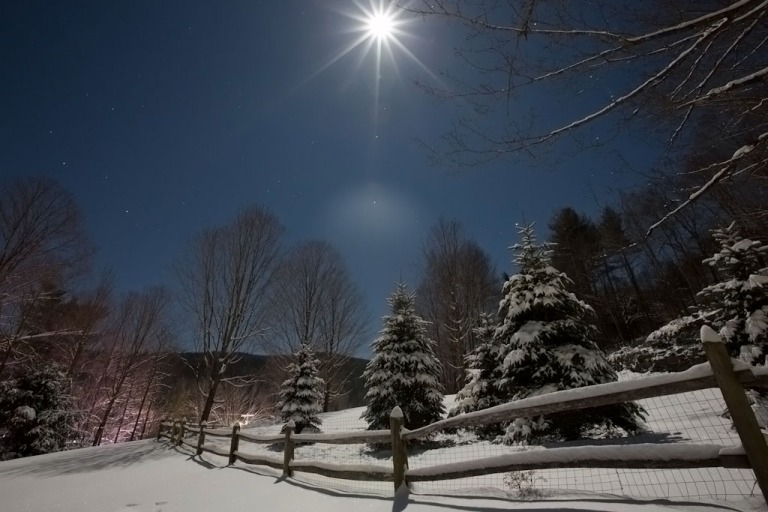
Whoa there. Before you flag this post as inappropriate, answer this question. Was this photo taken at noon or at midnight?

winter_night
Full Moon Illuminates Fresh Vermont Snowfall, Loren Fisher

If you answered midnight, congratulations! And surprisingly enough, this stunning photo of a full moon could only have been photographed in the winter. But why winter? Don’t we get full moons year-round? This is true; however, just as our Sun rises and sets higher in the summer and during certain times of the year, the Moon follows a similar trend. As you have probably noticed, in the summer months of the Northern Hemisphere the Sun traces a large arc, high in the sky; this leads to the longer days we experience during that time of the year. What you may not have noticed is that while the summer Sun shines highly in the sky, our Moon cruises lowly in the night sky, tracing a small arc over the horizon. This small arc and altitude mean that any full moons we observe will last a comparatively short time. On the other hand, when winter sets in and the days begin to shorten as the Sun traces a smaller arc at a lower altitude, it is now figuratively and literally the Moon’s time to shine! During these cold winter months, the Moon rises high in the sky and follows a long arc over the horizon, and what does that mean for you full moon fans? A long and pleasant (albeit cold) evening in the moonlight! With the moon tracing a longer arc, the full moon will hang higher in the sky and last much longer than any moon you’ll see during the summer. So night-hikers and moon enthusiasts rejoice! The time of fuller-mooning is upon you!


Posted in Class, Sun | Tagged , , , , | Comments Off on Fuller-Mooning in the Winter

Chase’s Solar System blog 2016-01-26 19:46:22

Earth’s Elliptical Orbit and Seasons

Though a common misconception about the cause of seasons is that they are caused by the Earth’s distance to the Sun, in actuality, seasons are caused by Earth’s 23 degree axial tilt. But why do changes in Earth’s distance from the Sun have virtually no effect on temperatures on Earth? It seems like a logical explanation for the changing of seasons and many brilliant people still hold this misconception to be true.

Earth orbits the Sun in an ellipse. At its closest point to the Sun, Earth is 147 million kilometers away from the Sun, while at its furthest point from the Sun, Earth is 152 million kilometers away from the Sun. This represents a difference of 5 million kilometers, which certainly seems substantial enough to change temperatures here on Earth. This, however, is not the case.
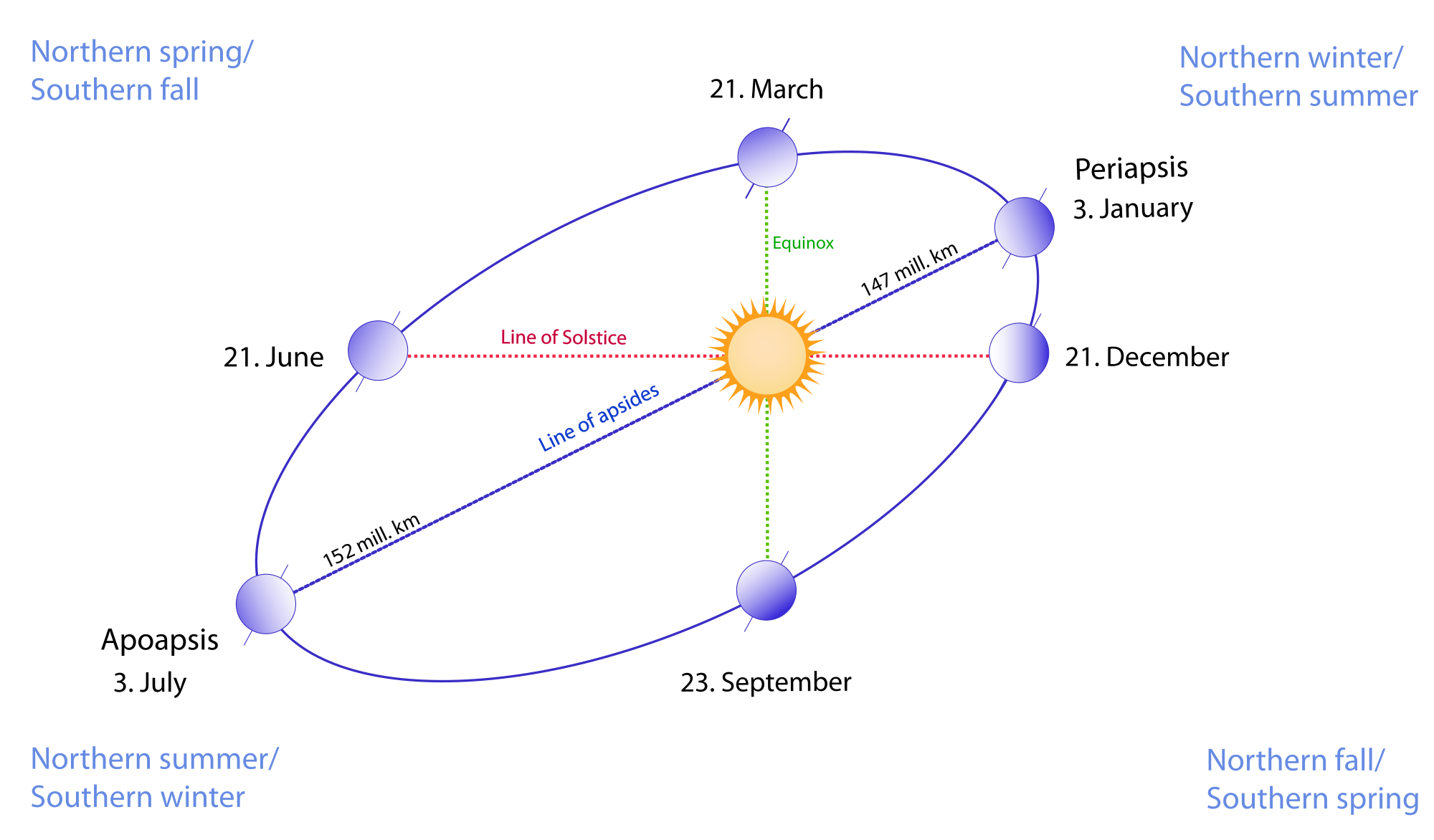
(Earth’s elliptical orbit)

Since the Earth is so far away from the Sun to begin with, this relatively small change of 5 million kilometers as virtually no effect. Imagine you are holding up a piece of paper and standing at a football field’s length away from a powerful flashlight. You first observe the amount of light hitting the paper and take note. Next, you step a yard closer to the light and observe how much light is hitting the piece of paper. You will not be able to tell the difference in light hitting the piece of paper since the flashlight is so far away to begin with and you only walked 1% closer to the flash light. If you had some very accurate machinery to measure the change you definitely would be able to pick up a tiny change, but there simply would not be any noticeable change.

Earth’s elliptical orbit, though, does have a small effect on seasons. When Earth is closer to the Sun, it travels faster in its orbit than when it is further away from the Sun. During winter in the northern hemisphere, the Sun actually travels one kilometer per second faster than it does during summer in the northern hemisphere. This causes winter in the northern hemisphere to be a full five days shorter than it is in the southern hemisphere!  (See here for more)


Posted in Class, Light | Tagged , , , , , , | Comments Off on Chase’s Solar System blog 2016-01-26 19:46:22

Stargazing: There’s an App for That!

imageimage2image3

Source: Google Play

Ever look up at the sky and wonder what that one bright star is called? Well there’s an app for that! Google Sky Map allows the user to hold their phone up to the sky, day or night, and scan the area for constellations, planets, and more. It has features similar to those in Stellarium such as a “time travel” mode, a search bar, and toggles for each display. What makes Sky Map particularly interesting is its ability to show the user what they’re looking at in the real sky with the constellation, star, and planet names displayed. Even if the planets aren’t visible to the naked eye, Sky Map shows you where that planet is in the sky.

The app uses GPS data to pinpoint your location and compass data to identify how your phone is oriented.  Its time travel mode allows you to view the sky as it appeared in the near past or future (unfortunately, it won’t allow you to peek into the stars 5000 years ago or a millennium into the future). And if you have an object in mind that you’d like to locate in the sky, you can simply use the search bar to find it. This app allows everyone from the astronomy enthusiast to the curious couple on a stargazing date to have the entire night sky in their hands.

Currently, Sky Map only displays planets, stars, constellations, the sun, the moon, and meteor showers. Perhaps in the future, a more advanced application can be created that allows the user to locate faraway comets, galaxies, and even track upcoming solar and lunar eclipses.

Sky Map is available on Android, and a similar version is available for Apple.


Posted in Class, Observables, Stars | Tagged , , , | Comments Off on Stargazing: There’s an App for That!

Life as a .05 Second Year-Old

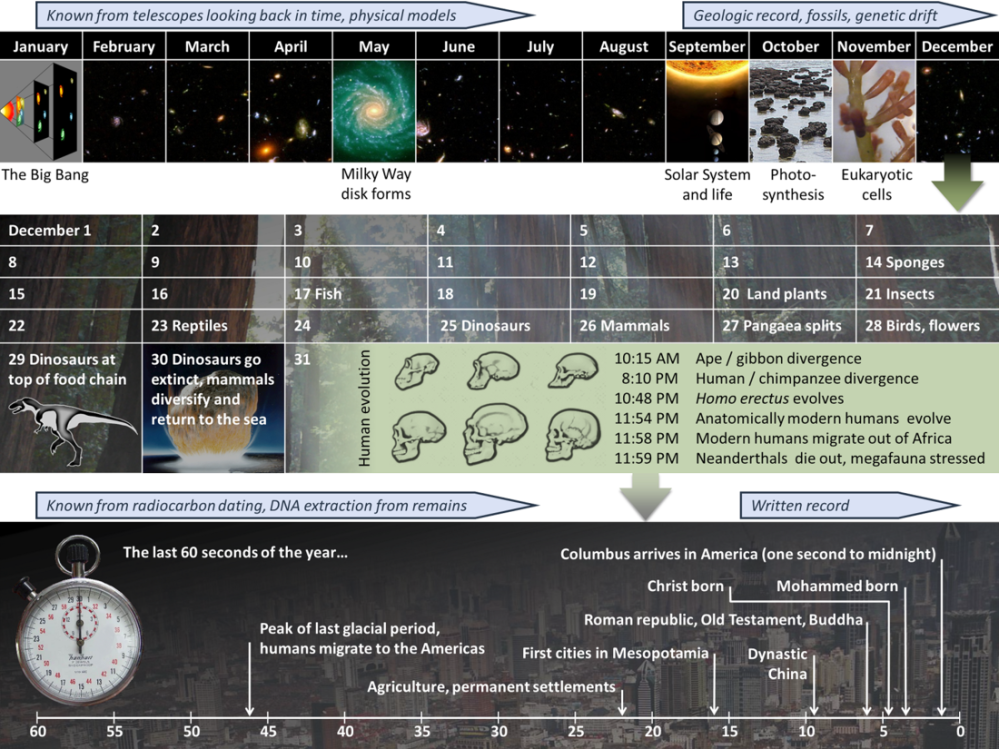
In the novel, In Desert and Wilderness, Henryk Sienkiewicz remarks, “…he began to fear whether in the presence of far greater events, all his acts would not fade into insignificance, just as a drop of rain disappears into the sea.”On the Cosmic Calendar, the average human life span is only about two tenths of a second, transforming my 20 years of life into a mere .05 seconds. On this type of scale, a scale on which the pyramids were build in 11 seconds and dinosaurs were the universe’s Christmas present, it’s rather easy to feel as if one’s .05 seconds are a simple drop of rain in the sea. But as Neil deGrasse Tyson reminds us, we are stardust. That means were are inherently connected and a part of the sprawling, intricate, magnificent universe that has seen the birth and death of stars, the colliding of planets, and the rise of life on Earth. We cannot separate ourselves from the story of the universe, because it is also our story. While my entire life thus far may have occurred in the last .05 seconds before the clock strikes midnight, that means that the rest of my life is the very beginning of a brand new year, one that will encompass another 14-billion years and the remarkable evolution and excitement that may come with it.


Cosmic Calendar
Carl Sagan’s Cosmic Calendar, which puts the roughly 14 billion years of the history of the universe into a single calendar year. 

Posted in Universe | Tagged , , , , | Comments Off on Life as a .05 Second Year-Old