Mayans Predicted the 1991 Solar Eclipse

maya

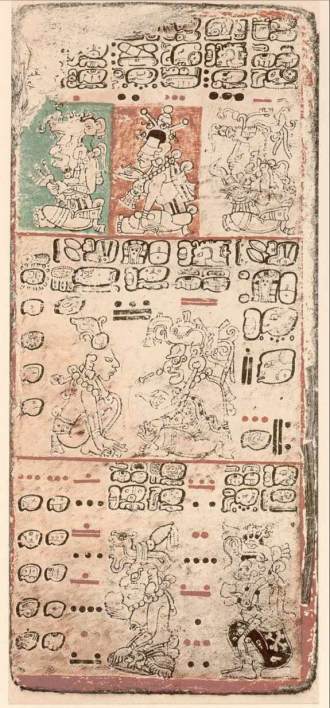
Okay so this picture may look like just a bunch of doodles on a piece of clay, but it actually is hieroglyphs from four ancient Mayan codices that predict with surprising accuracy the 1991 Solar Eclipse. The Mayan astronomers were able to predict within a day, the time of the 1991 solar eclipse. Keep in mind that all of these predictions took place before the 16th century, so that is pretty impressive. The calendar was found to date the eclipse as being either on the 11th or the 12th and however many centuries later in 1991, the eclipse happened on July 12. That’s crazy. It seems like people today tend to assume that all of the stuff we have discovered about the path of the sun and stars has happened in the past couple hundred years, but the people of ancient times were killing it at the astronomy game before we even figured out what electricity was. These guys didn’t have any computers or fancy telescopes, but still managed to figure out when the moon is going to block the sun 500+ years before it actually happens. Serious props to the Mayans.

Check out the picture and article here


Posted in Class, Sun | Tagged , , | Comments Off on Mayans Predicted the 1991 Solar Eclipse

The Speed of Light

The speed of light is very, very fast, almost incomprehensibly fast. It is unusual to think that whenever we see an object, light is bouncing off that object and hitting our eye. We perceive this to be instantaneous, but it actually takes some infinitesimal amount of time for light to travel from nearby objects to our eyes.

However, the case is the same, and yet different when we look at distant objects in space. Light travels at 300 million meters per second. The earth is about 150 billion meters from the sun. Therefore light takes 500 seconds, or eight minutes and 20 seconds, to travel from the sun to the earth. It is strange to think that if the sun were to “go dark” in an instant, the earth would still be receiving light for over eight minutes.

The most distant man-made object from earth is the Voyager 1 spacecraft. The Voyager launched in 1977, and traveled through our solar system using gravitational assists from other planets to achieve escape velocity from our solar system. In 2012, the Voyager crossed the heliopause and entered interstellar space. The voyager still communicates with earth via satellite transmission, which travels at the speed of light. As of 2014, transmissions take 18 hours to go from Voyager back to earth.

When looking at the stars in the night sky, we are looking at light that has been traveling for years! A light year is the distance that light can travel in one year. The nearest star is Proxima Centauri, which is 4.2 light years from earth. Most stars are much, much farther away. Therefore looking at stars is like looking back in time because the light has been traveling for so long!


Posted in Class, Light, Sun | Tagged , , , , , | Comments Off on The Speed of Light

The Speed of Light

The speed of light is very, very fast, almost incomprehensibly fast. It is unusual to think that whenever we see an object, light is bouncing off that object and hitting our eye. We perceive this to be instantaneous, but it actually takes some infinitesimal amount of time for light to travel from nearby objects to our eyes.

However, the case is the same, and yet different when we look at distant objects in space. Light travels at 300 million meters per second. The earth is about 150 billion meters from the sun. Therefore light takes 500 seconds, or eight minutes and 20 seconds, to travel from the sun to the earth. It is strange to think that if the sun were to “go dark” in an instant, the earth would still be receiving light for over eight minutes.

The most distant man-made object from earth is the Voyager 1 spacecraft. The Voyager launched in 1977, and traveled through our solar system using gravitational assists from other planets to achieve escape velocity from our solar system. In 2012, the Voyager crossed the heliopause and entered interstellar space. The voyager still communicates with earth via satellite transmission, which travels at the speed of light. As of 2014, transmissions take 18 hours to go from Voyager back to earth.

When looking at the stars in the night sky, we are looking at light that has been traveling for years! A light year is the distance that light can travel in one year. The nearest star is Proxima Centauri, which is 4.2 light years from earth. Most stars are much, much farther away. Therefore looking at stars is like looking back in time because the light has been traveling for so long!


Posted in Class, Light, Sun | Tagged , , , , , | Comments Off on The Speed of Light

Your Zodiac Sign is Wrong: 3 Misconceptions You Have About the Night-Sky

We all get it. You’re a Capricorn or a Taurus or a Sagittarius or a(n) [any other zodiac constellation]. You’ve read all of your horoscopes, and they fit your personality soooo well. “This is so me,” you might yell to your friends, completely disregarding the fact that they don’t care which vague internet prediction you identify with. Aside from the many (and I mean, many) reasons that your horoscope is meaningless, the zodiac sign that you think is associated with your birthday is probably wrong. Read on to find the correct sign to freak out about as I debunk this and 2 other misconceptions people have about the night-sky.

  1. Your Zodiac Sign is wrong:

Depending on if you like to skip reading the title of blog posts, this fact may surprise you.

For those readers who don’t know, your zodiac sign is supposed to correspond to the constellation that the sun appears in on the day you were born. (This is also why some people call them “sun signs.”) And if you were born on May 12th, your zodiac sign would be the constellation Taurus–about 3,000 years ago.

The constellations shift positions in the night-sky throughout the year as our perceptions change with our orbit around the sun. Because our position around the sun changes, our perceptions of which star system is closest to the sun changes, making it appear as if the constellations are moving from month to month. So this is why we have different zodiac signs to start with. But why was your sign right 3,000 years ago but wrong today?

To get to the actual scientific reason your horoscope just got a little bit more meaningless we have to imagine the Earth’s behavior as it rotates around on its 23.5 degree tilted axis. Just like a spinning top, the Earth precesses as it rotates on its axis. Precession is caused by gravity’s effect on a tilted rotating object, causing it to wobble. Gravity from the sun and the moon tries to pull the Earth away from its tilt and into the ecliptic plane, which is basically just a straight line from the Sun to the Earth. (The ecliptic plane is actually what the Earth is tilted away from.) These gravitational tugs from the Sun and the Moon would work and straighten Earth’s tilt, but the law of conservation of angular momentum keeps it rotating along the same axis. Now that we have the science out of the way, let’s get back to what really matters.
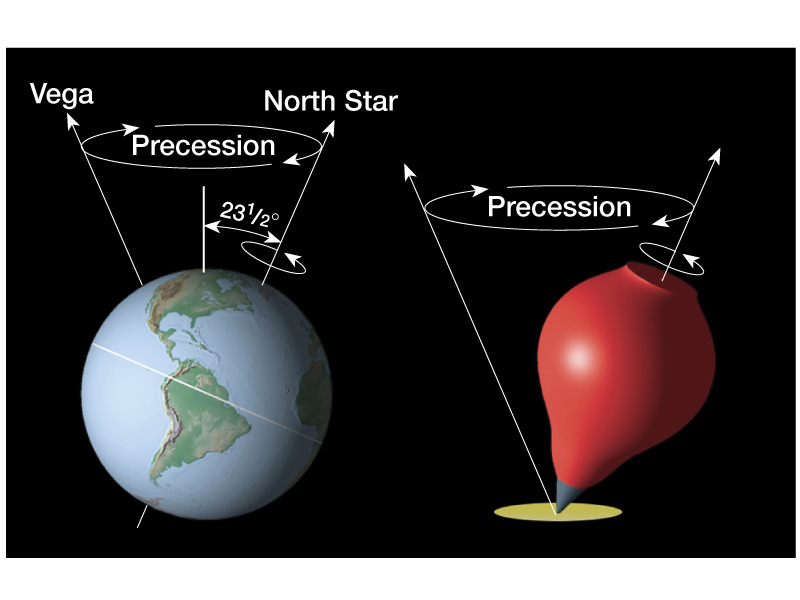
FIG14_006CA diagram showing the Earth’s precession next to the top. It also shows why the North star (Polaris) won’t be the North star forever.

The Earth’s precession is much, much slower than the rate at which it spins, taking about 26,000 years to complete one full rotation. Because the Earth’s perception changes as it precesses, the constellations that the sun appears in also change, similar to the ways in which they change throughout the year, but during a much larger timescale. The Earth’s precession combined with the fact that the Zodiac Astrological signs were devised around 3,000 years ago means that your sign is off by about a month. (Because we are about 1/13th of the way through the precession cycle).

Here is a list (taken from LiveScience.com) of all the zodiac signs with the correct dates (and a brand new sign!). Follow this link to read more on the Earth’s precession and its effect on our night-time view.

Capricorn – Jan 20 to Feb 16
Aquarius – Feb 16 to Mar 11
Pisces – Mar 11 to Apr 18
Aries – Apr 18 to May 13
Taurus – May 13 to Jun 21
Gemini – Jun 21 to Jul 20
Cancer – Jul 20 to Aug 10
Leo – Aug 10 to Sep 16
Virgo – Sep 16 to Oct 30
Libra – Oct 30 to Nov 23
Scorpius – Nov 23 to Nov 29
Ophiuchus – Nov 29 to Dec 17
Sagittarius – Dec 17 to Jan 20

2. The Reason for the Seasons:

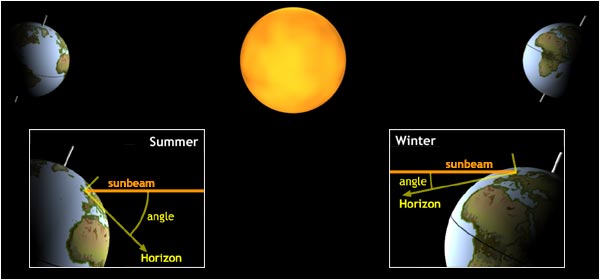
While we’re discussing the tilt of the Earth’s axis, I want to briefly point out another common misconception that many people who snoozed through 4th grade science class have about the seasons. A lot of people think that the seasons are caused by variations in Earth’s distance from the Sun. It makes sense right? The Sun is a big ball of fire (also false, but that’s an entirely different post!), so the farther you get away, the colder you get, and vice versa. While it is true that distance from the Sun affects temperature (why you’ll need some serious sunscreen to visit Mercury and a winter jacket to visit Pluto), the Earth’s distance to the sun is almost circular. And any variation is so small when compared to the overall distance to the Sun that we don’t feel any changes here on Earth.

So if it’s not distance what does cause you to need a jacket in December? If you were paying attention to context clues, you can probably guess: the Earth’s tilt. Because the Earth is tilted on its axis, there variations in the amount of sunlight that each hemisphere receives depending on our position along the orbit. For the same reason that a flashlight shining perpendicular to a wall will appear brighter than if it was shone on an angled surface, the tilt of the Earth affects the strength of sunlight.

The diagram below shows this effect on the Northern hemisphere.
sunbeams6.jpg

When a hemisphere is tilted towards the sun, that hemisphere experiences summer. When it is tilted away from the sun, it will experience winter. This is why the two hemispheres experience opposite seasons from each other, because one hemisphere is always tilted toward the Earth while the other is tilted away. We experience Fall and Spring when the Earth is in such a position that neither hemisphere is tilted toward or away from the Sun.

3. Is the Sun is directly overhead at high noon?

You hear this one all the time. Anytime someone is asked, when is the sky directly overhead in the sky, they answer with, “at noon.” But this a common misconception. The sun does reach its highest altitude at high noon, when it crosses the meridian (but even this is rarely directly at 12:00). Unless you live around the Equator (between 23.5 degrees South and 23.5 degrees North) the sun is never directly overhead.

Have you ever fallen victim to any of these common misconceptions? Want to tell me why horoscopes matter? What other misconceptions have you noticed that people have about space? Leave a comment below.


Posted in Aliens, Class, Dwarf Planets, Exoplanets, Galaxies, General, Historical, Instruments, Jovians, Light, Moons, Observables, Outreach, Physics, Planet Rings, Public Policy, Science, Small SS Objects, SolarSystem, Space Travel, Stars, Sun, Terrestrials, Universe | Tagged , , , , | Comments Off on Your Zodiac Sign is Wrong: 3 Misconceptions You Have About the Night-Sky

The Universal Speed Limit

According to the Special Theory of Relativity, the speed at which light travels is the same in all reference frames.  In other words, you will always observe that light will travel at 2.99*10^8 m/s, regardless of how fast you’re going.  At first, one might think that this number is so high that it would make little difference in how we observe the universe.  In reality, however, cosmic entities are so far apart that we use the distance light travels in a given time frame to describe astronomical distances. Below is a chart that describes the distances, in such units, of familiar objects in space:

Screen Shot 2016-01-26 at 5.15.23 PM.png
Distances between the Earth and other objects in space


Because we use light to observe these distant objects, we see them the way they were in the past.  For example, if we could see Jupiter in the night sky, then we would see how it looked 43 minutes ago.

The speed of light is not only constant, but it is the fastest an object with mass can move.  In fact, it would take an infinite amount of force to accelerate a massive object up to the speed of light.  That is to say, even with our best efforts, it would take us much longer than 4.35 years to get a probe even close to Alpha Centauri.  Moreover, the Special Theory of Relativity says that strange things happen for objects that travel near the speed of light.  For instance, an object moving near the speed of light will appear to age more slowly to us, as an observer at rest; this is called time dilation.  In addition, that same object will appear to be shorter in length; this is called Lorentz Contraction.  A picture below shows what this might look like for a baseball travelling at fractional speeds of light:


Screen Shot 2016-01-26 at 5.36.00 PM
Baseball at different relativistic speeds


These physical rules that define the speed of light make it one of the most interesting things in our universe.

Other sources:

Length Contraction and Time Dilation

Special Theory of Relativity


Posted in Class, Light | Tagged , , , , | Comments Off on The Universal Speed Limit

“Goodnight Nobody, Goodnight Mush”

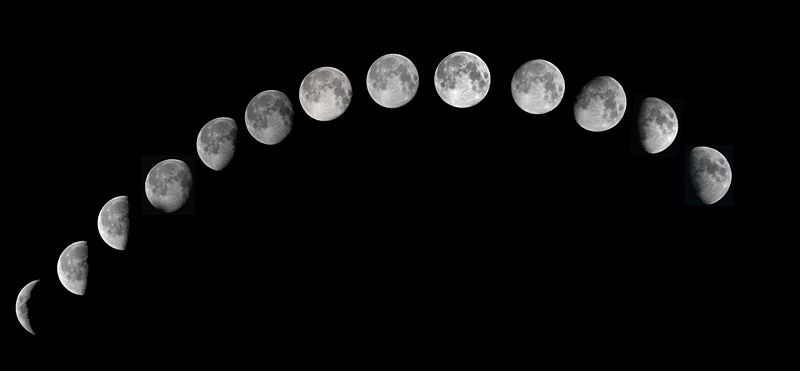
When we think we can’t see the moon, it can definitely see us. This doesn’t just hold true when we’re sleeping. As the children’s book, “Goodnight Moon,” goes, we may say “Goodnight” to the moon – but it’s still there outside our window and outside our atmosphere. Different parts of the moon disappear at different points during the month, and we can observe this even as children.

In elementary school, though, our teachers enlighten us on the process that causes these weird shapes. Sometimes they give us proper explanations. Other times, they don’t. In my personal experience, my teacher didn’t quite get it right. She used a nice display of the Sun, the moon, and the earth. The Sun was actually a round ball that contained a light bulb, with a little hole in the side to allow “sunlight” to escape. The overhead lights went off, and she lit up the earth and moon with our little “Sun”; however, she positioned the earth directly between the Sun and the moon -meticulously casting Earth’s shadow on the moon figure in shapes imitating waxing crescents and quarter moons.

Every night, my seven-year-old self would look at the moon from my bed. I looked at it like I felt bad for it, as if to say, “Goodnight, Moon. Sorry for covering you up.”

800px-Joka2000_-_Moon_in_Dec_2005_(by).jpg
Phases of the Moon

But this isn’t how the moons phases work at all. In fact, the earth is positioned so far away from the moon (a distance of thirty Earth diameters) that it rarely gets the chance to cast a shadow on the moon’s surface. When we see phases, we are actually just seeing the moon illuminated from a different perspective or angle. This is because the moon revolves around Earth, yet it always has a side facing the Sun (an illuminated side).

So, as the moon spins and revolves around Earth, we see it from different angles. Sometimes we get to see more of its (currently) illuminated half. Other times, we see less or none.

Honestly, the moon is just doing its thing.

Unless the earth is exactly positioned between the Sun and the moon, which may only happen every six months, we never cast a shadow on it.

I don’t feel bad anymore – we don’t steal the moon’s spotlight. Even in the rare event that we do (during a lunar eclipse), everyone’s more excited about staying up late to see the moon anyway. Now, going to bed as an enlightened college student, I might say something like, “Goodnight, Moon. Looking especially waxing tonight.”

Feature image from “Acculturated – Pop Culture Matters” (http://acculturated.com/goodnight-stars/)

Posted in Class | Tagged , , , , | Comments Off on “Goodnight Nobody, Goodnight Mush”

You are stronger than the Universe! (Kind of)

Minute Physics: Do We Expand with the Universe?

As you read this post, the universe around you is shooting outwards and stretching off into the unknown at unimaginable speeds! But if that’s true, why cant’t you feel it? In a way it is because you are stronger the the stretching of the universe! Well maybe not you yourself, but the forces that hold you and everything around you together are! While the expansion of the universe is able to haul entire galaxies apart from each other and out into the great beyond, it is too weak to overcome the forces of electromagnetism and gravity (finally, a truly universal glue!). Electromagnetism is the force that holds the atoms inside your body and inside every other piece of matter together. Despite acting on such an incredibly small scale, this electromagnetic force is so strong that not even the ceaseless rush of the universe can break its atomic grip. As for our second force, gravity is all around you; it holds you to the Earth, holds the Earth in orbit around the Sun, and holds our Solar System in orbit around the galaxy. The expansion of the universe is far too weak to overcome this force so instead of casting you, your planet, and your solar system out into the great beyond, the universe settles for the package deal and simply carries your entire galaxy along in its (possibly) never-ending expansion while you remain comparatively still inside of it. It’s like the universe is a highway leading out from a singular point in an infinite number of directions. And you? You are but a passenger being whisked down this universal highway in a crowded carpool of planets and stars we call the Milky Way Galaxy (talk about efficiency!). So for now, thank gravity and electromagnetism for keeping your world together, and enjoy your ride through the universe!


Posted in Class, Universe | Tagged , , , , , , | Comments Off on You are stronger than the Universe! (Kind of)

Blog #2 Observation

Much of what has been covered in class so far has been from the perspective of an observer on Earth. We know that light pollution from cities makes it difficult to see starlight with the naked eye. With that in mind, observatories tend to be far away from city limits. Additionally, they tend to be at high altitudes to avoid weather patterns and near coast lines, avoiding pollutants that passing air might pick up traveling across land. So, why do we even need to launch telescopes into space?

The atmosphere is always in the way.

telescopelocations
Observatory Map from Australia Telescope National Facility

A good majority of incoming radiation that enters the atmosphere doesn’t make it to the ground. Everything but electromagnetic waves in the radio, visible light, and ultraviolet/infrared ranges get absorbed in the upper atmosphere. Also, dust and water vapor in the air scatter even the visible light. If an astronomer is interested in viewing light in other wavelengths, they have to use an orbital telescope such as the Hubble.


Posted in Class | Tagged , , , , | Comments Off on Blog #2 Observation

Solstices & Spirituality


Maya-Summer-Solstice
The Spiritual Sun 

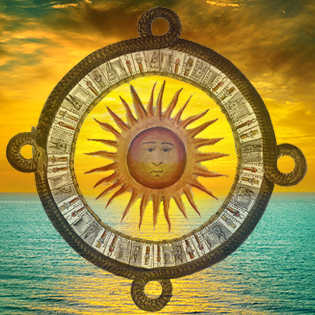
As we’ve learned through our assignments and reading, the spring and fall equinoxes are the times when the Sun appears to cross the equator, causing daytime to be the same length at almost all latitudes. These two days, in addition to the winter and summer solstices, held high significance in ancient spirituality. The adoration of the Sun is seen in a huge variety of ancient cultures, from Egyptian to Mayan to Incan, from Greek to even Christian identities, as it serves as a representation of the path to holiness or enlightenment. This is seen more obviously in the sun gods of ancient religions, but is also present in more modern expressions of religion – for example, the timing of the story of the birth of Jesus Christ at the winter solstice and His rising at the spring equinox. Cultures throughout time and across the Earth have developed (or recognized, depending on one’s point of view) the presence of a greater “Spirit” of sorts, and it’s interesting to see how the natural patterns of the universe have influenced organized religion and thus modern society.

“Thou shinest in the horizon, thou sendest forth thy light into darkness, thou makest the darkness light with thy double plume, and thou floodest the world with light like the Disk at break of day. Thy diadem pierceth heaven and becometh a brother unto the stars, O thou form of every god.” – “Hymn to Osiris”, The Egyptian Book of the Dead


Posted in Historical | Tagged , , , , , | Comments Off on Solstices & Spirituality

Solstices & Spirituality


Maya-Summer-Solstice
The Spiritual Sun 

As we’ve learned through our assignments and reading, the spring and fall equinoxes are the times when the Sun appears to cross the equator, causing daytime to be the same length at almost all latitudes. These two days, in addition to the winter and summer solstices, held high significance in ancient spirituality. The adoration of the Sun is seen in a huge variety of ancient cultures, from Egyptian to Mayan to Incan, from Greek to even Christian identities, as it serves as a representation of the path to holiness or enlightenment. This is seen more obviously in the sun gods of ancient religions, but is also present in more modern expressions of religion – for example, the timing of the story of the birth of Jesus Christ at the winter solstice and His rising at the spring equinox. Cultures throughout time and across the Earth have developed (or recognized, depending on one’s point of view) the presence of a greater “Spirit” of sorts, and it’s interesting to see how the natural patterns of the universe have influenced organized religion and thus modern society.

“Thou shinest in the horizon, thou sendest forth thy light into darkness, thou makest the darkness light with thy double plume, and thou floodest the world with light like the Disk at break of day. Thy diadem pierceth heaven and becometh a brother unto the stars, O thou form of every god.” – “Hymn to Osiris”, The Egyptian Book of the Dead


Posted in Historical | Tagged , , , , | Comments Off on Solstices & Spirituality