Light Travel: The “New” Hyperspace

We’ve read it in our beloved science fiction books. Superheroes and intelligent beings from other worlds harness massive amounts of energy and cross through different dimensions – traveling faster than the speed of light. It’s the kind of thing space-obsessed kids (and adults, alike) dream about. We dedicate movies, like “2001: A Space Odyssey,” directed by Stanley Kubrick, to the very thought of such developed technology.

Stanley Kubrick’s take on Arthur C. Clark’s “The Sentinel”

Yet, is traveling at hyper speeds really the dream? Many of us come into college-level astronomy courses excited to learn about game-changing developments that scientists at NASA or researchers at Caltech somehow, miraculously discover. The reality, however, is that we should really be dreaming about traveling at light speed first.

How boring, right?

Actually, it’s pretty exciting. The speed of light is often referred to as the “speed limit” of the universe. Perhaps our dreaming about hyperspace is attributed to the notion that we see speed limits as suggestions. Light speed? We can go faster than that.

Oh, 300,005 km/s won’t get me pulled over. 

Wrong. This speed limit isn’t a suggestion at all – there’s no exceeding it with our current technology. Light travels through space at 300,000 km/s. That doesn’t necessarily look like an impossible number. Something like 1 million km/s might seem like a stretch to the ordinary citizen. So, let me put it into perspective. The fastest known aircraft on Earth, the SR 71, travels at a measly 1 km/s. A speedy space probe only zooms through space at 50 km/s.

We haven’t come close to breaching even 1/3 of the speed of light. Our “limit,” as far as we know, is currently 6,000 times slower than the universe’s.

If this basic knowledge changes our perspective at all, it may be valuable to look at our other attitudes towards space with new eyes. Why limit ourselves to dwelling on Pluto’s classification as a planet, when there are other objects (Planet 9, for example) to observe excitedly?

Instead of regarding the speed of light as a boring limit to pass up, what if ordinary citizens regarded its sheer speed with wonder? At least this way, in the miraculous event that the human race ever discovers a way to reach light speed, we’d all understand the true weight of such a discovery. Let’s not set ourselves up for disappointment.


Posted in Class, Light | Tagged , , , | Comments Off on Light Travel: The “New” Hyperspace

The Universe Online

This class and lab last semester have taught me how easy it is to examine the sky above us. Previously, I had always thought that learning about space would necessitate daunting instruments and advanced calculations, but technology has allowed normal people to examine the great expanse of space.

Stellarium
EducationWare


Stellarium is by far my favorite program that I have used in my astronomy courses. It is user-friendly and beautifully done. I love working with Stellarium because it makes the difficult task of looking at the spherical sky on a flat plane much easier. The art of the sky is incredibly realistic, which makes it easy to track the motion of the stars, planets, and the Sun. I have found it to be a very helpful resource when visualizing the motion of the objects above us in my astronomy classes.

Time and Date
timeanddate

I have also really enjoyed working with the timeanddate program over the course of last semester and this semester. Like Stellarium, the website is user friendly and provides the user with ample information. The database of the website is vast, which allows users to track the daylight, Solar Noon, and other solar characteristics of almost any place imaginable. It also has ample information from a vast array of dates, so discovering patterns over time is very easily accomplished.

Overall, I have really enjoyed working with the space programs in my astronomy courses because it makes the idea of space manageable and accessible. I hope to find more resources in the future that can provide me with more information about our Solar System and the overall universe.


Posted in Class, Universe | Tagged , , , , | Comments Off on The Universe Online

The Unfathomably Large Universe

Traveling at the speed light, man would reach the moon in one second. Traveling at the speed of light man would reach the outer planets in one year. Not too bad right? Intergalactic travel appears to be practical at light speed right? Wrong. The first and most problematic issue of interstellar travel is that man has yet to discover how to travel at 3.0 x 10^8 m/s (671 million miles per hour). Even if man miraculously discovered a means to travel at light speed, a whole life spent traveling at light speed would not even bring you out of the universe. In fact, to leave the Milky-way it would take 100,000 years. 100,000 YEARS!!  One-hundred thousand years to leave, not explore, just leave one galaxy of the one-hundred billion galaxies. There is just no way to fully comprehend the vastness of the universe let alone explore it.  Trying to wrap your mind around such astronoimical distances is always a surreal experience that forces me to appreciate the miracle of our existence, and our capacity to be aware of the universe that surrounds us and make videos like the one below.

  (The Known Universe by AMNH)


Posted in Class, Universe | Tagged , | Comments Off on The Unfathomably Large Universe

The Cosmic Calendar

cosmic2bcalendar2b10-5x13-52baspect2bratio
From CosmicCalendar.Net

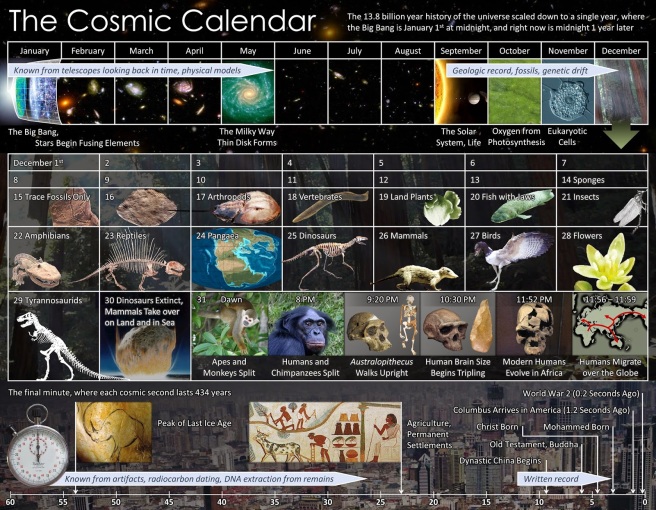
For my first blog, I wanted to discuss the Cosmic Calendar. Often times in our life we think of our lifespans as quite long. Especially when compared to our ancestors of a few hundreds to thousands of years ago, we are long surpassing their lifespans. However, compared to the lifespan of the universe, we are just a tiny speck and I think it is extremely important to remind ourselves of that. Written history only began 12 seconds ago on the cosmic calendar, our lifespan won’t even last a second in the cosmic calendar. Other examples of how long this universe has been around can be found in the picture. The perspective of the cosmic calendar is astonishing because you notice how incredibly not important we are to the entire spectrum. The Big Bang was 13.8 billion years ago so they consider that midnight on January 1st. Every month roughly represents a little over a billion years. Humans weren’t even a thing till December rolled around, December 31st might I add.

I think if anything it’s incredibly important to realize that this universe went through a whole lot before we arrived on the scene. The universe has never and never will revolve around humans. We are just a speck of time on a speck of land in a universe that is ever expanding. I think everyone should realize this as it should be a goal on this earth to make our extremely short time relative to the universe worthwhile and mean something valuable to everyone. The cosmic calendar gives us perspective that nothing else can because there is no single thing that can show us how little of importance we actually are in the grand scheme of this universe. Let’s just leave it a better universe than when we found it, that should be our goal.


Posted in Class, Historical, Universe | Tagged , , | Comments Off on The Cosmic Calendar

Consequences of a Constant Speed of Light

I find it fascinating that what we see in the night sky is an image from the past.  Since nothing moves faster than the speed of light it is impossible to know what is going on at this exact moment on places other than the Earth and the Moon.  Hypothetically, the Sun could suddenly explode but we would have no idea of this event until 8 minutes later, when the light reaches the Earth.

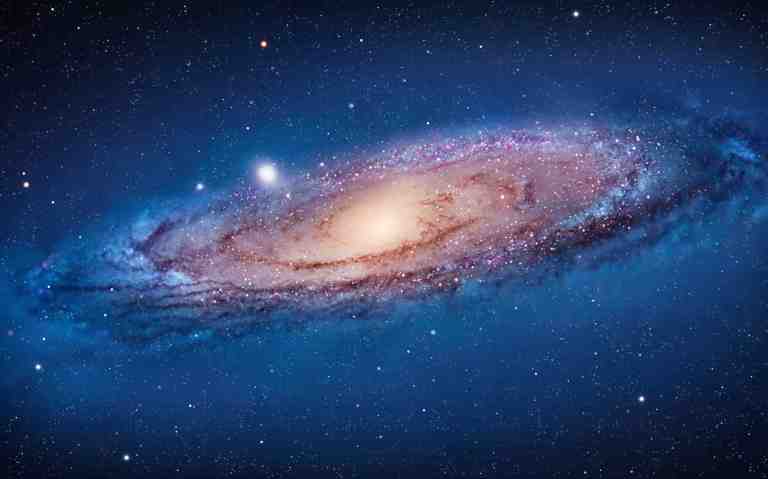
It’s a little strange to think about how images of distant objects such as galaxies are not from a single moment in time.  Most galaxies are not exactly perpendicular to our view and thus what we see as the more distant side of a galaxy is also much older than the closer side.  It had never occurred to me before that something like the Andromeda Galaxy was not from a single moment in time, but thousands of years as light from the far side of the galaxy has to travel a long way to reach the near side of the galaxy.  I like to think of something like Andromeda as a single object in the sky that has an absolute image of what it looks like, similar to the Sun, not as something that could very well lose half of its stars and we would slowly learn this information over the course of hundreds of thousands of years.

andromeda-galaxy
Image of Andromeda is not from a single moment in time. Source = Soulsalight


Posted in Class, Galaxies, Light, Science | Tagged , , , , | Comments Off on Consequences of a Constant Speed of Light

Consequences of a Constant Speed of Light

I find it fascinating that what we see in the night sky is an image from the past.  Since nothing moves faster than the speed of light it is impossible to know what is going on at this exact moment on places other than the Earth and the Moon.  Hypothetically, the Sun could suddenly explode but we would have no idea of this event until 8 minutes later, when the light reaches the Earth.

It’s a little strange to think about how images of distant objects such as galaxies are not from a single moment in time.  Most galaxies are not exactly perpendicular to our view and thus what we see as the more distant side of a galaxy is also much older than the closer side.  It had never occurred to me before that something like the Andromeda Galaxy was not from a single moment in time, but thousands of years as light from the far side of the galaxy has to travel a long way to reach the near side of the galaxy.  I like to think of something like Andromeda as a single object in the sky that has an absolute image of what it looks like, similar to the Sun, not as something that could very well lose half of its stars and we would slowly learn this information over the course of hundreds of thousands of years.

andromeda-galaxy
Image of Andromeda is not from a single moment in time. Source = Soulsalight


Posted in Class, Galaxies, Light, Science | Tagged , , , , | Comments Off on Consequences of a Constant Speed of Light

Lightspeed, Cosmic speedlimits, and Looking into the Past (Part 1)

In my last post, I made it a point to say that I would try to keep my blog interesting.

In light of that decision (I didn’t even notice this pun until I already had this entire post typed up, so this one’s not on me), and because the winter makes me long for the sun, I decided to make a two-part post on all things light-related. Light-speed, light-years, observational time travel. It’s all here! (Or it will be when part 2 rolls around, this post is gonna cover the former two topics.)

Hyperspace

Hopefully after you’re done with this post, you’ll think light-speed is a little bit more than the speed that Hans Solo and Chewie blast through space at.

Wow, you’re surely thinking, your brain taken aback after reading the information it’s going to learn, it would take me a light-year of studying to understand all of this sciency stuff. But hold it right there! Not only are you wrong in thinking that you’re not smart enough to learn about astronomy, you’ve just committed a huge astro-sin. Even though the name could fool anyone, a light-year is not a measurement of time. (It’s also not a last name, no matter how much Buzz LightYear argues otherwise.) A light-year is actually a measure of distance, specifically, the distance that light can travel in a year. How far can light travel in a year? 9.4605284 x 10¹² kilometers.

That is an absolutely astronomical distance, so let’s examine it in a unit that will make us feel like an astronomer. One astronomical unit (AU) is about the distance that Earth orbits from the sun (about 150 million kilometers). An AU is an outstanding distance, but one light-year is about 63,240 of them. How fast does light have to travel to cover this distance?

Fast. Like “close to 300,000 meters per second” fast. To put that into perspective, many scientists (Albert Einstein included!) think that the speed of light could be the actual speed limit of our universe. The speed of light is constant (at least in the dark vacuum of space–it can actually slow down based on the material it’s passing through, but that’s for someone far smarter than me to explain). It doesn’t matter if the light is moving toward or away from you, it will always travel a cool 300,000 meters a second. 

main-qimg-a0043dc4bc6c68c9600ef8c953a1f931

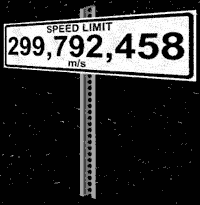
Pictured above: an actual, legally-binding galactic road sign.

As an added bonus, here’s a video of another person smarter than me letting you know why humanity doesn’t have to worry about getting a galactic speeding ticket anytime soon. (Hint: it has something to do with our fastest object going a measly 0.023% the speed of light).

Do you think human’s will ever break the light-speed limit? Have you been using “light-year” hopelessly wrong? Want to tell me that you hate space puns? Leave a comment below.


Posted in Light, Physics | Tagged , , , , | Comments Off on Lightspeed, Cosmic speedlimits, and Looking into the Past (Part 1)

Ancient Astronomers and the Zodiac

zodiac


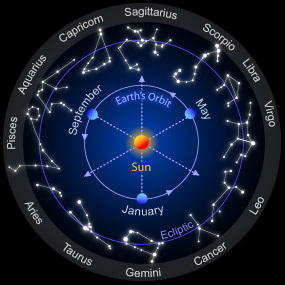
We’ve learned that the zodiac constellations are connected to the position of the Sun as it moves along its path. The sun spends about a month closest to each of these constellations, or “in” the constellation, and then moves on to the next. Ancient Greek and Babylonian people groups named the constellations and defined the term zodiac, meaning “circle of animals.” The zodiac is documented to have been referenced by the Babylonians and Armenians, and is also referenced in the Bible. There exist both a Hindu and a Chinese zodiac.

Ancient people connected the knowledge that gained from studying the stars to their own personal lives on Earth. They developed astrology in order to attempt to assign meaning to the lives of individuals based on their birth month and which constellation the Sun was in at that time. It is preposterous of course to assume any knowledge about personality based on the movement of the stars. However, these ancient people should still be applauded for using the knowledge and resources they had to learn about the way the Sun moves in relation to the stars throughout the year.

Even in our modern day, humans are still fascinated by the idea that the stars can predict our fate. We read about star-crossed lovers in Romeo and Juliet and some of us choose to believe that our love lives could be influenced by the movement of the stars. I personally do not believe in zodiac signs in terms of their influence on my life, but it is very interesting to learn how they are assigned to the path of the Sun and how they can be useful in orienting oneself throughout the year.

Check out this article explaining the history of the Zodiac.

So, do you read your horoscope? What are your beliefs on the constellations and their potential relation to our lives?


Posted in Class | Tagged , , , , , , | Comments Off on Ancient Astronomers and the Zodiac

Ancient Astronomers and the Zodiac

zodiac


We’ve learned that the zodiac constellations are connected to the position of the Sun as it moves along its path. The sun spends about a month closest to each of these constellations, or “in” the constellation, and then moves on to the next. Ancient Greek and Babylonian people groups named the constellations and defined the term zodiac, meaning “circle of animals.” The zodiac is documented to have been referenced by the Babylonians and Armenians, and is also referenced in the Bible. There exist both a Hindu and a Chinese zodiac.

Ancient people connected the knowledge that gained from studying the stars to their own personal lives on Earth. They developed astrology in order to attempt to assign meaning to the lives of individuals based on their birth month and which constellation the Sun was in at that time. It is preposterous of course to assume any knowledge about personality based on the movement of the stars. However, these ancient people should still be applauded for using the knowledge and resources they had to learn about the way the Sun moves in relation to the stars throughout the year.

Even in our modern day, humans are still fascinated by the idea that the stars can predict our fate. We read about star-crossed lovers in Romeo and Juliet and some of us choose to believe that our love lives could be influenced by the movement of the stars. I personally do not believe in zodiac signs in terms of their influence on my life, but it is very interesting to learn how they are assigned to the path of the Sun and how they can be useful in orienting oneself throughout the year.

Check out this article explaining the history of the Zodiac.

So, do you read your horoscope? What are your beliefs on the constellations and their potential relation to our lives?


Posted in Class | Tagged , , , , , , | Comments Off on Ancient Astronomers and the Zodiac

Blog #2

The topic of zodiac signs and how they the constellations and the ecliptic is fascinating to me. Humans have recognized the appearance of certain constellations behind the sun throughout a large part of history. Of course, the true cause of the changing zodiac signs is that the earth’s position changes relative to the sun and certain constellations move into position “behind” the sun. Back when humans believed that the sun revolved around the earth, they might have thought that the sun actually changed position to be in front of different constellations, but now we know the truth. I find it interesting that a different constellation is clearly behind the sun for each of the different months and that the constellation opposite to the current zodiac sign is the one that is currently brightest in the night sky. The whole structure of the zodiac ecliptic is really interesting because it seems to have been another thing in the universe that was made to be noticed by humans. There are so many different things in astronomy that we have personalized to our own culture throughout time because it’s so easy to do so. This may lead some to believe that the universe was made for humans. Even though we’ve long abandoned the belief that the universe literally revolves around us, it’s easy to think sometimes that it was created for our particularly advanced form of life to enjoy and explore. The art of studying different constellations and naming them based on our current mythology started with the Greeks and Romans, who named the constellations after their different mythological figures. The correlation of zodiac signs to personality traits might be clearly invalidated, but the idea that we can relate to things in the sky on a personal level is not. The image below shows the different zodiac signs and their relationship to the ecliptic (Zodiac sign constellations)r412726_1952222


Posted in Class | Tagged , , , | Comments Off on Blog #2