No Need to Feel Small

imax

The Powers of Ten video, originally made in 1977 by Charles and Ray Eames, is a stunning look into not only the unimaginable vastness of the universe, but also the depth of biological life itself. The video takes away the anxiety of being a very small human in a very large universe by presenting the perspective that life extends infinitely outward at the same time that it extends so far inward. We are small compared to the universe, but enormous compared to the particles that make up our physical bodies, allowing for our very existence. It is a beautiful thing to realize that exploring the universe is not about feeling small and insignificant, but rather uniquely bestowed with the gift of life in all its glorious detail.

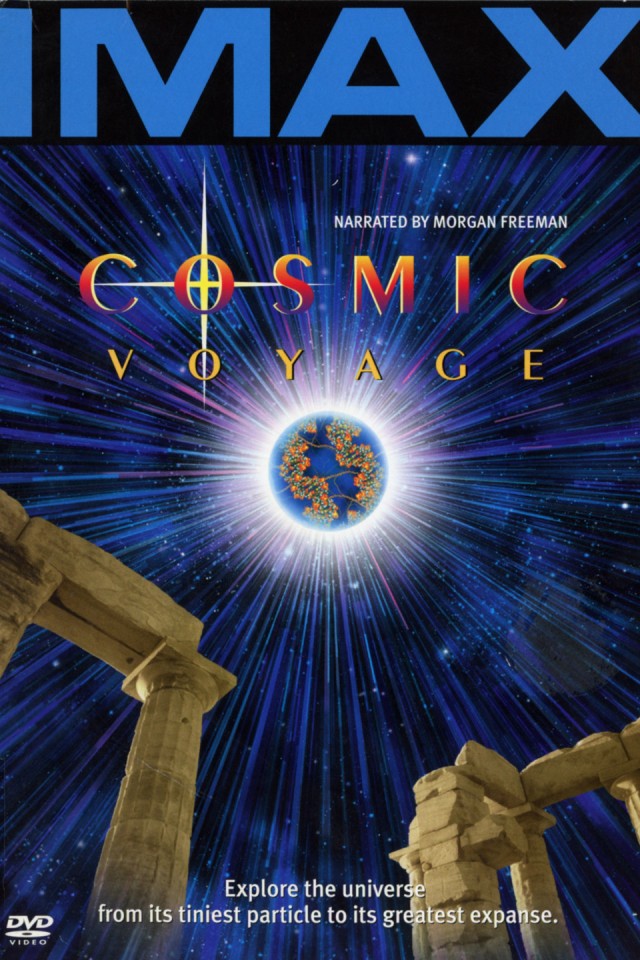
In 1996, the Powers of Ten video was redone as part of an IMAX film called Cosmic Voyage, narrated by Morgan Freeman. The premise is exactly the same, starting with one small child and his hula hoop and expanding outward and then inward by powers of ten. It is truly amazing to know that the universe has not fully been discovered, and our understanding of it ends with the observable universe. There is mystery beyond what we know. The same is true for smaller particles within us. Quarks may contain even smaller particles, just as there may be more beyond our observable universe. It makes one feel as though everything is infinite, both outward and inward, and so there is no reason to worry. There is much so much left to discover!

Check out the Morgan Freeman version here:

Updated Powers of Ten Video

Posted in Class, Science, Universe | Tagged , , , , | Comments Off on No Need to Feel Small

No Need to Feel Small

imax

The Powers of Ten video, originally made in 1977 by Charles and Ray Eames, is a stunning look into not only the unimaginable vastness of the universe, but also the depth of biological life itself. The video takes away the anxiety of being a very small human in a very large universe by presenting the perspective that life extends infinitely outward at the same time that it extends so far inward. We are small compared to the universe, but enormous compared to the particles that make up our physical bodies, allowing for our very existence. It is a beautiful thing to realize that exploring the universe is not about feeling small and insignificant, but rather uniquely bestowed with the gift of life in all its glorious detail.

In 1996, the Powers of Ten video was redone as part of an IMAX film called Cosmic Voyage, narrated by Morgan Freeman. The premise is exactly the same, starting with one small child and his hula hoop and expanding outward and then inward by powers of ten. It is truly amazing to know that the universe has not fully been discovered, and our understanding of it ends with the observable universe. There is mystery beyond what we know. The same is true for smaller particles within us. Quarks may contain even smaller particles, just as there may be more beyond our observable universe. It makes one feel as though everything is infinite, both outward and inward, and so there is no reason to worry. There is much so much left to discover!

Check out the Morgan Freeman version here:

Updated Powers of Ten Video


Posted in Class, Science, Universe | Tagged , , , , | Comments Off on No Need to Feel Small

The Speed Limit of the Universe

58,536 km/h. That’s the speed of the fastest ever man-made vehicle: the New Horizons space probe. Though this may seem like an unfathomable feat to the layperson, there’s something that can travel even faster than that by five orders of magnitude.

Light is the current “speed limit of the universe.” It travels at 3 x 10 m/s or 1 x 10⁹ km/hr. The New Horizons—though it has surpassed the speed of sound—comes nowhere near the speed of light. But even though it may seem like such an astronomical (no pun intended) concept, light speed taken in the context of the universe is suddenly much easier to swallow. Light takes 8 minutes and 20 seconds to travel from the sun to the Earth. It might seem like an instant to us, but in reality the sun’s light reaches our planet in the time it takes to bake a batch of cookies. Another way to put the speed of light into perspective is to use it to measure distances in light years (the distance light covers in a year). Our galaxy, the milky way, is 100,000 light years from end-to-end. The distance from here to the nearest star other than the sun, Proxima Centauri, is 4.37 light years. And finally, the distance from the milky way to its nearest galaxy Andromeda is a whopping 2.5 million light years. This distance only spans the width between two neighboring galaxies. Considering the hundred billion+ other galaxies in the universe, this number seems minuscule, which shows just how infinitesimally small our earthly concepts of measurement are in the grand scheme of things.  Your daily commute to school or work doesn’t seem so long now, does it?

speedoflight_54634c728ea75_w1500
Conceptualizing the speed of light source: visually

Posted in Class, Light, Universe | Tagged , , , | Comments Off on The Speed Limit of the Universe

Blog #1

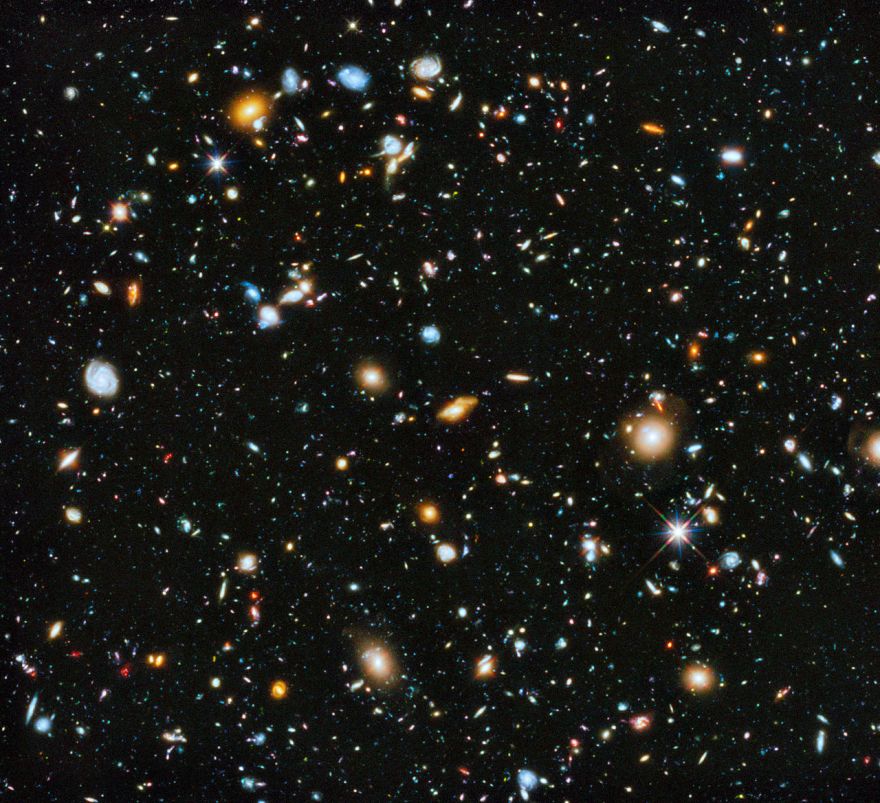
For my first blog, I will write about the size and scale of the universe and what that might mean from a human and space travel perspective. Our galaxy, the Milky Way, is about 100,000 light years across. The nearest major galaxy, Andromeda, is 2.5 million light years away. The limit of direct space exploration for humans, therefore, seems to be the confines of the Solar System. The New Horizons probe managed to reach Pluto, and it seems that humans may have a chance to reach Mars in the near future. But, clearly, none of our ships will ever even come close to the speed of light, and even if they did, we wouldn’t be able to make a major dent in exploring the rest of the observable universe. Without the theoretical possibility of a wormhole, which seems more like science fiction than reality, we have a very limited frontier that we can actually explore. I suppose this fact could be taken in one of two ways. We could resign ourselves to the fact that we will never complete our exploration of space as we did with the frontiers of land and water on our own planet. We could see the study of astronomy as futile, and we could limit our view to what happens on earth. Or we could use the knowledge of our inability to grasp or see the vast majority of our universe as comforting and inspiring–and perhaps suggestive of some outside force that may have had a hand in its creation. With this view, we could keep making small progress at understanding as much of the universe as possible and keep expanding our minds. This is the view that scientists like Tyson would suggest, and I would have to agree with it. There are about 10,000 galaxies in the Hubble Ultra Deep Field shown below. (Wiki Hubble Ultra Deep Field)NASA-HS201427a-HubbleUltraDeepField2014-20140603


Posted in Class, Space Travel, Universe | Tagged , | Comments Off on Blog #1

Common Misconception: The Earth’s Tilt At An Equinox

3002629
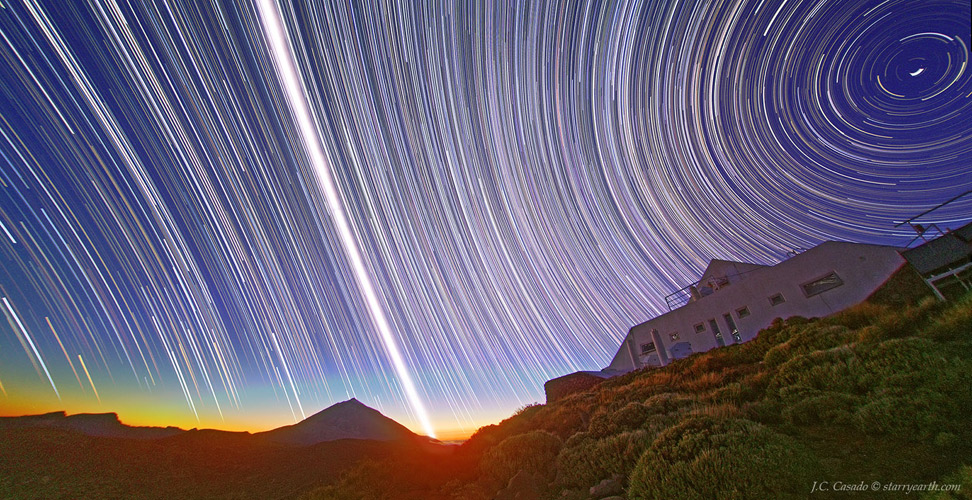
“Equinox Trails” by Juan Carlos Casado Taken on the Canary Islands during the 2010 Spring Equinox
earth on a straight axis   Google Search
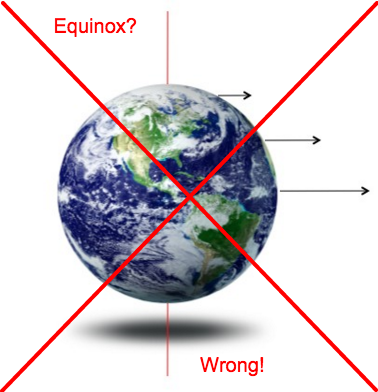
Courtesy of The Physicist (edited by Andy Kistler). Note: The Physicist did not believe the world rotates on a vertical axis.

Upon visiting Dr. Grundstrom with a homework, I caught myself making a pretty silly error regarding the Earth’s Equinoxes. Looking at one of the homework questions for the seasons, I was asked to rank the order of several globes in order of how much daylight they received. One of the globes stood straight up, rotating on a perfectly vertical axis.

“How much daylight does would you get at this location on this planet?” Dr. G asked.

“12 hours,” I answered correctly, “because Earth is in Equinox.” I cringed a little bit, realizing my mistake. The Earth has two Equinoxes, and yet the planet never stands straight up on its axis. Our planet constantly rotates around an axis with a tilt of about 23.5 degrees (with minor variation), and the reason Earth experiences a Spring and Fall Equinox is because of the Earth’s position in its tilt relative to the Sun.

equinox
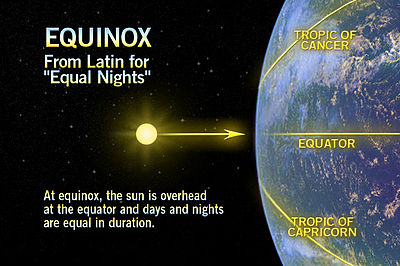
Courtesy of Cat Scouts

As the illustration shows, an Equinox occurs when the Sun is positioned over Earth’s Equator. During an Equinox, there is an even distribution of sunlight across both Northern and Southern Hemispheres, resulting in equal day and night for both. Although the planet in my homework assignment was constantly in a state of Equinox because of its tilt, because Earth rotates on an angled axis, the planet only experiences an Equinox two times out of the year (kind of like a clock is only a certain time twice a day).


Posted in Class, Observables | Tagged , , , | Comments Off on Common Misconception: The Earth’s Tilt At An Equinox

Solar Eclipse

eclipse

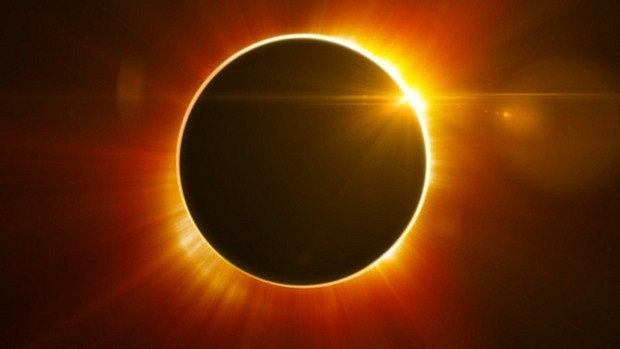
A total solar eclipse. Source: SoftPedia

There are two types of eclipses, lunar and solar, but I’d like to talk about the latter. Solar eclipses can be broken down into four subtypes: total, partial, annular and hybrid. In order for any of these to happen, the Sun, Moon and Earth must form a straight–or almost straight– line. A total eclipse is pictured above, and is when the Moon blocks the entire sun, though one could argue that this is actually an annular eclipse, where the Moon blocks most of the Sun but a ring, or annulus, of the Sun is still visible. Partial eclipses are when the Moon, partially, blocks the Sun and hybrid eclipses are combinations of 2 of these types, where the Moon partially and then either totally or annular-ly blocks the Sub.

These eclipses happen due to chance. The first is the huge coincidence that the Sun is about 400 times the size of the Moon, and is also about 400 times further than it, relative to Earth. Because of this, the Sun and Moon appear to be roughly the same size in the sky. The Moon also has to be at one of its nodes for this phenomenon to occur. The Moon’s nodes are where it crosses the ecliptic as it orbits the Earth, which makes sense, because the Moon has to be between the Sun and Earth to block the Sun’s light from reaching us here. Now, in order to have a total solar eclipse, the Moon must be at or very near the perigee of its orbit, which is where it is closest to Earth. If the Moon is not at or near the perigee, it appears slightly smaller in the sky and we would be left with an annular eclipse, as opposed to the total eclipse.


Posted in Sun | Tagged , , , | Comments Off on Solar Eclipse

The Vast Size and Scale of the Universe

8_Observable_Universe_(ELitU).png

Image Source

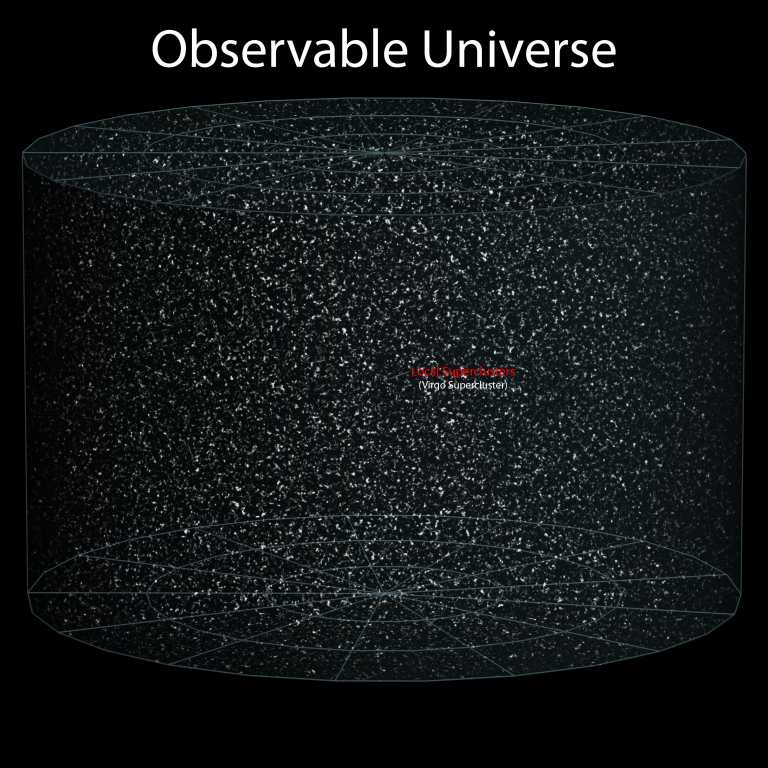
The universe is so massive that it is difficult to grasp a sense of scale. In the image above, you can see what astrophysicists call the “observable universe.” This is unique to the entire universe because it excludes the parts of space that are so far away that their light has not had time to reach us since the Big Bang. If this is true, then that means our observable universe is constantly (although slowly) expanding. Furthermore, every point in space should have its own “observable universe.” If this is also true, then this begs the question of whether or not a human mind can possibly conceive how large the universe might be.

We can try. We can use interactive tools to conduct comparative analysis and math to try to quantify the diameter, mass, and volume of our observable universe. However, if the observable universe is constantly expanding, then it will be less and less likely as time goes on for our minds to understand its size. What do you think? Could a human mind possibly grasp the size of our observable universe? What about the rest of the universe that we can’t actually see yet? Leave your thoughts in the comment section.


Posted in Class, Universe | Tagged , , , , , | Comments Off on The Vast Size and Scale of the Universe

One Long Trip

When we look up at the sky during the night, it can feel comforting that instead of being surrounded by darkness, we see the bright twinkles of stars all around us. Though this might make us feel like we are not simply on a rocky planet hurtling through space far from everything else, this is not the case.

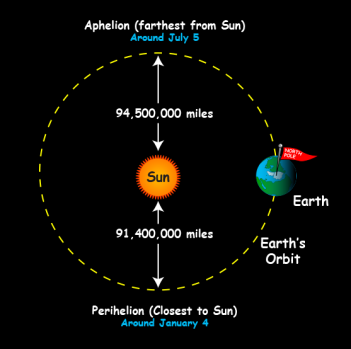
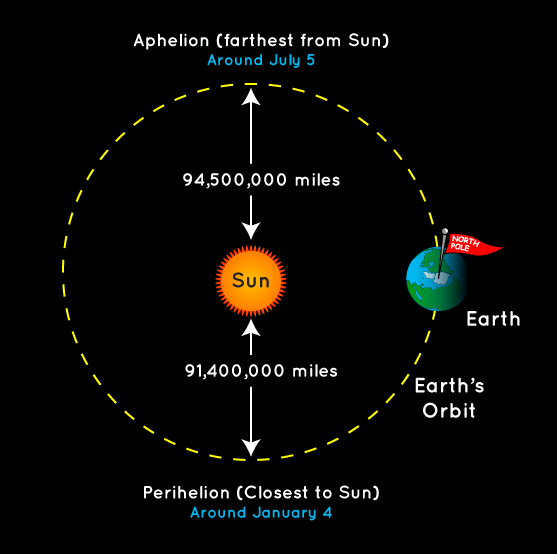
Even the distance to our own Sun is quite astonishing. In fact, it takes light a full eight minutes to get from the Sun to the Earth. This is equivalent to roughly 93 million miles. Even with the fastest rocket ever launched, it would still take about 156 days to get to the Sun. Even the very thing that supports life on Earth takes about half a year to get to while traveling at the fastest speed humans have ever obtained!

aphelion-perihelion-lrg.png

(Earth’s orbit and distance from the Sun)

In the scheme of things, though, the Sun is extremely close. If we wanted to travel to the next closest star, Alpha Centauri B, it would take 4.3 years even if we somehow managed to build a rocket that travels extremely close to light speed. If we were to use the fastest rocket we have ever actually built, though, the trip would take about 6,310 years. The distance we must cover to get to even the closest star system to us is almost incomprehensible to fathom. What’s even more remarkable is that in the scheme of things, Alpha Centauri is actually extremely close to us, considering that our own galaxy (which is one of roughly 10 billion) is over 100 million light years wide.

Will it ever be possible for humans to truly understand these massive distances?


Posted in Class, Light, Stars | Tagged , , , , , | Comments Off on One Long Trip

Precession of Earth

I think one of the most interesting topics in Chapter 2 of the Astronomy textbook is about the concept of precession, or the gradual change in the rotational axis of Earth. The direction of Earth’s axis rotates on a 26,000 year cycle. That may mean next to nothing to us in our lifespan, but precession will gradually flip the orientation of the Earth’s axis in 13,000 years, resulting most notably in a reversal of seasons. It can be thought about as a rotating spinning top (as Dr. G showed us in class). This video below also highlights how one might perceive precession in a slower manner than a spinning top.

In the video, it shows that precession is a result of the unequal distribution of Earth’s mass along the equator of Earth (the “equatorial bulge”, so to speak). This causes an external torque from the gravitational forces of the Sun and Moon, which together result in precession.

earth-axial-precession
Currently, the Earth is positioned to point close to Polaris, but in 13,000 years, it will point towards Vega. Source

Because the Earth is gradually precessing, the stars and constellations that it points to also gradually change. As shown in the picture above, Polaris is currently known as the North Star, but in 13,000 years, Vega will be the new “North Star”. While we don’t generally use stars as navigation anymore, it’s interesting to think that 13,000 years ago, humans would have had completely different reference points for North and South than they would now.


Posted in Terrestrials | Tagged , , , , , | Comments Off on Precession of Earth

The Cosmic Calendar

Imgur
Imgur

We, as humans, can have difficulty understanding amounts that exceed our narrow perspective. To aid us in understanding the 14 billion years that the universe has existed and the minuscule amount of time humans have inhabited it, scientists have put it in our terms of one year. Each month of the “cosmic calendar” represents roughly 1 million years, which allows us to comprehend the development of the universe. The beginning of the universe, the Big Bang, in this analogy occurred at midnight on January 1st, and our Milky Way galaxy did not form until around February. From there, very little happened that pertained to humans until our equivalent of September (4 and a half billion years ago in reality), when our solar system was formed. By late September, early life on Earth had begun to flourish, and until December, the organisms on Earth were microscopic and primitive. Life recognizable to us did not appear on the scene until mid-December and thus has only been around for a very short period of time in comparison to the age of the universe. The dinosaurs appeared and disappeared yesterday on the cosmic calendar, but in reality, it was 65 million years ago. The early hominids didn’t appear on the cosmic calendar until 9 PM on New Year’s Eve, and the entire ancestry of humans has occurred in the last 30 seconds on that scale. While nearly impossible to fathom, our existence in the span of the universe has been merely a few seconds. The use of the comic calendar helps to show how much has happened within the lifespan of the universe, and it shows us how much further we can go.


Posted in Class, Historical, Universe | Tagged , , , , | Comments Off on The Cosmic Calendar