Every morning the sun rises on the Eastern horizon, and every evening the sun sets in the West. I have seen approximately 7800 of these sunrises and sunsets over the course of my life. Every night I go to bed in the dark, and every morning I wake up to a (hopefully) sunny day.
My experiences, however common they may be for the majority of the Earth’s population, are not the only reality. For people who call somewhere north of the Arctic Circle home (no one permanently resides inside of the Antarctic circle), the sun does not always rise and set each day.
Midnight sun occurs in the summer months in locations north of the Arctic Circle or south of the Antarctic Circle. This phenomenon occurs because of the tilt to Earth’s axis. Around the summer solstice (June in the northern hemisphere and December in the southern hemisphere) the sun is visible for a full 24 hours. At the polar circles, the duration of midnight sun lasts for one day. However, as one moves closer to the poles, the number of days that experience midnight sun increases. At the poles, the sun rises and sets only once each year. During the 6 months that the sun is above the horizon, it continuously spiraled around the sky, reaching its zenith on the summer solstice.
Here is a video produced by MIT that helps explain the concept further.
Would you like living with six months of darkness followed by six months of light? Or do you prefer the daily rising and setting of the sun?
Every morning the sun rises on the Eastern horizon, and every evening the sun sets in the West. I have seen approximately 7800 of these sunrises and sunsets over the course of my life. Every night I go to bed in the dark, and every morning I wake up to a (hopefully) sunny day.
My experiences, however common they may be for the majority of the Earth’s population, are not the only reality. For people who call somewhere north of the Arctic Circle home (no one permanently resides inside of the Antarctic circle), the sun does not always rise and set each day.
Midnight sun occurs in the summer months in locations north of the Arctic Circle or south of the Antarctic Circle. This phenomenon occurs because of the tilt to Earth’s axis. Around the summer solstice (June in the northern hemisphere and December in the southern hemisphere) the sun is visible for a full 24 hours. At the polar circles, the duration of midnight sun lasts for one day. However, as one moves closer to the poles, the number of days that experience midnight sun increases. At the poles, the sun rises and sets only once each year. During the 6 months that the sun is above the horizon, it continuously spiraled around the sky, reaching its zenith on the summer solstice.
Here is a video produced by MIT that helps explain the concept further.
Would you like living with six months of darkness followed by six months of light? Or do you prefer the daily rising and setting of the sun?
If there is one thing that I have learned so far in the Solar System, it’s that the universe is really big. Just for light to travel from one end of the Milky Way galaxy to the other takes 100,000 light years, and this distance is short compared to the universe itself! Additionally, since light is the speed limit of the universe, the vastness of space creates major limitations on the future of space exploration.
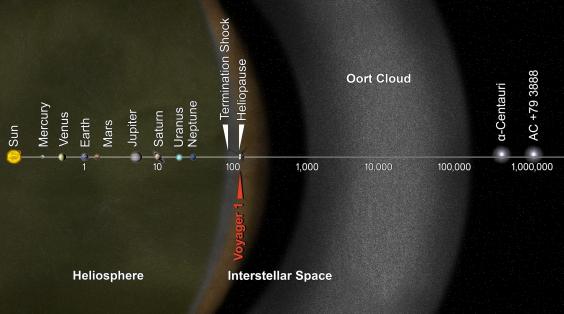
The current location of Voyager 1, the farthest a spacecraft has ever gone. Note that these distances are logarithmic. Source
As far as unmanned space travel goes, Voyager 1 was the first (and only) spacecraft to make it into interstellar space. Granted, that was after 36 years of travel. According to an article by National Geographic, NASA is hoping to send humans to the moon again by 2020, with the hopes of even going further to Mars. But, as we’ve learned in class, this distance is nothing compared to the universe itself. Is there even a hope for human interstellar space travel?
At the present, it seems like probably not. Not only is human space travel rife with controversy (as an example, my parents are aerospace engineers and are very much against putting humans in space, for reasons such as the high amount of risk and enormous cost associated with it), but space is so big that it would be impossible to travel such huge distances in any sort of timely manner (unless, of course, a convenient Interstellar-esque wormhole suddenly appeared in our immediate vicinity).
The Earth is like the top from Inception. As it spins around at very high speeds it wobbles or “precesses” back and forth as the force of gravity from the Moon and Sun tug it from different directions, but it will never fall over. This movement, although much slower and less noticeable than the Earth’s orbit and rotation, can have massive impacts on the planet in the long run.
None of us alive today will be around to experience any of the changes, but if we managed to live 13,000 years a lot of information regarding constellations and weather will have changed. The precession cycle takes about 26,000 Earth years to complete, so in 13,000 years the Earth will be tilted the opposite direction that it is today, but at the same angle. This will result in some very interesting changes. Thestar Polaris will no longer distinguish the North Pole, as the “North Star” will now be Vega. The constellations that we see today will also be changed, as the Northern hemisphere will now be tilted downwards when it previously was tilted upwards and vice versa. Probably the most significant difference will be the shifts in seasons that will occur globally. Today, in Nashville, TN, we know that summer occurs during the months of June, July, and August. In 13,000 years, those months will be right in the middle of winter. The opposite goes for the Southern hemisphere. This is because the Earth will be tilted away from the Sun during those months, where as in 2016 it is tilted towards the Sun. Humans, if they even still exist in 13,000 years, will need to come up with some clever ideas to fix the calendar system when this time rolls around.
The effects of aberration and the Doppler Effect. Source: Comic Vine
During one of the first class sessions, we were given a minute or so to write down what would happen if the speed of light was only 100 mph. I’d never really thought about this before, so I struggled to get anything more than “The light from the Sun would take forever to reach us” and “it would be cold”, so I figured this would be a good time to tweak the question and ask “What would happen if we traveled at the speed of light?”
There are a couple of really strange consequences that would occur if you were to travel at the universal speed limit. The first is called time dilation, where time moves slower for someone moving at higher speeds. Let’s say you moved at 90% the speed of light, your watch would show 10 minutes have passed but to an outside observer, 20 minutes have actually gone by. The next two consequences will distort your vision, and you’ll see something like the image above. The first cause behind this vision change is due to aberration, which is where you would essentially get tunnel vision. This view occurs because the photons around you all appear to be coming from in front of you, even any behind you. I believe this makes sense because these massless photons move at the speed of light and if you traveled faster than them, in the split second you saw them, they would appear as a streak in your view. I imagine this as someone moving during a series of photos, where they’re blurred in each. The other vision-changer is the Doppler Effect, which causes the light from everything in front of you to bunch together and appear blue, as show in the picture. All the light behind you would actually spread out and appear red. If your speed were to continue increasing, the light would appear to shift out of your view and fade into the darkness.
Now, this is actually impossible because of Einstein’s equation E=MC^2, where energy and mass are the same thing. Since E and M are the same, you can conclude that the faster an object goes, the more mass it will have (and this of course only happens at realllllly high speeds). So if an object were to travel at the speed of light, it would have infinite mass and you would need an infinite amount of energy to actually move that object, which is sadly why this is impossible, for now.
I got this information from a good piece at How Science Works, that explained this topic very well.
Many sci-fi books, shows and movies incorporate the idea of faster-than-light (FTL) travel. The first appearance of the term “warp-drive” was in John W. Campbell’s novel Islands of Space (all the way back in 1931), but the accepted value of the Speed of Light (c) had only been discovered 51 years earlier (in 1879). That is not to say that people had not thought about or attempted to measure this limit. Aristotle argued with Empedocles about the speed of light in the first known discourse on the subject (and as with many of his ideas about physics, Aristotle was wrong-he thought light traveled instantaneously).
Even as early as Galileo, people were attempting experiments to measure the speed of light- usually these experiments failed because they were carried out at distances that were too small to be able to detect any differences.
Finally, Albert Michelson (a former Navy Officer) came up with the accepted speed of light after his experiment with Edward W. Morley proved that there was no aether to cause drag.
It is hard to imagine the actual scale of the universe from a human perspective. Humans have personally witnessed the vastness of space only as far as the Moon and Earth orbit (International Space Station, as one vehicle). Instead, computer stimulations can help us get an idea of exactly how far the universe, as we know it, spatially extends.
The video above was created by the Astrophysics Department at the American Museum of Natural History in New York. The stimulation starts with the highest point above sea level on Earth (the Himalayas) and ends at the most distant light we can see (the Cosmic Microwave Background). The most distant “object” created as a byproduct of human civilization are the first radio signal broadcasts. Since the first signals were sent 70 years ago, they are only 70 light years ago. Thus, humans have only been able to touch an extremely small space in the Universe.
The best method to measure the distance of very, very far objects in the universe is by redshift. The farther an object is, the faster it appears to travel away from us as the universe expands. As of this expansion, the light from these objects appear shifted towards redder, or longer, wavelengths. The Sloan Digital Sky Survey (SDSS) is a large survey that observes both extremely distant corners of the universe and stars as close as the Milky Way Galaxy. Scientists observe the amount of redshift of these objects and we are able to create a large scale map of the universe below:
Image Credit: SDSS
The last marked redshift measurement, 0.14, is equivalent to about 1.928 billion light years. This is quite small compared to the maximum distance we were able to see, about 13.2 billion light years far away (see Hubble’s XDF). The black areas mark places in the universe we cannot see, due to obstruction from the Milky Way. Perhaps one day we will have the technology to observe these areas, too.
After studying the Cosmic Calendar, very little appears to have happened in “the first month of the universe.” Aside from the Big Bang in January and the formation of the Milky Way in March, most of the action begins in September, reaching a climax in December.
Of course, the notion that little happened in the first seven months of the universe is simply not true. As human beings living on planet Earth, we take great interest in events related to Earth, The Solar System, and the Milky Way Galaxy. This interest means the Cosmic Calendar places heavy emphasis on the formation of life on Earth, with the purpose of putting human existence in the context of the universal story. Although one could say the birth of mankind is the culmination of every cosmic event prior, the first events following the Big Bang are incredibly important, because those events can tell us how the universe and everything in it behaved in the earliest stages of existence.
Consider this. The formation of matter occurred approximately 1 trillionth of a second after the Big Bang. In essence, the universe was infinitely hot and dense at the time of the Big Bang, so hot that the basic building blocks of matter (protons, neutrons, and electrons) could not be formed. However, as the universe cooled to about 3,000 billion degrees Kelvin (still incredibly hot), the subatomic particles of the early universe began to form into particles in what seemed like an instant. Even with this spontaneous burst of creation, the formation of more familiar elements did not occur until 12:14am New Year’s Day (380,000 years after the Big Bang). As the universe continued to cool, the particles, formed at the instant of the universe’s creation, bound to one another to form the first elements of the Periodic Table – Hydrogen and Helium. With these basic elements formed, the first stars formed about 1.6 million years later (1/1 at 1:30 am).
Today, scientists believe the very first stars died in brilliant fashion just 2 million years after their formation (1/1 2:56am). The stars we see today were formed out of the supernovae of the first stars. In fact, these cosmic explosions were the primary means by which new elements were formed in the universe.
Looking Back Into January
While the formation of the universe is interesting, humanity has not had the astronomical firepower to observe some of the oldest objects of the universe. Recently, that has changed.
At the end of 2015, scientists discovered the Tayna Galaxy, the oldest known galaxy in the universe. Formed 400 million years after the Big Bang, some of the earliest stars would have formed the Tayna Galaxy on January 10th at 2pm (2 months before the Milky Way was formed).
An even more curious case is “the Methuselah Star.” Considering the observable universe is almost 14 billion light years wide, the star is relatively close to Earth at 190 light years away. However, despite knowing about the star for over a century, scientists first estimated the age of the star in April of 2013. Their research found that the star was an estimated 14.5 billion years old (give or take 800 million years). This estimation is problematic since the scientific community generally agrees that the universe is about 13.8 billion years old. At the star’s youngest (13.7 billion years old), the star would only be 100 million years younger than the universe.
Will We Ever See The Clock Strike Midnight?
The next question is this – if we can see some of the first galaxies and stars, could we eventually see far enough to observe the Big Bang itself? Unfortunately, seems like the answer is no.
According to Dr. Kristine Spekkens, because matter and energy were so densely packed at the time of the Big Bang, light could not freely emanate from matter as it does today. This means we will hit an observational limit once we turn our eye to an area of the universe whose light first emanated about 100,000 years after the Big Bang. This limit is known as the Cosmic Microwave Background.
Conclusion
While we may know far more about the present than the past, the amount of information we can gather about that first month of the Cosmic Calendar is astounding. While there may be a limit to our observation, who knows what we will learn in the future.
Question: What are some other noteworthy milestones in the Cosmic Calendar prior to the month of September?
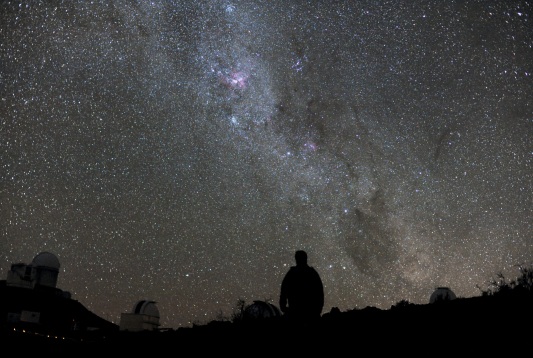
The Night Sky, showing the Milky Way, at La Silla Observatory in Chile. Source: Wikimedia Commons.
The constellations visible from the Western Hemisphere differ from those visible from the Southern Hemisphere. In English, we typically use names derived from Greek and Roman mythology for the constellations, referring to constellations such as Orion and Pleiades that are not visible from the Southern Hemisphere.
When explorers from the Northern Hemisphere ventured to the South, they were no longer able to use the North Star, Polaris, for navigation. The Southern Cross became a useful replacement because it is circumpolar – that is, over the course of the year it remains visible and never seems to dip below the horizon. However, the “Southern Cross” already bore many names and a prominent role in the cultures of the people of the Southern Hemisphere.
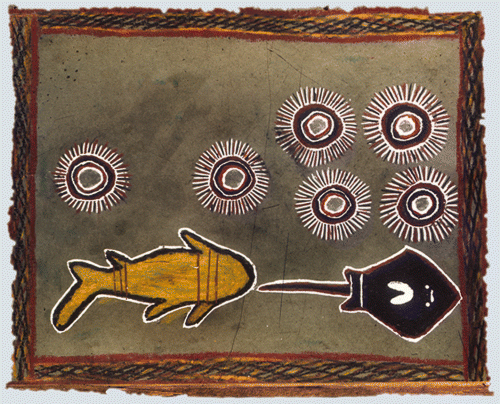
The Aborigine nation located around Arnhem Land see the Southern Cross as a stingray, while the constellation known as the Pointers become a shark chasing it. For another nation located in the desert of central Australia, the Southern Cross is the footprints of an eagle.
How else have famous constellations been interpreted? What purposes, navigational or otherwise, have these constellations been used for?
When people talk about the Cosmic Calendar – the entire history of the universe, from the Big Bang up until this very moment, plotted onto a Gregorian calendar – we often focus on the infinitesimal space that human history has taken up. According to the Cosmic Calendar in our textbook, modern humans as a species emerged on December 31st, 11:58 PM. The rest of human history – from the agricultural revolution, which allowed the human population to expand rapidly, to the Copernican Revolution – is compressed into those two minutes. The average human life span, according to the same source, is only about “two-tenths of a second on the cosmic calendar.” Whatever experiences or accomplishes mark our life amount, on a cosmic scale, to less than a second, and the lives of anyone we admire or loathe can’t stretch much farther, either. The universe, be it on the level of space or time, has a way of making human existence feel small.
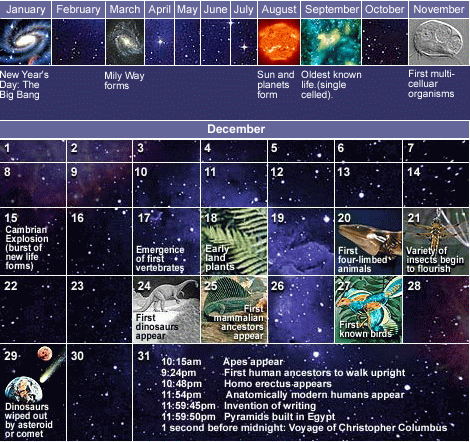
One depiction of the Cosmic Calendar. Source: VISAV.
According to the Cosmic Calendar, life originated around September 22 – to be more precise, about 3.85 billion years ago. The dinosaurs, so-called kings of the Mesozoic (an era that lasted 180 million years, from 225 mya to 65 mya), held sway over the Earth from December 26th to December 30th. They’re our temporal neighbors according to the Cosmic Calendar, even though we’re separated by about sixty-five million years.
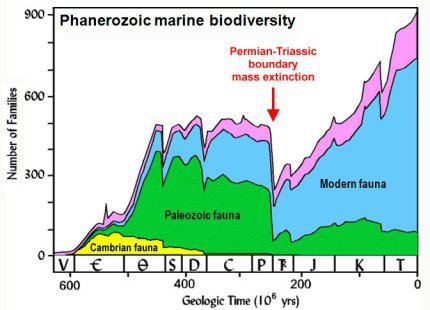
Another event that seems pretty close to us on the Cosmic Calendar is the end-Permian extinction: the “Great Dying,” the largest mass extinction in Earth’s history which ended the Paleozoic Era, occurred on December 25th, barely a week ago on the Cosmic Calendar but well over 250 million years ago (source: VISAV).
The drop in biodiversity caused by the end-Permian mass extinction can be seen in a survey of marine species. Image source: Know Your Dinosaurs
With life beginning in September and continuing up until today, that leaves January through August with a lifeless universe – or at least, a lifeless Earth. What events not listed in our textbook would you include on the Cosmic Calendar, and about when do they occur?