This is a picture of me in my happy place – after a long day of backpacking in Colorado, laughing and telling stories around the fire with people I love (taken by my friend Rachel)


This is a picture of me in my happy place – after a long day of backpacking in Colorado, laughing and telling stories around the fire with people I love (taken by my friend Rachel)
If you’re in my 2016 Solar System class, please put a comment here showing that you’ve found my blog and that you’re following it :) Please include your first name and last name initial. Note that you MUST be logged in to your own WordPress blog when commenting or else you’re doing it wrong!
Also make sure you have bookmarked the big class blog aggregator: Astro201 – The Solar System. From there, you can follow everyone or specific classmates if you like (when I post them).



Wow, it’s been a whole semester already. I’m about to be a senior and that is absolutely terrifying. I swear I was a freshman like two weeks ago. Of course, it’s all relative. If this time has been like a blink of an eye for me, it’s really some infinitesimally small fraction of the first movement of a blink for the universe.
I always had an interest in space but this class has been the first time that I’ve made a concerted effort to really understand things about it. I think the biggest change for me is how I think about the possibility of life on other worlds. I always thought that we had to find another earth to ever find life, but that perception has changed. Between the moons of the Jovian planets and the fact that most exoplanets we have found tend to be gas giants close to stars, the range of locations that I thought of as possible location for life has been greatly expanded.


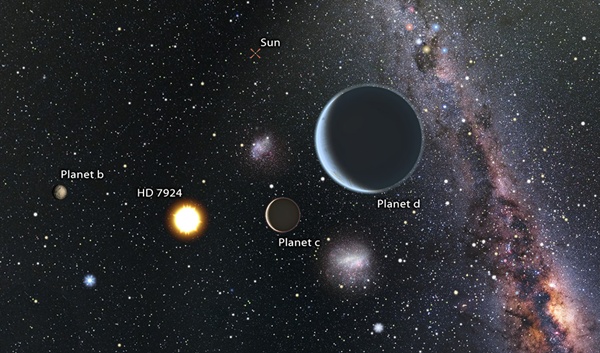
Hey everyone! This semester in Astronomy 201, I have learned a lot. Coming with almost no prior background in astronomy, I was truly shocked and astounded to learn so many things about the Earth, the solar system around us, and the universe as a whole. One thing in particular that interested me was learning about the possibilities of life on other places in the universe. Recently, I came across an article that reported that scientists in Arizona and Hawaii had discovered a planetary system only 54 light years away (a small distance in the grand scheme of things). This planetary system had 3 super-Earths orbiting a star! In case you didn’t know, a super-Earth is an extrasolar planet with a mass higher than our Earth’s but lower than Uranus’ or Neptune’s. While these planets are much bigger than our Earth and orbit their star at a much closer distance than our planet does, it is very exciting that the existence of a planetary system so close to us has been completely discovered. Scientists hope to have a census of small planets within 100 light years of Earth in the next few years, but until then, this is a significant discovery that puts us a step further in the quest to find life on other entities of the universe. To learn more about this discovery, click here.


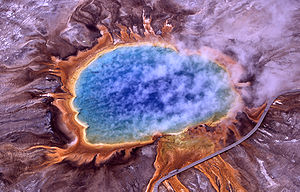
Hey everyone! Extremophiles are organisms that can survive in extreme environments (hence the name). They can survive in places with extreme pressures and temperatures, and can thrive where most other life forms on Earth would perish. Most extremophiles are microbes. The American Museum of Natural History, located in New York City, has opened up a new exhibit dedicated to extremophiles, called “Life at the Limits”. The exhibit provides models of extremophiles, myriad photos and videos accompanied by text, and more interactive cases that simulate an environment where an extremophile could live. The goal of the exhibit is to provide evidence of the “persistence and tenacity of life on Earth”. By visiting this site, people can learn more about extremophiles and how they live under such circumstances. By learning more about extremophiles here on Earth, we can better hypothesize the possibility of extremophiles and other life forms on other planets and in other solar systems. To learn more about the exhibit, click here.


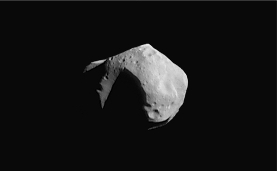 A research team at the Tuscia University in Italy has released a study suggesting that the kick-starter for early life may have hitched a ride to earth on the backs of meteorites. Formaldehyde, an organic compound that is posited as the key building block for early microbial life, is known to exist in the centers of galaxies and in stellar nurseries. More importantly, comets and meteorites have been known to carry formaldehyde with them on their journey to earth. The research team theorized that the combination of formaldehyde, meteorite material and the radiation given off by solar wind would cause the combination of a ‘pre-biotic soup’ prime for the creation of life.
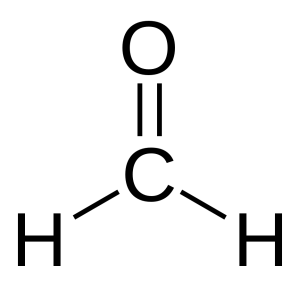
To simulate the effects of solar wind, the scientists fired a proton beam into a mixture of formaldehyde and meteorite powder. With exposure, the materials formed amino acids, carboxylic acids, sugars and nucleosides, which together make up the basis for DNA and RNA. The fact that these organic compounds can form out in space gives credence to the idea that life on other worlds may be more similar to life on our own than we would first think.


I had taken Astronomy 201 because I was curious about humanity’s place in the universe. As a second semester senior, I didn’t need this class at all; I just wanted broaden my understanding of the world around me.
Deep down, I also wanted form an educated opinion on the possibility of extraterrestrial life. It was hence interesting to learn about extremophiles, about solar, galactic, temporal and dimensional habitable zones, and that water was probably brought to Earth after its formation by a comet. It was amusing to debate about Drake’s equation, and frustrating to read that most of the extrasolar planets that we have discovered are inhospitable Jovian worlds. The question of Fermi’s paradox keeps me thinking and the fact that life sprang on Earth just few million years after the end of the heavy bombardment still surprises me.
All in all, I had a wonderful semester learning about the origins of our blue planet. Truth be told though, even after a semester, I am nowhere close to forming an opinion if life on Earth was just a fluke.


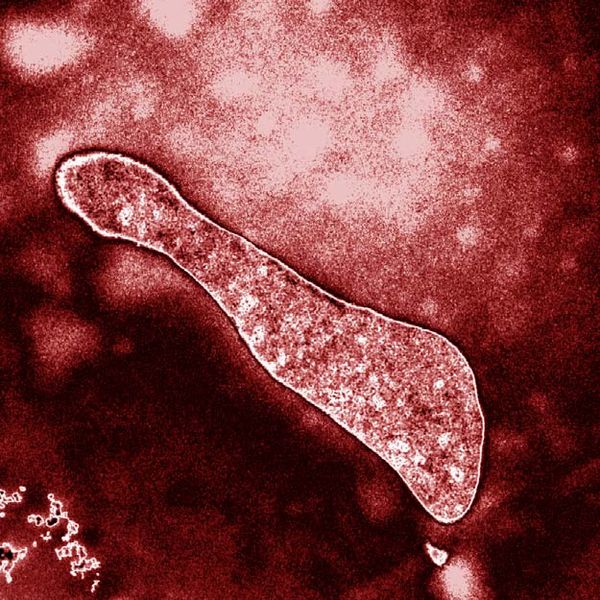
Extremophiles are organisms that thrive under “extreme” conditions. The term frequently refers to microbes such as prokaryotes, which are single-celled organisms that lack a membrane-bound nucleus. Extremophiles do come in all shapes and sizes, and are grouped according to the environment they thrive in. One such group is the acidophiles: organisms that grow best at acidic (very low) pH values.
The Ferroplasma acidiphilum is an acidophilic microbe that lives in a metal-heavy environment containing high levels of iron and sulfur at a low pH. This is because the mircrobes “eat” iron, i.e oxidize ferrous iron, which is primarily found in iron pyrite ore (FeS2). Hence they are generally found in acidic mine drainage, which are the outflow of acid from metal mines.
At a pH as low as 1.3, Ferroplasma can grow and thrive!
References
http://web.mst.edu/~microbio/BIO221_2007/F_acidarmanus.htm
https://microbewiki.kenyon.edu/index.php/Ferroplasma_acidiphilum


From NASA
The search for habitable life beyond Earth is a driving force to the human existence. For a place to be conducive to habitable life, one of the most important questions becomes whether or not there is evidence of liquid water. The recent investigations of the existence of water beneath the icy surface of Europa has lead to proposed missions to the moon and fueled our desire of finding suitable conditions for life beyond Earth. It is a question that some scientists believe could be answered within the next decade. Just this month, NASA chief scientist Ellen Stofan spoke of the signs of water on planetary bodies beyond Earth, and predicts the discovery of “strong indications of life beyond [our planet] in the next decade and definitive evidence in the next 10 to 20 years.” With the continual research for water and discovery of other planetary systems, perhaps it won’t be so long before we discover whether or not we are truly alone.
From NASA, Washington Post and Astrobiology


From this class, I learned about many things that I never knew about that. I learned about the formation of our solar system and many others. I learned about each planet specifically and what makes each one unique and bizarre in their own ways. The one thing that I especially enjoyed learning about was talking about the possibility of extraterrestrial life. After running the drake equation activities, I have increased optimism for the possibility of alien life. Through blogging, I was able to actively learn about new things through Google News that I would not have looked at otherwise. I enjoyed reading the articles about possibilities of this and that. I look forward to the many discoveries that will happen in the future and will actively keep up with astronomy related news. I hope that we discover an advanced civilization in this century.
Also, here’s a cute video of aliens: