HD 7924 Planetary System
This week, a collective team of astronomers from the University of Hawaii at Manoa, UC Berkeley & the University of California Observatories, and Tennessee State University has announced the discovery of a planetary system orbiting a nearby star, believed to be “just” 54 light years away from Earth. The planetary system was found with 3 ground-based telescopes located at observatories in Arizona, California, and Hawaii. These telescopes, known as Automated Planet Finders (APF) are optic telescopes that use radial velocity measurements to search for extrasolar planets as much as 20 times the mass of Earth. Using this technology, astronomers were able to discovery the planetary system through detecting the wobble of the star (HD7924) as the planets orbited and pulled on the star gravitationally.
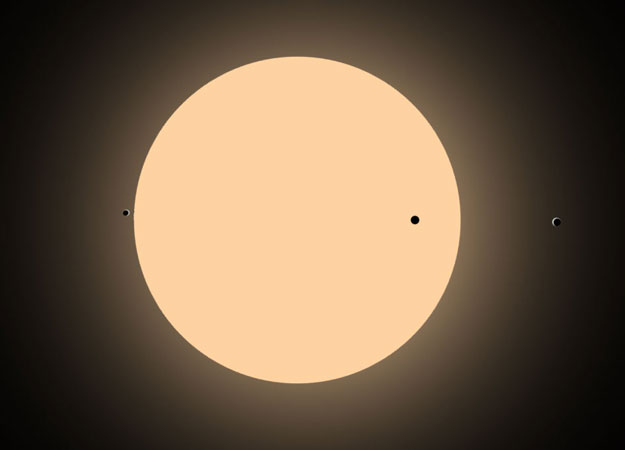
The three planets making up the planetary system have masses 7-8 times the mass of Earth, and are said to orbit their star at a closer distance than Mercury orbits the Sun, with each planet completing its orbits in 5, 15, and 24 days. The discovery of new planetary systems using APF telescopes illustrates the “game-changing” role of automated telescopes in discovering extrasolar planets, and researches anticipate the discovery of similar planetary systems such as this in the near future.
From Astrobiology and Wikipedia