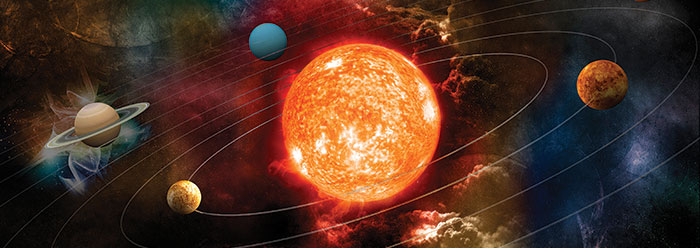
Thanks for a Wonderful Semester!

This has been an absolute whirlwind of a semester! There was not a class that went by in which I didn’t learn anything (and most of the time I learned multiple things)! And even though I feel like I understand solar systems and the universe a little better now, I can definitely say that the universe is a little more mysterious now than it was before! Each new thing we learned just brought along a whole slew of new questions to be answered!

One of my favorite things we learned about was about the formation of planets and small stuff in our solar system. Before this class, I had no idea that distance from the Sun was what determined what type of planet formed! I also did not know the differences between comets, asteroids, and meteors.

I also really liked talking about exoplanets – how we go about finding them and how different they can look from the planets we know and love in our personal solar system. For instance, “super Earths” and Jupiter-like planets close to stars were both concepts that were new to me!

gliese832c_vs_earth

A “Super-Earth” – Gliese 832 c – compared to Earth

I feel that after this class, I can appreciate how varied and weird the universe is. There are multiple exceptions to every rule, and constantly-arising new mysteries.

A topic that I want to read about more in the future that we didn’t touch on a lot in this class would be binary star systems, and the types of planets that are able to form around these. Are planets even able to form around binary star systems? What would life be like in these systems, if it was there? I guess I’ll have to read to find out more!

What were some things that you didn’t know about before this class?


Posted in Class, General | Tagged , , | Comments Off on Thanks for a Wonderful Semester!

Let’s Talk About Extremophiles

Extremophiles are organisms that can live in environments that are considered ‘extreme’ due to conditions that make ‘normal’ life basically impossible. These conditions could be extremely hot, reaching temperatures of 240 degrees Fahrenheit, or and environment with very little to no oxygen. There are many different kinds of extremophiles grouped into categories depending on the environment in which they thrive: thermophiles, psychrophiles, acidophiles, alkalophiles, barophiles, xerophiles, halophiles, and anaerobes corresponding to extremely hot, cold, acidic, basic, high pressure, dry, salty, and oxygen-poor environments. An interesting question that arises when dealing with these organisms. Could planets with very extreme (to humans) environments harbor some kind of extremophilic life? Do these organisms increase the range a habitable zone? I argue that the presence of extremophiles on Earth does not support the idea that life may be able to develop in environments that are considered extreme. Instead, extremophiles are simply very specifically adapted organisms that shared a common, less extreme ancestor with all other organisms. Without going too in depth to an evolutionary discussion, it is perfectly understandable that organisms able to survive where nothing else is able could thrive without considerable threat. This would lead to larger colonies and populations that would, over long periods of time and countless generation, evolve further to cement the species deeper in the niche. Evidence for species of extremophiles being results of evolution rather than initial life (which would imply that a planet must be able to support less extreme life to have extremophiles) can be seen in the morphology of extremophiles. Many are microbial, particularly in the domain of Archaea, but there are multicellular examples like the Pompeii worm or Antarctic krill. This diversity within the extremophile ‘family’ suggests that there is some natural process driving the movement towards adaptation for extreme environments rather than the opposite direction. Therefore, normal life appears to be a predecessor to extremophilic life and that searching for life on other planets, with the evidence we have, should not be expanded to what are considered inhospitable environments.

 Wikipedia
Wikipedia

Posted in Universe | Tagged , , , | Comments Off on Let’s Talk About Extremophiles

Astronomy, we need it!

Throughout two semesters of astronomy I have always been torn about its importance. On one hand the problems we face on Earth seem to trump anything that can happen is space, but on the other hand the more knowledge we obtain the more we are able to understand. What I started to realize towards the end of my studies is that the practical importance of astronomy is the need to push our brains farther in order to study astronomy. In many fields the existing means of discovery leads people to staying within the boundaries already set. However, in astronomy for more to be discovered boundaries must be pushed. If one wants to travel farther and faster, they can’t use anything currently used. If one wants to travel to an extrasolar planet, they must push the boundaries of physics. Astronomy is all about discovering the unknown, and I believe that some of the next centuries greatest ideas and inventions will have a base in astronomy. And for a final bold prediction, someone who wants to learn more about space will discover the source for ‘limitless’ energy.

universebubble

This picture is cool.


Posted in General | Tagged , , | Comments Off on Astronomy, we need it!

Is the Drake Equation Useful?

The idea behind the Drake equation is perfectly logically. Take the variables that most likely determine whether or not life exists, assign a value to those variables and calculate the number of civilizations. And to put the Drake equation in perspective I will quote the one, the only, Drake “I’ve never been reckless – always calculated.” That is all one is doing when predicting other intelligent life, trying to use calculated guesses.

drake-4          url

But the bigger idea is whether or not the Drake equation is useful.   In my opinion, it is not. Because the equation has 5 variables, the number one gets when doing the equation is just a measure of a person’s level of optimism. While some people use science to obtain minimum and maximum values, the point at which you lie in between in how optimistic you few the potential to life. Until more variables become concrete numbers, the Drake equation will be nothing more than a test of optimism.


Posted in General, Historical | Tagged , | Comments Off on Is the Drake Equation Useful?

Extremophiles

Life outside of Earth can be hard to find. It was thought that life could not survive in our solar system outside of Earth. It would be too harsh for any living creature to survive. It is; except for extremophiles.

Lichens showed promising results under Martian conditions. Escherichia coli and Paracoccus denitrificans not only survived, but also grew under high gravity (403,627 times the gravity of Earth) such as those found on large stars.

Life outside of Earth in our solar system may not exist as 4 feet tall, green creatures from movies, but they may exist in places outside of our vision.

Source

Source
Source

Posted in Class, General | Tagged , , | Comments Off on Extremophiles

New Horizon’s Approaches Pluto: So What?

Moving onward, one dwarf planet at a time.

NASA’s New Horizon’s spacecraft is only three months approaching Pluto, and for the first time, we have a true color picture of the Pluto/Charon dwarf planet system. As I sit here typing this, I say, “so what?”

Well, it turns out that this is the first time that any spacecraft has traveled so long and so far (9 years, and 5 billion miles), to reach a particular target. With such a goal achieved, it is only a matter of time before astronomers send another object to observe a celestial body even farther away than the Pluto system. With each successive trip, we’ll only want to go farther and farther, until inevitably we find ourselves traveling to other star systems, and what then? Well, then we must begin to ask ourselves how unique is our solar system, and are we the only life in the universe?

This video readdresses this same question. It also presents the idea of exactly how long it might be before we actually find out if there is life in the universe. Even so, however, I personally am optimistic that there is life within our universe beyond Earth, even if not necessarily like us. That doesn’t mean we should necessarily actively go out and search for such life (if intelligent, what might their motivations be?) But I do believe we are unlikely to be alone in the universe, and if this class has taught me anything, it is to be open to novel experiences and learning about the unknown. Ultimately, I believe anything can be discovered — it is merely a matter of time before it is.

Read about the article on Pluto here.


Posted in Class, Exoplanets | Tagged , , , , , , | Comments Off on New Horizon’s Approaches Pluto: So What?

The Solar System: My Changed Perspective

Hey Guys!

This will be my last post for Astro 201. As I look back on this semester’s teaching, I realize how insular my perspective was. I had always heard about the vastness of the universe and how small we were in comparison, but I never realized how small exactly. This first struck me when I read that our star in the vastness of the galaxy was comparable to a grain of sand in comparison to all of the sand on all of the Earth’s beaches. And that was just our galaxy! This newly received perspective was a humbling and elucidating experience.

This wasn’t the only thing I gained from this class. I was surprised by all of the seemingly basic, essential things about our solar system I had a non-existent or incorrect conception of prior to this class. I had no idea that the tilt of the Earth remained static (in a short time span) and assumed precession of the Earth’s tilt was the cause of seasons. To think, I didn’t even understand such a basic principle prior to this class! I also was aware the moon was the cause of the tides, but had no idea specifically how it created them. Finally, I find it very cool that I can recognize the phase of the moon (and even determine what time it is based off how high it is in the sky)!

Overall, I have thoroughly enjoyed this class, and learned a lot of things about our solar system and beyond.

Source


Posted in Class | Tagged , , | Comments Off on The Solar System: My Changed Perspective

Fermi Paradox: Where is Everyone?

Hey Listeners!

Today, because we have recently been discussing life, I’m going to discuss one of the arguments against there being other intelligent civilizations in our galaxy (or the universe). This argument is called the Fermi Paradox. It consists of a number of primary points. One is that the Sun is a relatively typical star who is relatively young, and there exist billions and billions of stars like it who are much older. Based off our discussions, it seems highly likely that many of these stars possess habitable stars orbiting them. It is also possible, and quite likely considering the age of the universe and the trajectory of human technological progress, that a civilization would develop on these billions of suitable planets which would create interstellar travel and make contact with us.

Fermi’s question is: why haven’t they?

There are a number of possible explanations. Some are bleak or pessimistic, and account for this lack of contact by asserting that there are little to no other intelligent civilizations out there. Others assert that these civilizations exist, but they are choosing not to reveal themselves because we have not reached a level of sentience or development that warrants communication. What are your thoughts on this conundrum?

From Wikipedia

Source


Posted in Class | Tagged , , | Comments Off on Fermi Paradox: Where is Everyone?

Possible Messages from Aliens?

Recently, the search for alien life has become more and more prevalent in astronomy during this past century. New fields, such as astrobiology, have formed. Theories and formulas focused on the search for alien life, such as the Fermi Paradox and the Drake Equation, have become widely known. Messages for possible intelligent life have been included on spacecraft leaving our solar system. The chances that there is life outside of our solar system seems to be more likely as more information is collected.

But, is there a possibility that we have already been contacted by alien life without realizing it? The “Wow! Signal” was a radio signal received in August 1977 by astronomer Jerry Ehman when he was working on the SETI project. It had hallmarks on non-terrestrial and non-Solar System origins. However, it never occurred again and remains a mystery to this day.

Wow_signal

The Wow! Signal, named after the note that Jerry Ehman wrote on it.

Another event similar to this occurred in July 2014. The Arecibo radio telescope in Puerto Rico detected a “brief mysterious pulse” that astronomers were not able to decode. Even though it was just a split-second burst of radio waves, the origins of it are still unknown. Possibilities of its origin include an evaporating black hole, mergers of neutron stars, and even, maybe, a message from extraterrestrial life!

Is it valid to believe these brief anomalies could be messages from aliens? Or is it more likely that the origins are nonbiological in nature?


Posted in Aliens | Tagged , , | Comments Off on Possible Messages from Aliens?

Looking to the Future

Coming into college, I was excited to finally be able to take astronomy courses to satisfy my science requirements, since I had always had a mild interest in space. Taking ASTR 102 in my fall semester opened my eyes to just how extensive the universe was, and what an incredible way in which it developed. However, my real interest in astronomy peaked while taking this class this semester. I had always had a general knowledge of the solar system, but going in-depth and finding out WHY our galaxy formed how it did was truly rewarding.

The most fascinating part of astronomy to me is just how much information humans have been able to gather about such an expansive place from our humble place on Earth. However, it is equally astounding to me that there is an endless amount of information still out in the universe waiting to be discovered. There are innumerable missions NASA and other astronomers can conduct, and this class has especially helped to peak my interest in these future scientific endeavors, and I will be actively following them from here on out.

Lastly, this class has changed my perspective on the idea of other life in the universe. I used to be extremely skeptical about the existence of “aliens” and did not quite understand the fascination with wanting to find external life. However, I can now say that I am definitely more open to the possibility of finding other intelligent, communicative beings based on the factors of the Drake Equation, as well as my larger interest in space exploration. After this semester, it is safe to say that ASTR 201 has given me a new cosmic perspective on the aspects of our universe.


Posted in Class, Universe | Tagged , , | Comments Off on Looking to the Future