My New Outlook on Space

Space has always been a fascinating thing to me. In the past, I would often find myself getting lost on Wikipedia reading articles about the Big Bang or the future of the Sun. When I was a kid, I had a recurring dream of traveling through space on a spaceship. Taking this course allowed me to finally learn more about what has intrigued me through much of life.

Now, if I am walking around on a clear night, I can’t help but look up at the stars and planets in the sky. I now eagerly peruse the NASA website for news of the latest discoveries. I can’t wait to see how the astronomical field develops throughout my life. Perhaps life will be discovered on one of the countless extrasolar planets. Perhaps a method of interstellar travel will be perfected.

Whatever happens with space in the future, I will surely be watching.

Space, Image Credit
Space, Image Credit

Posted in Class, General | Tagged , , | Comments Off on My New Outlook on Space

Is Anybody Out There?

While eating lunch with some colleagues in 1950, Enrico Fermi made an innocent yet profound comment about life in the universe. As a well-known physicist, Fermi knew that the universe was old enough to possibly have other life present, especially within the Milky Way. If this was the case, there was an obvious question – “where is everybody?”

There are a few possible explanations to this. First, there might not actually be any civilizations out there at all. Based off of the most conservative calculations with the Drake Equation, it could be incredibly rare and difficult for a civilization to develop, and Earth was just the product of a series of extremely lucky events. Another way we could be alone is the possibility that all other civilizations have destroyed themselves in warfare. Many people believe that Earth will be obliterated by nuclear warfare between nations not long in the future, so this could also have happened to other planets as well. The second general consensus is that there is evidence of life out there, but there is no evidence to show it. This could be due to civilizations being simply too far apart for communication to be feasible within our lifetimes, since even traveling at the speed of light would take tens of thousands of years between some worlds. In addition, the distance problem could hinder other beings from branching out as well and colonizing worlds closer to our Earth.

One other reasoning used, and the one I personally believe in, is that there are galactic civilizations out there, but they just have not revealed themselves to us yet. I am somewhat optimistic that there is some communicable life out there in such a vast, constantly expanding universe. However, I also believe that they are pacifists and/or smarter in that they have not contacted us yet. Sometimes, I think we humans can take actions before we think them through, and thus I feel that other civilizations are biding their time and watching us, waiting for the right time to reach out.

These are just a few of many possible explanations for why we have not found any evidence of other civilizations yet. There is no one true answer for Fermi’s question; just like the Drake Equation, it ultimately depends how optimistic you are about the possibility of life elsewhere in the universe. Until some definitive proof is found, which could take many more years to obtain, us humans can just simply wonder if anybody is out there with us.


Posted in Space Travel, Universe | Tagged , , | Comments Off on Is Anybody Out There?

Faster-than-light Travel

Wormhole_travel_as_envisioned_by_Les_Bossinas_for_NASA
Conceptual drawing of wormhole space travel, Image Credit: NASA

Many different propulsion methods have been proposed for interstellar travel. One of the most intriguing is hypothetical faster-than-light travel. Most sci-fi movies contain this in some form, whether it be the Millennium Falcon traveling through hyperspace or the Endurance traveling through a wormhole in Interstellar.

A few different methods have been postulated for faster-than-light travel. One example is the Alcubierre drive. According to general relativity, spacetime is curved. This method involves exploiting the curvature of spacetime to take a “shortcut” to a different location. This spacecraft would travel by contracting space in front of it and expanding behind it, essentially shifting space around it until it arrived at its destination. However, this idea is dependent on the existence of negative mass, which has not yet been proven.

Another method is the use of wormholes, as in Interstellar. It is theorized wormholes connect two points in the universe through an Einstein-Rosen Bridge. There is currently no observational evidence of wormholes, but general relativity equations have valid solutions that contain wormholes. Like the previous method, wormholes are also dependent on the existence of negative mass.

If negative mass is ever discovered, it could be a breakthrough for interstellar travel.

Source


Posted in Space Travel | Tagged , , , , , | Comments Off on Faster-than-light Travel

Hubble Telescope’s 25th Birthday

Source: Astronomy Now

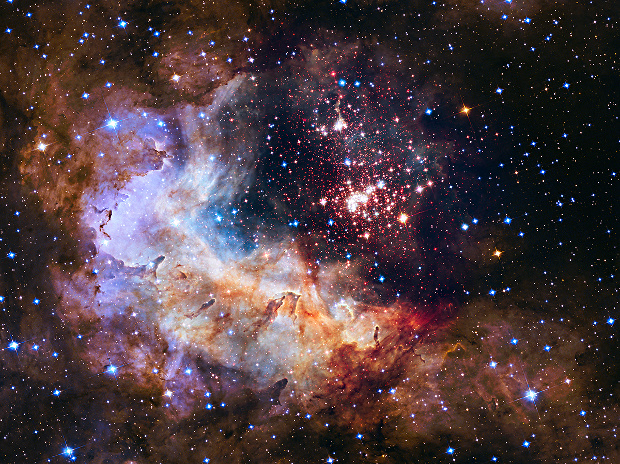
On April 24th, 2015, Hubble celebrated its 25th anniversary. It celebrated its birthday by taking some amazing images of some giant star clusters. The image above is one of Westerlund 2 which is a giant cluster of stars and dust – a breeding area for new stars. The dust pillars are the main areas where new stars are formed and every red dot on the image is a newly formed star in the area. The scale and the sheer beauty of the image is breathtaking. The dust cloud seems like a world in itself with what looks like valleys, ridges and mountains. In fact this is area is so huge. There are millions of stars being born there all the time following the same laws of physics that define our Solar System, our Sun, our planet, us. There are planetary systems being born there in the mix of organic compounds and water, carrying the seeds of life perhaps. I believe areas of the Universe like this one are some of the most fascinating areas, the ones we can learn the most from. They can shows us how stars form, how planets form, perhaps even how life forms. We are still bound by the technology that we have but it is technology that can bring us immense amount of ground-breaking information, just like Hubble has been doing for the past 25 years. Using such technology and learning about space, about how stars and celestial bodies are born and die, we can learn a lot about ourselves and maybe even find another civilization out there. (Source: Astronomy Now)


Posted in Instruments, Universe | Tagged , , , , | Comments Off on Hubble Telescope’s 25th Birthday

Voyager 2

Today Voyager 1 was on Earth just 38 years and now it’s more than 130 AU away. It is venturing into deep space and exploring areas of the Universe that we have never seen before. On September 12, 2013, the spacecraft left the Solar System. The spacecraft is unique and fascinating in many ways. We all know about Voyager 1, but what few people don’t know is that Voyager 1 and Voyager 2 are perfect twins. They are absolutely the same technologically but were sent on different paths around the planets. Voyager 2 took the slow out of the Solar System visiting all four giants, while Voyager 1 was sent on the fast track speeding past Jupiter and Saturn and then leaving the Solar System. The trajectories for the two spacecrafts were chosen from 10,000 possible trajectories and took advantage of a rare alignment of the four giants that happens only every 175 years. Interestingly, Voyager 2 was launched before Voyager 1 but NASA astronomers chose to name them the way they did because Voyager was expected to leave the Solar System first. Both spacecrafts also carried what is known to be the Golden Record. It contains images, sounds and music from Earth, an attempt to communicate with extraterrestrial life. You can hear the playlist of the music from Earth here. Finally, Voyager took the first ever photograph of the Solar System. The “Family Portrait” was taken through various filters so that the different planets can be seen. Because the different planets require different filters, the image appears fractured – more like a collage of images rather than one photo – but in reality it is one image picturing the whole Solar System (Mercury and Mars are not visible due to the Sun light). The faint light doth close to the Earth and Venus is the Sun. Below you can also find a close up on Earth’s photo. From the edge of the Solar System, the Earth appears to be only a “pale blue dot” circled in the image below. Source: NASA, Wikipedia, History

Source: NASA
Source: NASA
Source: Huffington Post

Posted in Instruments, Space Travel | Tagged , , , , , | Comments Off on Voyager 2

My Cosmic Perspective

Coming into this course, I was already very interested in astronomy. I have always loved looking at the stars, and I had my first formal experiences with astronomy in Astronomy 102: Stars and Galaxies and Astronomy Lab last semester. Thus, I was extremely excited to continue my study of astronomy. I have remained intrigued about and fascinated by astronomy throughout the semester. Although the topics have varied throughout the class, I have always tried to keep Neil deGrasse Tyson’s advice from the textbook’s foreword in my mind and “however big the world is—in our hearts, our minds, and our outsize atlases—the universe is even bigger” (The Cosmic Perspective, XXVII). I wrote my first blog post about this foreword, and it has influenced my entire perspective on this class and on how I view the universe.

Every time we learn a new topic, I try to approach it with an open mind. On this note, I have been especially intrigued with Chapter 24 and the possibility of extraterrestrial life. I have been amazed by how much technology has advanced and can now reveal to us on Earth about our universe. At the same time, there is still so much that we do not know about our surroundings. I am always someone who tries to look for solid answers, but I have had to accept that there may oftentimes be no one correct answer (at least at this point in time) and, instead, be open to many people’s theories and speculations about what could be.

Although this specific class is coming to an end, I am really looking forward to using all of the knowledge and new perspectives that I have acquired throughout the semester every time I look out at the night sky or up at the clouds, as astronomy really is applicable in everyday life. I enjoy looking at NASA’s Astronomy Picture of the Day (a website that I really recommend; I have included an example below) and will definitely continue this habit. In particular, as a (possible Political Science major), I am especially interested to see whether or not public policy about astronomy and astronomical achievements changes in the future, for advancements in technology and achievements in exploration may require new policy measures.

ant_hubble_1072

(NASA’s Astronomy Picture of the Day for April 26, 2015: The Ant Nebula)


Posted in General, Science | Tagged , , , , , , | Comments Off on My Cosmic Perspective

The Golden Record

Regardless of whether or not life beyond Earth actually does exist, it is fascinating to consider how extraterrestrial life might view Earth and Earthlings. Most of the time, people tend to focus on how humans on Earth would respond to aliens, should they come into contact, However, during lecture the other day, I was intrigued by thinking about this other perspective: how would aliens perceive Earth? What would Earthlings want aliens to know about us? Would aliens interpret everything that we send into space in the same way that humans intended?

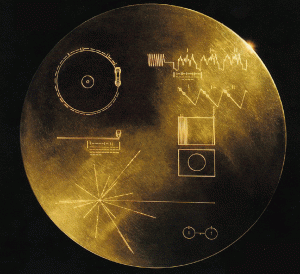
The world faced these very questions when the Voyager spacecraft was launched in 1977. Golden Records were sent into space on the spacecraft in the case that the Voyager spacecraft is discovered by extraterrestrial life. According to the Wikipedia page, the images and sounds on these phonographic records are meant to illustrate Earth’s diversity of life and culture to any intelligent for of extraterrestrial life

On these records, there are 116 images and sounds (from sounds of weather to sounds of animals), songs from throughout history and all around the world, spoken greetings in 55 languages (ancient & modern), and written messages from president Jimmy Carter and the secretary of the UN Kurt Waldheim. There is a wide range of images, ranging from humanity and cultures, food, architecture, animals, and even chemical composition. There is also variety in the music included. The musical sections range from classical (like Bach, Beethoven, and Mozart) to Gospel (like Blind Willie Johnson) to rock and roll (like Chuck Berry) to international music like (Valya Balkanska).

While it must have been extraordinarily difficult to choose the images, sounds, and musical selections included on the Golden Record, perhaps the most controversial inclusion was a silhouette of a nude woman and a nude man. Originally, this was supposed to be a photograph of a nude couple, but after a lot of backlash about the nudity, only a silhouette was incorporated into the Golden Record. Despite the controversy, the Golden Records do contain a drawing of an anatomically correct male and a female. In addition, the record also has a pulsar map and a diagram of a hydrogen molecule.

Personally, I think that the choices made for the Golden Record do a good job of portraying the stated goal of portraying Earth’s diversity. I wonder what would change if we were to make another Golden Record to send into space today, as so much has changed since 1977. What would you have included in the Golden Record?
golden_record_cover

(Source: NASA)

Posted in Aliens, Universe | Tagged , , , , | Comments Off on The Golden Record

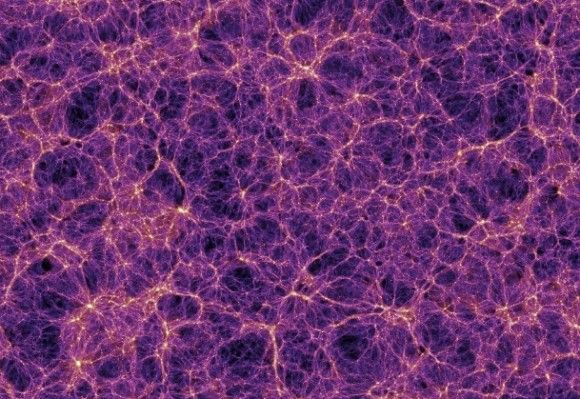
The Cosmic Web

83c9f43a04f0

Source: abovetopsecret.com

This photo, based on our current models of the observable universe, shows our cosmos on the grandest scale that we can imagine.   Each dot is a cluster of galaxies, rich with stars and (probably) planets.  Every law of the universe has teamed up to produce this image: the laws of gravity, astrochemistry, planetary geology, etc.  This is the sum of their parts.  So what else is out there?


Posted in Physics, Universe | Tagged , , | Comments Off on The Cosmic Web

Earth’s Cousin

kepler186f_earth.jpg.CROP.original-original

Source: slate.com

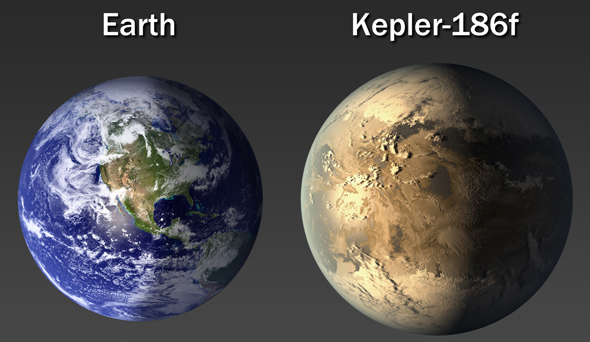
This picture is an artist’s depiction of what the rocky planet Kepler-186f might look like.  On April 17, 2014 astronomer’s announced that they had found this planet using the transit method, making it the first confirmed earth-size exoplanet in the habitable zone!  There is no data yet on whether or not Kepler-186f has an atmosphere or has any water in its atmosphere, but astronomer’s that it is in the right location in its star system to have liquid water.

While much of what is said regarding Kepler-186f at this point is mere speculation, it does tell astronomers that earth-size planets in the habitable zone might not be a rare occurrence.  While it is too distant to determine its atmospheric composition with telescopes, we soon may have the capability to get accurate data on it, which could tell us if Kepler-186f has water or not.  Whatever the results, knowing that we now have the technology to at least find earth-size planets means that the next several years could greatly change how we foresee the future of astrobiology.


Posted in Exoplanets, Historical | Tagged , , | Comments Off on Earth’s Cousin

Doctor Who is not COMPLETELY fictional

Tardis

Image from wikipedia.com

This article covers arguably one of my favorite topics to swoon over-Doctor Who.  I will be completely honest in saying that my intense interest in studying the solar system and beyond came pretty much single-handedly from watching Doctor Who (and maybe a teensy bit by my mom making me watch old Star Trek re-runs with her when I was a kid…).  So it’s been fun for me to gain a lot more “science-based” understanding of the universe that, in my mind crazy David Tennant-filled dreams, was filled with aliens from all over the universe both time and space-wise attacking our home planet of Earth.  Now that I now a bit more about astronomy, I was curious about how accurate my favorite show was in describing some scientific phenomena.  While I know that alien life hasn’t been discovered yet by scientists here on Earth, I was hoping at least some other aspects of the show were factual and not telling lies just purely for entertainment.

The article above confirms my hope!  Obviously, in a show that has aired over a span of 50 years, the science discussed on the show will advance as the knowledge astronomers gain increases/changes, but this article discusses some notable accuracies in the topics discussed in the series.  From discussion of the Big Bang, formation of our moon, and dinosaur extinction among many other topics, there is some serious science talk going on, which is accurate as far as scientists know!  This makes me feel a bit better about indulging in hours and hours of Netflix watching of my favorite shows, knowing that I am getting at least a bit of real science in the midst of a lot of science fiction.


Posted in Aliens, Science, Space Travel | Tagged , , , | Comments Off on Doctor Who is not COMPLETELY fictional