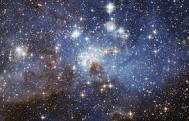
Humans have been trying to find an adequate and cost efficient method to achieve nuclear fusion. We have tried such things as cold fusion, but failed due to the fusion process needing extreme amounts of heat or kinetic energy to work. The only place we see this naturally happening is in the core of stars through a process called stellar nucleosynthesis; the temperature at the core can be well above millions of kelvin which is hot enough to fuse hydrogen atoms together to form helium.
fusion of hydrogen atoms to from helium
What fusion is defined as is a reaction which forces two atomic nuclei to fuse together. In order to do this they must overcome the Coulomb force that make the protons in each atom repel one another and then join together by nuclear force, which joins protons to neutrons. Once this is achieved excess energy is transferred to the environment for lighter elements or absorbed for heavier elements. This, I believe, is what humans are trying to garner from nuclear fusion since it would mean they can take a rather abundant and cheap element, like helium or hydrogen, and make potentially every other element. Along with creating other elements they would also be getting excess energy from the reactions which could be used for our power needs.
Currently, though, we are far off from making this dream to harness the power of the stars a reality.
There are twelve zodiac signs to correspond with the twelve months of time it takes our Earth to make one full revolution around the sun; each zodiac represents a specific star constellation that the Sun is within as we travel around it. However, there is a thirteenth constellation named Ophiuchus that is not often included. This problem stems from the original Zodiac star map, made by the Babylonians around 1000 B.C, having equal thirty degree pieces set for each constellation on the ecliptic. This is inaccurate since the constellations have varying dimensions and, as such, take up different amounts of the ecliptic instead of equivalent portions.
Zodiac wheel including Ophiuchus
When the constellation boundaries were redrawn in 1930, it was discovered that the ecliptic path passes through the bottom part of Ophiuchus between Scorpio and Sagittarius. Nothing has really changed due to Ophiuchus’s introduction, though, as the zodiac signs have simply been sensualized since their creation; they are hardly used for anything outside of horoscopes in modern times.
This is the first-full color photo taken of Pluto ever that NASA published yesterday. The space probe New Horizons took the image about 71 million miles away as it nears the “dwarf” planet. New Horizons is the fastest spacecraft ever launched and the first in history to visit Pluto. The unprecedented flyby is expected to take place in Pluto and will bring some long-awaited insight and “exciting discoveries” about the workings of the little planet.
At first glance, this picture of two blurry white and blue spots is really not that “exciting.” First, it’s blurry. Second it’s really not even that pretty to look at…because it’s blurry so I guess that’s redundant, but it kind of just looks like someone got their hands on a too fancy camera and it’s just the flash bouncing off something. Or, at least that’s what I would have thought four months ago.
Now, I know a few more things.
I know Pluto is 28 AUs from us (or at least the textbook does and I have the textbook). I know what AUs are. I know that blue light is a higher energy than the orange-whitish light. I know how Pluto lost its planethood. I know to put the “dwarf” in “dwarf” planet in quotations. I know that Pluto is a Kuiper belt object and I know how to pronounce Kuiper. I know Pluto is beyond freezing and basically a comet, but a big one, since it’s made of ice and rock as comets are. I know that Pluto’s significantly elliptical orbit puts it closer to the sun than Neptune for 20 years of it 248-year orbit and I know there is no danger of collision between the two because of orbital resonance. I know what orbital resonance is and, if pressed, could explain it. I know the thought is that Charon was created after a giant impact from a large comet, and the blasted-away pieces formed a ring around Pluto that eventually re-accreted into Charon. I know what accretion is and why it doesn’t happen to the Jovian rings. And so, I feel fairly confident that I also know that the reason Charon was able to form is because Pluto doesn’t have enough difference in gravitational attraction on each side to create the tidal force that keeps Jovian ring pieces pieces and not moons.
“I believe we are going to have strong indications of life beyond Earth in the next decade and definitive evidence in the next 10 to 20 years,” Ellen Stofan, chief scientist for NASA.
“It’s definitely not an if, it’s a when,” said Jeffery Newmark, one of Stofan’s colleagues.
NASA made these bold claims at a press conference earlier this month. Their confidence comes from their growing discoveries or strong indications of water. So far, they believe or have seen that Mercury, Mars, the Moon, Jupiter, Saturn, Uranus, Neptune, Ganymede, Europa, Callisto, Enceladus, and Titan all have water in their interiors or atmospheres. They are especially certain of liquid oceans on Europa and Enceladus, which both have the three components astrobiologists say are necessary for life- water, energy (volcanic activity), and chemicals used in biological processes. Here’s hoping for microbes.
Tycho Brahe – Born December 14, 1546; Died October 24, 1601
Tycho Brahe was important to astronomy, because he witnessed a supernova and through that he rejected the Aristotelian belief that the celestial realm was unchanging.
During the period that Tycho Brahe was alive the Renaissance was going on. This was a period starting in Italy around the 14th century and lasting until the 17th century. This was a period marked by growth in many fields and essentially paved the connection between the Middle Ages and the Modern Age. Also during this time frame, Romeo and Juliet came out (1597) just a few years before Tycho’s death. This play was one of the greatest that Shakespeare ever wrote.
William Shakespeare was a famous historical figure during Brahe’s time. He was one of the greatest poets to have ever lived and is often named as the “greatest writer in the English language”. Some of his more famous works that came out while he was alive were: Hamlet, Othello, Romeo & Juliet, and his many numbered sonnets.
What I find interesting about seeing the connection between Brahe, Shakespeare, and the Renaissance movement is that in that time period, the world was more open to changing ideals; not only in science, but also in art were we seeing change. Not only were we more open to exploring the wonders of the world through our intellect, but also through our creativity. Had either of them tried to pass their ideas (creative or scientific) to an audience in the 11th century, they may have both been hanged for treason.
Hello everyone! Before taking this course, I only knew very basic knowledge of topics relating to astronomy. I didn’t think it was very important to know why we needed to know about the celestial beings outside of the Earth in which we live. However, now after learning about the myriad objects outside of Earth, I realize that learning about our solar system, galaxy, and universe, can help us understand and appreciate the Earth even more. I recently came by an article that expressed this sentiment as well that also brought up some interesting points. Astronomy has inspired many of the worlds leading thinkers, including Paul Nurse, the President of the Royal Society and a Nobel Prize winner in medicine. Nurse discovered his love for science when he first looked through a telescope at age eight. For me, studying astronomy this past semester has inspired me to learn even more about the universe and how the world came to be.Astronomy is present through history, literature and scientific thinking among many different subjects, and study astronomy helps to unlock the key to the mysteries of the world. To read this eye-opening op-ed, click here.
Hello everyone! Some exciting new has been happening in the astronomy world. NASA, the National Aeronautics and Space Administration, is launching a space mission to the dwarf planet Pluto, a feat that has never been accomplished before! This is super exciting because this mission will potentially give us a much clearer idea of what is happening on Pluto, and through this we can learn more about the dwarf planet and how it functions. The mission will be carried out through a spacecraft called New Horizons, which will fly past Pluto on July 14th, 2015.The spacecraft will take thousands of images of Pluto, and will make scientific observations.It was launched nine years ago in 2006. To learn more about the spacecraft and its mission, click here.
Is time travel possible? Would humans be able to discern how to accomplish it even if it was possible? Upon reading the 1884 novel, Flatland, an interesting notion is introduced to the audience. You can only completely see objects one spatial dimension below you, and can only infer the dimension you spatially occupy through the use of other tools. An example of this can be seen in humans; we are third dimensional beings, but we see the world in two dimensions. We can infer that objects are three dimensional based off of shadows and perception.
When the protagonist of Flatland is visited by a three-dimensional being, he himself being a two-dimensional being, he can not comprehend the being before him. The being is a sphere, but the protagonist can only see a line (indicative of a circle). Again, applying this to humans, even if we were visited by a fourth-dimensional being, we would not be able to comprehend them as we would see them in two dimensions and infer them as a third dimensional being (perhaps this could be an explanation for the stories behind such things as ghosts?).
Going down the line with dimensions we see that they follow a pattern that makes sense to us up until a point:
zero dimension — single point
one dimension — two points connected together to form a line
two dimensions — lines connected together to form a plane
three dimensions — planes connected together to form a solid
four or more dimensions — manipulation of the past dimensions
Illustration of the dimensions, zero – three
In general the fourth dimension is depicted as a cube that rotates through every possible iteration of its existence in frames of its life that can be rewound and fast forwarded at will. The problem that we as humans run into most when considering time travel and the fourth dimension is that we can’t properly understand a mechanism for which backwards time travel could ever be possible due to such things as the grandfather paradox. Time travel into the future is looked at as being more plausible but still not fully tested yet.
The theory behind forward time travel is related to faster-than-light travel and strong gravity (such as that found near a black hole). A great example of this can be found in Albert Einstein’s general relativity theory in its dealings with black holes; the intense gravitational pull from the singularity begins to warp the fabric of space-time to such an extreme that there is an intense gravitational time dilation created which slows the clock, so to speak, of the object near the intense gravity origin.
While I may never get to visit a future me, per se, an understanding of the fourth dimension and beyond could lead to humans figuring out information about the Universe they never knew existed which will lead to discovery and progress they never once imagined possible!
Posted inClass, Universe|Taggedastro201, blog8, me, Time|Comments Off on Hello future me, I am the past you from the present (4th dimension)!
The discovery and study of exoplanets, or planets in other solar systems, is one of the newest sub-fields of astronomy. The reason for this is that, prior to the mid 1990’s, we didn’t really have the technology to find these planets. Through various means, the discovery of exoplanets has taken off at an exponential rate in the last twenty years and the number of known exoplanets now sits at about 2000. The following graphic, created by University of Warwick PHD student Hugh Osborn shows the rapidly accelerating rate at which we discover exoplanets as well as their mass, orbital period and means of discovery.
One of the most distinctive astronomical features of our solar system is the brilliant ring system of Saturn. Due to their position, scale and material composition, Saturn’s rings have a visibility and tone not present in the ring systems of other planets. I wondered what it would look like if earth had rings and what those rings would mean for us. I found a blog post from an artist who created a series of images showing what our sky would look like if Earth had a set of Saturn-like rings.
The rings have a profound effect on the sky, providing more illumination than a full moon and never changing in position. The ability to observe stars is impacted by the constant light pollution generated by the rings and humans and animals likely have altered evolutionary histories due to night-time illumination. The rings play a heavy role in the various religious pantheons of the world and are a source of great mystery and wonder for ancient people.