Saturn’s Titan doesn’t have it’s own magnetosphere!

So whilst finding out some information about Saturn’s orbiter Cassini, I came across this story: Cassini Catches Titan Naked in the Solar Wind.  We’ve been talking a lot about magnetospheres when we discuss the giant worlds so this whole thing is really interesting!

Titan outside of a compressed Saturn magnetosphere

Titan outside of a compressed Saturn magnetosphere. From NASAs Cassini page

The space probe Cassini was going by Titan in 2013 when a big solar storm hit Saturn’s magnetosphere and compressed it.  This left Titan without the protection of that magnetosphere.  According to the newly published data, Titan has no appreciable magnetosphere because particles interacted with its atmosphere just like the particles in the atmospheres of Venus and Mars (no magnetospheres due to not spinning fast enough and solid core, respectively).  The scientists interviewed for the article talk about how this information shows them that computer models developed for closer worlds can still be used for worlds farther away and that’s awesome :)  I love the Universe :)


Posted in Jovians, SolarSystem | Tagged , , | Comments Off on Saturn’s Titan doesn’t have it’s own magnetosphere!

Ganymede’s Ocean Confirmed?

I didn’t even know Ganymede had aurorae.

Recent observations of Ganymede by Hubble appear to suggest that it may truly have an ocean far beneath its crust. Aurorae on the planet, caused by Ganymede’s magnetic field (the only moon in the solar system to have one), and their behavior seem to be suggestive of this high possibility. Ganymede’s distance from Jupiter allows its magnetic field to remain entirely within Jupiter’s much larger one. While Ganymede’s aurorae should shift about 6 degrees along the planet’s surface, the actual amount is closer to two degrees. The only seeming explanation for this is that the moon must have a subsurface ocean which is large enough to counteract much of the effects of Jupiter’s own magnetic field. If this is indeed true, Ganymede’s ocean would be over 60 miles deep, more than ten times the depth of Earth’s, and contain far more water as a result. Given water’s role in sustaining known life, who knows what may lie deep within the moon’s crust!

Read more about this here.


Posted in Class | Tagged , , , , , , , , | Comments Off on Ganymede’s Ocean Confirmed?

Could our Solar System have once had Super Earths?

 A size comparison of Earth to a Super Earth

New research appears to suggest that the early solar system might have been home to several “Super Earths,” terrestrial planets which are between 1 to 10 times the mass of Earth. One of the lingering questions about the formation of the solar system involves exactly how is it that the terrestrial planets of our solar system are so much less massive than terrestrials found in other solar systems. It seems likely, given this research that Jupiter might have originally formed farther out from the sun than where it is currently located. As it moved inward, it threw large objects around thanks to its gravitational influence, and tore apart others. Had Saturn’s gravity not slowed and eventually halted Jupiter’s descent into the sun, it is likely that Jupiter would’ve fallen into the sun, and even had a greater destructive influence on the inner solar system. Another seemingly likely reason why Super Earths might have once existed in the solar system is due to the fact that many other systems contain planets closer to their stars than Mercury is (respectively speaking), and the objects are generally the Super Earths that would have been destroyed, or thrown about by Jupiter. Once Jupiter stopped falling in, however, it seems likely that this inner region of the solar system became stable enough for the inner system planets to have formed without much more interference.

Read more about this here.


Posted in Class | Tagged , , , , , , , | Comments Off on Could our Solar System have once had Super Earths?

Colliding with Jupiter

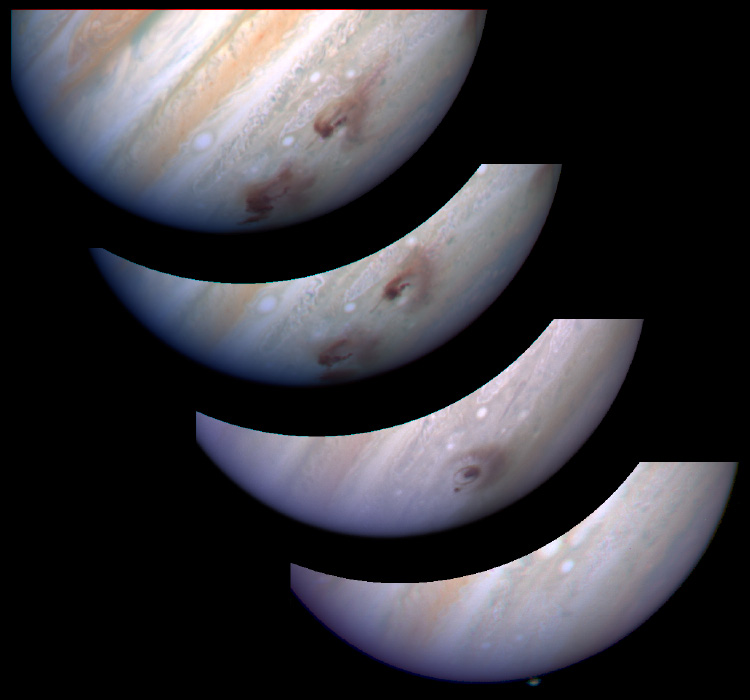
The Shoemaker–Levy 9 collision with Jupiter was the first direct observation of an extraterrestrial collision of Solar System objects. Shoemaker–Levy 9 disintegrated in to 21 fragments during a close encounter with Jupiter in July 1992 and finally collided with Jupiter two years later in July 1994.

Source: A NASA Hubble Space Telescope (HST) image of comet Shoemaker-Levy 9, taken on May 17, 1994, with the Wide Field Planetary Camera 2 (WFPC2) in wide field mode.

The remarkable collision lasted a week and left large, murky marks on Jupiter’s southern hemisphere that took weeks to dissipate. With some individual fragments as large as 2 km in diameter, Shoemaker–Levy 9 would have been catastrophic to Human civilization but might not be enough to cause mass extinction on Earth, such as the 10 km wide asteroid that triggered the Cretaceous–Paleogene extinction event 66 million years ago.

Source: Jupiter G impact evolution taken by Hubble over a period of 5 days

Posted in Jovians | Tagged , , , , , | Comments Off on Colliding with Jupiter

Colliding with Jupiter

The Shoemaker–Levy 9 collision with Jupiter was the first direct observation of an extraterrestrial collision of Solar System objects. Shoemaker–Levy 9 disintegrated in to 21 fragments during a close encounter with Jupiter in July 1992 and finally collided with Jupiter two years later in July 1994.

Source: A NASA Hubble Space Telescope (HST) image of comet Shoemaker-Levy 9, taken on May 17, 1994, with the Wide Field Planetary Camera 2 (WFPC2) in wide field mode.

The remarkable collision lasted a week and left large, murky marks on Jupiter’s southern hemisphere that took weeks to dissipate. With some individual fragments as large as 2 km in diameter, Shoemaker–Levy 9 would have been catastrophic to Human civilization but might not be enough to cause mass extinction on Earth, such as the 10 km wide asteroid that triggered the Cretaceous–Paleogene extinction event 66 million years ago.

Source: Jupiter G impact evolution taken by Hubble over a period of 5 days

Posted in Jovians | Tagged , , , , , | Comments Off on Colliding with Jupiter

WASP-12b

WASP-12b is an HUGE planet that orbits extremely closely to its star. Due to the close distance (at 1/44 the distance compared to the distance between Earth and the Sun), WASP-12b has a very low densities from the flux of energy from the star and is being distorted into an egg shape. The most interesting thing is that its star is consuming WASP-12b’s atmosphere at 189 quardrillion tonnes per year.

Source
Source

Posted in Class, General | Tagged , , | Comments Off on WASP-12b

Saturn 2.0

deep-space-ring-system-aas219

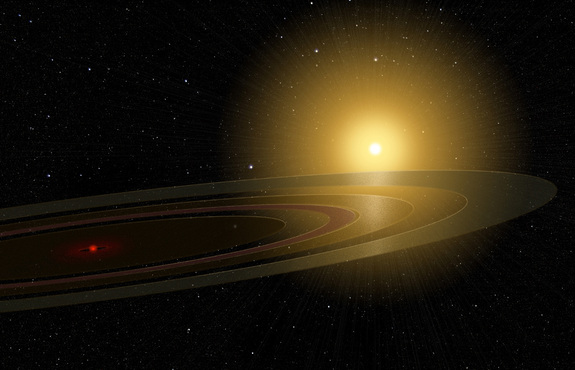
So all the planets know that Saturn’s rings give it a really over-inflated ego.  But now there’s good news!  Maybe it’ll quit bragging now that it looks like there’s another planet with a bigger ring system.  Scientists think they’ve found an extrasolar planet with an elaborate ring system, the first discovery of a planet with rings outside of our solar system.  This was announced at the American Astronomical Society in January of 2012.

The image (from the web page of the linked article) is an artist’s representation of what this system might look like.  According to the data, the planet orbits its star at about 1.7 AU, but its mass is not yet known.  The outermost rings stretch to a diameter of about 120 million kilometers – that’s an astonishing 0.8 AU, compared to Saturn’s major rings that extend for a diameter of about 270,000 kilometers.  For comparison, if this system were swapped out for Mars, which actually orbits at a slightly shorter orbital distance of 1.5 AU, the rings would almost be only .1 AU from Earth’s orbit!


Posted in Exoplanets, Planet Rings | Tagged , , | Comments Off on Saturn 2.0

Krakatoa: Will It Erupt Again?

Krakatoa is one of the deadliest volcanoes in human history. The island of Krakatoa (Krakatau) is part of the Indonesian Island Arc. It’s a volcanic island that has undergone a dramatic eruption in 1883. In May 1883, sailors began noticing clouds of ash rising more than 6 miles above the volcano as shown on the drawing below. Krakatoa continued to be highly active in the next 4 months with continuous eruptions lighting up the clouds above and thundering noises. People organized festivals celebrating the natural “fireworks.” Thinks drastically changed shortly before 1 pm on August 26th, when a blast from the volcano sent debris shooting 15 miles into the sky. This was only the beginning to what is one of the deadliest volcanic eruptions in history. Several massive eruptions followed on the 26th and the 27th which ended up blowing 2/3 of the mass of the island into the sea and sending debris 22 miles into the sky. From a 2,667 ft high island, Krakatoa was turned into a caldera 820 ft beneath sea level. The island blew away with the explosive force of 13,000 times greater than the atomic bomb dropped over Hiroshima. Shock waves circled the planet at least 7 times. The eruption caused a massive tsunami with 130 ft high waves. In total, it ended up killing over 36,000 people. But this may not be the end. Since 1927, the volcanic island has started rebuilding itself. The eruptions have become more frequent and violent ever since November 2007. The island is currently half the height of Krakatoa when it erupted in 1883. The current state of the volcanic island can be seen in the second picture below. Scientists are still debating whether a similar massive eruption will follow in the next century. Some scientists argue that an eruption of the scale of the one from 1883 likely happened 200 years before that as well, making it more likely to have a repeat explosion in the next century. Other scientists argue that there is not a big enough reserve of magma for such a huge explosion. The whole region is hoping that the latter are correct since the area is a lot more densely populated nowadays than it was in 1883 and an eruption of that scale would be a lot more devastating today than it was 1883. But there’s not really a way that anybody can predict such explosions with 100% accuracy. We will only know whether Krakatoa is going to be deadly again once it happens. (Source: LiveScience, Daily Mail)

Source: LiveScience
Source: LiveScience
Source: Daily Mail
Source: Daily Mail

Posted in Historical | Tagged , , , , , | Comments Off on Krakatoa: Will It Erupt Again?

Ganymede’s Ocean

When we think of Earth we tend to associate it very strongly with water and life. It makes sense since water covers up 75% of Earth’s surface. Water in liquid form seems to be unique to our world … or does it? … As it turns out, Earth’s salty water oceans may not be the only ones in our Solar System. Jupiter’s moon Europe has been long thought to have an ocean buried under its icy surface. Some of the other moons of Jupiter had been thought to have such oceans as well ever since the 1970s. The largest of those moons is Ganymede. Using models for such a large moon, scientists have theorized that the moon should have a large ocean under its surface. In 2002, NASA’s Galileo mission measured Ganymede’s magnetic field as it was passing through. This measurement indicated some possibility for a salty ocean but it wasn’t conclusive. In 2015, Hubble Telescope finally managed to get enough evidence to prove the existence of that ocean. NASA astronomers think of the measurements taken as if Hubble was looking at the planet’s interior. In fact, Hubble was looking at Ganymede’s auroras. The auroras can be seen on the picture below in blue. Using the auroras scientists analyzed Ganymede’s magnetic field and from there they can reach conclusions about the moon’s interior. Ganymede is within Jupiter’s magnetic field so Ganymede’s own magnetic field should be shifting with Jupiter’s magnetic field. What Hubble observed though is that Ganymede’s own magnetic field was so strong that it could counteract some of the shifts in Jupiter’s magnetic field. When the moon’s magnetic field was expected to shift by 6 degrees, it only shifted 2 degrees. This points to the fact that Ganymede should have a huge underground salt water ocean that creates a strong magnetosphere for the moon. According to calculations this ocean should be 60 miles deep which is 10 times deeper than Earth’s ocean. This means that water is not just not unique to Earth but it might be a lot more abundant somewhere else. Maybe our perception of the abundance of water in the Solar System doesn’t reflect the reality. (Source: NASA)

Source: NASA
Source: NASA

Posted in Instruments, Moons | Tagged , , , | Comments Off on Ganymede’s Ocean

The Cosmic Snowball

Halley’s Comet

This video tells us about the history of Halley’s Comet, which turns out to have actually been documented in medieval history in previous passes by the sun.  Because of the rarity with which comets actually appear in our night sky, they used to be tied to ancient superstitions; for example, to the ancient Chinese they signaled a period of rapid change.  Now we know that comets are simply chunks of ice and dust formed in the outer regions of the solar nebula.  After a gravitational encounter with a jovian planet, a comet may fall into the inner solar system, where it would brilliantly light up our night sky.

Because comets formed in the outer solar system, Kepler’s Third Law tells us that they have very long orbital periods compared to the Earth (those that fall into the inner solar system also have highly elliptical orbits).  Thus, when a comet does fall to the inner solar system, it only reappears usually after several decades.  Halley’s comet, for example, will not reappear until 2061.


Posted in Historical, Small SS Objects, SolarSystem | Tagged , | Comments Off on The Cosmic Snowball