Pluto: Why isn’t it a planet?

Hey Followers!

Today, I’m going to be discussing some basic characteristics of the now dwarf planet Pluto. Pluto is the largest object in the Kuiper belt. It is approximately 30-49 AU from the Sun depending on its position in its elliptical orbit (this variance also indicates a high eccentricity in its orbit). An interesting phenomenon that results from this eccentricity is that form some portions of its revolution, it is closer to the Sun than Neptune. It has 5 known moons with the most notable being Charon. Pluto has a mean radius of 1,184 km making it the second largest dwarf planet (with the the first being Eris). Interestingly, it is the discovery of this larger dwarf planet (Eris) which led the International Astronomical Union to formally define the categories of planet and dwarf planet in 2006. Pluto was found to be one of many icy objects in the Kuiper belt, and was thus demoted to dwarf planet.

From Wikipedia

Source


Posted in Class | Tagged , , | Comments Off on Pluto: Why isn’t it a planet?

When Will The Next Impact Be?

Chelyabinsk, meteor

The Chelyabinsk Meteor as seen by person driving a car right during explosion

I watched another video and decided to watch one on the extinction of the dinosaurs. The video is very short and not absolutely thrilling but as I was watching the beginning of the video I thought to myself what if that was us. Going about life as usual with no idea what could go wrong and then all of the sudden something like this happening. And it could potentially happen. According to our homework assignment “Impacts” asteroids 2 m in diameter hit the Earth multiple times a year. And as they increase in size they hit the Earth less frequently until they seem like they are not even a threat. the Tunguska Event, which occurred in 1908 in Russia, was the largest impact event in our recorded history. Even though the asteroid/comet was thought to explode in mid air, the event was still registered as an impact and the estimated size of the object was between 60 -190 meters in diameter. Then two years ago, in February of 2013, a meteor estimated to be over 12000 metric tonnes exploded over Chelyabinsk in Russia and destroyed over 7,000 building with the wave from the blast alone. With these events happening only 105 years, the question of when will it happen again comes to mind. This obviously should not be an every day worry, but it is definitely something to think about and research further.

Resources: Wikipedia


Posted in Class, Historical, Universe | Tagged , , , , | Comments Off on When Will The Next Impact Be?

The Earth With No Moon

This video, though it is 8 minutes, is fascinating. Its main focus is what the Earth would be like without the Moon. The most surprising thing I got from this was that humans would probably not exist because they would not be able to withstand the extreme conditions that the Earth would experience without the Moon. Another part that was interesting to imagine was that life could still exist and that evolution would favor smaller, shorter creatures and plants that could withstand extreme climates and rapid changes in those climates. So try to imagine us living on another planet (we have to be somewhere for this image to work) and visiting our Earth but with no humans. There would be no forests and pretty much nothing very large would exist. Try to put yourself in a place where you could see everything to a certain point because there would be nothing tall in the way and imagine all of the creepy-crawlers and strange organisms that would exist. The way I try to imagine it is it would be like a dinosaur world but with miniature dinosaurs. Watch a few minutes of the movie it is definitely worth seeing what the world is like without a Moon.

The video is hyperlinked.


Posted in Universe | Tagged , , , | Comments Off on The Earth With No Moon

White Dwarf- A Large Piece of Condensed Diamond

We have leant in the class that our Sun is going to become a white dwarf at the end of its life. We also already know that the Sun is now fuse hydrogen into helium during its main sequence stage which may last for ten billion years.

After the Sun has fused all hydrogen in it, it would expand into a red giant which is brighter than the Sun now but way larger than it. The lifespan of a red giant is much shorter. Around one billion years. During the red giant period, helium in its inner core are fusing into heavier elements such as carbon and oxygen.

However, most stars such as our Sun are not massive enough for further fusions to take place. So as soon as all the helium runs out, no further fusions can produce energy for the star to fight against gravity collapse, so the red giant collapse into a small white dwarf with large density. Approximately 1 ton per square centimeter. White dwarf is still really hot when it is formed. About 100,000 degrees Celsius.

Theoretically, white dwarf is going to cool down and finally turn into a black dwarf. However, our universe is still too young for a white dwarf to cool down completely into a black dwarf which emits almost no energy. The oldest white dwarf is still about several thousand Kelvin.

Because the chemical composition of diamond is actually carbon, white dwarf is a large piece of highly condensed diamond in the space. Name a newly discovered white dwarf as a wedding ring might be the most romantic thing for astronomers.

white-dwarfs_8996_600x450


Posted in Class | Tagged , | Comments Off on White Dwarf- A Large Piece of Condensed Diamond

The Discovery of Neptune

The history of the discovery of Neptune was rather dramatic. Neptune is sooooo far away from Earth so it is almost impossible to see it with naked eye, even with low-power telescope. On Dec. 28th, 1612 Galileo became the first one who found Neptune and actually described his discovery in his research draft. However, at that time Neptune was so close to Jupiter that Galileo thought it was a distant star.

neptunes

Two centuries later, on 1821, Alexis Bouvard published the rotation orbit of Uranus. However, later observations showed that the actual orbit is rather different from the calculated results, so he made a hypothesis that there is another nearby celestial object influencing the movement of Uranus. Then in 1843, British astronomer John Couch Adams sent his calculation of the eighth planet to Royal Astronomical Society.

On the other hand, French mathematician, astronomer Urbain Le Verrier calculated the orbit of Neptune on 1846. His calculation was really accurate and later in the same year German astronomer Johann Gottfried Galle found the existence of Neptune mainly on his calculations.

However, the observation did not begin until 1846. Johann Gottfried Galle began the searching in Berlin Observatory. And in Sept. 23rd 1846, Galle claimed his discovery of Neptune and for the first time in human history, people know the existence of Neptune for sure.

220px-Johann-Gottfried-Galle (left: Johann Gottfried Galle)


Posted in Class, Historical | Tagged , | Comments Off on The Discovery of Neptune

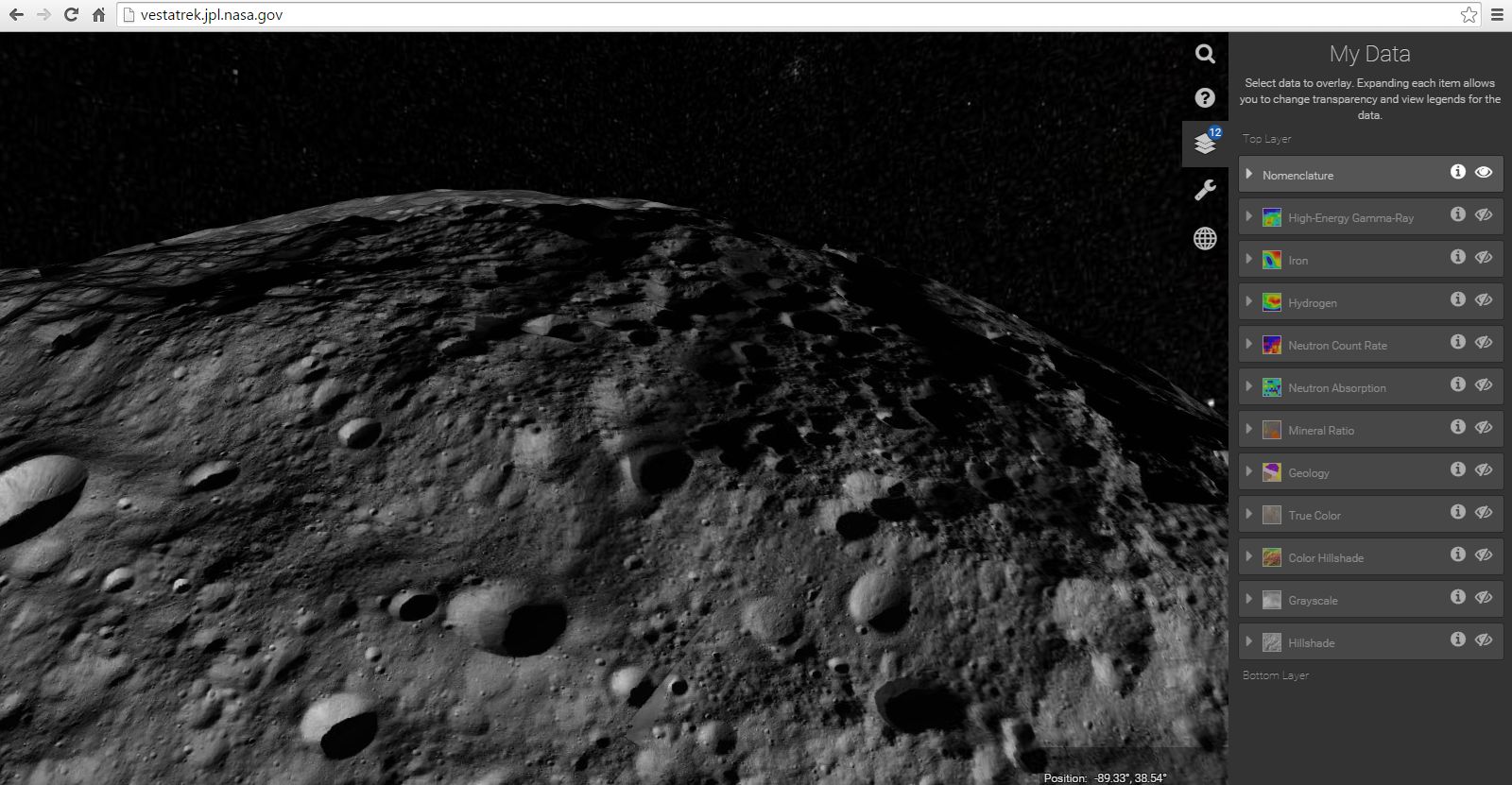
Explore Vesta with Vesta Trek

vesta_trek
Screenshot of Vesta Trek, provided by NASA

Today, NASA released Vesta Trek, a free web-based application that provides a detailed visualization of Vesta, one of the largest asteroids in the Solar System. This was made possible by NASA’s Dawn spacecraft, which studied Vesta from July 2011 to September 2012. This application includes interactive maps, the ability to print Vesta in a 3-D printer, and several analysis tools. Think of this as Google Earth, but for Vesta.

Vesta Trek was made possible by NASA’s Lunar Mapping and Modeling Project, which was initially created to provide visualization tools for our moon. Vesta Trek is the first LMMP application for a world beyond the moon, and applications for other worlds in our Solar System are currently in development. As Dawn is currently exploring Ceres, a similar application for Ceres will eventually be developed!

See Vesta Trek for yourself here!

Source


Posted in Instruments | Tagged , , , , , , , , | Comments Off on Explore Vesta with Vesta Trek

United States Space Force

It’s actually called the Air Force Space Command, and it has its headquarters at Peterson Air Force Base, Colorado. Space Command is relatively new, and the programs it has consolidated and eradicated to get to this point is impressive and a bit dizzying, but I think important to understand how the Air Force came to be not only responsible for our skies, but also the rest of the universe.

In 1946 Air Defense Command (ADC) was activated by the United States Army Air Force (the Air Force wasn’t yet its own branch at this point), with the mission to organize and administer an integrated air defense of the continental US as well as coordinate all passive means of air defense. 1950 ADC was inactivated when it became part of Continental Air Command (ConAC) but reestablished a year later. In the 60s ADC began missile warning and space surveillance missions before being redesignated the Aerospace Defense Command (ADCOM) in 1968. Air Force Systems Command was designated in 1961 after the DOD won the proposal assigning the military space mission (think Space Race) to the Air Force and the command was responsible for weapon system acquisition. The space lift and space launch operations of the Air Force Systems Command were combined with the missile warning operations of ADCOM  (that had been assumed by Tactical Air Command (TAC) in the late 70s) and formed a new Air Force major command in 1982 knows as Space Command, renamed Air Force Space Command (AFSPC) in 1985.

And there you have it, a brief yet confusing history of our militarization of space that is mostly just a jumble of acronyms.


Posted in Historical, Public Policy | Tagged , , | Comments Off on United States Space Force

Mercurial Art

“It appears that Mercury may well be a painted planet,” said Prof Peter Schultz, a co-author from Brown University.

Mercury’s dull surface has long been a point of perplexion in the field of planetary geology. Scientists have thought that there must be a mystery darkening agent contributing to the planet’s low reflectance. A new study has given that mystery a name and that name is comet.

When comets get close to the sun, their icy space-rock composition starts to crumble and the dust that is produced is high in carbon. Replicating this dust with sugar grains, researchers fired projectiles at a sugar-coated basalt rock with a four-meter cannon. When the projectiles hit basalt that was mixed with sugar, the sugar would melt on impact and produce carbon that would “paint” the surface darker. This modeled what it would be like for Mercury to be intermittently blasted with the carbon-rich comet dust as it got closer to the Sun.When the sugar was substituted for sand the researchers say the results were “less impressive,” meaning that they need to seriously consider the carbon painting theory. Personally, I’m rooting for a bright blue planet underneath all the carbon dust- I think it would liven up the inner solar system a bit.

Painted Mercury

Painted Mercury


Posted in Observables, Terrestrials | Tagged , , | Comments Off on Mercurial Art

The Goldilocks Zone: Not as elusive as previously thought?

New research from the Australian National University and the Niels Bohr Institute at the University of Copenhagen has calculated that billions of the milky Way star’s have one to three planets in the habitable zone (or nicknamed: “The Goldilocks Zone” because it is not too cold or too hot, but just the right temperature for liquid water). Below a picture shows the different habitable zones based on the different temperatures of stars. The red area is too hot for liquid water and the blue area is too cold for liquid water. The green area is the habitable zone where the temperature is appropriate for liquid water.

NASA’s Diagram of the Habitable Zone of Planets based on Temperature of Stars

The group of researchers figured this out using a law established back in late 1700s called the Titius-Bode Law. The Titius-Bode Law is a rule that predicts the spacing of planets in the Solar System. The relationship was first discovered in 1766 by Johann Titius and was turned into a mathematical equation by J.E. Bode in 1778  (Cornell University). The researchers took a close look at 151 planetary systems. These 151 planetary systems had between 3-6 planets detected by NASA’s Kepler satellite. All of these 151 planetary systems had at least one planet in the habitable zone. Don’t get your hopes up for aliens just yet, however! Just because a planet is in the habitable zone and has the possibility of liquid water does not necessary mean water is there. This research, however, reveals that our Earth might not be the only habitable planet in our galaxy.


Posted in Aliens, Exoplanets, Stars | Tagged , , | Comments Off on The Goldilocks Zone: Not as elusive as previously thought?

Do we have Jupiter to thank for Earth?

A new study by the Proceedings of the National Academy of Sciences revealed that Jupiter may just be more than the largest gas giant planet in our solar system. We little earthlings may be here thanks to Jupiter and its role in the formation of the solar system. The theory states that the inner solar system (the area between the Sun and the asteroid belt) was once home to many “super-Earth” planets. “Super-Earths” were planets in the size range from slightly bigger to Earth and slightly less than Neptune. Scientists suggest that Jupiter had an “epic, planet-shattering journey” into the Sun knocking all the Super-Earths into the Sun and destroying them. Jupiter then migrated back out to its current position. This theory attempts to explain why our own solar system is an outlier compared to other solar systems in our galaxy. As we remember from our class lectures (and our recently handed back test 3), most exceptions in solar system formation are the result of giant impacts. Jupiter would have collided with these Super-Earths resulting in a giant impacts creating exceptions and maybe accounting why our solar system might look different from other solar systems in our own galaxy. So let us all say a quick thank you to Jupiter for clearing the way for our spectacular Earth! So from us Earthlings: Thank you, Jupiter!

jupiter_Jupiter_Texture_1__
A Detailed Picture of Jupiter from March 2010

Posted in Jovians, SolarSystem | Tagged , , , | Comments Off on Do we have Jupiter to thank for Earth?