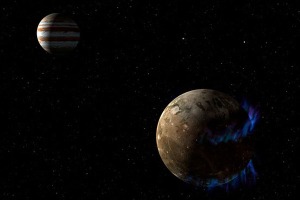
Recent evidence has shown that Jupiter’s largest moon (and the largest moon in our solar system), Ganymede, has a massive ocean lying underneath a thick layer of ice. In fact, it’s believed to have more water than all of Earth!
Ganymede, which is just slightly larger than the planet Mercury, has long been suspected of harboring liquid water. The Hubble Space Telescope has given the latest evidence in favor of this – changes in the auroras that are produced by the moon’s magnetic fields.
What is it that is allowing Ganymede, a moon so far away from the Sun, to harbor liquid water? It is small, like Mercury, and far away from the intense sunlight that the terrestrial planets face. Also, the water is under thick layers of ice, which shows that the inner layers of the planet must be warmer than the outer layers. How can this be so, when the planet is roughly the size of Mercury, which long ago lost its heat?

(A cross-section of Ganymede, with size comparisons to the Moon and Mercury)