The Potsdam Gravity Potato

Source: Universe Today

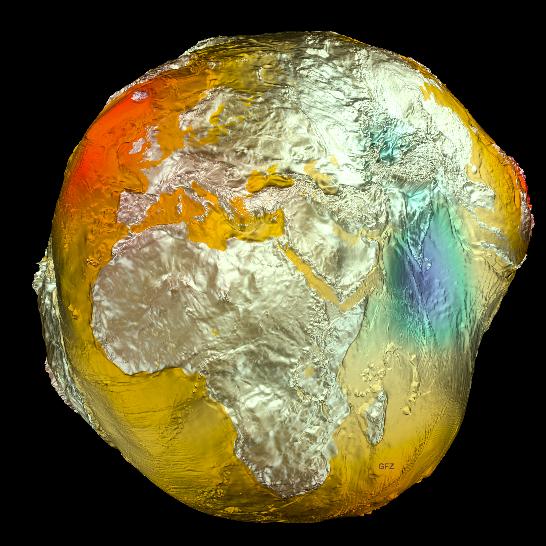
The above picture is a rendering of the Earth’s gravitational field produced by the German Research Center for Geophysics’ Helmholtz’s Center in Potsdam, Germany. Known as the “Gravity Potato,” it shows that the Earth’s gravity is not as uniform as one would think. In fact, the gravitational force is a dynamic surface that varies depending on time and location. The picture above is like a frame in a video; the Earth’s gravity shifts and fluctuates with a number of variables, such as the the melting of glaciers, the amount of water stored in river systems, and the density of land masses. The model required over 800 million observations containing over 75,000 parameters, making it an extremely difficult project to put together. Despite the difficulty, the group managed to achieve results accurate to centimeters. Ultimately, these results and future observations will have implications for a number of fields, including aerospace and atmospheric sciences. It can also be used to monitor sea levels and to understand continental geology. In addition to advancing these fields, the results are eye-opening to anyone who imagines the Earth’s gravitational field to be the same shape as the planet itself.


Posted in Physics | Tagged , , , | Comments Off on The Potsdam Gravity Potato

Spectacular arrangement of Mars, Venus and the Moon this week!

Check that out!

Later on this coming week, it is expected that Mars, Venus, and the Moon will come so close to one another in our sky, that they will be separated by less than a single degree in the sky on February 20! While given the moon’s moves along its orbit rather fast around the Earth, Mars and Venus will remain very close to one another through at least the next night or so, providing viewers with the fairly rare event of conjunction, or when two objects in the sky appear really close to one another. Despite the fact they are not particularly common, already we’ve had one conjunction last month in which Venus and Mercury appeared close to one another. Some scientists are already saying that given the frequency of expected conjuctions within the rest of the year, that 2015 should be declared “The Year of the Conjunctions.” This particularly conjunction is currently ongoing, and is expected to continue up through the beginning of next month.

You can read more about it here.


Posted in Class, Physics | Tagged , , , , , , | Comments Off on Spectacular arrangement of Mars, Venus and the Moon this week!

Black Hole!

A black hole is a mathematically defined region of spacetime exhibiting such a strong gravitational pull that no particle or electromagnetic radiation can escape from it. (Definition from Wikipedia)

General relativity indicates that a sufficient density can deform spacetime to form a black hole. The boundary of the region from which nothing can escape is called the event horizon. It has no detectable features when observing something traveling across an event horizon, because any information about the shape of the object or the charge on the object is lost to outside observers.

The simplest static black holes have mass but without any electric charge or angular momentum, which is called Schwarzschild black holes.

Charged black holes are named the Reissner–Nordström metric, while the Kerr metric describes a rotating black hole, and Kerr–Newman metric describes a black hole with both charge and angular momentum.

Structure of a black hole:

Event horizon: The defining feature of a black hole is the event horizon-a boundary in spacetime, from which no particle of electromagnetic radiation can escape.

Singularity: At the center of a black hole there is a gravitational singularity, where the spacetime curvature becomes infinite.

Photon sphere: The photon sphere is a spherical boundary where photons moving along the tangent line to the sphere will finally travel in a circular orbit.

Ergosphere: The ergosphere is an oblate spheroid region outside of the event horizon, where objects cannot remain stationary.


Posted in Class, Physics | Tagged , , | Comments Off on Black Hole!

The Dual Nature of Light

One thing that has always fascinated me about light is that is that it has both wave-like properties and particle-like properties. Intuitively, light seems like a wave, and Young’s double slit experiment – which can and has been recreated easily in freshman physics labs – seems to show “definitively” that it is a wave. But in the early’s 20th century, work by Einstein and Max Planck showed that light was actually composed of discrete “packets” of energy – particles that would later be known as photons. These two findings seem contradictory given what was thought about physics at the time, but it has since been accepted that light is simultaneously a particle and a wave. Even more astounding – so is matter. All physical objects actually have a feature called a wavefunction – basically a “probability cloud” that specifies the probability of that object being found in that specific place. While this feature of matter is only observable for very small particles, it exists for all matter. In this way, the dual nature of both light and physical matter challenge how we think about the world around us.

For more information, see Rosenblum, Bruce, and Fred Kuttner.Quantum Enigma: Physics Encounters Consciousness. Oxford: Oxford UP, 2006. Print.


Posted in Light | Tagged , , , | Comments Off on The Dual Nature of Light

Earth in Infrared

Source: rt.com

Two of NASA’s geosynchronous satellites, GOES 13 and GOES 15, have captured infrared light emitted from the Earth, and a University of Victoria graduate student recently used this data to put together a video that shows the behavior of this light over a two month period. Infrared light is generated by heat from the Earth’s surface and is then absorbed into clouds and water vapor in the Earth’s atmosphere. The resulting video shows the fluid motion of the Earth’s atmosphere in a way that is normally invisible to our eyes. The idea that there is light that is imperceptible to us is hard to grasp, but it becomes clearer when our technology opens up new phenomena like this one for us to explore. Videos like this one help us understand that there are probably many things about our own planet that we take for granted because of the limitations of our senses. Over time, our technology will allow us to learn more and more about the universe and ourselves.


Posted in Light | Tagged , , | Comments Off on Earth in Infrared

Special Relativity

In physics, special relativity (SR, also known as the special theory of relativity or STR) is the accepted physical theory regarding the relationship between space and time.(Definition from Wikipedia)

At the end of the 19th century, Maxwell equations of electromagnetism had been proved by plenty of experiments. However, Maxwell equations are not consistent with the Galilean transformations in Newtonian physics. As a result, Albert Einstein corrected the Newtonian mechanic under situations involving motion nearing the speed of light, and proposed the special theory of relativity in his paper  “On the Electrodynamics of Moving Bodies“.

The special theory has many consequences, including length contractiontime dilationrelativistic massmass–energy equivalencea universal speed limit, and relativity of simultaneity.

The special relativity put forward the replacement of Galilean transformations of Newtonian mechanics with Lorentz transformations, defining how measurements of space and time by two observers are related.

The theory is called “special” because it applied the principle of relativity only to the special case of inertial reference frames. In 1915, Einstein published a paper on general relativity  to apply the principle in general cases.


Posted in Class, Physics | Tagged , , | Comments Off on Special Relativity

“Where are they?”

Enrico Fermi, the Italian physicist, was once having a casual conversation on UFO reports with his colleagues during a lunch break at the Los Alamos National Laboratory in 1950. He had exclaimed “Where are they?”, alluding to extraterrestrial life. Fermi was perplexed that despite the large probability of alien life not only existing but also colonizing planet systems, there was no evidence of alien contact with Earth. This conversation led to the naming of the paradox known as the Fermi Paradox.

The Fermi paradox is the contradiction between high estimates of the probability of the existence of extraterrestrial civilization and humanity’s lack of contact with such civilizations. The contention that contact with an extraterrestrial civilization is likely lies in the fact that the galaxy houses billions of stars, a few of which may contain Earth like planets. Intelligent life could have developed in these Earth like planets and could have developed interstellar travel; this is very likely as there are billions of planets in our 10 billion year old galaxy that are millions of years older than the Earth.

But what about the great expanse of the galaxy, let alone the universe? Surely even with faster-than-light travel, interplanetary travel will take hundreds of years. Without FTL technology, colonizing a galaxy might take hundreds of millions of years, perhaps outstripping the lifetime of the colonizing civilization as itself. However, an advanced civilization could create self replicating exploration probes, such as the theoretical Bracewell-von Neumann probes. With sub light speed travel, such probes could colonize the Milky Way in 4 millions years; given the age of our galaxy, an advanced civilization could have colonized it 250 times over !

Plausible Timeline of the Colonization of the Milky Way

colonize_galaxy

Some plausible explanations to this paradox include difference in communication protocols. Even if aliens are here, they may not use electromagnetic waves for communication; their understanding of mathematics itself might even be completely different than ours! Or perhaps, we ARE THEM; the Earth being the outpost of a civilization that has long lost contact with founding specie and home world!


Posted in Aliens, Universe | Tagged , , | Comments Off on “Where are they?”

Tides

Have you ever been to a beach and wondered why at some times of the day, the ocean water reached further onto the land than at other times of the day?  You may have heard the terms ‘high tide’ and ‘low tide’. Tides are caused by the gravitational force of the sun and moon, as well as the rotation of the Earth. Even though the sun is much bigger than the moon, the moon plays a more direct role on how the tides of the various bodies of water on Earth happen. The Moon’s gravity brings together the Earth and the moon. However, as the moon is closer to the side of the Earth facing the moon than the other side of Earth, this creates tidal a stretching force called tidal force that creates two tidal bulges. According to the Cosmic Perspective: The Solar System ( 7th edition textbook) Chapter 4, Earth’s rotation carries any location through each of the two tidal bulges on Earth, resulting in two high tides in a given day. Low tides happen when the location is halfway between the two tidal bulges. The next time you go to the beach and see that it is either high tide or low tide, you can understand why it is happening!

High Tide

High Tide in Venice, Italy


Posted in Class, Universe | Tagged , , , | Comments Off on Tides

The Search for Life and the (Not So) Habitable Zone

The question of other life in the Universe is one that has long plagued scientists and astronomers. The pure size of it makes it supposedly statistically probable that if life can happen on Earth, then it can (and probably does/has) happen elsewhere. Because the only type of life that we know is our own, scientists have been searching for planets that have a lot of the same properties as Earth: water existing in a solid, liquid, or gaseous form on the surface is one of what is believed to be the core necessities to life. This requires a very specific temperature range which can only be achieved within a certain distance from a planet’s star. NASA recently discovered a planet that exhibits many of these desired qualities and is considered to be in the Habitable Zone of its star: Kepler-186. However, being within the Habitable Zone does not mean that the planet has the right temperature. The chemical composition of the atmosphere of Kepler-186f may cause the surface of the planet to be much hotter than its position suggests. The so-called Habitable Zone is really just the starting point for NASA scientists, who now work towards discovering if Kepler-186f is, in fact, a larger version of Earth.

 NASA
NASA

Posted in Universe | Tagged , , , | Comments Off on The Search for Life and the (Not So) Habitable Zone

The Continual Search for Planets

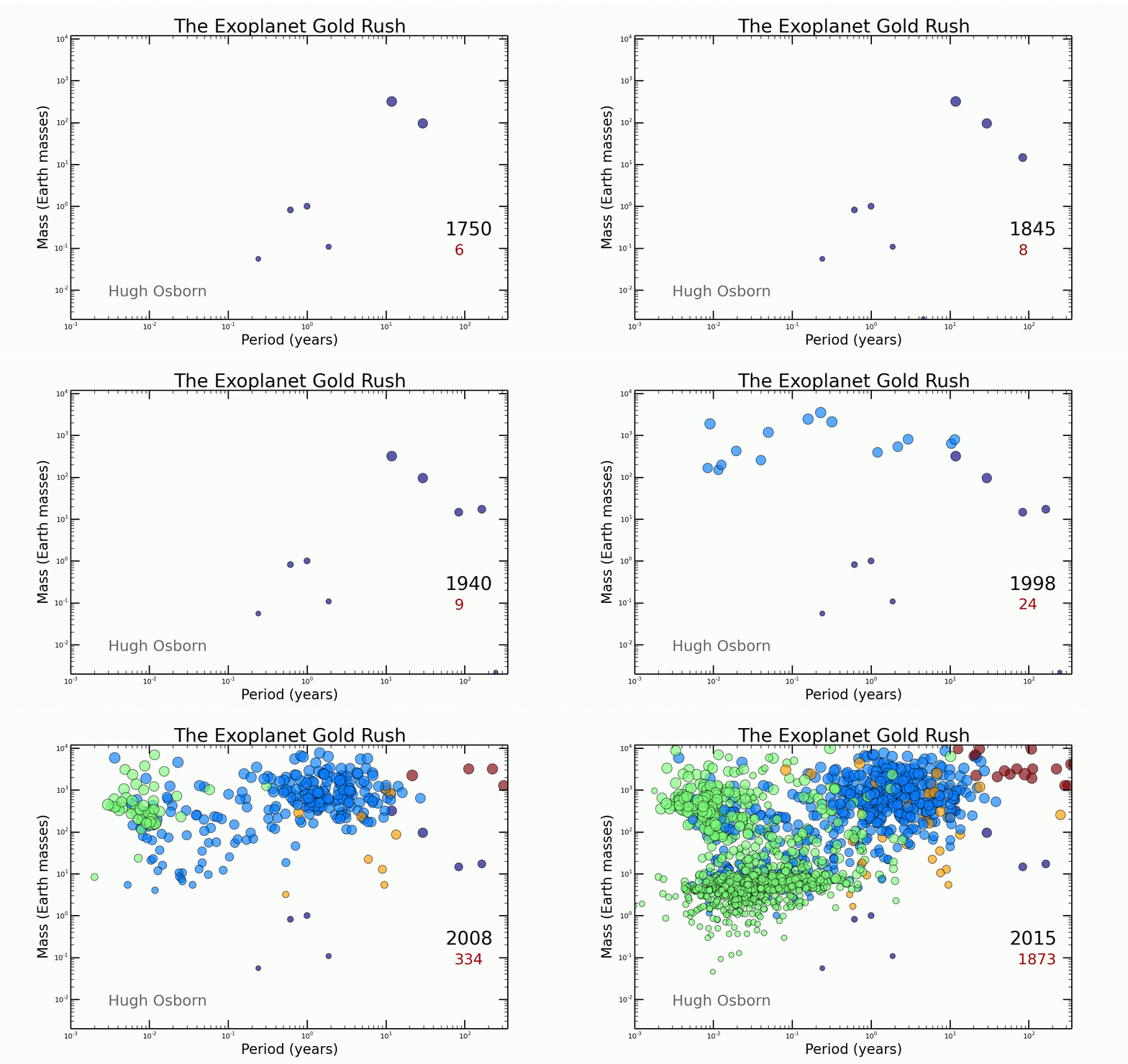
The discovery of planets throughout the ages

The discovery of planets throughout the ages

The discovery of new life-harboring planets has been a hot topic in the last century, but there has always been a limitation: we couldn’t see other planets. However, observational technologies and techniques have progressed to the point where we may be able to find more Earth-like planets within a few short years.

The main problems with discovering so called exo-planets is that they are not luminous, they don’t shine. Because of this, we need to indirectly detect them by observing the stars around which they orbit. As the planets orbit their respective stars, they briefly block some of the light from reaching us; however, that only works when the systems are exactly in-line with ours, which rules out the vast majority of systems.

There is one other way, though, which involves measuring the “wobble” in the star as the planets orbit. As the planet circles, it exerts a gravitational force on the star, causing it to wobble ever so slightly. This has allowed us to find planets that have a radius equivalent to the diameter of our Earth, but hopefully that size will shrink as we continue to develop new and more precise observational technologies.


Posted in Exoplanets, Instruments, Stars | Tagged , | Comments Off on The Continual Search for Planets