When in Polynesia…sail as the Polynesians do

Old traditions have come back to life in Polynesia, and you can take part. Tucked deep within the Cook Islands is an adventure-travel service that will teach you how to navigate the seas with nothing more than the celestial bodies above. The boat you will travel on is equipped with one of the coolest ancient navigation chart’s I’ve ever seen carved directly into the wood. By lining the map up with where certain constellations are rising over the horizon, you can ensure accurate travel. The fact that a culture became so adept at sea-faring is simply astounding.

Polynesian star chart


Posted in Class, Historical | Tagged , | Comments Off on When in Polynesia…sail as the Polynesians do

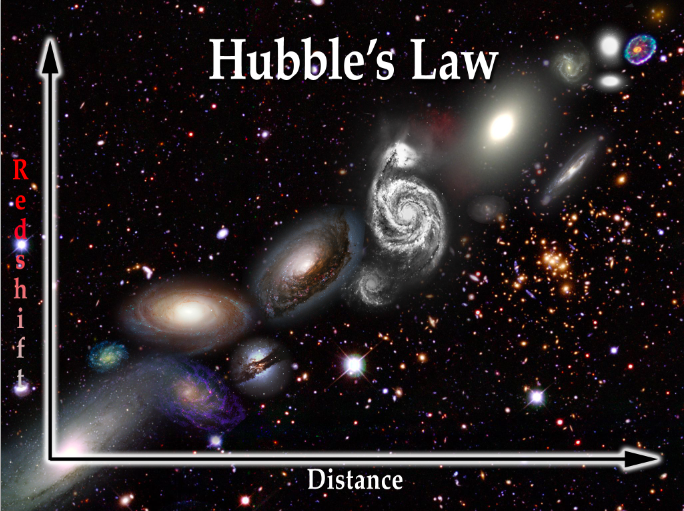
Hubble’s Law

hubble-law-by-tony-farley1

Photo Source: Hubble’s Law

Considering the topic of what light can tell us, Hubble’s Law is one topic I’ve always found greatly interesting.  As the picture suggests, the redshift of a distant galaxy is in direct linear proportion to its distance from Earth.  This is the essence of Hubble’s Law – which relates a galaxy’s radial velocity from us to its distance – this means that we can find out how far something is from us just by looking at it!

Mathematically, it is given by v=Hd (v – radial velocity; H – Hubble’s constant; d – distance).  Astronomers can find the speed of a galaxy away from us by its redshift, and then it’s easy to solve for its distance!  In fact, Hubble’s Law is what has indicated to physicists that our universe behaves as a uniformly expanding body.  Just one of the many things that light can tell us about the universe!


Posted in Galaxies, Light, Physics, Universe | Tagged , | Comments Off on Hubble’s Law

What if Earth is the Center of Our Solar System? (Part 1)

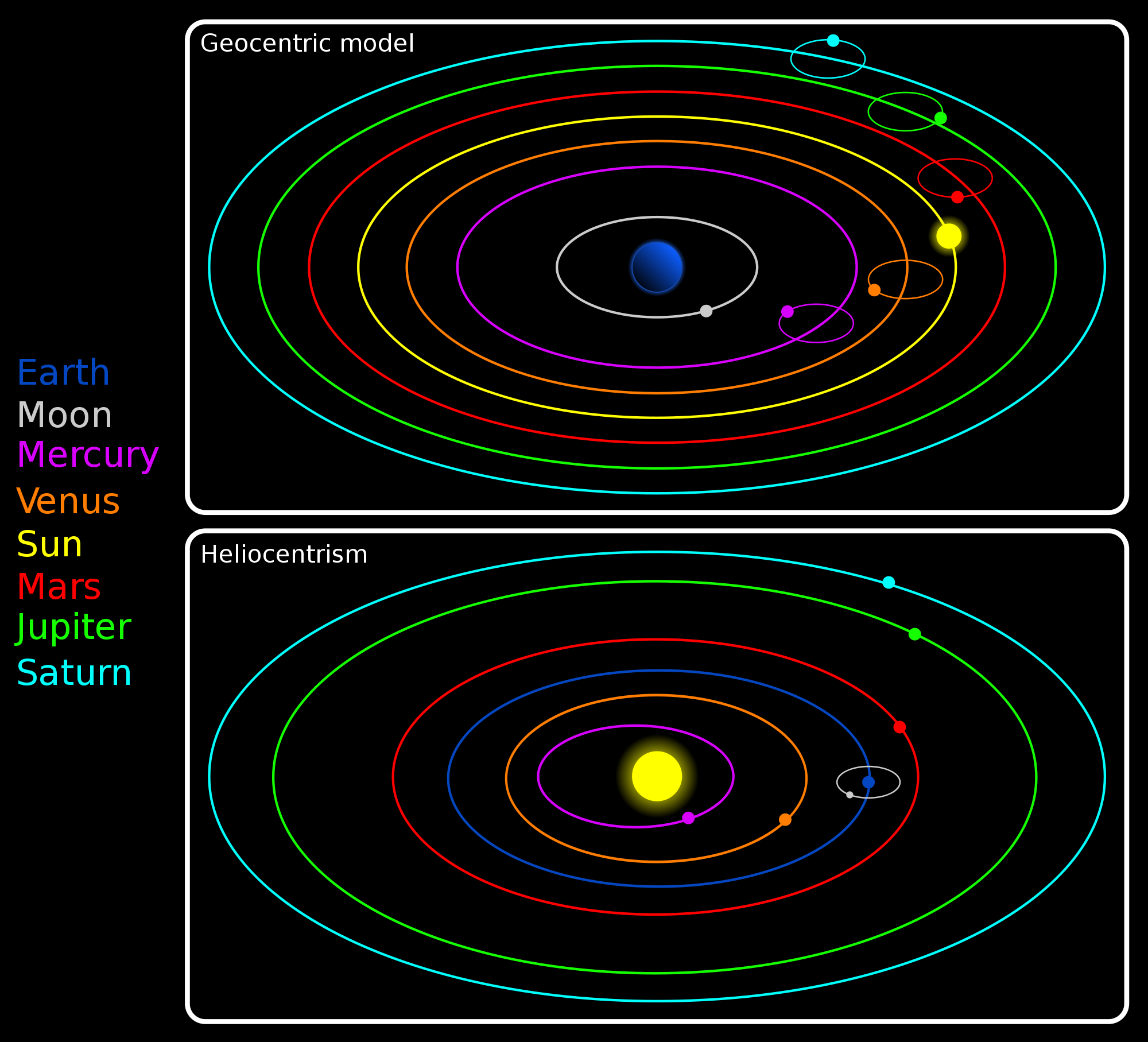
From the time of ancient Greece, people were convinced that Earth was the center of the universe. The theory of geocentric was still believed by public and authorities until the time of Renaissance. However, what if Earth suddenly becomes the center of our solar system? We can consider what will happen if the geocentric really comes true.

Ptolemaic-geocentric-model

Mercury was the closest planet to the Sun, so now it’s the closest planet to the Earth. Because the distance between Mercury and Sun was so close, the traveling speed of Mercury was so fast and the gravity of Earth is unable to maintain Mercury in its current orbit, it is very possible for the Mercury to “fly away” along one of its orbit’s tangent line. And if the tangent line is not close to where the Sun is right now, it’s very possible for our solar system to lose Mercury forever.

Venus is farther away from Earth but close to the Sun right now. If the starting position of Venus is close to the Sun, it may develop another orbit around the Sun. If not, we are losing Venus, too. However, as the orbiting speed of Venus is much slower than that of Mercury, we have longer time to say goodbye to Venus.

Although the Sun is located where the Earth was, Earth now still orbits the Sun for its massive mass. As the lost of Venus and Mercury, now Earth becomes the closest planet to the Sun.

The Mars has a much smaller mass than Venus so it has a greater opportunity to be pulled back by the gravity of the Sun after it flew away along a tangent line. If it is pulled back, the Mars can form a ellipse orbit with a large eccentricity and its perihelion and aphelion’s distances from the sun are very different. Now the orbit of Mars seems like an orbit of a comet.

(To be continued)

2000px-Geoz_wb_en.svg


Posted in Class | Tagged , , | Comments Off on What if Earth is the Center of Our Solar System? (Part 1)

Time to Understand the Tides

Even though I am from Colorado, I have to admit that I am more of a beach person than a mountain person, and a fascination with the tides has always been inherent in my love for the beach. However, until reading Chapter 4 of the textbook, I had never understood exactly why or how the tides occur and had always fallen victim to the common misconception that the Moon’s tugging of Earth’s oceans toward it causes the tides. Now, I am glad to say that I understand that it is in fact the difference between the force of gravity on each side of the Earth that results in tidal force.

Most of all, I am continuously amazed by the degree of interconnectedness between different objects in the Solar System, especially the Earth, Moon, and Sun. Although the fact that distance between the Earth and the Moon is much smaller than the distance between the Earth and the Sun results the Sun’s tidal force on the Earth only being about half of the Moon’s tidal force on the Earth, the tidal effect of the Sun must not be overlooked. During new moon and full moon, the tidal forces of the Moon and the Sun synchronously, and this teamwork between the Sun and the Moon produces intensified spring tides. On the other hand, during first- and third-quarter moons, the tidal forces of the Moon and the Sun fight each other, creating weaker neap tides.

The highest tidal range around the world occurs at the Bay of Fundy on the Atlantic coast of North America between New Brunswick and Nova Scotia. According to the Bay of Fundy website, the bay fills and empties more than a billion tons of water twice daily during each tide cycle. The enormous range of the tides at the Bay of Fundy is perfectly illustrated in this time-lapse video of a spring tide (when the tidal force is even more intense than usual) at the bay.

The Bay of Fundy 


Posted in Moons, Sun | Tagged , , , | Comments Off on Time to Understand the Tides

Archaeoastronomy: A Connection between Ancient and Modern Cultures

I have always been fascinated by different cultures and how cultures interact with each other. Thus, whenever I learn about a new subject, I always try to approach it from a cultural perspective. I had not found a way to do so with astronomy until I learned about the field of archaeoastronomy. I am especially fascinated by archaeoastronomy’s interdisciplinary combination of anthropology, history, science, and astronomy. As I discussed in a previous blog post about the Cosmic Calendar, although the human history that we usually study makes up a miniscule part of the history of the universe, it is nonetheless significant. No matter all of the differences between people and cultures throughout thousands of years, every single person has observed the sky in some shape or form. It is absolutely incredible to realize that we are all connected in this way.

Beyond simply looking at the sky, many cultures throughout history have made significant astronomical accomplishments in their meticulous observations of the sky. Archaeoastronomy makes it possible to study the physical evidence of the astronomical studies and achievements of these cultures. However, some archaeoastronomical evidence is not straightforward and is the subject of much debate, as it can be difficult for scientists to understand completely. For example, it is not clear exactly what the lines and patterns etched into the sand in the Nazca desert by an ancient culture in modern day Peru mean. These patterns could represent some of the recognizable constellations of the geographic area, but there is no way to know for sure. Beyond the physical evidence, archaeoastronomy also helps scientists understand the motivations and goals of ancient builders (such as the connection between folklore and Pawnee lodges in Kansas) and begin to grasp the astronomical sophistication of some ancient cultures.

Although archaeoastronomy may not provide all of the answers that scientists seek, it serves as a representation that the study of astronomy connects the modern world to ancient cultures

.nasca-lines-golomb_28404_600x450

The Lines in The Nazca Desert (Source: National Geographic)


Posted in Class, Historical | Tagged , , , | Comments Off on Archaeoastronomy: A Connection between Ancient and Modern Cultures

It’s About Time

Most of us have calendars hung in our kitchens or virtual apps constantly berating us with times, dates, and upcoming holidays. But have you ever stopped to think about where calendars came from or why our society relies so devotedly on them? How did we decide to divide our time that way? Why did we all agree on the same calendar?

western calendar

Modern Gregorian Calendar (Web Design Tunes)

Calendars were first used in the time of the Ancient Egyptians and Babylonians to help predict changes in weather, especially for the purpose of agriculture. Ancient farmers noticed that flooding or dry spells tended to happen over and over again, with equally spaced time in between each occurrence. If they could tell when floods or heavy rains would hit, farmers could prepare to irrigate this water efficiently to crops or to save it to use during subsequent droughts. Of course, it was hard to map out exactly when these events would occur, so ancient civilizations looked to patterns that were a little more reliable – the movement of the stars.

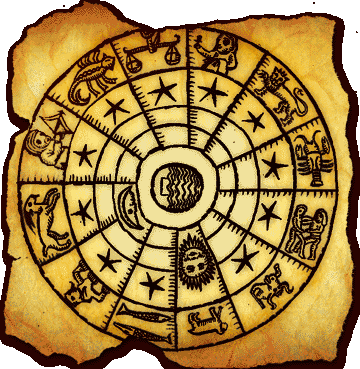
The Egyptians were the first to see that constellations, groups of stars seen with the naked eye, moved around the sky in predictable patterns. The twelve constellations that we think of as Zodiac signs even seemed to chase each other in a circle around the sky. The time that it took for one of these constellations to return to the same place in the sky (at the same time of night) was classified as a year. Years were subsequently divided into twelve months of thirty days each.

The Babylonians, existing shortly after the time of the Egyptians, went on to define the month as the time between identical crescent moons. It was at this point that the calendar became lunisolar – relying on patterns of motion of the Sun and Moon through the sky (See different types of calendars here. The next major calendar to come into play was that of the Romans. Its most important additions included February as a twenty-eight day month, the division of months into weeks of seven days, and the proclamation that leap years would occur every four years to keep the calendar in line with Earth’s revolutions around the Sun, which take about 365 days and 6 hours (See here for more about leap years). At this point, the calendar was important not only to keep track of agricultural patterns but also to sustain the logistics of an expanding economy, which reached from Rome to other parts of Europe, Africa, and Asia. (See Time Center’s History of the Western Calendar or Exovedate for more about the Roman calendar.)

The most recent calendar used in the Western world is the Gregorian calendar, which was endorsed by Pope Gregory XIII in 1582. It includes the omission of three leap days every four hundred years to account more exactly for Earth’s revolution around the Sun, which is really about ten minutes short of 365 days and 6 hours. The Gregorian calendar is the official calendar in Europe and in most parts of the world. However, other calendars are used by various cultures. For example, the Chinese calendar varies in number of days per year and adds a thirteenth month for leap years. Many Islamic calendars rely on local observations of moon cycles, which can vary slightly depending on the weather and the location of the observer, so they are not constant among regions or countries. For a list of more calendars in use today, see here.
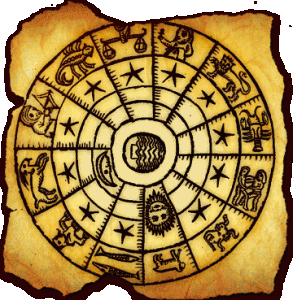
julian calendar

Ancient Julian Calendar as used in Rome (Hotel Rome)


Posted in Historical, Sun | Tagged , , , , , , , , , , , , | Comments Off on It’s About Time

Think Saturn’s rings are cool? Think Bigger.

saturn201

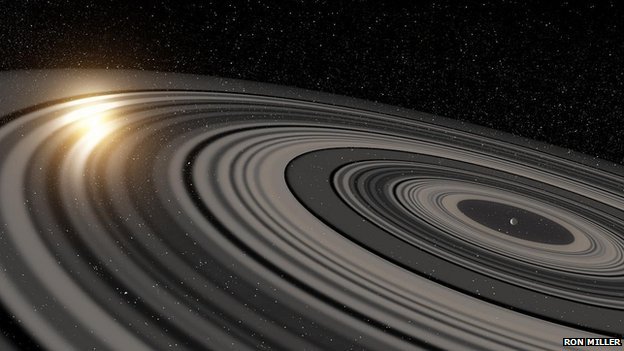
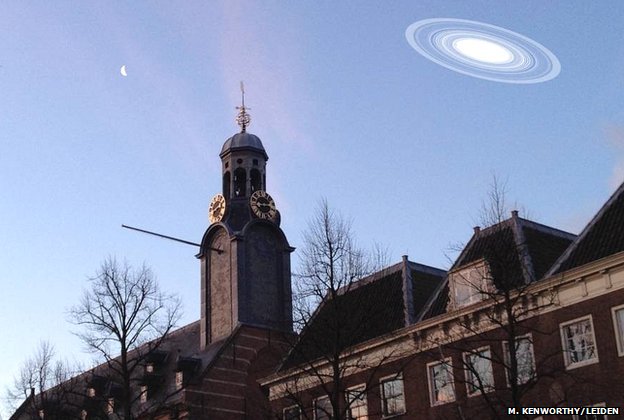
Saturn’s rings are large, 175,000 miles across large, but as the old adage goes-bigger is better. Scientists looking at exoplanets have discovered a planet with rings 200 times larger than that of Saturn’s. The planet itself, known as J1407b, is guessed to be a gas giant 10 to 40 times larger than Saturn. Scientists hope they can observe these rings over time and learn about the formation of moons around gas giants similar to our solar system.

(An artist’s rendition of J1407b if it were in the place of Saturn in our Solar System)

saturn200


Posted in Exoplanets | Tagged , , , , , , , | Comments Off on Think Saturn’s rings are cool? Think Bigger.

Tour de Light

If you’re like me, when you think of light you think of the visible light spectrum, the colors of the rainbow. In reality light is much more than what we can see with our eyes, the spectrum extends far in both directions. Through the use of this interactive tool, you can fully explore the spectrum of light. Since electromagnetic radiation is the only way we can receive information from the universe, it’s very helpful to have a full understanding of light because one day you could be the man or woman behind the telescope on the brink of the next astronomical breakthrough!electromagnetic-spectrum-in


Posted in Light | Tagged , , , | Comments Off on Tour de Light

Smiling Galaxy Cluster Found in Space!

That’s some intense gravitation lensing!

A cluster of galaxies was recently discovered by the Hubble Telescope (AKA, uber relevant to class!) that appears to take on the shape of a bright smiling face. The galaxy cluster, known as SDSS J1038+4849, recently had the above picture taken by said telescope. While it may appear to us that the stars are actually smiling, the truth is that this image is actually the result of some major gravitational lensing. In essence, there is so much mass in the direction of these galaxies, that their gravity is actually bending the light that approaches us (more proof of Einstein’s theory of general relativity!). Another likely conclusion is that the bent galaxies above are likely much further away than the two “eyes” in this picture. Given that the only other major galaxy in our local cluster is Andromeda, and that these two “eye” galaxies are beyond our cluster, the bent galaxies must be even further than that! The scale of the universe is amazing!

Read more here.


Posted in Class, Galaxies, Physics | Tagged , , , , , , , , , , | Comments Off on Smiling Galaxy Cluster Found in Space!

Radio Telescopes: Like Car Radios, but Bigger

When we think “telescope”, we picture peering through a viewfinder or viewing images of the stars. However, visible light is only a small part of the electromagnetic spectrum; we can learn much about our galaxy by viewing visible light’s less frequent older brother, the radio wave. Radio telescopes are the technological descendants of actual radios (like the one in your car!). Karl Jansky, who worked for Bell Telephone Laboratories, created a large radio antenna to test for sources of static which would interfere with radio telephone calls. He identified static from nearby thunderstorms, but heard a constant “faint hiss.” This “faint hiss” was radiation from the universe, concentrated in the Milky Way galaxy.

Radio telescopes typically look like huge dishes with an antenna. Currently, astronomers often use radio interferometers: series of connected radio telescopes. While radio interferometers are used to observe information about galaxies, planets, and nebulae, some of the most groundbreaking work in radio astronomy is taking place examining cosmic background radiation. Cosmic background radiation is the thermal radiation left behind from the Big Bang. Differences in radio frequencies of cosmic background radiation reveals early differences in temperature which dictated how stars and galaxies form. Thus, radio telescopes can reveal how and why the universe formed the way it did.

hintergrundstrahlung

Photo source

Posted in Class | Tagged , , | Comments Off on Radio Telescopes: Like Car Radios, but Bigger