Tidal Changes from a Beach Stand

I worked for two years renting out beach umbrellas and chairs at Assateague State Park for two summers in high school. I would walk out to the beach and set up my little stand next to a fence used to protect the dunes from wandering beach-goers. Assateague has a very large sandbar and some days I would be able to walk very far out at low tide without going in the water. This obviously made problems for my business because often people wanted to get as close to the water with their rented equipment, which would then be quickly submerged by the rising tide through the day. These days of very strong tidal differences were caused by “spring tides” which are caused by the Sun, Moon, and Earth in a line. The greater force causes a noticeably higher high tide along the plane, and in turn a lower low tide perpendicular to this plane.

 Tides

The opposite, when the Earth’s focal point creates a right angle between the Sun and Moon, is known as a “neap tide”. These tides are almost half the strength of spring tides, which was very nice for the beach rental business because people tended to choose spots that would not be overtaken by the tides throughout the day. An interesting note, in many areas surfers prefer the spring tide because it tends to create much larger waves, but at Assateague the sandbar is so large that it creates an amplified wave space during neap tides.

 National Park
National Park

Tides


Posted in Observables, Physics | Tagged , , | Comments Off on Tidal Changes from a Beach Stand

The Super-Saturn

Credits: Sci-News
Credits: Sci-News

Astronomers in the University of Rochester recently discovered a planet with a massive ring system that dwarfs Saturn’s rings. Exoplanet J1407b is a gas giant with 10 to 40 times the mass of Jupiter orbiting a 16-million year old star located 434 light years away. Scientists usually find and study exoplanets and stars when the planet moves in front of the star (from Earth’s perspective) creating an eclipse. Usually passing exoplanets will cause a dimming in the light of the star that is received on Earth for a couple of hours. But when studying star J1407 and its exoplanets astronomers observed dimming in the light of the star during for almost two months. They were actually observing the exoplanet J1407b with its spectacular ring system. This planets ring system is more than 200 times the size of Saturn’s ring system. The planet has 37 rings and each ring is millions of kilometers in diameter.  Scientists estimate that the mass of the particles in the rings equals at least the mass of the Earth. Such a huge ring system dwarfs any ring system in the Solar System. Astronomers call J1407b a super-Saturn. If Saturn had rings as large as those, they would be easily visible from Earth because they would be several times the size of the full moon. I personally find it fascinating to think that such a massive ring system exists out there. Sources: TechTimes, Sci-News


Posted in Class, Exoplanets | Tagged , , | Comments Off on The Super-Saturn

Hubble Telescope

In April 1990 NASA launched the Hubble Telescope in an orbit around Earth. The telescope has been orbiting Earth for almost 25 years and is monumental in its contribution to science. The information gathered by the telescope has helped astronomers to narrow down the age of the universe down to a few hundred million years, prove that all galaxies with bright centers have a super-massive black holes in the center and many more fundamental discoveries. But the Hubble Space Telescope Mission is bound to end one day. The telescope has been serviced through shuttle missions five times in its life. Those missions have helped both correct issues with the telescope and prolong its useful life.  But the fifth mission in 2009 is planned to be its last one leaving the telescope’s instruments to decay over time and the telescope itself exposed to continuous drag from Earth’s atmosphere. Currently, NASA expects Hubble to be able to operate at least until 2019. At the end of its useful life, though, certain procedures need to be undertaken for the safe de-orbiting of the space observatory. Hubble is nearly 44 ft long which means that it will not fully disintegrate in Earth’s atmosphere during its fall. But NASA has a plan for that. During the last servicing mission, astronauts attached a ring-like devise to Hubble’s bulkhead called a Soft Capture Mechanism (see the second picture below) that will make it easier for a robotic shuttle to “grab” the telescope and direct its de-orbiting. NASA is still working on the development of a robotic shuttle that will be able to do that. This means that Hubble will never make it back to Earth in its entirety though. It is most likely that the majority of it will burn out on its way down. Even though Hubble will not survive this, its legacy will continue to be one of the most fundamental discoveries about the universe of its time. Sources: Space.com, Hubblesite, NASA

Credits: Spacetelescopes.org
Credits: NASA
Credits: NASA

Posted in Class, Instruments | Tagged , , , , | Comments Off on Hubble Telescope

Jupiter’s Galilean Moons

moons

Following our extensive discussion in class about the effects our Moon and the Earth have on each other (tides, speed of rotation) I became very curious about other planets and how they interact with their moons, specifically, Jupiter because it has a whopping 63 moons orbiting it. However, the main moons we ever really hear about are the four Galilean Satellites, named so because they were first discovered by Galileo.

So, I did some googling, not really sure what I would find, and I found this page. This page was chalked full of crazy things I never knew about these moons. There is way too much to put here in this blog so I will highlight some of the more interesting things about each moon and I encourage you to go read the page for yourself.

tidal-heating

Io: “Io is the most geologically active world in our solar system.” It constantly has volcanic eruptions that are, in part, caused by its tumultuous orbit around Jupiter as shown in the illustration above.

Europa: Europa is a moon covered in ice and a deep ocean and based on the way its spin changes with relationship to Jupiter’s spin supports the idea of magnetic fields being induced by the two celestial bodies. This suggests that the oceans are most likely salty, like here on Earth, as an ion solution (such as salt water) is necessary to create such magnetic fields. Also, the most exciting find: “Europa is the most likely place in our solar system for current life to exist beyond the Earth, even more likely than Mars.” 

Ganymede: Ganymede is the largest of Jupiter’s moons and is even larger than Mercury. But since it orbits Jupiter and not the sun it is not considered a planet. Parallel ridges line the surface that suggest some sort of plate tectonics in the past but it is thought that any geological activity has not happened in hundreds of millions of years.

Valhalla

Callisto: I think the coolest thing about Callisto is its massive impact site named Valhalla. When an asteroid hit Callisto, it exploded on impact heating the ice on the surface to melting temperatures. The water however froze in a ripple pattern making Valhalla look very much like a bullseye as evidenced in the picture above.

I had a lot of fun reading about these moons. We learn about all of the planets from such a young age but we never focus on any other moons and I for one think these four moons are way cooler than Mercury.


Posted in Moons | Tagged , , | Comments Off on Jupiter’s Galilean Moons

The 12…wait, there’s 13?…Zodiac Signs

If you’re like me, you identify pretty deeply with your zodiac sign. Although I don’t believe that every word of my horoscope is necessarily true, I still like to think that I embody all the qualities of a Leo. In addition, it’s entertaining to read my horoscopes from time to time, even though they aren’t the most reliable.
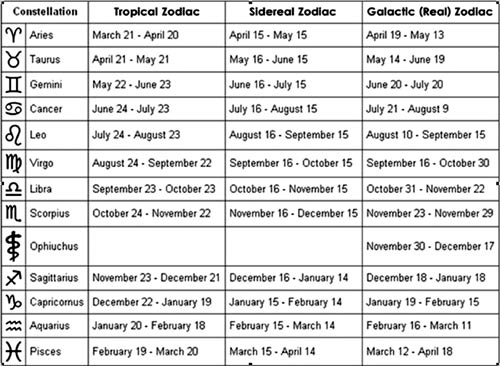
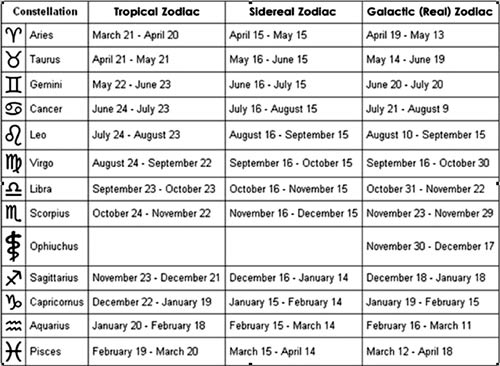
And then the news came out that there was a new, 13th zodiac sign…Ophiuchus. No longer was I a Leo, like I had thought myself to be my whole life. I’m now supposedly a Cancer, and even though I know very well that horoscopes don’t apply in real life whatsoever, I still felt extremely betrayed. And to this day, I firmly still consider myself a Leo, and am unable to see myself embodying any Cancer-like characteristics.
The origin of astrology was as early as the second millenium BC, where the interpretation of celestial cycles was used to predict seasonal shifts and as a form of “divine communication.” The modern zodiac as we know it today has its roots in Greco-Roman culture. Dividing the year into 30 degree sectors along the ecliptic, the Greeks found that the sun passed through 12 constellations there, one in each sector. The constellations were already named according to Greek mythology, and so the original zodiac was made up of Aquarius, Pisces, Aries, Taurus, Gemini, Cancer, Leo, Virgo, Libra, Scorpio, Sagittarius, and Capricorn. Ophiuchus now falls between Scorpio and Sagittarius due to the fact that the sun’s passing through a constellation’s position has changed since the Greeks originally documented the 12 zodiac signs, resulting in it being added as the “13th” zodiac sign.
Although Ophiuchus is now part of the horoscopes, don’t worry if you’re no longer the sign you thought you were. Science has ultimately outweighed astrology time and time again, so it doesn’t really matter what horoscope you read…it probably won’t come true anyways.


Posted in Class, Stars | Tagged , , , | Comments Off on The 12…wait, there’s 13?…Zodiac Signs

The Mystery of Stonehenge

The mysterious, striking structure of Stonehenge has fascinated archeologists, historians, and many people alike ever since its discovery. There are a multitude of theories as to what its purpose might have been, such as an astronomical observatory, a religious/spiritual site, and some even believe that it was placed on Earth by extraterrestrials.
Many archeoastronomers believe that Stonehenge was an ancient observatory of sorts. Evidence to its structure points to it possibly being used to mark the solstices and equinoxes because it has a large opening in its earthwork facing the northeast. On the summer solstice, the Sun rises very close in alignment with the Heel Stone, and its first rays shine directly into the center of the horseshoe arrangement. Some believe that this is just a coincidence, but to others, this is definitive proof that the builders of Stonehenge planned its structure for astronomical purposes.
Still, no one is truly sure why Stonehenge was built, or by who. The Sun does not rise directly aligned with the Heel Stone, and this was originally believed to be the case due to obliquity of the ecliptic and its changes over time. However, astronomers’ calculations show that at the estimated time of Stonehenge’s building, this alignment would have been even farther off than it is today. Thus, the debate over Stonehenge continues. There is a strong possibility that Stonehenge was originally intended to be an observatory of sorts, but other theories may still very well be possible.


Posted in Historical | Tagged , , | Comments Off on The Mystery of Stonehenge

Blog Post #3: The Magellanic Clouds

When we were discussing celestial navigation in class, a thought occurred to me: if Polaris cannot be seen in the southern hemisphere, then what did navigation in this part of the world look like in the age of exploration?

The first explorer that popped into my head was Ferdinand Magellan. He circumnavigated the earth, and the majority of his route was in the southern hemisphere (See below).

magellan2

Robinson Library

Turns out, Magellan and his team used two celestial “clouds” to navigate the night sky. These clouds have since been named the Magellanic Clouds. They are actually two dwarf galaxies that are believed to be orbiting the Milky Way. These two clouds can be seen best on moonless, cloudless nights in the southern hemisphere, and form an equilateral triangle with the third point being the south celestial pole.

South-Celestial-Pole

Science Blogs

This is a picture of the triangle the Magellan Clouds form with the south celestial pole. Using this visual, Magellan, a Portuguese explorer from the northern hemisphere, was able to successfully circumnavigate the world and find his way through both hemispheres with differing night skies!


Posted in Galaxies, Historical | Tagged , , , | Comments Off on Blog Post #3: The Magellanic Clouds

Archeology plus astronomy equals archeoastronomy

Archeoastronomy is the combination of archeology, the study of human activity in the past, and astronomy, the study of celestial objects. Archeoastronomy is the study of how people of the past have interpreted the skies above. This type of study also looked at how ancient people adopted the phenomenon of the sky into their cultures. The textbook goes into stories about different cultures and their experiences with archeoastronomy, but the example that stands out to me is the Chinese.  I find it to be almost impossible that the Chinese’s astronomical observations date back to 5000 years ago and beyond that, that these observations are still evident and recognized today. I find it to be extremely impressive not only that the Chinese were able to have astronomic observations 5000 years ago, but that archeologists have been able to preserve these findings. To this day, a 15th century observatory still is intact in Beijing. The book also made fascinating connections when it tied together archeoastronomy to ancient builders. The textbook goes into detail about how the Pawnee people in Kansas built structures with holes in them and that the holes served the purpose for viewing constellations that passed by. I think it is really cool that aocheoastronomists were able to make a connection between the holes in a structure to viewing constellations.


Posted in Class | Tagged , , , | Comments Off on Archeology plus astronomy equals archeoastronomy

Is There Life On Other Planets?

Many people always think about aliens. The idea has always been thrown around and many people have had many different opinions on the subject. There have been pictures that cannot be explained of bright lights in the sky. This video contains pictures that have been speculated upon forever. Check out this video. At 2:40, 4:44, 5:15, and at 7:00 minutes all have to do with mysterious sightings of lights and UFO’s in the sky. You may or may not believe the things said, but most of the pictures themselves have been deemed real or have yet to be deemed fake and are still controversial. The rest of the video is still interesting and enjoyable, but the photo at minute 7 is the one that really grabbed my attention. The lights were deemed real and many people saw the lights appear in the sky. There have been many hoaxes and this one was confirmed by many people to be a real photo and a real sighting. Let me know your thoughts on aliens and UFOs. Further evidence to there being life elsewhere is the theory of water once existing on Mars. I believe we will continue to uncover unexplainable truths that will take years to prove about extraterrestrial life.


Posted in Aliens, Class, Universe | Tagged , , | Comments Off on Is There Life On Other Planets?

What Would Happen Without Gravity?

no gravity

Is this what the world would be like without gravity?

I have always wondered what earth would be like without gravity. There is gravity on the Moon and we are weightless because we are in a constant state of free fall, not because there is no gravity. But if there was no gravity on earth, would we be able to jump and float away? Imagine being able to jump in the air and have nothing to pull you back down. You would have to walk everywhere with a string between you and your home to keep you from floating away. Everyone would be attached to something. Imagine basketball without gravity. We could all dunk! But would we lose control of how high we could jump? Would we just jump right past the rim and keep on going? Imagine the world without gravity and let me know some scenarios that you think would happen without gravity.


Posted in Class | Tagged , , | Comments Off on What Would Happen Without Gravity?