During class today, I talked about tides and how there is a great deal of misinformation out there.
My favorite websites for the astronomical explanation of tides are:
A rigorously correct but a tiny bit snarky treatment – it’s my favorite: Tidal Misconceptions by Dr. Donald E. Simanek
One of the links from the page above is a much more mathematically rigorous treatment with equations and animations: Tides and centrifugal force by Paolo Sirtoli
National Oceanic and Atmospheric Administration (NOAA) Ocean Service Education Tides and Water Levels page
During class today, I talked about tides and how there is a great deal of misinformation out there.
My favorite websites for the astronomical explanation of tides are:
A rigorously correct but a tiny bit snarky treatment – it’s my favorite: Tidal Misconceptions by Dr. Donald E. Simanek
One of the links from the page above is a much more mathematically rigorous treatment with equations and animations: Tides and centrifugal force by Paolo Sirtoli
National Oceanic and Atmospheric Administration (NOAA) Ocean Service Education Tides and Water Levels page
This picture looks like something that could be taken on Earth, however it is not! This picture was taken by the Curiosity rover near the base of Mount Sharp. Mount Sharp, also know as Aeolis Mons, reaches a height of about 3.4 miles. Surprisingly, it is one of the smallest mountains on Mars. The tallest mountain on Mars is the famous Olympus Mons, which reaches a height of 14 miles (wow!). For comparison, Mount Everest, the tallest mountain on Earth, is 5.5 miles high. So what causes these layered rock formations on Mars? The leading theory is WATER! Scientists believe that the layering was caused by an ancient Martian lake. Imagine the possibilities if this theory is true. There was once water on Mars, which might lead us to the possible conclusion that there is life on Mars! This picture was taken from the Astronomy Picture of the Day website, go ahead and check it out! It is interesting to see what pictures they post every day!
The world’s largest vacuum is located at NASA’s Space Power Facility in Ohio. In this video, a bowling ball and a feather are dropped together under the conditions of outer space to demonstrate the concept that objects will fall at the same constant rate regardless of weight. The reason why this experiment must be conducted in a vacuum is because of air resistance. The reason why a bowling ball and a feather will not fall at the same constant rate on Earth is due to air resistance. The shape of the feather creates more drag thus causes it to accelerate slower than the bowling ball. However, in space like conditions (a vacuum with no air resistance) both objects will accelerate at the same speed because the only force acting upon them is gravity. This experiment seeks to support the experiments the famous astronomer Galileo performed by dropping objects off the Leaning Tower of Pisa in 1589. Give the video a watch! Its pretty amazing to see the size of the vacuum, which measures 100 feet in diameter and 122 feet high!
Conspiracists, rejoice. After two decades of filing Freedom of Information Act requests for any information the US government has on UFOs and other weird sightings, the efforts of proclaimed UFO enthusiast John Greenwald have been fruitful. Last month the files were released and Greenwald posted the 130,000 pages of declassified material on his website, The Black Vault. Pieces of the project had been available to public viewing previously, but this is the first time the whole of it was published in a convenient, searchable database. The files include 12,618 sightings from 1947-1969 of strange phenomena, and 701 of those sightings remain “unidentified.” The famed Roswell, New Mexico incident of 1947, where an alien spacecraft allegedly crash-landed and the military took both the spacecraft and its occupants, is not included in the released files. The National Archives says it was “unable to locate” any documentation on the incident.
Project Blue Book (1952)is the most recent and final study of unidentified flying objects by the United States Air Force (I’ll go into further detail about the Air Force and its ties to space at a later time). Blue Book was the third study of its kind, succeeding Project Grudge (1949) and Project Sign (1947), each lasting about a year apiece. Blue Book had two objectives: First, to determine if UFOs were a threat to national security and second, to scientifically analyze UFO-related data. It was ultimately terminated in 1969 because, as then Secretary of the Air Force Robert C. Seamans Jr expalined, further funding “cannot be justified either on the grounds of national security or in the interest of science.” No UFOs that had been reported, investigated and evaluated by the Air Force ever gave any indication to be a threat of national security, and nothing they saw represented anything beyond the range of present day knowledge. No threats, no aliens, no reason to continue.
So, if you find yourself seeing a UFO, please follow the Blue Book’s list of reasons why people see UFOs and if you answer yes to any of the following (you will), stop emailing Buzzfeed :
Are you suffering from a mild form of mass hysteria?
Are you trying to perpetrate a hoax or seek publicity?
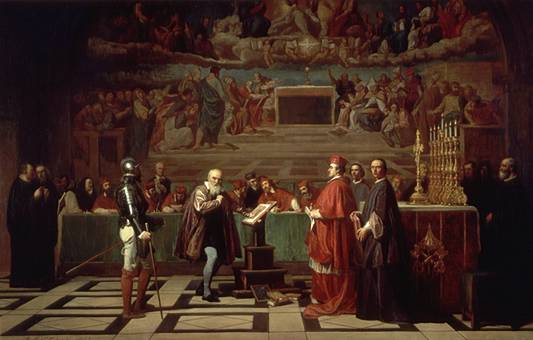
Legend has it that these were the words whispered by Galileo after he recanted his claim that the Earth orbits the Sun before the Catholic Church at his trial in 1633. The Church had threatened his life if he did not, so this story shows a 70 year old man not willing to die for his work but not willing to go without a word or two- a feel good story of the great conflict between religion and science. The thing is, it’s probably not true.
First, Galileo was not the first to publicize a Sun-centered solar system that went against the Church’s belief that the Earth was the center of the universe. More than a century before the work of Copernicus, Nicholas of Cusa published a book in 1440 arguing for heliocentrism and was ordained a priest that same year, later becoming a Cardinal. When Copernicus polished off Aristarchus’s 1700 year old sun-centered idea and expanded the theory with his own geometric model, high-ranking officials were the ones who urged him to publish a book of his work. Galileo himself was friends with Cardinals and even the Pope who would later be in charge of his trial for most of his life. So what was the problem, if not the science?
We can take a clue from Giordano Bruno (1548-1600). Bruno was a supporter of Coperniucs and wrote a piece stating that if you were a rational person, you could not disagree with his findings. For his judgement the Church deemed him a heretic and Bruno was burned at the stake. Like Bruno, Galileo also wrote an inflammatory piece that made the other side look uneducated. In 1632, a year before his trial, Galileo had published a book where two characters debated the geocentric and heliocentric view. The character who argued for geocentrism was named Simplico, and apparently someone convinced the Pope that Simplico was supposed to be him. Cue the trial by Roman Inquisition and verdict of heresy.
Above is a photo of Stonehenge I took when I visited England the summer after freshman year of high school. I was so amazed by this structure. I wondered why it was built and what was its purpose. I did not know at the time, but many believe Stonehenge has connections to ancient astronomy.
Archaeoastronomers are generally in agreement that Stonehenge represents an “ancient observatory” but there are differing opinions on the extent of its use for that purpose. It was first acknowledged in 1720 when William Stukeley drew the site and observed that the summer solstice sun rose close to the Heel Stone. He used this theory to incorrectly predict that Stonehenge was built in 460 B.C.
Gerald Hawkins later published a controversial work in 1963. After observing numerous lunar and solar alignments, he argued that Stonehenge was used to predict eclipses. This work was strongly criticized by Richard J.C. Atkinson in 1966 who took issue with the methods Hawkins used.
Recently, scholars have gained evidence that prehistoric people only visited Stonehenge during the winter solstice. Although there has not yet been a consensus on its purpose, I think the possibility that an ancient civilization built this to observe the sky is a fascinating concept.
Galileo Galilei (February 15, 1564 – January 8, 1642)
Galileo was important for quite a few discoveries. His career in science began when he began to study as a mathematician. One of his largest contributions to astronomy was the discovery of the telescope. The telescope became a huge sensation. His refinement of the telescope allowed for the careful and precise observations of the sky. From his observations with his telescope, Galileo discovered a long list of things: Venus has phases, the Sun has spots, the moon’s surface isn’t smooth, and more. These discoveries led Galileo to believe that the heliocentric model of the universe to be correct over Copernicus’s Earth-centered model. For the late part of his life, Galileo argued against the Catholic Church over the correct model of the universe. From his observations, Galileo delved into a battle of science versus scripture. Galileo has been called ~`the “father of modern science.”
1607 – Jamestown, Virginia is established as the first English settlement on the North American mainland. This is the very beginning of the United States.
1618 – The Thirty Years’ War begins around this time. In this same year, Kepler proposes three laws of planetary motion.
John Napier (1550 – April 4, 1617) – A mathematician, John discovered logarithms in the year of 1614 near the end of his life. His other contribution to mathematics was the implementation of the decimal point in common usage in math.
This assignment made me realize what a golden age of science the 1600s were. After Copernicus’s death, Brahe, Kepler, and Galileo picked up where Copernicus left off. Each scientist fed off of each other’s knowledge and findings. I think it has made me appreciate the history of science more. Galileo almost became a priest, but went to a university to study medicine at the encouragement of his father. If Galileo had become a priest, this world we live in today could be so different.
Galileo was instrumental to the development of astronomy because he was the first to use a telescope and publish his findings. His findings proved the heliocentric over the geocentric model which was a pivotal change in astronomy. He was considered a major player in the scientific revolution.
During Galileo’s lifetime, the first major event that I will cover is the Eighty Year War. This was a war fought for Dutch independence of Spain and lasted from 1568-1648 with the result being Dutch independence. The war was set off from high taxation and dissatisfaction with their foreign rule.
The second major event that I will cover is the Gunpowder Treason Plot. Occurring in November of 1605, it was an assassination attempt on the King of England, King James I. The assassination attempt was led by English Catholics and intended to blow up the House of Lords. All conspirators were executed. This is the plot that the movie V for Vendetta used as historical inspiration.
Ivan IV Vasilyevich, also known as Ivan the Terrible, lived from 1530-1584. He was the first Tsar of Russia and considered to be the leader that brought Russia from medieval to a true power in the region. His nickname comes from his brutality against nobility and his mental instability, shown in the Massacre of Novgorod.
The world was a very different place when Galileo was an astronomer. Spain was still an empire still fighting for control over Europe. King and Queens still ruled empires, monarchy was the norm for most countries. Freedom for Galileo to do his work was low due to control from the churches and state. During his lifetime there was definitely more turmoil from wars and executions than we see nowadays.
Hello! For my homework assignment, I researched some basic information about Nicholas Copernicus, the Polish astronomer. Copernicus was born on February 19, 1473, and died on May 24, 1543. You can find more information on Copernicus’ life here! There were many fascinating events and people that lived during Copernicus’ lifetime. In 1492, when Copernicus was 19, Columbus sailed the ocean blue and landed in the Caribbean for the first time. This eventually led to the formation of the colonies, and without Columbus, we would not be here today. Find more information on Columbus’ expedition here. One fascinating person that lived towards the end of Copernicus’ lifetime was Queen Elizabeth I of England. She was beloved by her people and during her reign, England became a key power player in Europe. To find more information on Queen Elizabeth’s life and legacy, click here. It was interesting to see the context in which Copernicus lived. He was born at the onset of the Renaissance period in Europe as well as the beginnings of the Enlightenment period in science and thinking that occurred during the Renaissance. Copernicus, a Polish-born astronomer who lived in many different places in Europe, grew up in a time where the area was coming out of the Dark Ages and experiencing a flourish of thinking, science, and the arts. This may have prompted Copernicus to study astronomy and eventually challenge the beliefs that held firm in the era before him.