
Galileo Galilei (1564-1642)
Galileo Galilei was born into an era where the Aristotelian notion of a perfect universe dominated astronomic thought and the Roman Catholic Church dominated all knowledge. Rather than fall prey to these traditional views of the universe, Galileo was a scientific pioneer that would pave the way to a picture of the universe based on observation rather than strictly theological notions.
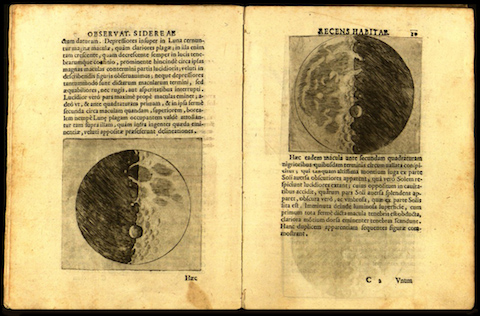
Up until Galileo’s discoveries, Copernicus’s heliocentric model of the universe fell largely on deaf ears. The universe, as proposed by Aristotle, was seen to be perfect with Earth at its center. Galileo was monumental in proving that the “heavens” weren’t necessarily perfect. He first did so by noting that the surface of the moon was filled with mountains and craters, not a smooth sphere. He later observed sunspots on our sun, again disproving that everything in the universe was perfect. Galileo also made a discovery that would directly lend credibility to the heliocentric model. Galileo observed moons orbiting Jupiter implying that not everything needed to orbit the Earth.
Galileo would suffer criticism from the Church following his publications. He died in 1642 under house arrest after being forced to recant his claims. It was not for another 16 years that the Church began to allow works supporting a heliocentric universe.
Source: The History Channel
What else was happening during this time?
Shakespeare’s Hamlet was published in 1601. Hamlet is perhaps Shakespeare’s most famous play and remains a contender for the greatest piece of literature ever written. From it derives the popular quote, “To be, or not to be.” It continues to inspire modern day adaptations such as Disney’s Lion King.
The first permanent American colonial settlement of Jamestown was established in 1607. 66 of the 104 settlers died in the first 8 months since its establishment.
King James I of England (also known as King James VI of Scotland) was born in 1566 and died in 1625. Under his reign, a Church of England sponsored version of the Bible would be translated – appropriately titled the Authorized King James Version. He would also see the failed “Gunpowder Plot” against parliament of 5 November, 1605, in which Guy Fawkes would be forever immortalized.
The early 17th century held great promise. While this time period is of course not limited to the above events, these are all names and events we grew up learning about. A new precedent was being set with regards to literature. The British empire was expanding its borders into the future American homeland. So too was Galileo doing his part in revolutionizing astronomy. It is through his work that we were able to move forward to an accurate model of the solar system and beyond.
Image Source: Open Culture


