While we discussed the science behind solar eclipses and totality in class on Wednesday, I wanted to explore the culture and lore behind solar eclipses. Total solar eclipses are very rare: at any particular location on earth, a total solar eclipse will only be visible once every 360 years! However, many “eclipse chasers” are undaunted by the rarity. They travel across the world to watch these very infrequent occurrences. For example, “Eclipseguy” has witnessed 20 eclipses in 13 countries on 7 continents.
Another interesting cultural fact about eclipses is the mythology and lore surrounding them. Eclipses were typically viewed as times of upheaval or disruption. In fact, most cultures believed that an eclipse was the result of some creature eating the sun. In Vietnam, for example, a frog was traditionally believed to swallow the sun during a solar eclipse. Some Native American peoples often would attempt to scare off whatever was eating the sun by playing drums or banging pots and pans. The Navajos hold that the eclipse is a part of the balance of the cosmic order, and observe this still today by singing special songs and fasting.
While we discussed the science behind solar eclipses and totality in class on Wednesday, I wanted to explore the culture and lore behind solar eclipses. Total solar eclipses are very rare: at any particular location on earth, a total solar eclipse will only be visible once every 360 years! However, many “eclipse chasers” are undaunted by the rarity. They travel across the world to watch these very infrequent occurrences. For example, “Eclipseguy” has witnessed 20 eclipses in 13 countries on 7 continents.
Another interesting cultural fact about eclipses is the mythology and lore surrounding them. Eclipses were typically viewed as times of upheaval or disruption. In fact, most cultures believed that an eclipse was the result of some creature eating the sun. In Vietnam, for example, a frog was traditionally believed to swallow the sun during a solar eclipse. Some Native American peoples often would attempt to scare off whatever was eating the sun by playing drums or banging pots and pans. The Navajos hold that the eclipse is a part of the balance of the cosmic order, and observe this still today by singing special songs and fasting.
It is extremely difficult for humans to wrap our minds around how big the universe is. Even when we think we can maybe understand it, the more we discover and learn, the more mysterious and seemingly larger it becomes. One of the things about the size of the universe that our book mentions that really made me think was in front fold-out section. There is a small blurb about “The Observable Universe” that says: “Because our universe is about 14 billion years old, we can see no more than about 14 billion light-years in any direction.”
This is something that I had never really thought about before. The universe may be (and probably is) much larger than what we can observe. Even light is not traveling fast enough for us to see the entire universe. The universe that we can see, which contains everything that we know and more things than we could imagine, still only contains the light that has had the time to reach us. According to the Wikipedia for “Observable Universe”, the lowest estimates of the size of the entire universe is “in excess of 250 times larger than the observable universe”. Wow!
Although the speed of light has been taught to be a constant value in a vacuum setting like the universe, however a team of Scottish scientists have valid proof that this might not always be the case. The Scottish researchers from the University of Glasgow and Heriot-Watt University made this amazing discovery by firing two photons, which are bundles of light, in a vacuum. The catch is, that one of the photon’s shape was altered, this resulted in the altered photon traveling slower than the untouched photon. Scientists now believe that the known “constant” speed of light may actually be the maximum limit that light can travel at. This is an astonishing finding that could potentially change the way we research the universe.
Looking to explore the northern plains of Mars? Or perhaps the craters in the south? Maybe scale Olympus Mons, or visit the Curiosity Rover? If you’re intending to travel without preparing properly, chances are you’re going to freeze to death. Luckily for you, Mars experiences seasons. With just a little bit of research, we can make sure you’re stepping foot on Mars during the summer months. You may still freeze to death, but at least you’ll be comfortable during the daylight hours.
We know that Earth has seasonal climate variety due to its axial tilt. This causes one hemisphere to be closer or further from the sun for a portion of its orbit, experiencing summer on one extreme and winter on the other. The Earth is titled at 23 degrees, while Mars is tilted at 25 degrees. With only a 2 degree difference, the seasons should look fairly similar to one another. Mars’ orbit around the Sun is nearly twice as long. That means the seasons would also be (nearly) twice as long. This complicates our planning process slightly. Mars also has an orbit that is slightly more elliptical than Earth. You can read more about how the shape of the orbit affects seasons here.
With the help of Planetary Society, we can see exactly when Mars will be experiencing its next summer solstice in each of the hemispheres. If you’re looking to traverse the southern hemisphere, your window for summer exploration ends on Jun 18, 2015. Unfortunately, northern hemisphere vacationers will have to wait until Jan 03, 2016.
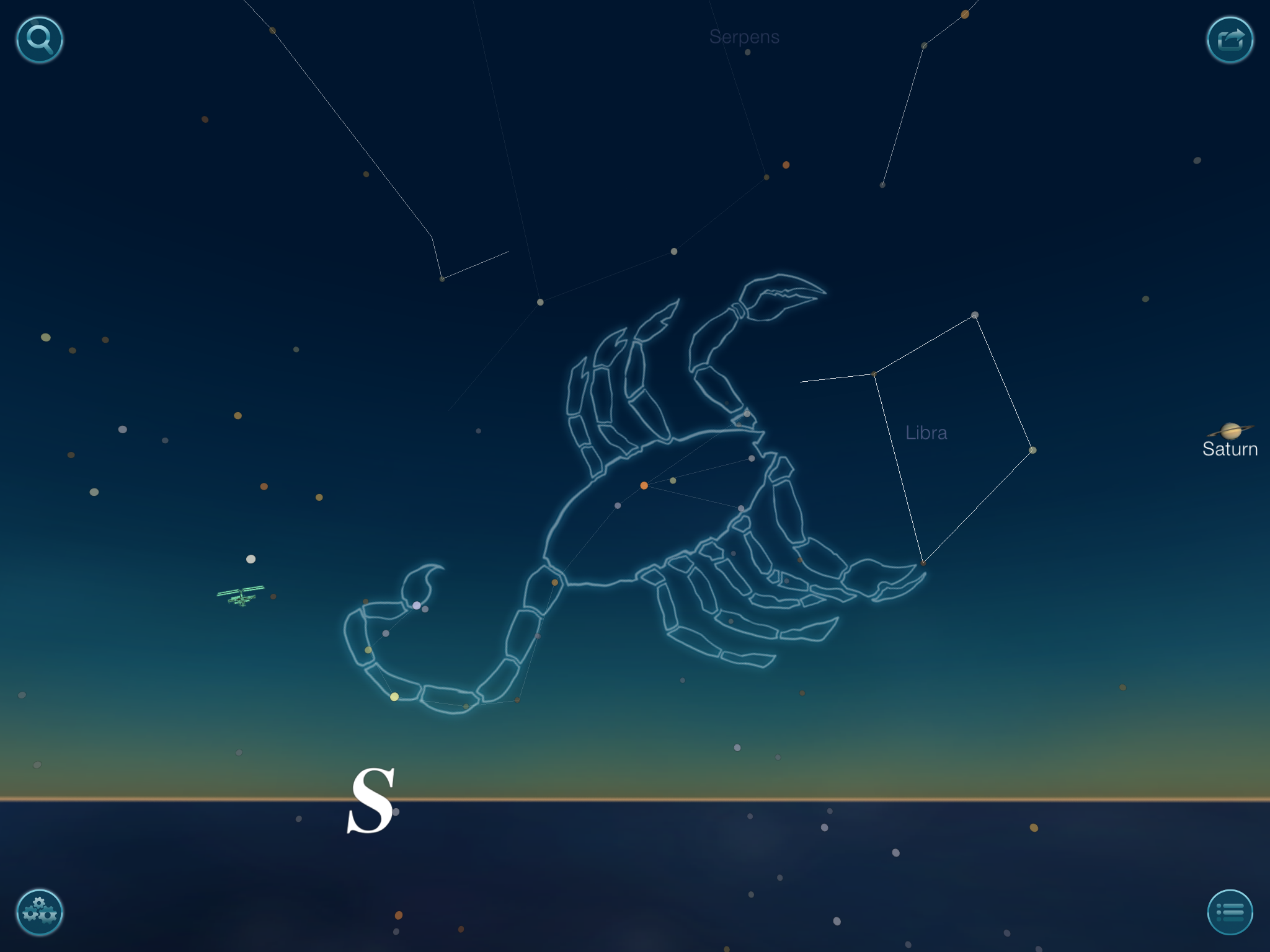
Night Sky 2 The hyperlink above is to a webpage with the information and a review for a REALLY cool observing app! I got Night Sky 2 before I even took an astronomy class at Vandy, and it’s easily my favorite. You can get real-time views of all constellations, planets, stars, satellites, and even comets! Not going to lie, it definitely saved me a LOT of time out in the cold in the introductory astronomy lab when my planisphere just wasn’t cutting it. Also attached is a photograph of what the app’s display looks like, which comes from the hyperlinked source. You face your phone’s camera in a certain direction, and it shows you what the sky looks like looking that way at that time!
Posted inObservables, Stars|Taggedastro201, blog2|Comments Off on Wait, where is that constellation? said me, about a million times while holding a telescope
After 6 months, astronauts in the International Space Station would have aged about 0.007 seconds less that people on Earth. This is due to the International Space Station moving much faster than the Earth. Time itself will bend due to differences in gravity or velocity. Now what if an object starts to move close to the speed of light? Time would seem to slow down for the object when observed from immobile point of view. A person traveling at 75% of the speed of light in a space ship will age only 40 years compared to 60 years on earth.
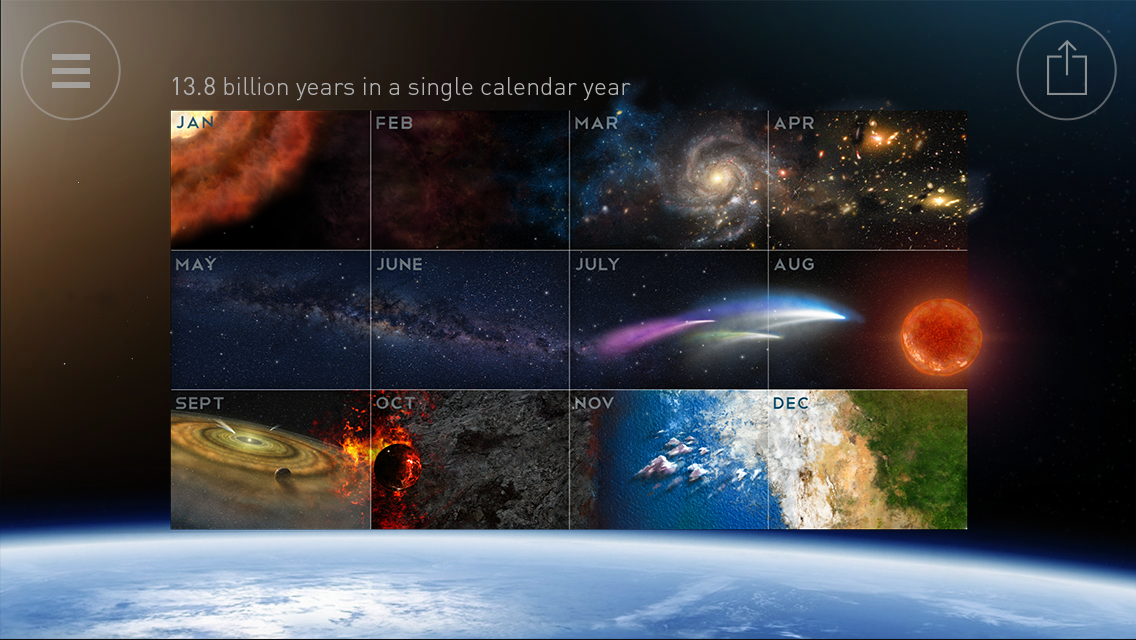
In the 1980’s, a 13 episode television series Cosmos: A Personal Voyage was presented by the famous Carl Sagan covering topics such as the origin of life and a perspective of our place in the universe. In the first episode, “The Shores of the Cosmic Ocean” Carl Sagan presents the the Cosmic Calendar. The Cosmic Calendar is “a method to visualize the vast history of the universe in which its 13.8 billion year lifetime is condensed down into a single year” (Wikipedia). More recently in 2014, a follow-up television series to the original 1980s show was released titled Cosmos: A Spacetime Odyssey. The series is hosted by astrophysicist Neil deGrasse Tyson and loosely follows the same thirteen-episode format. The first episode. “Standing Up in the Milky Way” also touches on the Cosmic Calendar. In the original 1980s episode, the age of the universe was believed to be 15 billion years old, instead of the 13.8 billion years old, as we know it today. With the new figure of 13.8 billion years old, the Cosmic Calendar starts at midnight on January 1st with the Big Bang Theory. The current moment is midnight on December 31st.
What is really interesting is that there is an app modeled on the television show available for iOS called “Cosmos: A Spacetime Odyssey”. Here is a link to the webpage describing the app’s features. I downloaded the app to explore its features in-depth. One of the coolest things I discovered was an interactive Cosmic Calendar. Below you can see the layout of the Cosmic Calendar.
Cosmos App Screenshot
You can then click on each month and view the events that have occurred during that month/time period. For example, below is a screenshot of the month of December with the various events that occurred.
Cosmos App Screenshot
You can see that the first multicellular organism did not even form on Earth until December 15, only two weeks before current time on the calendar. This helps put into perspective the brevity life on Earth in relation to the age of the Universe. Intelligent life, such as humans, have only existed for mere seconds in Cosmic Calendar. This is fact is very humbling but encouraging as well. The fact that we have only existed for a fraction of the time in the life of the Universe, yet we have gained such knowledge about our existence and our Universe is amazing. It makes me excited to see the progression of science and where our human creativity, intelligence, and imagination will take us next.
I think it’s incredibly fun to look at the scale of the universe in a sense we can understand. The D.C. Voyage model gives us a good sense of distance. What about the size of things? We can use compare fruit all we want, but all it’s doing is making me hungry.
Instead, I’d recommend checking out this video produced by the Russian Federal Space Agency. We can see the size of some of the more familiar stars if they were at the same distance as our sun. If you can read Cyrillic, you should get a sense of what we’re looking at. Otherwise, turn on closed captioning or reference below. I’ve also included the sizes of the stars if you’re interested in the numbers.
Just remember that these are size representations, not luminosity. We wouldn’t be able to see much of anything if they were scaled to luminosity at this distance. One of these stars is over 2000 times brighter than the sun!
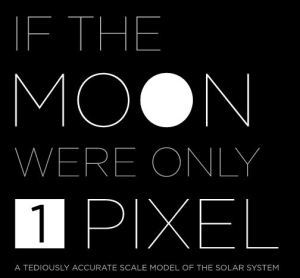
Have you ever felt that understanding the truly staggering size of the universe is unfathomable? With the help of this interactive website you can see first-hand the tremendous distances in just our own solar system! Starting from the center of our solar system, the Sun, you can travel all the way out to Pluto with one pixel on the webpage equaling the size of the moon. This great tool lets you look at distances in a variety of different measures including, but not limited to, kilometers, miles, blue whales, and Great Walls of China. Not only does this website put on display the vastness of our solar system but it allows you to visualize the speed of light relative to the great distances in space. By clicking on the “C” icon in the bottom right corner the website will scroll at the speed of light! Give this website a try and maybe you will be a hair closer to genuinely understanding how big our solar system really is!