Extremophiles on Earth

Image

Extremophiles are life forms that can tolerate extreme conditions. They are found in exotic environments all over Earth, such as deep sea vents, the upper atmosphere, and boiling hot geysers, such as those in Yellowstone National Park. Many astrobiologists believe that extremophiles represent the most likely type of life to exist on other planets. In fact, many of the bacteria we find here on Earth could probably survive on other worlds. For example, on Jupiter’s moon Europa, which likely has a large, subsurface ocean. We have not been able to detect the presence of extremophiles elsewhere yet, since it would likely take a landing mission to do so, but scientists have not given up hope. The greatest concern is that bacteria might survive the trip and our spacecraft might end up seeding other worlds with life. In my opinion, it would be great to discover life on another world, but if none exists now it would be almost as good to intentionally seed life there and study how it evolves and alters its environment.


Posted in Class | Tagged , , | Comments Off on Extremophiles on Earth

The Most Astounding Fact

This has always been one of my favorite videos. It always make me think about how transient life is and what the important things in life are. It is so fascinating to think that the atoms that make up who I am and everything around me originated from the beginning of the universe and have traveled through space and time to create the life and world that I know today. Studying astronomy more has made me look at the world different and realize that there is so much more out there. It is exciting to think about the possibilities about what else can exist in the universe, even though we may never know for sure what is out there.


Posted in General, Universe | Tagged , | Comments Off on The Most Astounding Fact

Tardigrades

This video discusses what the toughest animal on Earth is. It as interesting to me that while I imagined a big animal like a lion, they determined that the toughest animal is a tardigrade, a type of extremophile. These animals are able to withstand the greatest temperatures and pressures on Earth as well as the frigid and seemingly uninhabitable conditions in space. It’s so cool to think that it’s possible for some type of life to survive such extreme conditions. This is an important scientific discovery because it makes the possibility of other life in the universe that much more plausible.


Posted in Aliens, Universe | Tagged , , | Comments Off on Tardigrades

The Future of Astronomy

Image

The future of astronomy lies in finding or making worlds habitable for people. While we are learning so much about the universe around us, the things that people seem to care about are aliens and space colonization. This is why I feel that resuming space travel is crucial to reviving public interest in astronomy. While stars, planets and science are awesome in themselves, it is the expansion of our knowledge of life in the universe captures the imagination like nothing else.


Posted in Space Travel | Tagged , , | Comments Off on The Future of Astronomy

What’s in store for the future?

images-3

The field of astronomy is fascinating; there is much that we have yet to learn. This semester in Astro 201 has been very enlightening for me. The things I’ve learned have amazed me. However, gaining this knowledge, though satisfactory on one level, leads one to ask more questions about the universe and what our potential is as humans to harness what we know to explore. Astronomy is an exciting frontier – hopefully one day we will be able to be able to go out and visit other star systems and colonize on other planets, both here in the Solar System and afar.

I will most look forward to learning about the technological progress that we can create and utilize in the near and distant future – especially about travel. One can only wonder when we will be able to approach the speed of light and how that would effect civilization on every level, not just an astronomical one. Potential is very exciting and I look forward to the future.


Posted in Class | Tagged , , , , | Comments Off on What’s in store for the future?

My Big Takeaway

Astronomy has taught me a lot of stuff about the universe that I didn’t know. What I will remember learning though is the size of our earth. Relative to our Sun, we are quite small. Relative to our solar system, we are barely visible, and relative to our galaxy, earth is nothing. The lesson is that it’s all relative. What are you comparing your life to? To a big shot investor on Wall Street, to Lebron James, to Oprah? I’d say that Astronomy has taught me to value how big the things around us are, but to treasure the uniqueness of our earth just as much.

Earth in size

photo from here


Posted in General | Tagged , , | Comments Off on My Big Takeaway

The Fermi Paradox

Image

The Fermi Paradox points out the issues with the expected number of predicted civilizations in the galaxy and the lack of interaction that mankind has had with them. It points out that the Sun is a young star and that many other star systems have had the time and conditions to bring about a civilization. Possible explanations for this are that there are no other civilizations either because none come about, or because civilizations tend to destroy themselves. These are more significant to me because they tell us that we should try not to destroy ourselves. We are conceivably alone in the universe and so destroying ourselves makes the universe seem more meaningless.


Posted in Class | Tagged , , | Comments Off on The Fermi Paradox

Extraterrestrial Detection

images-2

Perplexed by the lack of communication by extraterrestrial beings, Freeman Dyson proposed a new tool for searching for intelligent life. His concept, known as the Dyson Sphere, presumed that some intelligent life beyond our Solar System could have been around for a much longer time than our own species. If that is true, than these civilizations would have needed to use more and more energy over time. Eventually, these civilizations would need to harness the power of their star.

The Dyson Sphere is a hypothetical structure that has the ability to capture most of a star’s energy output. It is a megastructure – one that encompasses a star in its entirety to harness its energy. On the Kardashev scale (measurement of how much energy a civilization is able to use), any Type II civilization and above would have the ability. This sphere, he hypothesized, would significantly alter a star’s spectrum from the normal emission lines to that of blackbody radiation. Thus, such an alteration in a star’s spectrum should alert us of an intelligent civilization.


Posted in Historical, Universe | Tagged , , , , | Comments Off on Extraterrestrial Detection

Where are they?

Ever since human beings have been aware of our place in the universe, we have been searching for signs of extraterrestrial life, specifically intelligent life. However, despite our best efforts and certainty that it is unlikely that we are alone in the galaxy, we still find ourselves asking: “Where are they?”

With modern scientific knowledge, scientists are fairly sure that life in our Solar System is not incredibly unique or rare. The circumstances that lead to the first life on Earth and consequently the evolution of homo sapiens should theoretically, and even likely, occur on the planets of many other stars in our galaxy. However, we have yet to find any signs of intelligent or even simple life in our Solar System or in the galaxy. Could we be alone or is there another reason that we have yet to make contact?

aliens
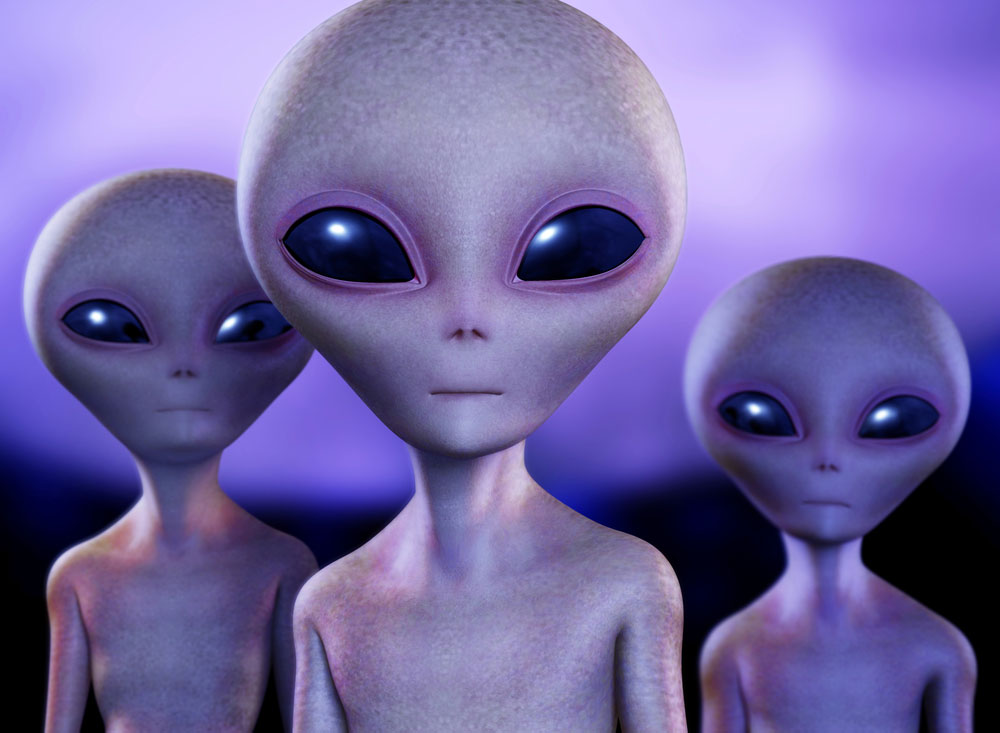
An artist’s depiction of extraterrestrial life

There are many reasons why we haven’t found intelligent life  in our galaxy yet, and the most likely culprit is not that we are alone. For one, take the picture above. As humans, we have a natural bias toward assuming that the life we find will be similar to our own. We like to think that aliens will just be warped versions of ourselves. However, it is possible that life in the galaxy is nothing that we can even comprehend. Perhaps we are looking for the wrong thing entirely.

Another possibility is that we simply haven’t been looking for long enough. We only developed the technology necessary to detect interstellar signals in the past century. We need to be patient and continue to improve upon our current technology.

The bottom line is that we are still fairly sure that there should be intelligent life somewhere in the galaxy, or at least the universe. We should not discount the idea just because we have been unsuccessful so far. Hopefully, homo sapiens has many years of progress and research ahead of it that will allow human beings to one day make contact.


Posted in Aliens | Tagged , , , | Comments Off on Where are they?

Our Guiding Star

So many stars come and go based on the time of year, where we are located on the planet, how much of the sky is visible, etc.  Although we can only see some stars on some nights there is one star that we can always see.  This star is the North Star also known as Polaris.  Polaris is an extremely special star because no matter what time of year and where you are on the planet you can always look toward the Northern Hemisphere and find the North Star.  Not only is this star used to know the compass direction North, but is can also be used do guide people who all they have is the sky.  It may not be the brightest star in the sky, but to us on Earth it is one of the most important and well known.


North Star

Image


Posted in Class | Tagged , , , , | Comments Off on Our Guiding Star