I took this class because I wanted to learn more about the solar system. Growing up, I really enjoyed learning about the planets and stars. One of my favorite parts of the class was the observing. I was able to see the difference between a red-shifted and blue-shifted star which before this class I wouldn’t have known what that meant! I hope that I have the chance to observe again soon.
The idea that there is life that does not live and survive the way we do is very interesting. I think humans have come up with an idea of what they are looking for when defining “life.” Yet, these extremophiles prove many of these ideas wrong. They live in places humans never could survive but it is the habitat they wish to have. I think it is important to study these because they can allow humans to develop a new idea of life.
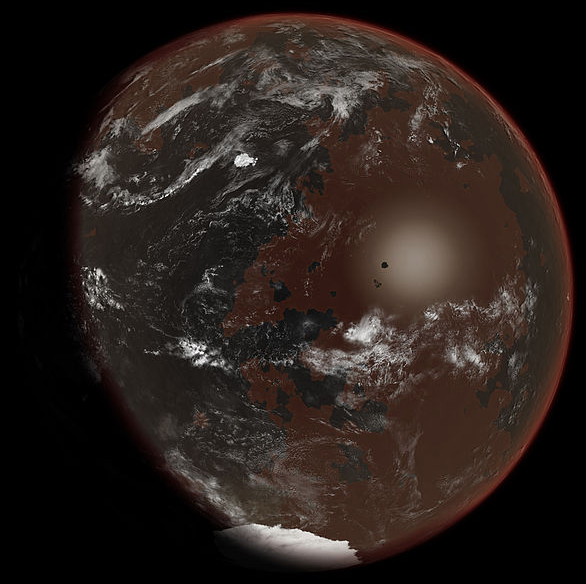
This class has taught me to never doubt human innovation. Man has been looking to the stars since the beginning and the milestones we have made over the centuries are astounding. Ancient peoples figured out orbital speeds and distances of the planets by just observing the night sky, and nowadays, we have traversed open space and humans have stepped foot on the moon. Just the fact that we can find exoplanets light-years away and figure out their compositions from just light waves is amazing. I can’t wait until I am reading about private space agencies taking over the space industry and making astronomical dreams become a reality. I hope to one day hear about efforts of terraforming Mars like is pictured above and colonization of other worlds in our universe. This class has also made me believe that there IS life out there beyond our home on Earth. The subsurface oceans of gas giant moons radically change our perceptions of a habitability zone, which astronomically improves the chance of life in the universe. I’m also hoping that there is some sort of galactic community out there that is waiting for us to figure out interstellar travel to reveal themselves. That sounds like something out of a science-fiction book, but hey, we’ll never know until we put in the effort to do it, so lets start figuring these things out! Humans have always had an interest in the night sky and now we have the capability to go out and explore it. That, to me, is awesome.
A hypothetical world with ammonia instead of water as the solvent of life
When we look for planets that harbor alien life, we usually are searching for planets within the habitability zone around their stars. This habitability zone really is just where the temperature is just right for liquid water to exist. All life on Earth uses water as the solvent for the reactions of life, so it makes sense that we look for alien life that matches the only example of life that we have. However, there are many theories about what alternate biochemistries could exist in alien life. One of those theories is that ammonia could replace water as a solvent. Ammonia is very common in the universe, is amphoteric like water, and can dissolve many organic and nonorganic compounds. However, ammonia has weaker hydrogen bonds and surface tension than water and is flammable in oxygen, so aerobic metabolism would not mix well with ammonia based life. But what if oxygen could be replaced by some other molecule as well? The possibilities are numerous. Other possible solvents are hydrocarbons like methane, hydrogen fluoride, or sulfuric acid.
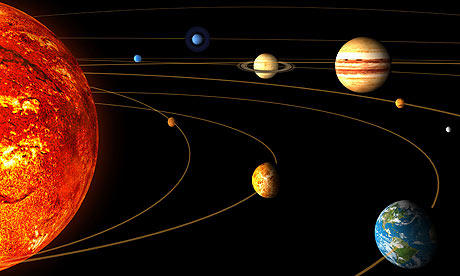
The solar system is an amazing place filled with a vast spectrum of unique objects, and the most notable of them all is us. We and everything else in the solar system are comprised of the same materials that came from the same place, but only we have grown and developed to appreciate that fact. We have arisen from the dust only to find that dust is all there is. Many people might find this idea saddening or bleak but for me it fills me with a sense of awe. That the dust we see so calmly following the laws of physics to the letter can arrange twist and organize itself to create something as remarkable as us is an astounding fact. In the 93,000,000 mile neighborhood that we call the solar system we are likely the only lifeforms left. It is our responsibility to prove the worth of the dust our universe is made out of by striving to continue our growth. Our existence is a testimony to the beauty of our solar system and our learning of it is our method of acknowledging it.
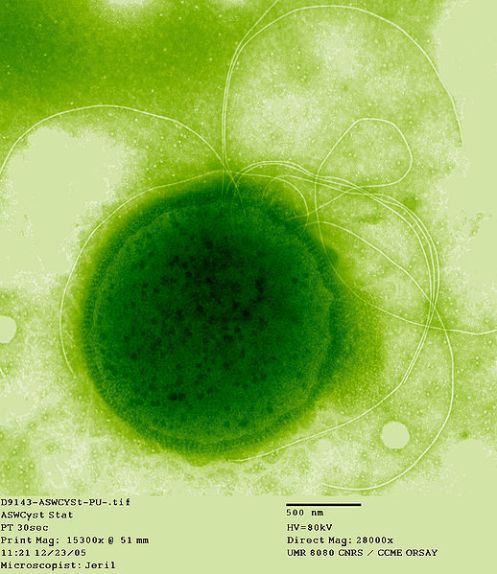
This rare microbe is the most radiation resistant organism known to man. Discovered in 2003 living inside of a hydrothermal vent at the bottom of the pacific ocean off the coast of California, this little guy is capable of withstanding over 30,000 grays (a Gray is the absorption of one joule of such energy by 1kg of matter) This is about 6,000 times the tolerance that human beings have. They thrive between temperatures of 55 and 95 degrees Celsius with an optimal environment close to 88 degrees. The reason that Thermococcus gammatolerans is able to survive these extreme conditions is because, unlike other organisms, its cell survival does not change based on changes in its growth phase. The organism can rebuild damaged or reproducing chromosomes rapidly or slowly without any change in the viability of its survival. These highly radioactive conditions are abundant in the thermally hot and geologically active pockets of our universe. If there were to be an underwater ocean on Ganymede, these radioactive conditions might be the norm as energy radiates out from the core of the planet. Extremophiles like this one show the resilience of life even in nature’s harshest environments and give astronomers hope that life is not as picky about the conditions for its inception as was previously believed. Extreme extremophiles
About six months ago, scientists retrieved samples of water that are nearly two billion years old from the depths of a mine in Timmins, Ontario. They are now attempting to determine whether or not any life exists within the liquid. If in fact lifeforms are present within the water, this would be yet another area in which scientists find that extremophiles can exist. This would offer the possibility of life elsewhere in the solar system or galaxy where extreme conditions may be present. On the other hand, if life is not discovered within the liquid, such a discovery is just as valuable. This is because this information could provide evidence for an abiotic line, which is an environment where an element necessary for life is absent. A further understanding of an abiotic line allows astrobiologists to narrow down their search for extraterrestrial life. Thus, one can see how the discovery of extremophiles or the lack there of can contribute to our search for life beyond Earth.
To this day, extremophiles have been discovered in volcanic vents that are subject to extremely high temperatures. Moreover, the European Space Agency sent microorganisms into space to see how they would react to the harsh conditions; these lifeforms were able to survive. Although all of this helps us to expand the possible areas of the cosmos where life may be present, this also makes our search less narrow, which we do not have the resources nor time to account for. As our research in extremophiles advances, I hope we can find a balance between a broad enough area for possible life, and a narrow enough area that we have the time and resources to allocate toward. Maybe then we can finally find extraterrestrial life.
Around a century ago, humanity thought we had finally conquered the final frontier – Antarctica. It was quite unfathomable for many to think that we could ever leave the confines of Earth, but within a matter of three and a half decades we succeeded in building the first aircraft, retrofitting it to better suit specialized purposes for war or commercial travel, sent satellites and humans into orbit around Earth, and finally sent men to the Moon. All of that, within four decades. We clearly have much left to do.
Our understanding of the universe has expanded vastly since then, and the technological boom that started in the late twentieth century and continues today has lead to millions of new technologies that have revolutionized our way of living. We’ve explored much of the face of the Earth, though there are still an innumerable things we have left to discover on this great, small planet of ours, and one of our satellites has finally left the solar system. Though it will take millions of years to reach another star, it is a testament to human understanding and knowledge that we succeeded in escaping the confines of Earth and now our own solar system. With new technologies being created and refined every day, it is but a matter of time until we can come up with a way in which interstellar travel is viable.
We have much work left to do within the solar system as well. Humans have only set foot on one world other than Earth to date, and there are a slew of worlds left to explore and discover within the solar system. With the possibility of microbial life on Mars or even complex life in the subsurface oceans of the Galilean moons or Titan, there is much we can learn about the universe within our own neighborhood.
Let’s not forget our “pale, blue dot” either. We have polluted and contaminated a lot of this planet, and are continuing to do so now. Though there are plans to help clean up the grand mess we’ve created in a matter of decades, we have yet to do anything substantial. Millions of animals and plants die every year because of the pollution that we’ve introduced, and we need to act fast in order to protect Earth from ourselves, while developing new, eco-friendly technologies to continue the pursuit of a better, more comfortable life. Still, there are billions of humans living in poverty, and slavery is a major issue in the world to this day. We have much work left to do here as well as out there.
We are not blind to these problems, fortunately. Scientists are hard at work trying to eradicate major diseases, working to create better crops and livestock to feed the hungering masses, working to come up with more efficient ways of cleaning the environment while preventing further pollution. There are more at work developing technologies that can help us navigate the vast emptiness of space, and observing and analyzing other worlds from telescopes while we remain grounded on this planet. We cannot expect to solve all of the world’s problems very soon, but at least we are working hard to do so. Still more will join this venture, and pursue the betterment of humanity and the furthering of science.
The discovery of extremophiles within the last few decades has expanded the amount of worlds viable for some sort of life, and has greatly increased the chance of life being found elsewhere within our galaxy, let alone our own solar system. Extremophiles are microorganisms on Earth that live, and actually thrive in, extreme conditions. Extremophiles can be found in some of the most seemingly inhospitable conditions here on Earth. Some of the most well-known extremophiles live underwater, close to very hot thermal vents. The immense pressure and heat at these depths makes it very hard to imagine that any sort of organism could live down there but hardy thermophiles, a type of extremophile that loves heat, thrive in such areas. Astrobiologists are hopeful that such thermophiles may exist in the subsurface oceans of the Galilean moons orbiting Jupiter, since it has been theorized that similar thermal vents may be located on the floor of the subsurface oceans there. Even in the inhospitable geothermal vents in thermal springs located on or around volcanoes are home to types of extremophiles, some of which contribute to the beautiful coloration of these springs as pictured above. The discovery of extremophiles on Earth has renewed the search for extraterrestrial life, albeit very small
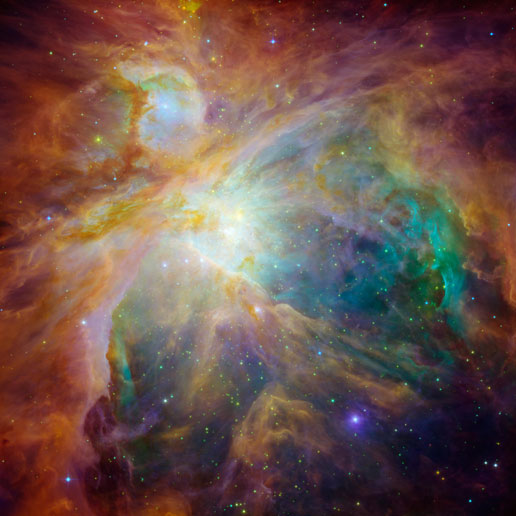
Above is one of my favorite images of a feature of the Universe.
The part of this class that has left the greatest impact on me is the material and discussion devoted to what exists (or potentially exists) outside of our Solar System. I believe I was most intrigued by this because it is what remains most unknown, but also has a seemingly endless potential for us to learn about and discover. Because of my increased awareness about research in the realm of interstellar travel and the existence of life beyond our Earth, I will be more interested in keeping up with scientific developments in these areas.
Another reason I’m glad I took this class is I now feel much more knowledgeable about the Earth, our Solar System, and the rest of the Universe around me. Our world is just going to be becoming more technologically advanced, and I think having knowledge of the topics covered in this class will be imperative for being an informed and involved citizen of the world.
From this class and the discussions we’ve had, I’ve decided I’m an optimist about the likelihood of extraterrestrial life and our ability to discover it. I don’t believe that we are the only, or even one of just a few, example of intelligent life developing, especially considering the hydrocarbons that exist already in the interstellar clouds. It’s just a matter of time (maybe a lot of time) before we develop the necessary technology to find and access other life forms.