Asteroid With Rings Found

Last month an asteroid in orbiting between Saturn and Uranus was discovered to hang a ring system. This asteroid is named Chariklo, and is part of a class of solar system bodies known as centaurs, which are thought o have originated in the Kuiper belt. The rings are thought to have formed after some slow solar system collision scattered debris around Chariklo. The reason the collision must have been slow is that Chariklo is very small and thus has little gravity, and faster moving objects would have escaped its force of gravity quite easily. Besides being quite a shock, this could never happen in the inner solar system near the asteroid belt. This is because the asteroid belt and inner planets are much more affected by solar wind, and if Chariklo were in that region the solar wind would have blown the tiny ring particles away. What they have not yet discovered is the shepherd moons, which scientists believe is the only explanation to rings forming on such a small system. A shepherd moon confines the small particles in orbit and is thought to be about as massive as both rings combined. The other possible option is that the rings are very young and time has not spread them out as expected.


Posted in Universe | Tagged , , , | Comments Off on Asteroid With Rings Found

Largest Solid Known Object in Solar System Found in Kuiper Belt

Largest Solid Knonw Object in Solar System Found in Kuiper Belt

Californian Institute of Technology astronomers have recently found a new object floating in an outer region of our solar system known as the Kuiper belt. The object, known as 2002 UX25, has measured density that is less than pure ice water and is being hailed as the “largest solid known object in the solar syste.” To measure the density of such distant objects requires small moonlet in orbit around such an object. What raises such surprise with scientists is that such a large object ( ~700km diameter) has a density that is 18 percent less than water ice. Objects this large tend to be much denser. The logic behind this is that gravitational pressure of larger bodies would cause greater compression, which subsequently would increase density. This is not the case for 2002 UX25. Planetary scientist Mike Brown of CAT, calls the Kuiper Belt the “war zone” of the solar system. The question that looms is whether 2002 UX25 is an outlier, or does it in fact challenge the established theory of planetary formation?


Posted in Observables | Tagged , , , | Comments Off on Largest Solid Known Object in Solar System Found in Kuiper Belt

Science Fiction to Science Fact

It has always been the fantasy of science fiction writers to mine an asteroid for its precious materials. Stories such as Catch that Rabbit by Isaac Asimov, The Rolling Stones by Robert A. Heinlein, and the Heechee stories by Frederik Pohl are among hundreds that feature futuristic mining camps on asteroids. But now humanity has reached the point where we could turn such an idea into a reality. Today, we possess the technology to find, prospect, mine, and bring home precious and rare metals from asteroids in our Solar System. The only reason we are not currently operating these plans is simply money issues. As lucrative as such an operation is, it would be incredibly expensive to start up and very risky to go through with. Nevertheless, there are people who are vocal in their effort to drum up the necessary funds to go through with such an endeavor. One such man is Peter Diamandis, a man who graduated from MIT with a degree in aeronautical/astronautical engineering, and then went to Harvard Medical School. Needless to say, he is an insanely smart individual; but what really sets him apart is his passion for exploring space. He founded a company which he called Planetary Resources, whose sole purpose is to mine asteroids. He headhunted the best NASA scientists and put together one of the most brilliant teams in rocket and rover construction.

Planetary Resources’ plan is actually quite simple. First, find and track “near-Earth” asteroids, which means asteroids which follow orbits that bring them relatively close to Earth (as oppose to those which inhabit the Asteroid Belt beyond Mars’ orbit). Then, send rovers as prospectors to the best asteroid candidates. Then when the go ahead is given, send another spacecraft to gravitationally tug the asteroid into a stable Earth orbit, at which point teams of astronauts can work from the relative safety of low-Earth orbit to extract metals.

In a recent interview on StarTalk Radio with Host Neil DeGrasse Tyson (a podcast/radio show that I highly recommend), Diamandis was asked why he wanted to pursue such a risky business. Diamandis then told the story of aluminum. Aluminum was more rare, and hence more expensive, than gold in the 1800’s. This was because, while aluminum is much more common on Earth than gold, most of Earth’s reserves are chemically locked within the bonds of other rock. At the time, the technology was not there to extract the aluminum ore from those rocks, thus the only ore available was the much rarer pure form. In fact, Diamandis pointed out that in Versailles, the French king’s palace, in the same display case as the crown jewels are two bars of pure aluminum. This is because at the time, aluminum was such a luxury that it was on par with the royal jewels of a great nation. But then, when chemists discovered a method to extract aluminum from rocks, all of a sudden there was so much aluminum that it became near worthless. The prices plummeted as the first law of supply and demand took over. But while this may have been bad for those invested in aluminum, it was vital for new discovery and invention. With the price at pennies, it became economically lucrative to use aluminum in new experiments and inventions, thus ushering in a new age of technological boom based off of aluminum. Now we think so little of the metal that we wrap our sandwiches in it and then throw it away. But that same metal was put on spacecraft, in factory machinery, in pretty much everything that defines the modern world, all because of an influx of supply from technological breakthrough. Diamondis wants to do just that, but with different metals, such as platinum and titanium which are both abundant in asteroids. He wants to lead the way in the search for new technologies based off of currently very expensive materials. Who knows, maybe in the future you will wrap your sandwiches with platinum foil!

Click here to learn more about Planetary Resources and Peter Diamandis.


Posted in Historical | Tagged , , , , | Comments Off on Science Fiction to Science Fact

A Breakthrough in Our Knowledge of the Big Bang

BICEP 2, a telescope located at the South Pole, has detected proof for gravitational waves, which are practically ripples in space-time inferring there was some sort of disturbance or bang that caused the universe to form and expand. Gravitational waves up to this point were just theorized to explain how during the Big Bang the fabric of space-time expanded faster than light. This evidence has major implications for the world of astronomy because it further confirms the Big Bang and it corroborates what Einstein idealized in his theory of general relativity. However, because this is such important news, it comes with some skepticism. The measurements could be contaminated, so its important for other experiments to be used to further confirm BICEP 2’s results. The Planck space telescope will also be doing using other techniques to try and confirm the presence of gravitational waves so its exciting to see if Planck’s experiments will further prove these findings.


Posted in Class | Tagged , , | Comments Off on A Breakthrough in Our Knowledge of the Big Bang

Newly Discovered Dwarf Planet

This month, scientists at the Carnegie Institution for Science discovered a distant dwarf planet. Labeled 2012 VP113, this dwarf planet was seen spinning way past the orbit of Pluto and the Kuiper Belt and is 80 AU away from the sun at its closest point. The Kuiper belt, a region of rocky entities, is between 30 and 50 astronomical units away from the Sun so in perspective, 2012 VP113 is quite far away. 2012 VP113 is believed to be made up of mostly ice, and scientists believe it is large enough to be considered a dwarf planet. Astronomers also think that it is part of a collection of Oort Cloud objects but astronomers struggle with how 2012 VP113 came to be. One belief is that gas giants released a rogue planet that then took objects in the Kuiper belt and flung them into the inner Oort Cloud. Another theory is that a passing star moved objects in the inner Oort Cloud closer to our Sun or that VP113 is actually a small planet from another star that was close to the Sun when it was born. However it came to be, VP113 is an interesting discovery and pushes the boundaries of our Solar system and how far it stretches.


Posted in Class | Tagged , , | Comments Off on Newly Discovered Dwarf Planet

Edmond Halley: Proving Newton

Newton was the first to provide a mathematical construct to describe the effects of planetary motion around the Sun. But then the question arose, how could we find evidence for the theory? Stepping up to the plate was the prominent astronomer Edmond Halley. Born in the English countryside on November 8, 1656, Halley was a inquisitive child, always looking up and always asking questions. He grew up to professional pursue his curiosities. In his early 20s he made an expedition to the island of St. Helena in the southern Atlantic in an effort to be the first man to map the southern skies. Little known to Halley, but the weather on this remote island was not favorable to sky viewing as it was often stormy and cloudy. As a result it took him over a year to map the locations of the brightest southern stars. Not only did he contribute to astronomy, but he was also a bit of an inventor: he is responsible for the creation of the diving bell. But anyways, what do diving bells have to do with Newton? Well, nothing really, but it was Halley’s most memorable accomplishment that connects him to Newton. The comet which now bears his name, Halley’s Comet, was one of the first pieces of evidence in favor of Newton’s theory. Although, there is a common misconception that Halley’s name graces the comet because he discovered the comet. This, however, is incorrect; Halley only recognized that the comet he saw in 1682 was the same one seen in prior years by other astronomers. In fact, Halley recognized that the same comet returns to the skies every 76 years, a conclusion he reached by using Newton’s equations and detailed astronomical observations going back hundreds of years. He calculated the orbital trajectory of the comet and predicted it would again return on March 13, 1759 (he was spot on! Even though he didn’t live to see it). With Halley’s correct prediction came definitive proof of the practicality and application of Newton’s law. And as icing on the cake, just like clockwork every 76 years the comet returns to the night sky in a dazzling display of the beauty of the universe. You too can see the comet, but not until July 28, 2061!

To learn more about the comet, check out this video!


Posted in Historical, Physics | Tagged , , , | Comments Off on Edmond Halley: Proving Newton

Rings and Diamonds? A Girl’s Best Friend!


Recent research shows that there may be diamonds on Jupiter and Saturn.

On Jupiter and Saturn, scientists have recently discovered that there could be a lot of carbon on the planet.  This carbon could be present in the form of diamonds that rain down from the sky.  While the diamonds eventually melt and don’t stay around for long, they can be as large as a centimeter across.

How do these diamonds form to begin with?  

In the upper atmosphere of Saturn and Jupiter, methane is struck by lightning in storms and is turned into soot.  This soot then falls down, transforming into graphite and finally diamond!  However, because there is such high pressures and temperatures closer to the cores of these gas giants, the diamonds melt.  On Neptune and Uranus though, the colder temperatures allow diamonds to stay solid.  This research is very new so it is not peer reviewed yet, but it is likely that there are diamonds on Jupiter and Saturn.

Forty light years outside of our Solar System, there is a planet called 55 Cancri e that is more carbon rich than Earth so it may be made of mostly diamond!  It takes quite a bit of heat and pressure on Earth to form diamonds, but on 55 Cancri e, the carbon richness makes it an ideal place for diamonds to form.


Posted in Jovians | Tagged , , , , , | Comments Off on Rings and Diamonds? A Girl’s Best Friend!

Halley’s Comet Shooting Through the Sky

A view of  Halley's Comet  when it passed by in 1986.

A view of Halley’s Comet when it passed by in 1986.

In 1705, Edmond Halley noticed records of comets passing by Earth in 1531, 1607, and 1682.  While at first they were thought to be three different comets, Halley thought they were all the same one.  The comet passes by Earth around every 75 years.  It was here last in 1986, and is predicted to come back in 2061.  I will be 67 when the comet returns, so hopefully I will be able to see it!  This time, in 2061, it is supposed to be on the same side of the sun as us so we will be able to see it better and it will be very bright for us to see.

While we call it Halley’s Comet, the first recorded viewing of the comet was in 239 BC by Chinese astronomers.  While the comet was seen after that about every 75 years, its most famous viewing was in 1066 when William the Conquerer invaded England.  He succeeded and thought his success was so dependent on the comet that he put it on a commemorative tapestry.  When the comet came by in 1986, it was the first time we could take pictures of it with spacecrafts.  Since it was on the other side of the sun than us, humans on Earth could not see it very well.  The space probes allowed us to get quality photos as the comets passed by.


Posted in Observables, Science | Tagged , , , , | Comments Off on Halley’s Comet Shooting Through the Sky

Any Sufficiently Advanced Technology is Indistinguishable from Awesome: Dyson Sphere!

Star Trek Wiki!
Star Trek Wiki!

In honor of Freeman Dyson’s upcoming visit, I thought we could talk about Dyson Spheres. A Dyson Sphere is a structure which surround a solar system and collects all of the energy which is given off by the star.  Dyson published this idea in his 1960 paper “Search for Artificial Stellar Sources of Infared Radiation“. The inspiration for the idea however, is said to be  Olaf Stapledon’s Star Maker,

The construction of such a thing would be enormously complex and a number of variations have been suggested. To simply build a solid structure around the star would be extremely difficult, Dyson himself called it “mechanically impossible”. Instead what Dyson suggested was what has come to be known as a Dyson Swarm. Which would be a swarm of devices orbitting independently around the star, these devices would have to transmit the power wirelessly. Setting up such a system would be very complicated to say the least, but the amount of energy that could be yielded would be enormous and a civilization advanced enough to construct a Dyson Sphere could use that energy to fuel interstellar vehicles.


Posted in Aliens, Stars | Tagged , , , , , , | Comments Off on Any Sufficiently Advanced Technology is Indistinguishable from Awesome: Dyson Sphere!

Dying for Comfort: Mankinds’ Descent into Climate Change

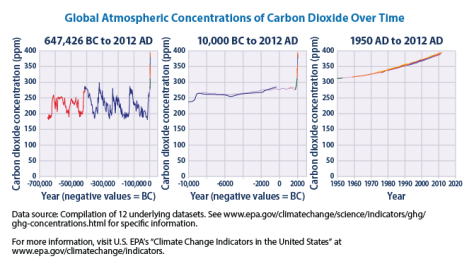
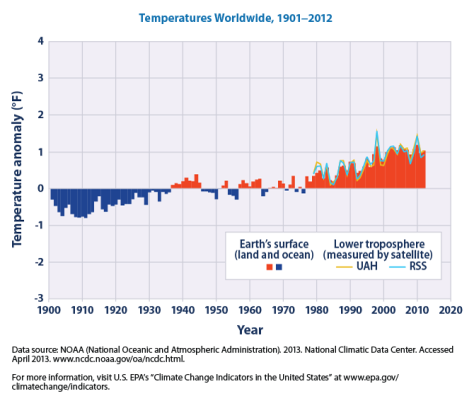
Global Warming can be easily linked to human activities, all one must do is look at a chart of Carbon Dioxide concentration in the atmosphere on any of a number of time scales. Compare this with global temperature change, and it is clear that as CO2 emissions are rising so is global temperature.


EPA
EPA
EPA
EPA

But what human activities are contributing to these changes in the natural environment?

In the case of Carbon Dioxide concentrations there are two primary behaviors. The first one will be obvious to most people, as it is the behavior which has garnered the most attention, the burning of fossil fuels. As human’s burn hydrocarbons they are releasing an ever increasing amount of CO2 into the atmosphere. These materials have fueled humanities journey into industrialization and they are the basis for the high quality of life many people enjoy; Because of the inextricable link between modern society and the burning of fossil fuels, mitigating this factor will require a very drastic alteration in human behavior.
The second behavior is not unknown, but many people seem to be unaware of its link to climate change, mass deforestation. As woodlands are destroyed either for lumber or sometimes to make more room for housing, plants are destroyed. Since photosynthetic organisms consume CO2 and convert it into oxygen, it follows that by decreasing these organisms numbers you will decrease the environments ability to regulate CO2 concentrations. The culmination of these two factors leads to an increase in greenhouse gases in the atmosphere and therefore leads to rising global temperatures.


Posted in Public Policy | Tagged , , | Comments Off on Dying for Comfort: Mankinds’ Descent into Climate Change