The Sun: Our Source of Light

Our Sun is massive! It is 333,000 times the Earth’s mass. It provides all the light and other energy we need to survive – which is pretty impressive within itself.  The sun is made mostly of helium and hydrogen and exists as plasma instead of a solid. But, what makes the sun shine? Some people believe it is a chemical reaction, but in fact, it is nuclear fusion. Nuclear fusion is when two nuclei collide and form a new nucleus. This is considered a “nuclear reaction”. If this seems a bit odd to you and hard to visualize, here is a video that I believe explains it very well.


Posted in Physics, Sun | Tagged , , , | Comments Off on The Sun: Our Source of Light

Reversing Mars

Terraforming_Mars_transition_horizontal

We’ve all at one time or another thought about how fantastic it would be to inhabit another planet and to live on it as we do here on Earth. Recently, the question of whether or not terraforming Mars for the expanding human population has come up. Is it possible to reverse Mars’s climate and atmosphere via artificial means? It turns out that we can indeed change some of these aspects of Mars.

In order to warm Mars and to increase the amount of greenhouse gasses, it has been proposed to send rockets that house fluorine compounds, like chlorofluorocarbons and sulfur hexafluoride. These “CFC rockets” would be sent to crash onto Mars’s surface and to release a large amount of fluorides upon impact. For Mars to heat up enough in order to melt its polar ice caps, an estimated 39 million metric tons of CFC is needed. This barrage of rockets would probably go on for a little over a decade.

Another interesting idea for making Mars’s atmosphere more friendly is to introduce darker soil to Mars’s surface (most likely from its moons Phobos and Deimos) that will absorb more sunlight. The possibility of introducing extremophile bacteria to Mars’s surface has also been considered, especially since they would give some oxygen and heat to the atmosphere as well.

There are many different proposed methods of changing Mars’s atmosphere to be more like our own. We have technology now that can start the process, but at the moment, there is not a feasible way to introduce other necessary elements to Mars for habitability – namely a protective magnetosphere after Mars cooled. Creating a worldwide magnetosphere is not possible at this time. However, it seems that given enough time, we could one day make Mars our own and to live on it similarly to how we live here on Earth.


Posted in Class, Terrestrials | Tagged , , , , | Comments Off on Reversing Mars

Aurora

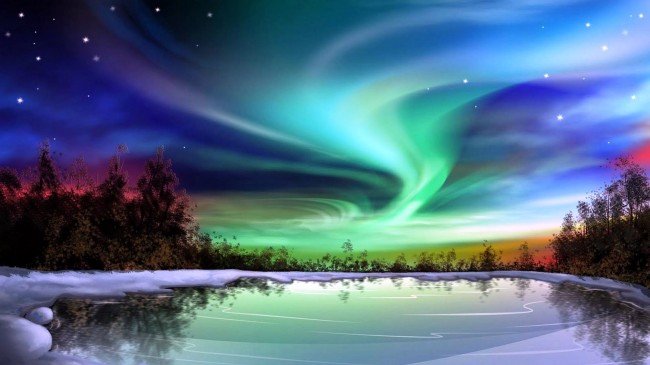
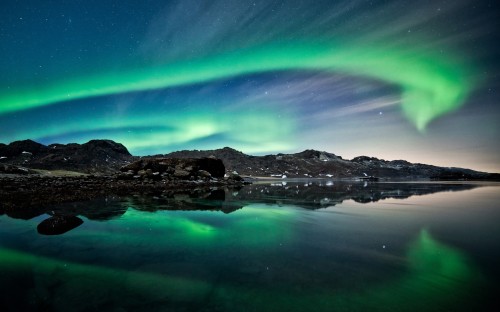
The Aurora, both Aurora Borealis and Aurora Australis, is an incredibly beautiful phenomenon that is the result of important characteristics of our planet and its atmosphere. It is actually a result of electrically charged particles from the sun entering our atmosphere and colliding with atmospheric particles. They occur around the magnetic poles because Earth’s magnetosphere allows some solar wind particles to enter into the magnetosphere near the poles and form charged particle belts. It’s these charged particles that are trapped in the magnetosphere that collide, creating the aurora. The aurora is best viewed at high altitudes and can even be viewed from space. The most common colors of the aurora are pink and green, but they can also appear as red, yellow, blue, and violet. The variation in color depends on the type of gas particle that is colliding. The most frequent pale green aurora is the result of oxygen molecules colliding 60 miles above Earth.

Here is a beautiful image of the Aurora Borealis :

And one more phenomenal image of the Northern Lights:


Posted in Class, Light | Tagged , , , | Comments Off on Aurora

Formation of the Solar System

I have always been a fan of Stephen Hawking. In this video, he does a great job of explaining the formation of the solar system beginning with the origins of the universe. From the Big Bang and how the explosion of an ancient star spread out all the elements generated from its life and death throughout the universe. He goes on to explain how gravity produced the cloud of dust that would eventually turn into our solar system. Once the Earth goes hot enough, nuclear fusion began and generated new elements that spread throughout our solar system with a huge gust of radioactive energy blowing the solar dust to the outer edges of the solar system. Fast forward hundred of thousands of years, and the planets have all formed. I like how even though its a short video on a multi-billion year process, Hawking explains the formation of the universe in an easy to understand, yet informative manner.


Posted in Historical, Universe | Tagged , , , | Comments Off on Formation of the Solar System

Things You Didn’t Know You Didn’t Know: Bismuth Edition

Bismuth, a very neat looking little element, is one of those things in life that went largely unrecognized for a long time, until the world wised up and started to take notice. I like that, because it means bismuth was an underdog and I’m a Tennessee Titans fan, so I can relate to that. Because it can be a little ambiguous looking, historically bismuth was often confused with either lead or tin. By the mid-1700s, however, a man named Claude Geoffroy the Younger discerned the difference and bismuth as an entity in the elemental world was born.

The reason I chose to write about bismuth was because of its peculiar radioactivity. It has the longest half life of any known element, clocking in at more than 20 billion years. To put that into perspective, consider this: in the time it takes bismuth to cycle through a single half life, our earth’s lifespan could have happened more than four times. Like, bismuth is radioactive, but fear not! Hold that element all you want; roll in it, grind it up and eat it (you actually can, we’ll get there in a second), go wild, because regardless of its radioactivity, us mortals are safe. We’ll never experience any of the negative effects of radioactive decay because…20 billion years, you know?

Now, if you recall, I mentioned something about ingesting bismuth. Sounds crazy, but bear with me–you actually can. Bismuth is often a primary ingredient in stomach medicines, for instance, Pepto-Bismol (I read that and my life was forever changed). I find it a little alarming and a little awesome that we ingest a radioactive element, and it helps us! I’m geeking out. Also, because I neglected to provide any earlier, here are some examples of what bismuth looks like. Pretty, right?


Posted in General | Tagged , , , | Comments Off on Things You Didn’t Know You Didn’t Know: Bismuth Edition

Why did the other planets get cool names but not us?

If you start naming of the planets you will realize that they all have something in common except for one of the planets.  That planet is actually our very own Earth.  The rest of the planets (Mercury, Venus, Mars, Jupiter, Saturn, Uranus, Neptune) are all named after a Greek  or Roman God or Goddess.  Earth actually got its’ name from an English word Ertha and a German word Erde, which both translate to mean ground.  Scientists believe that the name was given to our planet around a 1,000 years ago, but do not know who originally gave the planet it’s name.  It makes sense that our planet is named ground or soil considering that it is the only planet in the solar system with growing life, but it is also strange that it is the only planet that does not follow the pattern of having the name of a God or Goddess.  Maybe someday we will finally figure out who gave the planet its’ unique name.

Earth


Earth


Posted in Class, Historical | Tagged , , , | Comments Off on Why did the other planets get cool names but not us?

Exploration of Europa

Exploration of Europa

Image Source

For years now, scientists have been fascinated with Jupiter’s fourth largest moon known as Europa. What makes Europa such an interesting subject is the fact that it is home to a saltwater ocean beneath a layer of ice. Such characteristics make Europa the most likely other place in our Solar System to have life. In order to further investigate Europa, scientists are in the development of robots and instruments of the like that may sniff around Europa’s mysterious waters. Of these developments is a nuclear-powered autonomous underwater carrier (AUV), which will venture into dangerous areas on Europa while obtaining essential biological samples. These samples may hold the key to the famous question: Are we alone? It may only be a matter of time before this question is answered. For more details see here.


Posted in Moons | Tagged , , | Comments Off on Exploration of Europa

Geological Activity of Mercury

Perspective-view-of-ancient-volcanic-plains-in-the-northern-high-latitudes-of-Mercury
Image Source

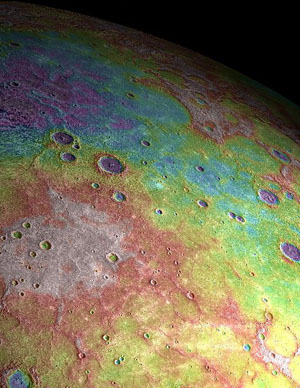
For many years, scientists have regarded Mercury as a planet that has little to offer, as it is more or less a ‘dead’ planet. Mercury has acquired such dull attributes given its treacherous location in the Solar System. Its proximity to the Sun allows the sun-facing side of mercury to reach temperatures of up to 840 degrees Fahrenheit, while the other side drops to temperatures of about -346 degrees Fahrenheit. As one could guess, these extreme temperature differences are not supportive of life. Moreover, Mercury’s small size of about 3000 miles in diameter suggests that its interior parts have been cooled for quite some time, thus supporting the fact that it lacks underground activity such as volcanism. However, scientists have recently noticed that Mercury is home to several clean surface areas, which is not characteristic of planetary surfaces without geological activity. Furthermore, pictures taken by instruments of the Messenger spacecraft show ancient volcanic plains as shown in the image above. The purpler regions are low elevation, while the whiter colors are high elevation. Although Mercury has lived in a hostile environment, there may be many more mysteries to uncover regarding its past.


Posted in Terrestrials | Tagged , , | Comments Off on Geological Activity of Mercury

Now You See Me

The sun is what gives us life, sustains humanity, and provides our planet with everything it needs to survive day to day.  Without Such an important star we would cease to exist.  Although the sun is the most important thing to our survival we don’t know a whole lot about it.  We know some details about the sun through math, tracking neutrinos, and images we can see of the photosphere, but not as much as we would like to know.  Luckily NASA is currently working on building a probe that will get closer to the sun than we have ever been before.  This new probe called the Solar Probe Plus Mission will travel into the Sun’s Corona to take images and readings of the sun.  This Probe will have to withstand temperatures of up to 1,650 Kelvin or about 2,500 Fahrenheit as well as intense blasts of radiation from the sun.  This Probe is estimated to launch no later than 2018.

Solar Probe Plus

solarprobe


Posted in Class, Sun | Tagged , , | Comments Off on Now You See Me

Gas giants are a girl’s best friend

Rappers these days seem to emphasize how they ‘make it rain’ with money, sex, and drugs. But the gas giants of our solar system seem to have one-upped these ‘young upstarts’ (as my grandparents would say) by making it rain diamonds. Yes, literally, diamonds. According to findings by Dr Kevin Baines, of the University of Wisconsin-Madison and Nasa’s Jet Propulsion Laboratory, the atmospheres of the gas giants (specifically Saturn and Jupiter), along with the existence of tremendous amounts of carbon, may have diamond rain. However they are supposed to eventually melt on Saturn and Jupiter. But if you can get to Uranus or Neptune, then with their colder cores, diamonds are forever (as attested to by self-proclaimed lyrical genius Kanye West).

Dreams or reality?


Posted in Jovians | Tagged , , , , | Comments Off on Gas giants are a girl’s best friend