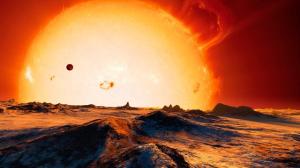
Am I beautiful enough for you?

Every teenager can confess to that one time when they saw a girl and thought she was the one. She was absolutely perfect, in looks and in personality. Let’s be real, it was only the looks. But when she got acne, that aura of divine beauty around her suddenly disappeared for you. You found it hard to accept, but eventually moved on.

The history of the Sun is somewhat similar. It was a divine body, worshipped by just about every ancient civilization. Helios, Ra, Apollo – you name it. So naturally the existence of sunspots discovered by Galileo in the early 17th century were a great cause for concern. While there had been scattered mentions of these spots which were darker in colour existing on the Sun in early history, by and large it was assumed that the Sun was perfect to correspond with the Aristotelian idea that the heavens and the earth were perfect and unchanging. Eventually though realism prevailed and today we appreciate the Sun for who it really is – imperfect yet beautiful.

Definitely not perfect, definitely beautiful.


Posted in Sun, Universe | Tagged , , | Comments Off on Am I beautiful enough for you?

The global warming “controversy” and the politicization of science

Despite popular, largely politically-based claims to the contrary, global warming is a scientific observation explained by an accepted, well-defined scientific theory. Most debate over whether global warming exists and how it is caused occurs not among scientists who study climate change, but among the general public, mostly due to a lack of understanding and what is called the politicization of science.

Carbon dioxide emissions

A graph comparing fossil fuel-related carbon dioxide emissions with the IPCC‘s predictions

Lobbyists for corporations and other entities often twist, cherry-pick, and/or simply lie about scientific studies for the purpose of achieving their own political or ideological ends—often, turning a profit. Since politicians (who listen to the lobbying) regularly interact with the public, but the scientists who have actually studied the  subject in great detail usually don’t, the politicized science is what the general public hears far more often. And, because different lobbies twist science in different ways, conflicting “facts” become common beliefs, and the debate is generated.

While those who know the most about global warming (climate change scientists) have moved past any doubts about the existence and general causes of global warming, national policies are shaped by a public opinion informed by a varying mix of some actual science and a lot of conflicting politicized science. And for this, the process of saving the climate that we know how to survive in is slowed drastically.


Posted in Class, Public Policy, Science | Tagged , , , , | Comments Off on The global warming “controversy” and the politicization of science

NASA’s Budget Problems

Image


Space should be made more accessible to the average person. That should be one of the main concerns for mankind as a whole in the next few decades. For years, interest in space has been dwindling, and it seems that all that is left are the last few dying embers of a once great and roaring fire that consumed a nation during the Cold War and shortly after. Within a decade, we as Americans went from not having a single satellite in space to landing men on the Moon, effectively winning the great Space Race, which some attribute as the cause for starting the end of the Cold War.

During the Cold War, NASA was at the heart of a lot of scientific endeavors and feats, and space was a matter of great interest for many scientists and non-scientists alike. However, our interest in space has collectively dwindled since then. With leadership problems in NASA and a state of fiscal uncertainty, the only kind of talk about NASA’s endeavors and missions has been about which ones to cut, and even talks about dismantling NASA itself. This great icon of ours that has achieved so much has been stripped of a lot of its income, yet is still criticized for using too much money. In truth, NASA gets around half a penny a year for every tax dollar yet they are still able to do quite a bit with what little they are given (for a few ideas on what NASA could hypothetically do with only half of the US military’s spending, check out this short Quora thread).

In order to divert more money towards further research and development for space we must generate more interest for the space program in the average person. NASA and other agencies are taking the necessary steps towards this already through community outreach programs, reaching out to schools and children of all ages in order to generate a greater interest in the program. The media would also be very effective in generating more interest, and already has been by covering important stories dealing with space. There is still much more that can be done though. Great shows like the reboot of the series “Cosmos” and interactive outreach efforts like NASA’s recent “Live from Space” program are some of the more effective methods for renewal of faith in NASA and in space research in general. The rise of private space companies will definitely ease a lot of the burden that NASA is currently bearing, and will make space a much more accessible area for hopefully thousands of people relatively soon.

<Image used in this article from this site>


Posted in General, Outreach | Tagged , , , , | Comments Off on NASA’s Budget Problems

The Probability of Life “Out There”

Image


Is there other intelligent life in the universe? Mathematically speaking, there’s almost got to be some. In fact, it would be quite surprising to find out that there aren’t other intelligent life forms, let alone simple life. Life as we know it can exist in a plethora of places and environments on Earth itself, which is further cause for hope in finding more life in the universe.

According to Wolfram|Alpha, there are approximately 1.7 * 10^11 galaxies in the observable universe, containing an average of billions of stars each. It is estimated that there are 3 * 10^23 stars in the known universe, with perhaps billions of them containing planetary systems with a high likelihood that there are terrestrial planets within many of those solar systems that are not too unlike our own terrestrial planets. If the configuration of these terrestrial planets with respect to the distance from their host star, their size, and their rotation speed are within an acceptable range as dictated by the laws of nature, life as we know it can very well exist on countless other planets as well.

However, those are just the basics of the list of features for a solar system and planet to have a good enough configuration to host life. Given this long list, it may not seem all that likely that there will be other humanoid beings on another distant planet enjoying the wonders of life that we are so fortunate enough to enjoy here on Earth. Then why is it so likely that there is more life out there? It has to do with the fact that life out there might not be even remotely close to the kind of life that we here on Earth are familiar with, and that that life can find a way to survive, and even thrive, in even what we may consider extreme conditions. The extraterrestrial life forms we may find somewhere out in the vast expanse of our universe may range from microbial amoeba-like organisms to massive giants much larger than any creature that has ever lived on Earth. They might survive on different materials, might be made of different base elements, might breath different gasses or fluids. They might be unintelligent or intelligent beyond our capacity to understand. Almost anything is possible.

There are organisms, albeit microscopic ones, that we know of that can survive all the way at the South Pole and even inside volcanoes. The life you will find hidden in the depths of our oceans are so bizarre that you would be right to think that they are indeed aliens themselves, and some can even grow to massive proportions. Life finds a way. So it may be entirely possible that there are millions or even billions of planets out there with life on them, and a high probability that many are highly intelligent. Until we have the means of finding them and then communicating with them (unless they find us first) we must simply explore and learn more, in hopes of developing better methods of travel and communication to find life in the vast, cold, dark reaches of space.

<Image used in this post taken from this site>


Posted in Aliens, Exoplanets, Universe | Tagged , , , , | Comments Off on The Probability of Life “Out There”

Goodness Gracious, Great Balls of Fire

Image

The Sun is often referred to as a great big ball of burning gas, perhaps most famously by Pumbaa in Disney’s The Lion King. This is actually a misconception because the hydrogen in the Sun does not burn, but rather emits energy through the process of nuclear fusion. If the Sun was really burning, then the energy radiating from it would be substantially less and it would have burnt out long ago. Nuclear fusion manages to send out incredible amounts of energy without running through material and therefore provides the perfect method of powering our Sun.


Posted in Sun | Tagged , , | Comments Off on Goodness Gracious, Great Balls of Fire

Super Volcanoes

Yellowstone-ash

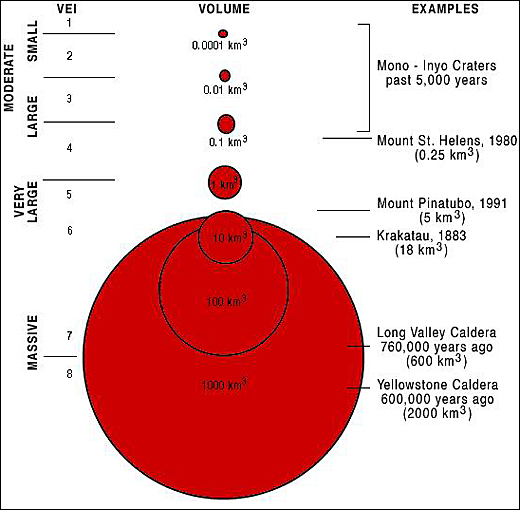
As we know, volcanoes have a significant impact on how Earth looks today. They replenish the atmosphere and fill in craters. However, those are just regular volcanic eruptions. Super volcanoes have magma chambers (which power the explosion) that dwarf that of “normal” volcanoes. A super volcano eruption could wipe out mankind. Luckily these explosions are incredibly rare, the last one occurring over 25,000 years ago. Not so luckily, Yellowstone National Park contains an active super volcano. Should it erupt, any of the effects we see in eruptions, even as strong as that of Mt. St. Helens, would be magnified 1000 or more times. The long term effect could create a mini ice-age, killing many more people than the initial blast. For more detail see link here.


Posted in Class | Tagged , , | Comments Off on Super Volcanoes

Aurora

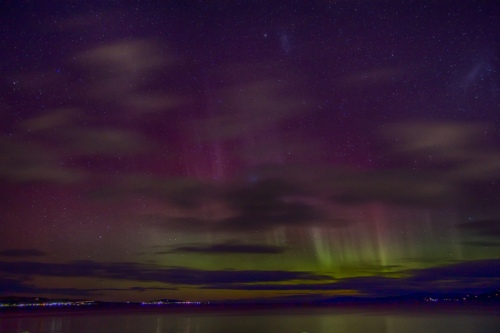
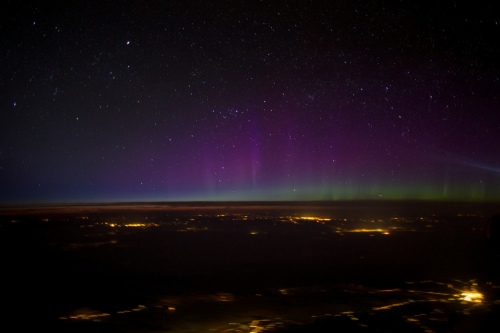
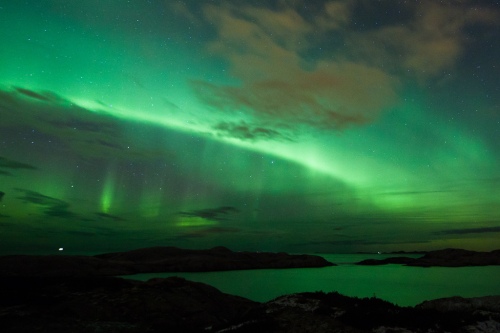
The Earth has a magnetosphere that protects us from charged solar particles coming from the sun. However, some charged particles manage to penetrate the magnetosphere. These then follow the magnetic lines of our magnetosphere. If these gain enough energy they can travel down into Earth’s atmosphere. Here they hit atoms and molecules, causing them to radiate light. These collisions produce the aurora seen near the poles. Aurora occur at the poles because solar wind particles are more likely to penetrate near the poles and because the particles follow the magnetic pole lines.

Image by   BaboMike on Flickr.

Image by
BaboMike
on Flickr.

Image from  p_c_w on Flickr.

Image from p_c_w on Flickr.

Image by B Eilertson on Flickr.

Image by B Eilertson on Flickr.

Image by  jennafa on Flickr.

Image by jennafa on Flickr.


Posted in Class, Light | Tagged , | Comments Off on Aurora

Why is there water on the Earth?

Comet

Photo from NASA.

By the current model of solar system formation, the solar system formed according to what materials condense at which distances. Near the center of the solar system nothing could condense because it was so hot. It was also very dense there, and this was where the sun formed. Farther out from the center, rocky and metallic materials could condense. So terrestrial planets like Mars, Mercury, Venus, and the Earth formed. Then at farther distances hydrogen compounds could condense and there the gas and ice giants formed. But it is obvious from this model that water, which is a hydrogen compound, should not have been able to condense on the earth at its formation. How then are water and other hydrogen compounds on earth?

The answer is comets. These  formed far from the center of solar system, where it was cool enough for water and other compounds to condense. They then later crashed into earth. The compounds were incorporated into earth’s interior by the impact. Volcanoes and other volcanic activity then released these compounds into Earth’s atmosphere and then onto its surface. Earth’s atmosphere and magnetosphere as well as climate then prevented the water from being lost to space or freezing onto the surface.


Posted in Class | Tagged , , | Comments Off on Why is there water on the Earth?

The Future of Life On Earth

The future of Earth and the future of life depends on multiple factors.  Disregarding human technology and the effects of global warming, Earth’s future depends on interactions with other objects in the solar system, the increase in the Sun’s luminosity, and the rate of cooling of the Earth’s interior.

For example, scientists have predicted that an orange dwarf star called Gilese 710 could smash into the Oort Cloud around the solar system in the next 1.5 million years. If this happens, it is likely that it would scatter comets towards Earth. Even if life and Earth survive, there are likely to be more bombardments in the future.

If a large star near Earth dies, it could result in a Near-Earth supernova, which could have adverse effects on life on Earth. These explosions release blasts of gamma radiation that could destroy the ozone, leaving life on Earth exposed to the Sun’s harmful radiation.

Our own Sun poses an even larger threat to Earth. The Sun is gradually gaining luminosity, which will heat up Earth’s surface, making life on Earth more difficult to sustain. Some predict that oceans will begin to evaporate turning the Earth into a desert in 500 million years and greenhouse gases will increase heating the surface to unbearable temperatures. Carbon levels could fall enough that plants will die off, ending photosynthesis, so animals will also die. If Earth’s orbit does not drift away from the Sun, it will eventually be swallowed by the Sun, which is predicted to swell into a red giant in about 7.6 billion years and then die.

The Sun

An artist’s depiction of the Sun looming over a dead Earth billions of year’s from now.

If Earth does drift away from the Sun, and somehow life survives these events, eventually the Earth’s interior would cool down. Plate tectonics would stop, outgassing would end, the magnetosphere would not exist, and the Earth would become a ball of rock like Mercury.

Although Earth’s future looks grim, thankfully these things will not happen for a very long time. Humans have only been around for 200,000 years and will likely be around for much longer.


Posted in Stars | Tagged , , , , | Comments Off on The Future of Life On Earth

Space Travel

download

Most people think traveling through an asteroid field would take a complicated series of evasive maneuvers and luck, but as it turns out, Star Wars got that part wrong. Dodging asteroids (like in the above picture), but odds are, you could steer blindly and never even come close to hitting anything. This is because asteroids are so spaced out. Over time they have collided and combined enough times that this no longer happens frequently. Space travelers would instead face the problems of running out of supplies or fuel since it takes much longer to get just from Earth to the Moon than people appear to take traveling between planets, solar systems, or even galaxies in movies. (Though the misconceptions/fiction are more entertaining.)


Posted in Class | Tagged , , , , | Comments Off on Space Travel