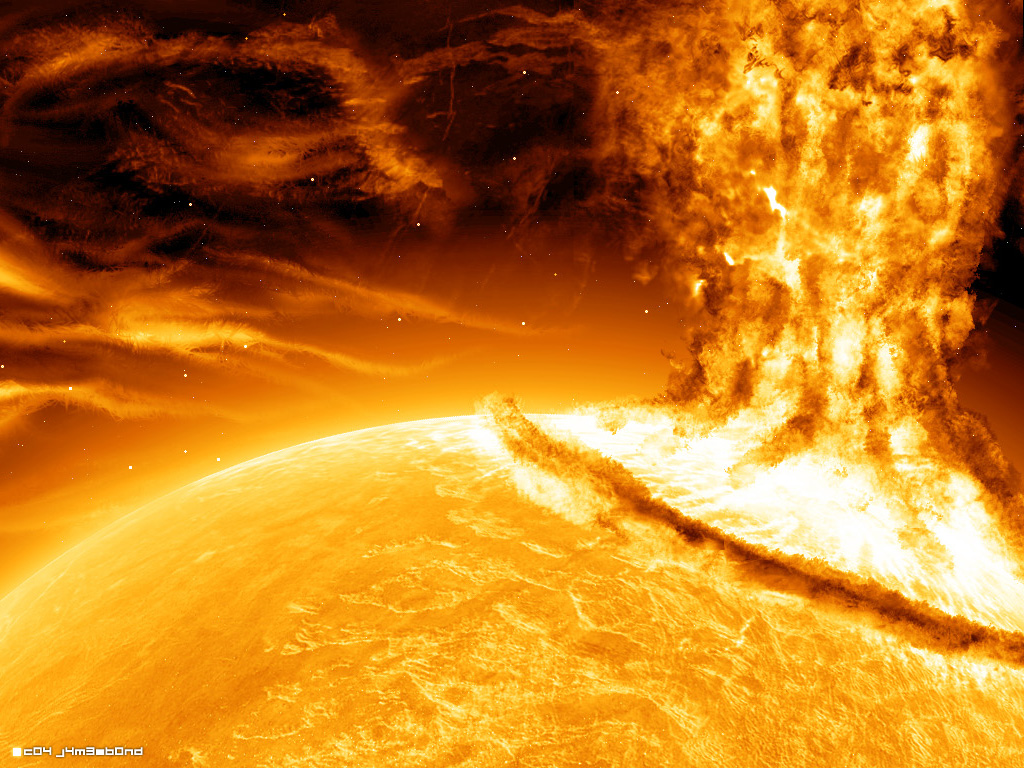
The Prodigious Sun

Is the Sun an efficient producer of energy via nuclear fusion?

While humanity may be years away from commercializing nuclear fusion power, the Sun has been doing it for a while now (and for free!). The Sun is the most efficient generator of nuclear power in our solar system. Inside the Sun, nuclear reactions are happening at a seemingly impossible rate. Hide your kids and hide your wife though, because eventually the Sun is going to run out of Hydrogen and will no longer be able to produce these reactions. When this happens, about 5 billion years from now, will humanity have come up with a way to circumvent the destruction of our society that would come as a result? It took us less than 2000 years to get to sliced bread, so I’m confident we’ll come up with something.

5 Billion Years From Now


Posted in Sun | Tagged , , , | Comments Off on The Prodigious Sun

If the Moon were only 1 pixel

Someone named Josh Worth made a to-scale model of our solar system wherein the Moon is only one pixel in diameter, and it’s totally awesome. The horizontally-scrollable webpage starts at the Sun, and moves right, with text interspersed into the vast distance between planets. What’s so cool about this particular model is that it represents both distance and size to the same scale, something that I have seen very few, if any, models do before.

We talked pretty extensively about the scale of the universe early on in the semester, but it’s something else entirely to really experience that scale to some degree. Worth’s text between planets is poignant at times, discussing the significance of human life to the universe. I would guess it took me about 20 minutes to scroll and read from the Sun to Pluto, and I strongly recommend you do so too.


Posted in Class, Universe | Tagged , , , , | Comments Off on If the Moon were only 1 pixel

Asteroid Mining

There are millions of asteroids in our solar system, and they are more valuable than most people think. When I thought of asteroids in the past, I thought of grey rocks that were uninteresting and dull. However, after learning about asteroid mining and the potential benefits asteroids could provide Earth, I re-evaluated my standpoint. It turns out that most asteroids have rare minerals like silver, gold, zinc, and tin and those minerals could be harvested through asteroid mining. The process involves sending up a probe to an orbiting asteroid, latching onto it, then gathering minerals to bring back to Earth. Additionally, Earth’s mineral resources have been declining and this is a good opportunity to increase the supply of these metals. With today’s modern industry these materials are necessary for industrial progress and expansion so asteroid mining could be a lucrative business to allow industries on Earth to keep producing at the current rate.

But it doesn’t stop there. Some asteroids also possess hydrogen and oxygen, which could be used as fuel for traveling spacecrafts. This means that on especially long journeys where all the fuel cannot be brought onboard the spacecraft; it is possible that they could land on an asteroid and re-fuel there. Asteroids could be like floating gas stations in space where spacecrafts can refuel and continue their journey. While asteroid mining hasn’t officially started, it is a promising business opportunity and could be helpful in future voyages through space.


Posted in Class | Tagged , , | Comments Off on Asteroid Mining

What is a Quasar?

This brief video explains our current understanding of quasars, and how the generate so much energy and are able to be seen from so far away. As the video discusses, when quasars were first observed in the 1960’s, there was a great deal of interest generated about these distant yet incredibly bright objects. As we now know today, quasars, blazars, and radio galaxies are actually examples of the same phenomena, just viewed from different angles.

The phenomena that generates these amazingly powerful objects is known as an active galactic nucleus. The video explains that while all galaxies are thought to have a supermassive black hole at their center, not all of these black holes are “feeding”. When galactic material gets too close to the black hole, it forms an accretion disk and heats up to millions of degrees as particles spiral into the black hole. The rapid movement of these hot, charged particles generates jets of energy perpendicular to the plane of rotation, which extend millions of light years into the universe. These beams of energy can be seen from across the galaxy. Up until recently, quasars couldn’t be used to estimate cosmic distances, as they vary in how much light they emit at each wavelength. In 2012, however, a team of researchers found a trend in the light emitted by various quasars that will hopefully lead to being able to use them as “standard candles,” which would allow astrophysicists to use them to better estimate cosmic distances and, ultimately the age of the universe.


Posted in Light, Physics | Tagged , , | Comments Off on What is a Quasar?

Antimatter Spacecraft

Despite the incredible distance to neighboring stars, there are scientists working on spacecraft that can theoretically take us to these distant worlds. One of the most interesting spacecraft concepts for the future is an Antimatter Spacecraft. The fundamentals of this design are outlined in HowStuffWorks’ article, “How Antimatter Spacecraft Will Work”. The article first gives an overview of what antimatter is, explaining that “These anti-particles are, literally, mirror images of normal matter. Each anti-particle has the same mass as its corresponding particle, but the electrical charges are reversed” (2). These mysterious mirror particles are common in our own universe, but only for a split second. As soon as they come into contact with their anti-pair, they “produce an explosion emitting pure radiation, which travels out of the point of the explosion at the speed of light” (2). This phenomena is how antimatter could be used to power spacecraft. Assuming that we could somehow collect and contain a sufficient quantity of antimatter, a spacecraft could collide antimatter with matter, producing a reaction with 100% energy yield. This level of efficiency is impossible with conventional chemical fuel. However, despite the promising possibilities, it is currently very expensive and inefficient to contain antimatter. Unfortunately, because of these financial and physical constraints, we shouldn’t expect to see antimatter rockets flying from star to star in the near future. Nevertheless, the possible applications of antimatter are fascinating.


Posted in Light, Physics | Tagged , , | Comments Off on Antimatter Spacecraft

The Northern Lights


I have always wanted to see the Northern Lights, also known as the aurora borealis.  I never understood what cause the bright colors in the sky until this class.  Upon reading the book I understood that the lights are simply the result of “charged particles trapped in the magnetosphere.”  It is fascinating to me that these charged particles are able to create this magnificent light.


Posted in Class | Tagged , , | Comments Off on The Northern Lights

Solar Flares

Learning about solar flares in class has been one of the most interesting things to me.  I think it is amazing how unpredictable they are and how they can affect of Earth.  It is fascinating to me to think about how a solar flare can wipe out our electronic systems.  Our book explains that the reason we lose electronics is due to the the geomagnetic storm that occurs when a solar flare happens.  It makes me wonder how vast of an area could lose power due to a geomagnetic storm and what would then happen.


Posted in Class | Tagged , , | Comments Off on Solar Flares

The “Mars One” Project has 200,000 Applicants

Over 200,000 people have applied for a one way trip to Mars to live out their lives. Does this say more about the state of the current political climate, or our own existential problems?This is is yet another existential question I guess…AHHH who am i to judge?? Regardless, The “Mars One” project is program to form a Martian colony. Their applicants have come from over 140 countries, and their plan is have teams selected by 2015, and the first humans on Mars by 2023. If you are curious what glorious life forms will be representing the human race feel free to check out National Geographic’s applicant greatest hits of the video applicants.

This initial mission will cost nearly 6 billion dollars, and the team is hoping to have private backing. The plan is to also have a reality television series to help raise money for the first mission and the following mission will leave out every 2 years. NASA is questioning the feasibility of the “Mars One” project altogether…


Posted in Class, Terrestrials | Tagged , , , , | Comments Off on The “Mars One” Project has 200,000 Applicants

ESO Spots Largest Hypergiant Star

The European Southern Observatory has found a very large star and it is now one of the ten largest stars known. This yellow giant measures nearly 1,300 times the diameter of the Sun, and even more interesting is that it is part of dual star system with the second star actually in contact with this star named HR 5171.

HR 5171 is a million times brighter than our Sun, and 50 percent larger than the Betelgeuse, a red supergiant that can be seen from Earth. Yellow hypergiants are extremely rare and are at a stage of their star life that is rapidly changing and highly unstable, especially their temperature fueled by nuclear fusion. This instability also causes an expelling of material thus forming a thick extended atmosphere.

HR5171 is roughly 12,000 light-years from Earth, and its companion is significantly smaller and cooler than its big brother. This companion is being watched closely as well for it can have a say in the fate of HR5171 by potentially stripping off its outer layers and altering its evolution.

HR5171


Posted in Class, Stars, Universe | Tagged , , , | Comments Off on ESO Spots Largest Hypergiant Star

Volcanoes on Venus

Infrared imaging of a hotspot on Venus, showing  volcanic activity.

Infrared imaging of a hotspot on Venus, showing volcanic activity.

Venus is around the same size as Earth, and therefore has a similar interior makeup.  Earth has volcanoes and they are still erupting today.  On Venus, there are signs of volcanoes but a space probe has never seen a volcano erupt on the surface.  By measuring infrared levels on the surface, we can tell that there has been volcanic activity on Venus in the past hundreds of thousands to millions of years.  Probes can monitor levels of sulfur dioxide, and when the levels increase, it means there has been a volcanic eruption recently that let out more gases.  From 1978 to 1992, there was an increase in levels of sulfur dioxide found by a probe orbiting Venus, supporting evidence that volcanoes are active on the surface.  There are hotspots on the surface of Venus that resemble the same hotspots that formed the Hawaiian islands, giving us clues as to how the surface of Venus has changes over time.  While many astronomers debate over whether or not the volcanoes on Venus are active, recent infrared images from probes have proven that the volcanoes are active and have erupted in the past, changing the surface of Venus.  Hopefully sometime soon we will see a volcano erupt and have photographic evidence of a volcanic eruption on our neighboring planet!


Posted in Observables, Universe | Tagged , , , | Comments Off on Volcanoes on Venus