The Mystery of Chaco Canyon

Chaco Canyon in New Mexico is one of the largest archeoastronmical sites in the world. The site is an artifact of the Pueblo peoples of north america and is now a protected national heritage site. Archeologists estimate that the main architectual landmark, the great Kiva of Chetro Keti, was constructed between 900 and 1150 AD. The structure is aligned synchronistically with the four cardinal directions, with the equinoxes marking the days where sunlight penetrates to some of the inner chambers. This sort of construction requires generations of exremely precise observations to execute. The bodies of the heavens are believed to have had extreme cultural and ceremonial importance to the Pueblo peoples. Since the seasons bring and take most of the resources in this area, appeasing the spirits of the skies was of the utmost importance. One of the most famous smaller discoveries of this region is also the “sun dagger” site at Fajada Butte. Rocks were placed in a chamber high upon one of the largest mesa’s in the area to create a narrow gap that puts a dagger shaped beam of light on one of two small sprials found inside on different significant astronomical dates. On the summer solstice the dagger pierces the center of the spiral and on the edges of the spiral on the winter solstice. Sites like these depict the profound effect the cosmos have had on the development of human culture. It seems even down here on earth we cannot escape the great cosmic dance going on all around us. Chaco Canyon  Fajada Butte


Posted in Historical | Tagged , , , | Comments Off on The Mystery of Chaco Canyon

Astronomical Satellites

The Hubble Telescope

The Hubble Telescope

Astronomical Satellites are observatories of some sort that are in orbit around Earth. These observatories vary greatly in specifically what and how they observe, but they all share the same rational for being in space, instead of on Earth. On Earth, telescopes have to attempt to see through Earth’s atmosphere and deal with the varied uncontrollable weather and light pollution produced by civilization. But once telescopes get above Earth’s atmosphere, they have clear access to the universe that isn’t disrupted by the processes it was subjected to on Earth. One other important reason satellites are put into orbit around Earth is they have access to many other forms of light that are blocked from reaching the ground by the atmosphere. Telescopes and other observation devices have full access to the various forms of light when in space. Because there are so many forms of light that can be observed, telescopes have been developed that pertain specifically to different wavelengths of light. There are radio, infrared, ultraviolet, X-ray, and gamma-ray telescopes. One famous example is the Hubble Space Telescope, which conducts high-resolution imaging and spectroscopy in ultraviolet light.


Posted in Class, Instruments, Universe | Tagged , , , , | Comments Off on Astronomical Satellites

The Space Race

The Space Race was a competition of sorts between the United States and the Soviet Union that started in 1955 and led to the first artificial satellites being sent into orbit, the first humans being sent into space, and the first humans landing on the Moon. The USA was the first to announce intentions to create a satellite, and the race began when the USSR made a similar announcement just four days later, on August 2, 1955. The two large countries were already in an arms race thanks to their simultaneous discovery of German missile technology at the end of World War II, and there is no doubt that the sense of rivalry stemming from that fact contributed to both the Space Race and the Cold War.

As it happened, the USSR launched its satellite, Sputnik 1, first. They also were the first to successfully send humans into space, meaning all of the pressure was on the USA to get to the moon first. This was accomplished in 1969 with the Apollo 11 mission, and after that the Space Race (along with the Cold War) slowly fizzled out.

Sputnik 1 replica

A replica of Sputnik 1

Buzz Aldrin

A photo of Buzz Aldrin on the moon, with Neil Armstrong reflected in the vizor


Posted in Class, Historical, Space Travel | Tagged , , , , | Comments Off on The Space Race

X-ray Telescopes

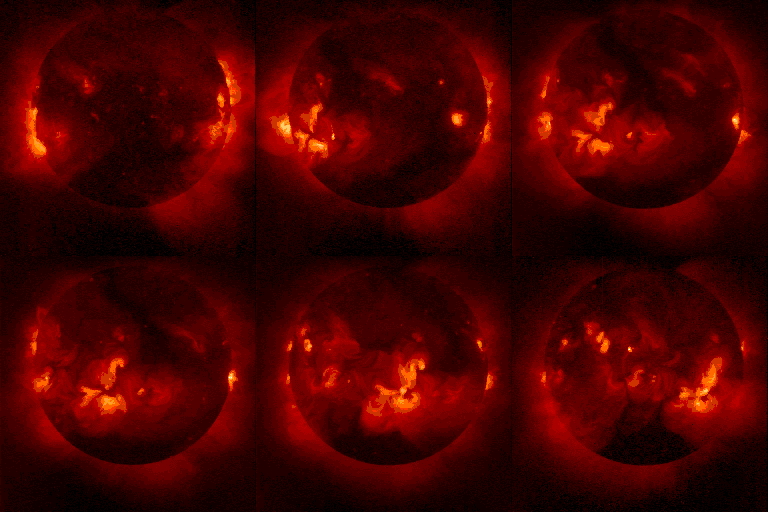
An x-ray image of the sun reveals more about the corona.

An x-ray image of the sun reveals more about the corona.

Light comes at many different wavelengths and energies. The light we see represents light with wavelength from about 400 to 700 nanometers. Infrared light and radiowaves have longer wavelengths (and thus carry less energy) than visible light, while UV rays and x-rays and gamma rays have shorter wavelengths (and carry higher energy). Even though we can only see the visible spectrum, we can build instruments that detect the other sorts of light. Radios pick up radio waves and x-ray imaging at the doctor’s office detects where x-ray light has been allowed to pass through the body.

In astronomy looking at the different wavelengths of light can tell us more about the Universe. For this reasons different sorts of telescopes have been designed. Visible light telescopes are considered normal telescopes, but there are also radiowave telescopes, infrared telescopes, ultraviolet telescopes, x-ray telescopes, and gamma ray telescopes. To observe the different lights the telescopes have to be built in a certain way and sometimes put in a certain location. Since gamma rays, x rays, and infrared light do not penetrate our atmosphere to the surface, telescopes observing these types of light must be launched into high in the sky or into outerspace.

X-ray light is hard to catch. Normal mirrors do not reflect x-ray light, rather the high-energy light simply penetrates the mirror. However, if the mirror is placed at an angle to the light the light will reflect. Many people compare this to shooting a bullet. If you shoot a bullet directly at a metal sheet, the bullet is just going to dent the sheet. But if you just let the bullet graze the sheet, the bullet will reflect off the sheet. So called grazing incidence mirrors focus the x-ray light so that an image can be constructed. This is part of what makes x-ray telescopes different from other telescopes. Many telescopes varying in mission and construction have been sent into space built on this concept.

The incline of the mirror allows the x-rays to be reflected and focused.

The incline of the mirror allows the x-rays to be reflected and focused.

XRTs (x-ray telescopes) have allowed us to observe phenomena we otherwise would not have known about or understood as well. The first x-ray telescopes were used to observe the sun. We have also been able to observe the heat distribution between galaxies, detect neutron stars and black holes, and examine supernova remnant expansion.


Posted in Class, Light | Tagged , , | Comments Off on X-ray Telescopes

Tides

This video is a cool, informative, easy understand animation of how the gravitational pull between the Earth and the Moon affect tides. It clearly and concisely describes how tidal forces cause high tides twice per day even though the moon is only overhead once per day and why the gravity is weaker at a greater distance (there is less force pushing the object away). It is so interesting that there are tides in the Earth’s crust because , while it is relatively easy to detect tides in the ocean, we do not notice any tides in the crust below our feet.


Posted in Moons, Physics | Tagged , , | Comments Off on Tides

Hipster Lens Flare–From Whence Do They Come?

This photo shows a pretty typical example of a lens flare. In chapter 5, we cover light, the visible spectrum, the three basic type of light, how it moves and bends and what can bend it. Lens flares are a practical and easy to understand example of how light is bent. Essentially, a lens flare is light going where you don’t want it to go, then being captured on film. The simplest run down is that when a camera takes a picture, it’s capturing light on film. The light hits the film and creates an image. The light creating the image is wanted light. Lens flares are generally considered gate crashers–they can reduce contrast in a photo (that means wash it out) and they create spots on the photo. If you’re a photographer and you’re capturing a moment for posterity, lens flares are probably the bane of your existence–unless, of course, you are a wedding photographer or a hipster who carries their camera around with them at all times. If you fall under either of these categories, you love lens flares because they’re pretty and you don’t even have to use third party filters to achieve them, which saves you time.

Typically, if you want to reduce lens flares you need to invest in a quality camera that can reduce the amount of unnecessary light picked up. Buying a lens hood will also help reduce superfluous light.Image


Posted in Light | Tagged , , , , | Comments Off on Hipster Lens Flare–From Whence Do They Come?

Planetarium

Growing up, one of my favorite things was going to the planetarium.  I was very eager to go learn about each of the planets and the universe.  I would spend lots of time trying to find the constellations, and my brother even got a star named for me! The star is located near Pegasus and I hope that during the observation part of the class, that I’ll be able to see it.


Posted in Class | Tagged , , | Comments Off on Planetarium

Tides

Having grown up near the ocean, I always found tides fascinating.  Until now though, I never quite understood what was happening. Moon tides are caused by the Moon’s gravity which creates two “bulges.”  Additionally, there are Sun tides, but these are not as strong due to how far away the Sun is.

Recently, in the San Francisco Bay Area, a man names Andres Amador, has been creating spectacular drawings in the sand during low tides.   Which are then of course, washed away during high tides.  I am very much looking forward to going to visit the beaches he designs on in the near future.


Posted in Class | Tagged , , | Comments Off on Tides

Blog #4: Telescopes

Even though I was born and raised in Los Angeles, California, I have never taken the time to visit the renowned Griffith Observatory until this past winter break.  After my trip, I found my awestruck in wonder by the breathtaking beauty of the night sky.  It is difficult to see stars in the city since there are so many lights and smog in Los Angeles.  However, looking through the huge telescope showed me that there is a whole new world that I haven’t seen yet.  Telescopes enable us to look at the universe in a way beyond our own human capabilities by manipulating and capturing the light in a certain way.  Though ground-based telescope use means that there might be a manipulation of the data found because of the atmosphere in the way, this is countered by putting telescopes in space.  With new highly advanced technology, we are able to observe and analyze the universe with greater skill and knowledge in a more effective manner.  Certain telescopes capture certain types of light ranging from ultraviolet to gamma-ray.

By me


Posted in Instruments | Tagged , , , | Comments Off on Blog #4: Telescopes

Blog Post #3: Defying Gravity

Learning Hub

Learning Hub

It always blew my mind that despite the vastness of the universe, there was a central force that centered it all.  Just thinking about how far away the sun is from the earth, but how a certain force (gravity) can still pull the two together past the distance to create an orbit and a revolution shows how powerful this force actually is.  The whole universe moves and is dependent on the concept of gravity, the WHOLE universe!!!  The universal laws of gravity govern motion in the universe.  The fact that the strength of this force is very much dependent on the mass of the object in question and can determine how a planet orbits also shows how motion in the universe is characterized in this way.  Gravity is the driving energy of the whole universe.  It does big things like causes tides and planetary rotations but then at the same time is the reasoning behind pressure keeping us grounded on earth.  Gravity is everywhere and affects everything!!!


Posted in Galaxies, Sun, Universe | Tagged , , , , | Comments Off on Blog Post #3: Defying Gravity