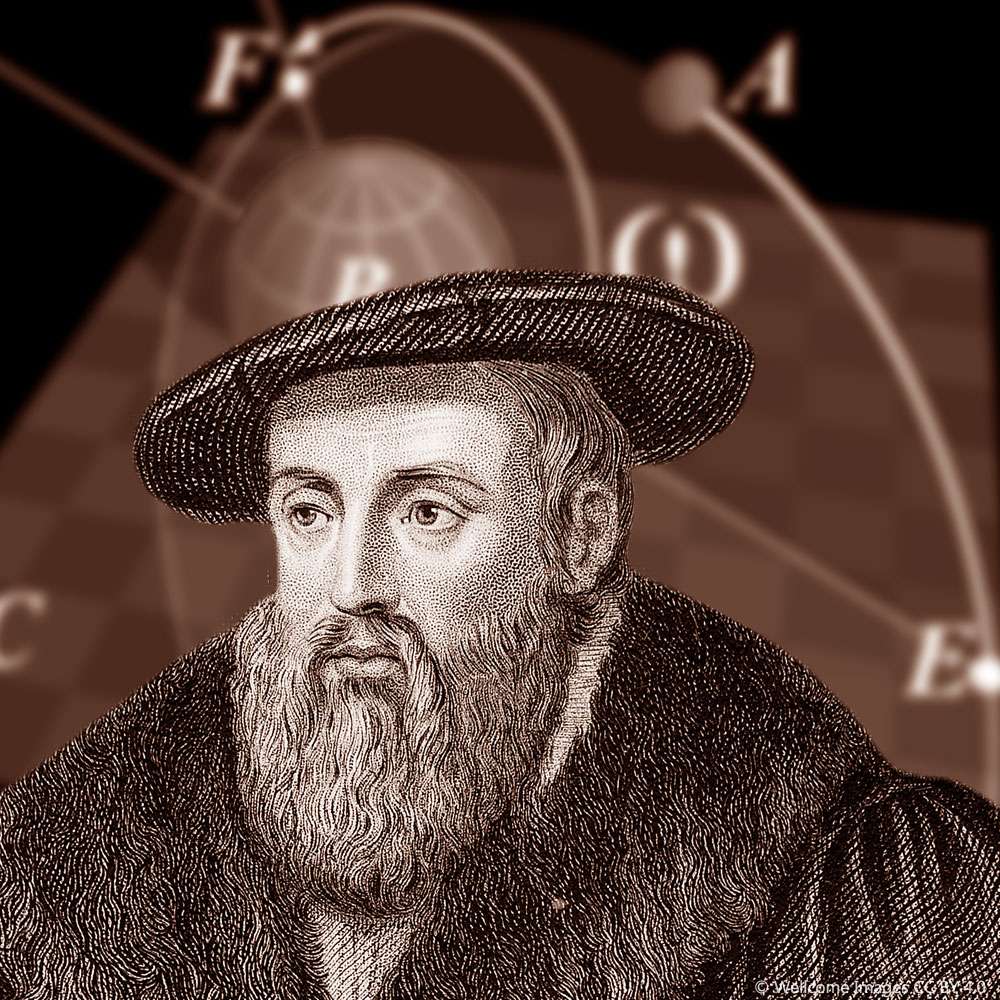
Johannes Kepler
Johannes Kepler, who lived from 1571 to 1630, revealed three laws of planetary motion which explain the motion of the planets in the solar system. The first law concerning orbits states that all planets move around the Sun in an elliptic orbit. The second law, the “area law,” implies that a planets angular momentum is constant. The third law is called the “harmonic law” which mathematically connects the time of an orbit to the distance of an orbit. These laws provided crucial information in the advancement of astronomy.
Historical Events During Johannes Kepler’s Life
On May 14, 1607, a settlement was established in Jamestown, Virginia by the Virginia Company of London who was granted by King James I of England.
On August 15, 1620, the Mayflower, an English ship, set out carrying a group of people referred to as the Pilgrims. They established Plymouth colony in what is now Massachusetts.
Historical Figure During Johannes Kepler’s Life
James I of England was born on June 19, 1566 and died on March 27, 1625, and he ruled for most of his life as the king of England and Scotland. While his reign is described as successful, he is set apart by his writings which have been preserved.
Reflection of Historical Context in Relation to Astronomers
The context for this time does not seem to overlap with astronomical discoveries at all. This is simply not true; we are all influenced by the time and place which we are in. This was a time of discovery in Europe. The common theme seems to be that they were interested in knowing more about the world. The Jamestown and Plymouth colonies being established is an indication of wanting to expand. The discoveries of astronomers of this time are also in the interest of learning more about the world. They wanted to know why the sky looked like it did. This contextual information helped me to better understand the motives of the astronomers. They were explorers, but instead of exploring land, they were exploring the sky.