Blog #2: Archaeoastronomy, or Ancient Astronomy

Archaeoastronomy is the study of the practice of astronomy in prehistory, or Ancient Astronomy. Once the subject of much debate by scientists, it is now accepted that astronomy was indeed practiced in prehistory. Human astronomical observations began in the Palaeolithic period, with the discovery of “decorated Baboon fibula with 29 parallel notches incised notches from Kwazulu border cave, Africa.” This discovery, from 35,000 – 33,000 BC, has 86 notches on a tablet, a number that has two special meanings: “it is the number of days that must be subtracted from a year to equal the average number of days of a human gestation”, as well as the number of days Betelguese, “one of Orion’s two prominent stars”, is visible. Later, in 32,000 BC, lunar notations were found on remains in W. Siberia, and even later, in 22,000 BC, artefacts to record “the solar year and phases of the moon” were also found in Siberia. Mesolithic Astronomy is the next phase, which began around 10,000 BC and includes the discovery of bone plaque being found, around 9,000 BC, in Grotte Dutai, in west France, as well as “engraved bone with lunar notations from Ishango, Congo” being found in 6,500 BC. Finally, we have the neolithic to present phase, which began around 5,000 BC, and included the discovery of the Kerkado passage in Carnac, France, a monument used for lunar observations, as well as the new, predominately lunar monuments being discovered in 3,300 BC , in Lochmariaquer, France. To learn more about Archeoastronomy, please refer to the source.
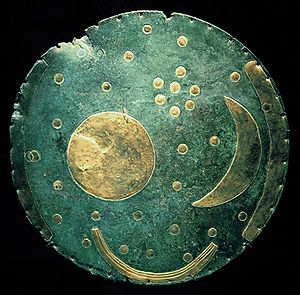
nebraskydisc

Source: ancient-wisdom.com/astronomy.htm


Posted in Class | Tagged , | Comments Off on Blog #2: Archaeoastronomy, or Ancient Astronomy

Blog #1: An Overview of Astronomy Apps

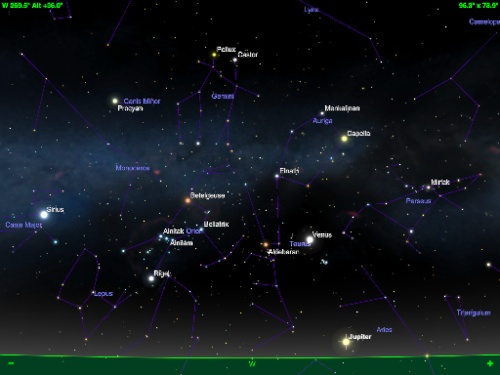
Today, we are going to explore a popular, modern, and convenient means of exploring our universe, stargazing apps. Available on the Apple App Store (iOS) and the Google Play store (Android), these apps use a multitude of information our mobile devices take in, including location (GPS or Wi-Fi), date and time, compass direction, and gyroscopic information so that your mobile device knows when and where it is, how it is oriented, and where it is pointing, so that it can show you a “virtual map” of any part of the sky, with labeled information about each star, planet, object, etc. In addition, mobile internet access allows users of these stargazing apps to access a virtually infinite bank of astronomical information and data, making the use of these apps an excellent educational experience. These apps are creating a revolution in astronomy, allowing anyone to learn more about stars, galaxies, planets, nebulae, and more, without needing to buy an expensive telescope or work at NASA. Many of the simpler astronomy apps are free, with the more expensive ones providing highly refined user interfaces and large amounts of relevant astronomical data, creating an immersive and complete mobile stargazing experience for the amateur to the pro. Astronomy apps are an excellent way to learn more about our universe, and to explore our solar system from anywhere by simply using your mobile device.

Source: space.com – mobile stargazing

20120410skysafari1

above: SkySafari, a popular astronomy app


Posted in Class | Tagged , , , | Comments Off on Blog #1: An Overview of Astronomy Apps

Blog #3

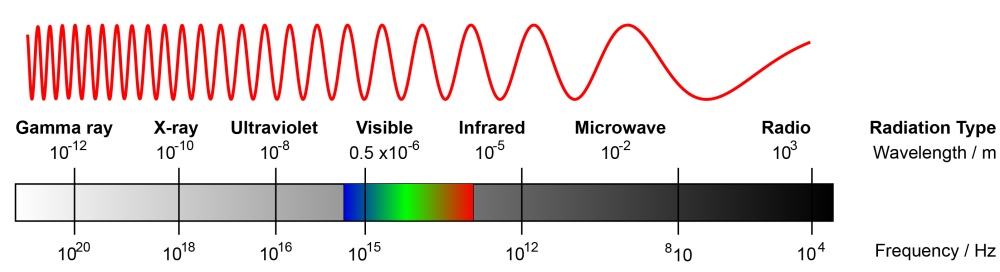
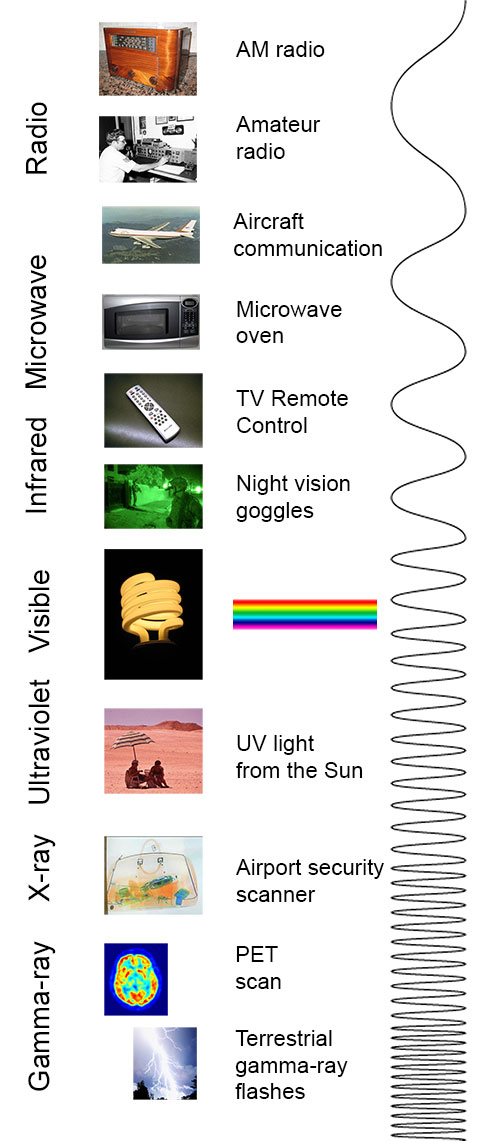
When we think of waves, the first thing that comes to mind would be waves in the ocean, or perhaps doing the wave at a football game. However there are also a great deal of other waves that are just as important in our lives if not moreso especially in the field of astronomy and these are the waves that make up the electromagnetic spectrum. The EM spectrum consists of radio waves which are the same waves that enable your radio to work and shows the location of stars in space, Microwaves which heat up food, Infrared used by nightvision goggles and maps the dust between stars, visible light which enables us to detect light and to see, Ultraviolet used in tanning and detecting heat in space, X-rays for viewing bones and finding hot gases in the universe, and Gamma rays to see inside the body. Fun fact, the universe is one giant gamma ray generator. The electromagnetic spectrum comprises of a plethora of different waves that have uses both in normal life and in astronomy.

Source: NASA

em_spectrum_sm
Waves grouped by wavelength

Posted in Class | Tagged , , | Comments Off on Blog #3

Blog #2

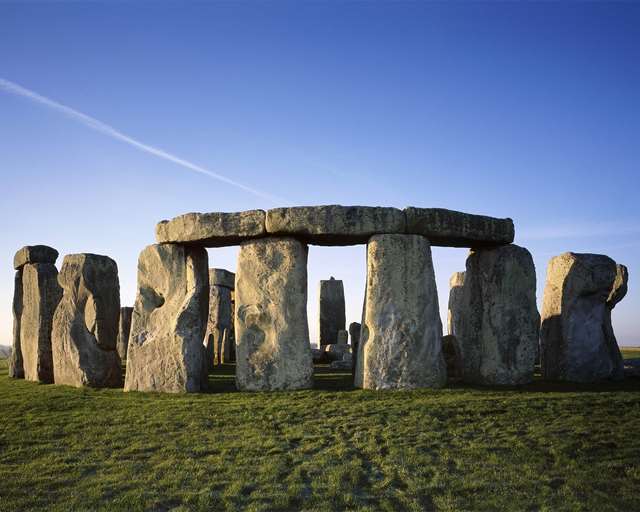
When you head outside at night to watch the stars and contemplate your own insignificance in the universe, you are partaking in a ritual that has spanned the length of all human existence. By watching the stars and planets in the sky, our ancestors were able to derive a great many advancements that we currently take for granted such as calendars and clocks. There is also a field of science dedicated to learning about these achievements known as Archaeoastronomy. Defined by archaeoastronomy.com as “understanding how skywatchers of the past fashioned and refined systems for regulating their primitive calendars and for memorializing celestial events, both cyclical and unique.” By learning how people in the past viewed the stars and grew from them, we can have a greater understanding of how our current world came to be and potentially even use that knowledge to make groundbreaking discoveries of our own.


Source: Archaeoastronomy.com

stonehenge-sunrise
A glorious tribute to Archaeoastronomy

Posted in Class | Tagged , , , | Comments Off on Blog #2

Blog 3 – Electromagnetic Spectrum

For this blog I thought I would further look into the electromagnetic spectrum.  As in the picture below, we can see that the light that humans see is only a small portion of the full spectrum of light, collectively known as the electromagnetic spectrum.  Light itself is technically radiation, but only certain types of light radiation is harmful for humans.  Largely, radiation with a short wavelength and a high frequency is going to be more harmful than the opposite.  Visible light ranges from 400 nanometers (1 nm = 1 billionth of a meter) at the blue or violet end to 700 nanometers at the red end.  Humans cannot independently perceive the color of frequencies above or below this range.  The varying amount of energy that different types of waves have are already utilized by mankind.  Radio waves have very low energy and cannot negatively impact our bodies, but can make electrons move enough on antenna to allow for radio communication.  For health purposes, X-rays have enough energy to move beyond the skin and tissues but are stopped by bones or teeth, allowing us to map pictures of these structures.  On the other side, we also deal with harmful wavelengths as well, from the Sun.  Our atmosphere protects us from gamma rays and X-rays, but ultraviolet light from the Sun still makes it through.  A lack of sunscreen on a sunny, yet not necessarily hot day causes our skin to react, leading to sunburn or even skin cancer.em_spectrum_properties_reflectedThe Electromagnetic Spectrum


Posted in Class, Light, Science | Tagged , , | Comments Off on Blog 3 – Electromagnetic Spectrum

Blog 3: Cosmic Background Radiation

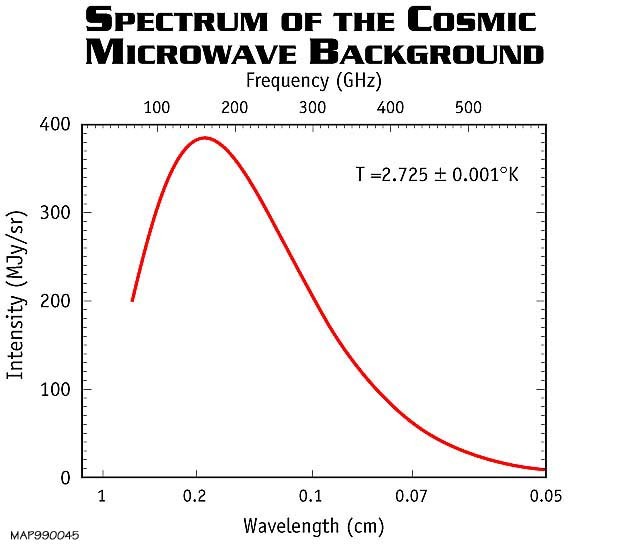
A radiation that is an after-effect of the Big Bang still around today. It was actually discovered accidentally by two Arno Penzias and Robert Wilson in 1965. They noticed a static that appeared to be coming from every direction at the same strength. Later scientists were able to trace out a Black Body curve for this background radiation, shown below.

bigbang_cmb

Essentially, at very early point in the beginnings of the universe, everything cooled down enough to where atoms could form and this radiation was formed. The temperature to which it has cooled, estimated to be around -270 K, scientists believe to be consistent with a universe that started at a very high temperature and in a very dense state, the Big Bang. Therefore, this cosmic radiation is very strong evidence in favor of the Big Bang. [1]


Posted in Class, Physics, Universe | Tagged , , | Comments Off on Blog 3: Cosmic Background Radiation

Blog 2: Celestial Navigation

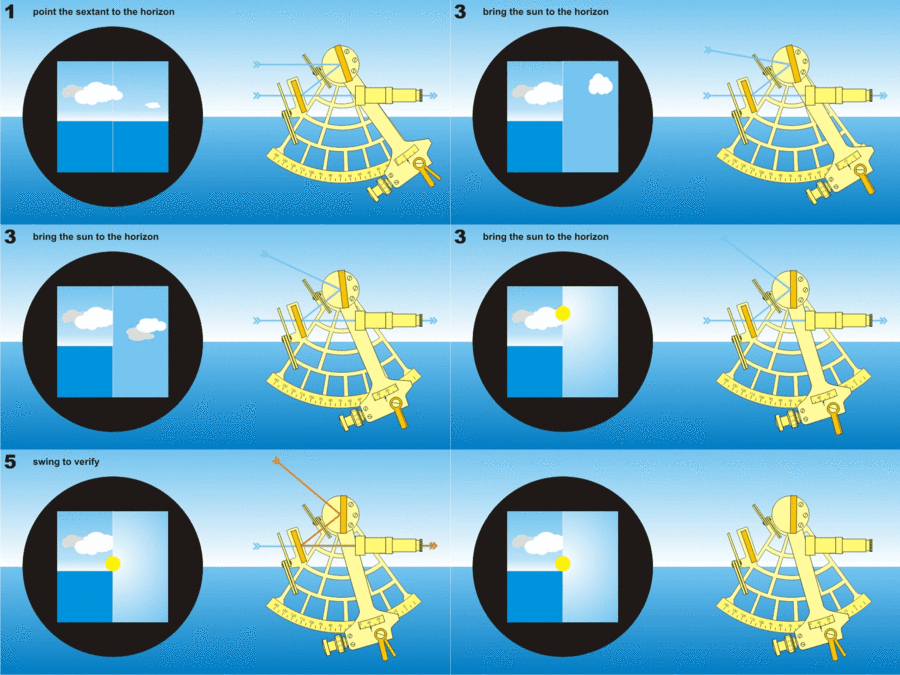
Even though astronomers use scales such as arcseconds and arcminutes to measure certain distances between stars, the main tool of celestial navigation, the sextant, is only able to measure arcminutes. The sextant uses reflection in order to find the angle of celestial objects. Traditionally, the sextant has two mirrors. The horizon mirror is stationary and keeps half of what the observer sees to be the horizon line. The second is called the index mirror. This mirror pivots until the celestial object comes into view and meets the horizon line. It is then necessary to rotate the sextant in order to ensure the correct angle has been found. The celestial object should move in a “u” shape from side to side as the sextant is rotated side to side. After the correct angle is found, the observer may read the angle above the horizon the celestial body is at on the bottom of the incidence bar, which is connected to the incidence mirror and pivots with it. The diagram below illustrates the basic operation of a traditional sextant. [1]

450px-using_sextant_swing


Posted in Class, Instruments | Tagged , , , | Comments Off on Blog 2: Celestial Navigation

Blog 1: The Speed of Light And Refractive Index

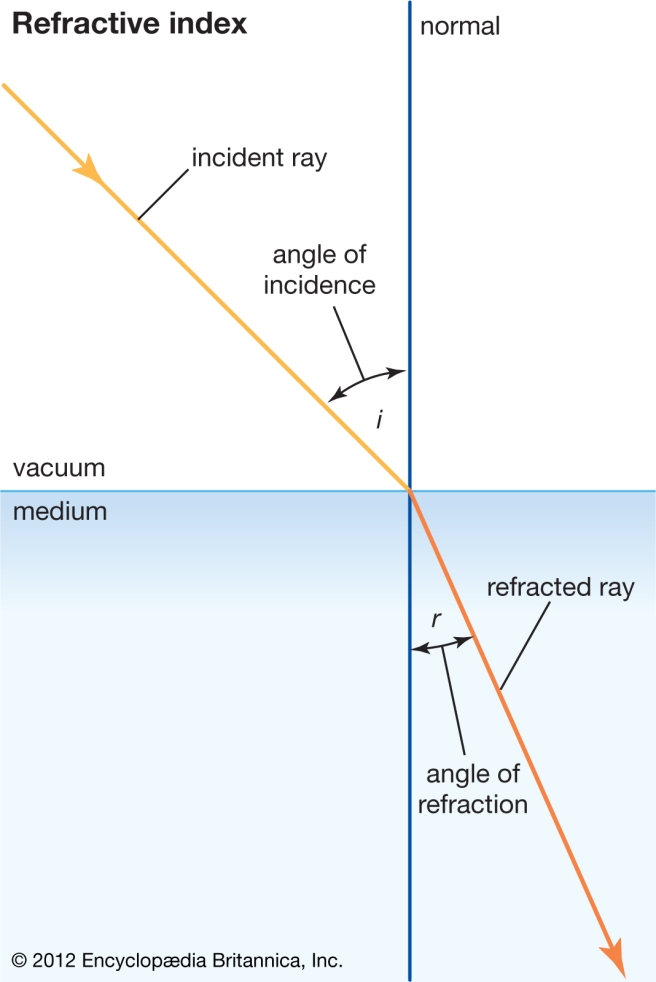
Light travels at a velocity incredibly difficult for us to comprehend other then as just a very, very large number. To be exact, light travels at a constant velocity of 299,792,458 m/s within a vacuum. This is not the same for light traveling through other conditions. When light does travel through things other then a vacuum, there exists something called the refractive index. This index represents the amount that light is slowed. It represents this as the ration between the speed of light in vacuum and the speed at which the light travels within the medium, which is always greater then one since light can never travel faster then when it’s in a vacuum. What’s interesting is that this equation is also defined a different way. Instead of being the ration between two velocities it is defined as sin(i)/sin(r), where i is equal to the angle of incidence and r is the angle of refraction. Since this ration is always greater then 1, then it means that everything light passes through bends it in some way. This diagram from Encyclopedia Britannica represents a visual of the how light travels through a medium.57722-050-37d0407f


Posted in Class, Light, Physics | Tagged , | Comments Off on Blog 1: The Speed of Light And Refractive Index

Blog 2 – Occam’s Razor

For my second blog, I thought I’d discuss the idea of simplicity in astronomy; specifically, the idea of Occam’s Razor.  One of the hallmarks of science is the progression of creation and testing of models of nature that explain scientific observations as simply as possible.  This idea, that scientists should prefer the simpler of two models that agree equally well with observations is named Occam’s Razor.  It is named after William of Occam (1285-1349), a medieval scholar.  This idea relates to the debate between heliocentric and geocentric views, starting in Copernicus’ 1543 posthumous work On the Revolution of Heavenly Spheres.  What was interesting to his contemporaries wasn’t his flawed data but instead was the simplicity of his ideas, such as the simple explanation for retrograde motion.  They were able to keep the idea alive until Johannes Kepler improved it.  In modern times, for example, we could likely produce trails of algorithms to still keep observations in line with the geocentric model, but the heliocentric model would still be better because it is more simple and produces the same results.

253688a9e17f93ec4a3fa4e57c1964ad02403e2b
 Early Heliocentric Model of the Solar System

Posted in Class, Historical | Tagged , , | Comments Off on Blog 2 – Occam’s Razor

Blog 1 – Cosmic Calendar

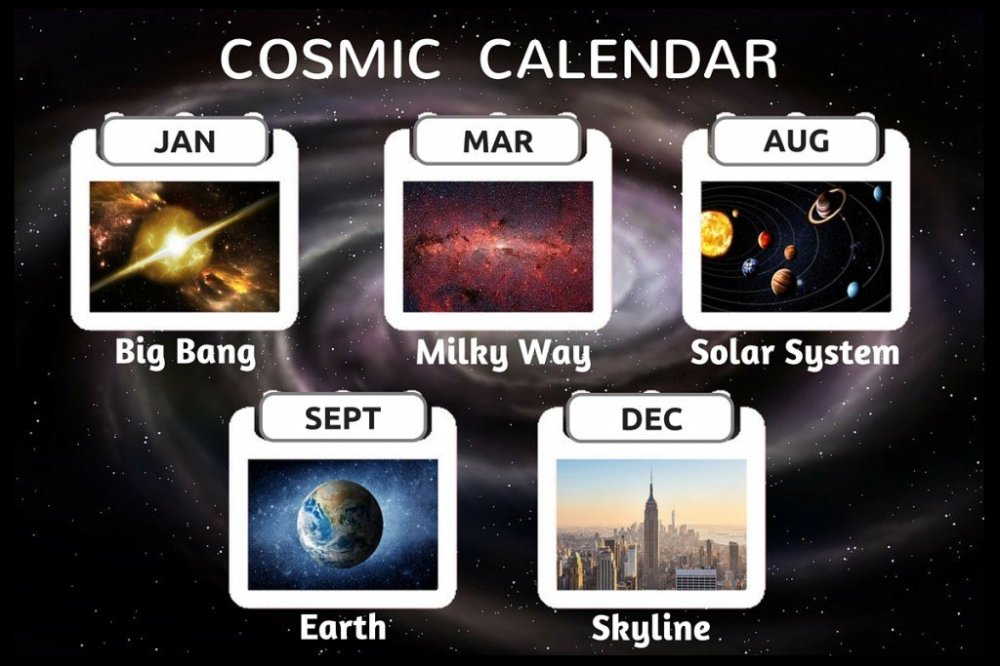
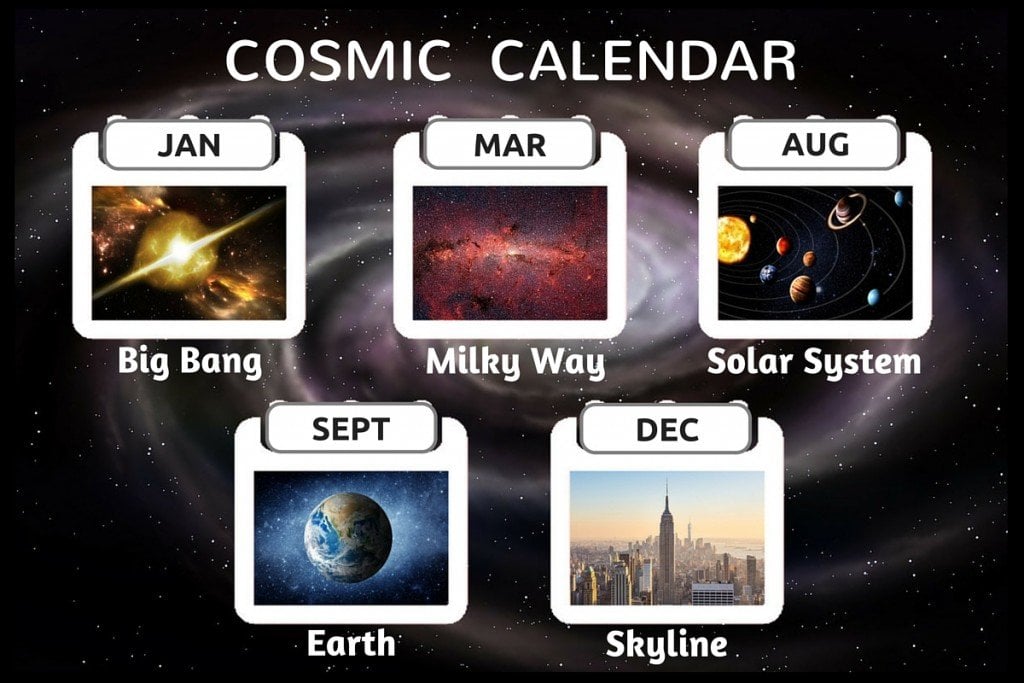
For my first blog, I wanted to discuss the cosmic calendar.  From the picture below, you can see, from a human bias, the five most important events in universal history, symbolized in the julian calendar: the big bang in january, the formation of the milky way in march, the development of the solar system in august, Earth’s formation in September, and the skylines from human manpower in December.  Already, it seems that our time in the universe is fairly insignificant, but this picture itself is very rough and misleading.

For example, in my Life Through Time course, we learned about the Cambrian Explosion, which was a metaphorical explosion where most of the phyla of organisms we know today came into being, the second or third class.  Meanwhile, on our cosmic calendar, the Cambrian Explosion did not occur until December 17th.  The rise and fall of dinosaurs took place in four days, December 26th-30th.  This leaves only one single day for humanity – but even that is not completely true.  Early hominids, a derivative of humankind, evolved at 9 p.m. on December 31st, and modern humanity as we know it evolved at 11:58 p.m.  The field of anthropology only covers 25 seconds of the cosmic calendar, and only in the past second have we proven heliocentric orbits and built skylines as in the photo below.  From all this, it is easy to convey the insignificance of humanity in the grand scheme of things.  Slowly, but surely, long after everyone who reads this is gone, humanity will be pushed back into December 30th and much earlier on the cosmic calendar.  Even if our descendants make a wasteland out of the Earth, time and the universe will live on.

cosmic-calendar-1
A rough picture depicting the cosmic calendar

Posted in Class, Historical | Tagged , , , | Comments Off on Blog 1 – Cosmic Calendar