Gravity is the magic super glue that keeps everything we know (and things we don’t know) together and functioning. Earth’s gravity keeps us on the ground, the moons gravity creates tides, and the sun’s gravity keeps us from flying away into oblivion. But why did Earth and the rest of the planets stay orbiting around the sun in the first place?
In order for an object to be captured in an orbit, it must face precisely the right conditions. Let’s talk in terms of an asteroid and a planet. If the asteroid passes too far away from the planet, the planet’s gravity will pull on the asteroid and change its path, but it will not capture the asteroid. If the asteroid passes too close to the planet, it will either make contact with the planet or experience something called a gravity assist. A gravity assist (recently seen in the movie The Martian) would pull the asteroid very close to the planet and slingshot it off at a speed much faster than its initial velocity. This method is frequently used in space missions to conserve fuel while increasing speed. A diagram below shows how a planetary/gravity assist was used to get the Cassini probe to Saturn.

The Cassini probe was launched and used four different planetary assists to increase speed and alter its direction to reach Saturn. It passed by Venus twice, then Earth, and finally Jupiter over the course of three years. The probe did not reach a velocity high enough to escape Venus’s orbit until it passed by Earth, which gave it enough juice to break the cycle and head towards Jupiter. The fact that scientists and astronomers were able to figure out that the planets would be the exact positions they needed to be in for this to work over a decade in advance astounds me. What do you think is the coolest thing astronomers have accomplished?






 A stacked star trail (came out pretty well!)
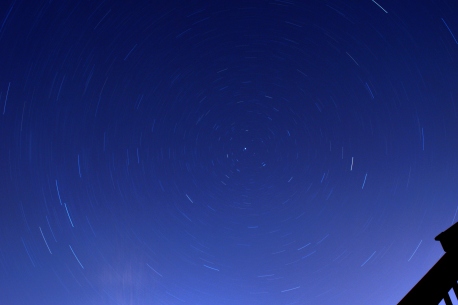 A single long exposure star trail (not as well)