Solar Eclipse in August

This August 21, Nashville, TN will have one of the best views in the United States to view the upcoming solar eclipse.  Middle Tennessee will have around 2 minutes 30 seconds of eclipse and will be right in the path of the total eclipse.  The eclipse will begin at around 1:30 pm, Central Time.

This will be the first time since 1918 that a total solar eclipse has crossed the continental US.  The last time this occurred, the path went from Washington to Florida and this August’s eclipse will have a similar path, from Oregon to South Carolina.  The next time the US will experience a solar eclipse will not be until 2024, so make sure to mark your calendars!

Photo courtesy of timeanddate.com


Posted in Observables, Sun | Tagged , , , | Comments Off on Solar Eclipse in August

The Invention of the Telescope

galileo_telescope

Galileo was the first astronomer to use a telescope to observe the moon, the phases of Venus, and the largest four moons of Jupiter. In fact, Galileo was the first astronomer to use a telescope for anything because he was the dude who invented it. He first heard about a dutch inventor who put curved panes of glass in front of each other to make things appear larger. Galileo, being the smart inventor that he was, was able to mathematically calculate a way to use glass to make the telescope even better. His best telescope could magnify up to twenty times normal vision. It wasn’t until the next truly great physicist, Isaac Newton, that the reflecting telescope was invented. In a similar fashion to Galileo, he constructed a telescope that could magnify up to 35x. From then on, scientists have been making larger and larger mirror telescopes to be able to produce better and better images. Which is your favorite kind of telescope? Is there a certain telescope which is your favorite? Comment your responses below.


Posted in Instruments, Light | Tagged , , | Comments Off on The Invention of the Telescope

A Brief History Lesson

Most people, when hearing the phrase, “history of astronomy,” probably immediately envision the Stonehenge, or some ancient relic that had to do with the alignment of the stars. However, many seem to forget, or ignore the fact that up until very recently (some 500 years ago),  there were great debates on the different models of the universe and which one was more accurate. Our perception of the universe around us have changed vastly over the course of civilization itself, so I compiled a brief chart below showing some of the major changes to the models of the universe. There is also another interactive online timeline that is wonderful for learning about this.

Astronomer Time Period Heliocentric or Geocentric? Major Discoveries and Other Fun Facts
Eudoxus Ancient Greece Geocentric Model of 27 nested spheres
Aristotle Ancient Greece Geocentric Expansion on Eudoxus’ model; 55 nested spheres. His theories were the main astronomy authority until the middle ages.
Ptolemy ~AD 150 Geocentric-ish Added epicycles to Hipparchus’ model to explain retrograde motion; Earth is at center but moves; moon orbits Earth in one month
Copernicus 1500s Heliocentric!!!!!!! Circular orbits made it inaccurate after short periods of time; pull of gravity from passing planets explains retrograde motion, so renders epicycles obsolete; moon orbits Earth in one month
Galileo Late 1500s to Early 1600s Heliocentric Moons of Jupiter, Rings of Saturn, surface structures on the moon, sun spots indicating an imperfect sun, phases of Venus showing Venus orbits the sun not the Earth
Tycho (New World Model) Late 1500s Geocentric(ish) Sun and Moon orbit Earth, but planets orbit the Sun; found consistency by abandoning UCM; only model with Earth at perfect center of the universe (stationary). He had a pet moose that he would feed beer to, once at a party, the moose got too drunk and fell off the stairs, and that’s how his pet moose died.
Kepler Late 1500s to Early 1600s Heliocentric Friends with Tycho and Galileo. Abandoned circular and uniform motion. More savvy about opinions so not condemned by Inquisition.
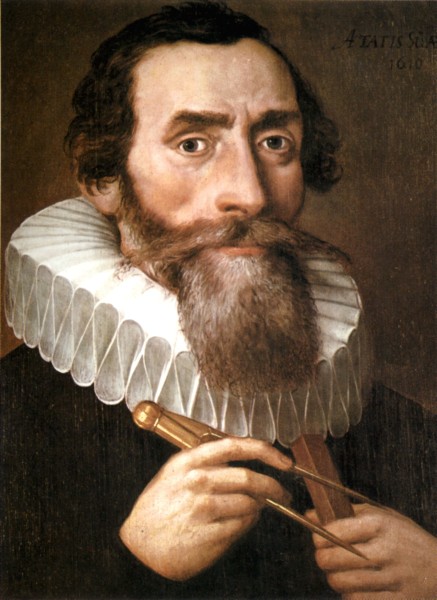
Johannes Kepler
Kopie eines verlorengegangenen Originals von 1610
Johannes Kepler (1571 - 1630)

Posted in Class | Tagged , , | Comments Off on A Brief History Lesson

A bit on Technology

Since I’m in the School of Engineering and the topics for this blog are a little more open ended, I figured I would write a quick post with an example of how technology works closely with astronomy to make it possible to study some of the things we want to observe. So, going off of my previous post of how IR is useful for studying far away objects or stars that are forming, I wanted to share something I got to learn about the James Webb Space Telescope last year in one of the Astronomy seminar courses.

Most hot objects emit significant amounts of radiation in the IR regions, so any space telescope that wants to analyze images in the IR region (which the Webb is highly specialized for) needs to be shielded from external heat. The highly sensitive devices can pick up even very small sources of heat, so any unwanted heat that gets to the instrumentation can make the acquired data/images unusable. In fact, it’s important enough that steps are taken to keep the instrumentation from being affected by its own electronics.

So, in order to keep the instrumentation very cold, several devices are going to be implemented on the Webb to keep heat out. The first is a massive multilayered sunshield, which both blocks heat and deflects more out its sides, keeping the other side at 50 Kelvin. Next, most of the instruments (which is designed primarily for near-IR observation) are cooled down to 39 K by a passive cooling system. However, most impressively, a helium refrigerator is used to cool one of the instruments (designed for further in the mid-IR regions) down to a whopping 7 K.

Considering that the Cosmic Microwave Background temperature (the temperature of most of the vast emptiness of space) is about 2.7 K, being able to cool down the instrumentation to 7 K is insane. The difference between the hot side of the sunshield and the cool instrumentation is so great that on one side of the telescope, you’re getting in the range of starting to boil water, while on the other side you can easily freeze nitrogen.

sides-sunshield-temps
Temperatures on opposite sides of the Webb (the temperatures achieved by the helium refrigerator are not shown)


Posted in Instruments, Light | Tagged , , , , | Comments Off on A bit on Technology

Blog #1:Solar Eclipses

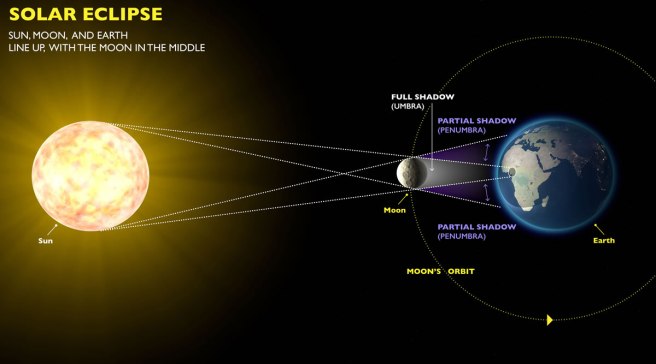
For many, August 21st  will be the highlight of their year, with many having planned out their day months if not years in advance, finding out prime locations, taking time off, and/or even going out of town. In fact one small town in Kentucky has had all of its hotels booked full for this day in advance for years now. What event is this you might ask? It’s going to be a total solar eclipse. Yes, the totally awesome kind you see on TVs and in movies where the sun becomes entirely covered up and day becomes night. Excited? Well here’s some tidbits about this phenomenon that explains the science behind it all.

solareclipse
Eclipse Diagram

As you probably already know, a Solar Eclipse happens when the moon obscures the sun in its orbit. It can either partially cover the sun, or completely cover the sun. In a total solar eclipse, there are five distinct phases. First is the partial eclipse, where the moon starts moving in over the sun, the second phase is where the  total eclipse begins where the entire sun becomes covered, next comes Totality, AKA the cool part where the sun is completely covered, revealing the Corona and turning the sky dark, then the moon moves away to uncover part of the moon, reverting to a partial eclipse, and finally that ends as the moon completely moves away. And then we won’t be seeing another one here in North America until 2024.

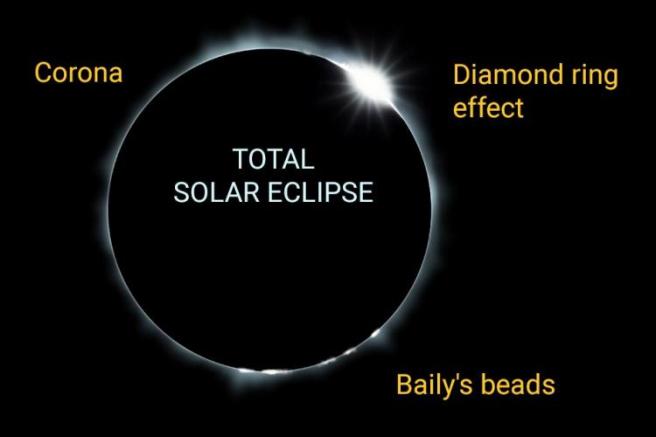
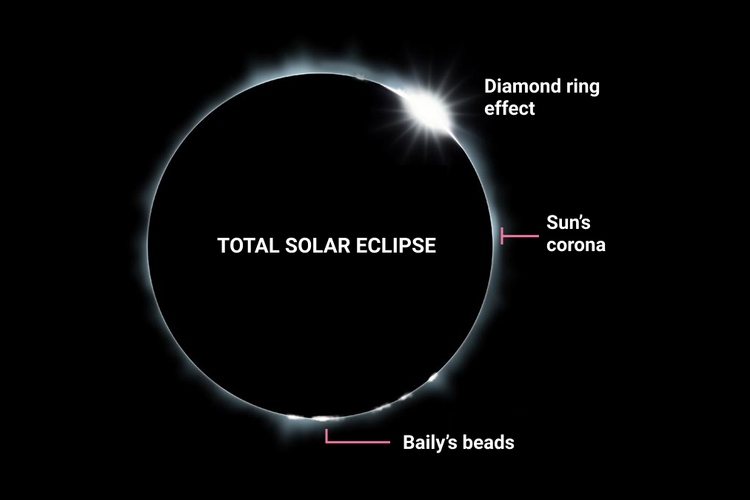
There are also some very interesting sights at Totality that can’t be seen anywhere else. They are Baily’s beads, which are some splotches of light on the edge of the moon, the Corona, the Diamond ring which is the combination of Baily’s Beads overlapping with the Corona, and the sun’s chromosphere, where its red glow can be briefly seen right after the diamond ring disappears. So if you can, make sure to check out this once in a decade phenomenon and don’t forget to bring eye protection!

total-solar-elipse-diamondring-beads
Special events you can only see during totality.

Source:TimeandDate


Posted in Class | Tagged , , | Comments Off on Blog #1:Solar Eclipses

The Importance of Spectroscopy in Solar System Exploration

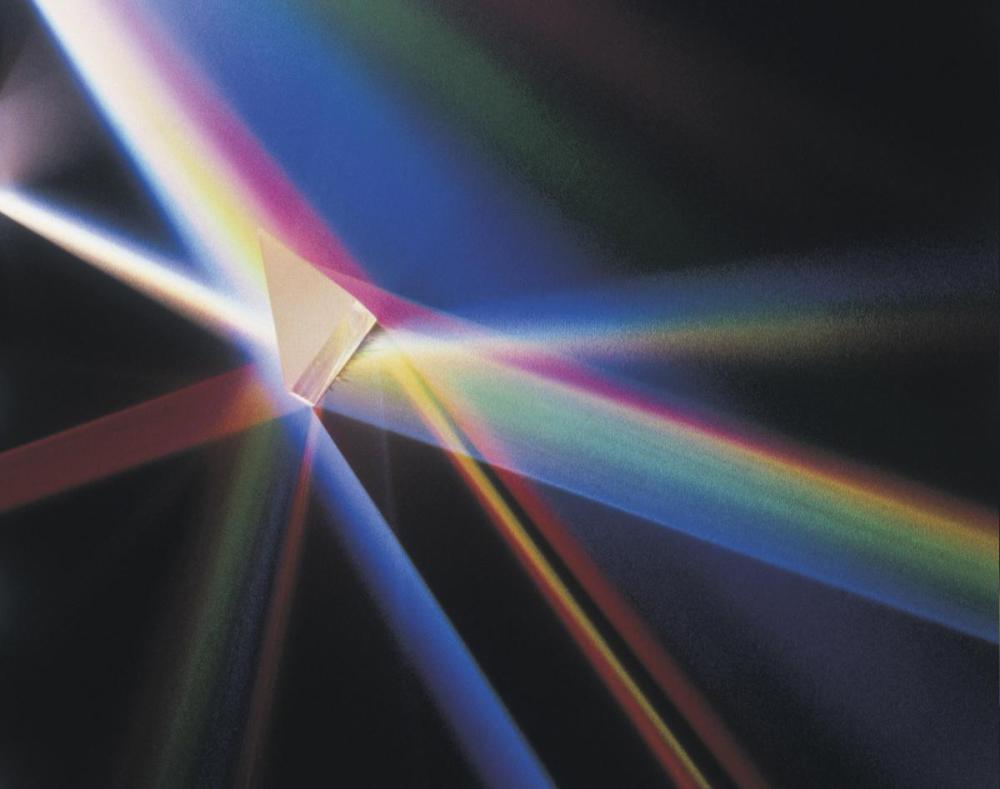
prism20-7852017620altered
©2017 National Institute of Health

While the very existence of visible light allows for the viewing of celestial bodies, not enough credit is oft given to the true capability of light’s full spectrum.

Spectroscopy is an imaging and scientific method of measurement that involves the unique spectra that occur when light comes into contact with an object or substance of interest. Two different kinds of spectra, absorption and emission spectra, are created by and can be used to identify different materials the light passes through or interacts with.

When light is absorbed by these different materials of interest, characteristic absences in the full spectrum occur, these positions then are used to quantify and characterize.

Spectroscopy was used in the Deep Impact mission, where the actual flyby satellite was equipped with an infrared spectrometer that was aimed at the cloud of gas and material formed from the impact of the comet observed and the crash lander. A characteristic spectrum “fingerprint”, representative of the composition of the comet’s core, can then be identified and analyzed.

For more on the usage of spectroscopy in space exploration, read more here at NASA’s official website.


Posted in Class, General, Instruments, Light | Tagged , , , , , | Comments Off on The Importance of Spectroscopy in Solar System Exploration

Cassiopeia

You can’t go through astronomy without talking about constellations, and for me, you can’t go through constellations without talking about my favorite: Cassiopeia. She is is not only a constellation in the northern sky, but also the queen of Æthiopia. Beautiful and proud, she was the wife of king Cepheus, and the mother of Andromeda; who, like her mother, was quite the beauty. She boasted of being more gorgeous than the sea nymphs of Nereids, daughters of Poseidon. This, as usual, enraged the god of raging seas, and he sent the monster Cetus to destroy Æthiopia. In order to save the kingdom, the king consulted the oracle, and was instructed that Andromeda must be sacrificed to Cetus. However, she was rescued by the hero Perseus on his way back from slaying the medusas. This was a happy ending until Poseidon decided that Cassiopeia’s crime must not be forgiven so easily, and opted to chain her in the skies, so she would be upside down at times– a most undignified position.

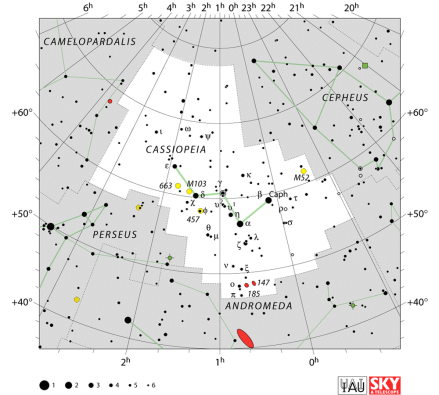
Lying in the rich Milky Way star fields, the once Queen-of-Æthiopia consists of many deep sky objects, such as nebulae, galaxies and open clusters. Some of the more prominent and major stars in Cassiopeia are Gamma Cassiopeiae— the center, and brightest subgiant star in the W that is 780 lightyears (ly) away. Beta Cassiopeiae is another subgiant or giant star about 54.5 ly distant. With a magnitude of 2.27, it is the second brightest Delta Scuti variable star. Alpha Cassiopeiae is an orange double star, shining at 229 ly away, and represents Queen Cassiopeia’s breast.
cassiopeia-constellation-map
Cassiopeia Skychart

Cassiopeia is tied to the sky between the Cepheus, her husband and Perseus, the hero who rescued her daughter. Andromeda is “below” her with the mythical beast Pegasus beside it. Cassiopeia is visible all year in the Northern hemisphere, and is best seen in November. The declination is 62.2 degrees, with a right ascension of 1.01 hours. Next time you look up in the sky, try to find the trapped queen. Then, perhaps, you may quote Rajesh Koothrappali from the Big Bang Theory, “It’s a little hard to see with the city lights, but that W-shaped constellation is Cassiopeia. And she was the mother of Andromeda, who’s over there.”


Posted in Class | Tagged , , | Comments Off on Cassiopeia

Gravity Waves

ns_gw_art

Have you ever wondered what the speed of gravity is? Were you under the assumption that the force of gravity was immediate? Like everything else in the universe, gravity has a finite speed. In fact, gravity travels at precisely c, the speed of light in a vacuum. This was first theorized as a result of Einstein’s theory of relativity. This has some interesting repercussions in the universe. If the sun were to disappear in a poof of magic, we would not find out for roughly 8 minutes since it takes light that long to travel to earth. However, it is another question to say whether the Earth will continue moving in a circle for 8 minutes or move in a straight line immediately. Since gravity travels at c, we would continue moving in a circle for 8 minutes. The gravity waves would have to travel from the sun and would take 8 minutes to reach us. Recent evidence has come out in favor of this theory. For the first time ever, gravity waves have been detected. Two black holes orbiting each other rapidly change the force of gravity they produce, like rippling waves in a pond. We have detected these waves, seemingly confirming their existence. The paper that was published is under review for any errors and many theorize that it will receive a Nobel Prize in the next few years. What do you think? Does this theory make sense to you? Comment your responses below.


Posted in Physics, Stars | Tagged , , | Comments Off on Gravity Waves

IR and Telescopes

I previous wrote about how the “oldest” and farthest galaxies and stars from us are also moving the fastest away from us and, as a result, highly redshifted. Some of these objects experience so much redshift from our perspective, that most of their visible light can be shifted almost entirely into the infrared. As a consequence, if we want to study, or even observe, these objects, we sometimes have to do so using telescopes observing in the IR regions.

carinanebulacomparison
Comparison of the Carina Nebula in the visible (left) and IR (right)

As seen in the picture above, viewed in the visible region, the dust clouds of the Carina Nebula outshine the stars forming within (shown on the left). However, the stars are much easier to detect when observing in the near-IR regions (shown on the right). This is just one example of how IR telescopes can help us learn about phenomena such as stellar formation.

Below is an interesting image I’ve found that illustrates the different types of objects that are most easily visible in different IR regions. On the left is the Horsehead Nebula seen in the visible region. In the middle is the same nebula viewed in the near-IR region, which brings more of the slightly cooler stars into view while getting some of the dust clouds out of the way. On the right, the nebula is viewed in the far-IR. Since the cold dust emits brightly in these wavelengths (all objects radiate heat, and objects with colder temperatures emit most of their radiation at longer wavelengths), the clouds are prominently displayed.

horsehead-visible-near-and-far-ir
Horsehead Nebula viewed in the visible (left), near-IR (middle), and far-IR (right)


Posted in Instruments, Light | Tagged , , , | Comments Off on IR and Telescopes

The Big Crunch

big-crunch-to-be-the-doom-of-universe-that-began-with-big-bang2
The Big Bang to the Big Crunch

While the Big Bang has become the quintessential theory for the beginning of the universe, the possible future of the universe is still an open question. While the universe we currently observe is expanding in all directions, who is to say that this expansion will continue indefinitely. And if the expansion of the universe ends, what happens next? While not all theorists agree with this model, one idea is known as the Big Crunch. This theory states that eventually the expansion of the universe will be overcome by the force of gravity. When this occurs, all of the matter in the universe will begin to collapse. Once this process has begun, there is no going back; the universe will continue to collapse until all of the matter in the universe is once again condensed into a singularity, just as it was before the Big Bang. While this result sounds catastrophic, it is unlikely to concern humanity due to the fact that our sun will die far before the universe would begin to collapse. While this idea is still supported by some theorists, many still continue the debate of the fate of the universe.

Source: The Big Crunch


Posted in Class, Universe | Tagged , | Comments Off on The Big Crunch