Milkomeda

A collision is coming. Andromeda, our spiraled galaxy neighbor, and the Milky Way will collide in  4 billion years. This process will result in the two galaxies interacting for 1-2 billion years as they rearrange the orbits of stars and planets before finally merging into an elliptical galaxy.

The movements of the galaxies toward each other was first noted in 1913 by Vesto Slipher, though he was not clear as to when the collision would happen, or even if it would happen at all. Proper motion refers to sideways motion, and is much more difficult to detect than motion directly toward or away. Avi Loeb and T.J. Cox  proved that Slipher was correct in 2007; Andromeda had very little proper motion and would collide with the Milky Way head on.

So what does this mean for Earth and the Solar System as we know it?

While the planets are not in danger of being directly hit, the Sun will be flung into a different section of the new galaxy. The Solar System will stay intact and move to the edge of the newly formed galaxy. However, by this point, the Sun would have become much hotter, most likely scorching the Earth and drying up the oceans and other water sources. For whatever life is left on Earth, this will be a great and amazing sight to see.

Source: National Geographic, NASA

National Geographic

Posted in Universe | Tagged , | Comments Off on Milkomeda

Blog 1: We Are All So Small!

Space is such a fascinating thing. There is just so much out there beyond our planet: so much we know about and even more we don’t know about! Growing up in school, we all learned about the solar system. As a result, we concluded that maybe our world isn’t the center of the universe like we may have thought it was. For example, there are 7 other planets on their own orbits around the Sun too. And this is just in our solar system, which comprises a seemingly negligible part of our universe. It really makes you think about how trivial one person’s day-to-day live is in the grand scheme of things. Nevertheless, even with all of this in mind, I don’t think I’ve ever really felt overwhelmed by how infinitely small we are until I watched the video below.

Powers of Ten (1977)

The short film takes us through a journey. First, it begins with an overhead view of a man and a woman having a picnic in a one square meter space. Then, it zooms out to view a 10 square meter space with the picnic still being the center of the image. It continues to zoom out at a rate of one power of 10 per 10 seconds. We start to acknowledge how insignificant this picnic is in the context of Chicago and then in the context of the states bordering Lake Michigan and then in the context of our entire Earth! As it zooms out, our planet vanishes in the distance. Beyond our earth lies the orbital paths of all the planets in our solar system. Then the video takes us outside even our solar system. Although the Sun is so incomprehensibly massive to most of us, it is clear that the center of our solar system is merely one of a myriad of stars in the Milky Way Galaxy. By the time we reach 100 million lightyears out, our galaxy becomes just one of many galaxies and many clusters of galaxies in the distance.

The theme I took away from this video is while the world relative to us is so minuscule and appears increasingly so the more and more we begin to understand what more is out there in the universe, the infinitesimal fraction of the universe that is our world becomes increasingly significant the more we realize how rich it is compared to the vast emptiness in the majority of space.


Posted in Class, Galaxies, Universe | Tagged , , , | Comments Off on Blog 1: We Are All So Small!

The Hubble’s Cooler Younger Sibling

Somewhat of an actual time machine, the telescope is probably the most well-known instrument of the field of astronomy. While the object itself is not a foreign concept, knowledge about specific telescopes is less common. In fact, aside from the Hubble, I probably could not have named one before this semester. Much to my surprise, the successor to the Hubble is going to be launched next year! What’s even cooler is that NASA has a website on which the entire project is being chronicled. “The JWST [James Webb Space Telescope] will be the premier observatory of the next decade, serving thousands of astronomers worldwide,” says the website. Why haven’t I been aware of this seemingly momentous project? Furthermore, why have I been oblivious to the many major telescopes launched within my lifetime? Space and our encounters with it used to be one of the greatest fascinations of the public. What happened? While the act of launching telescopes is not revolutionary science these days, you’d think I would at least hear reports or be told about these events. I understand that actual discoveries are the most exciting, it’s still pretty interesting that we, as a society, are continually increasing our ability to make such discoveries. Without telescopes and the corresponding opportunity to learn more about our universe, it will be much more difficult to accomplish more extensive human missions.

jwst-hst-primary-mirrors
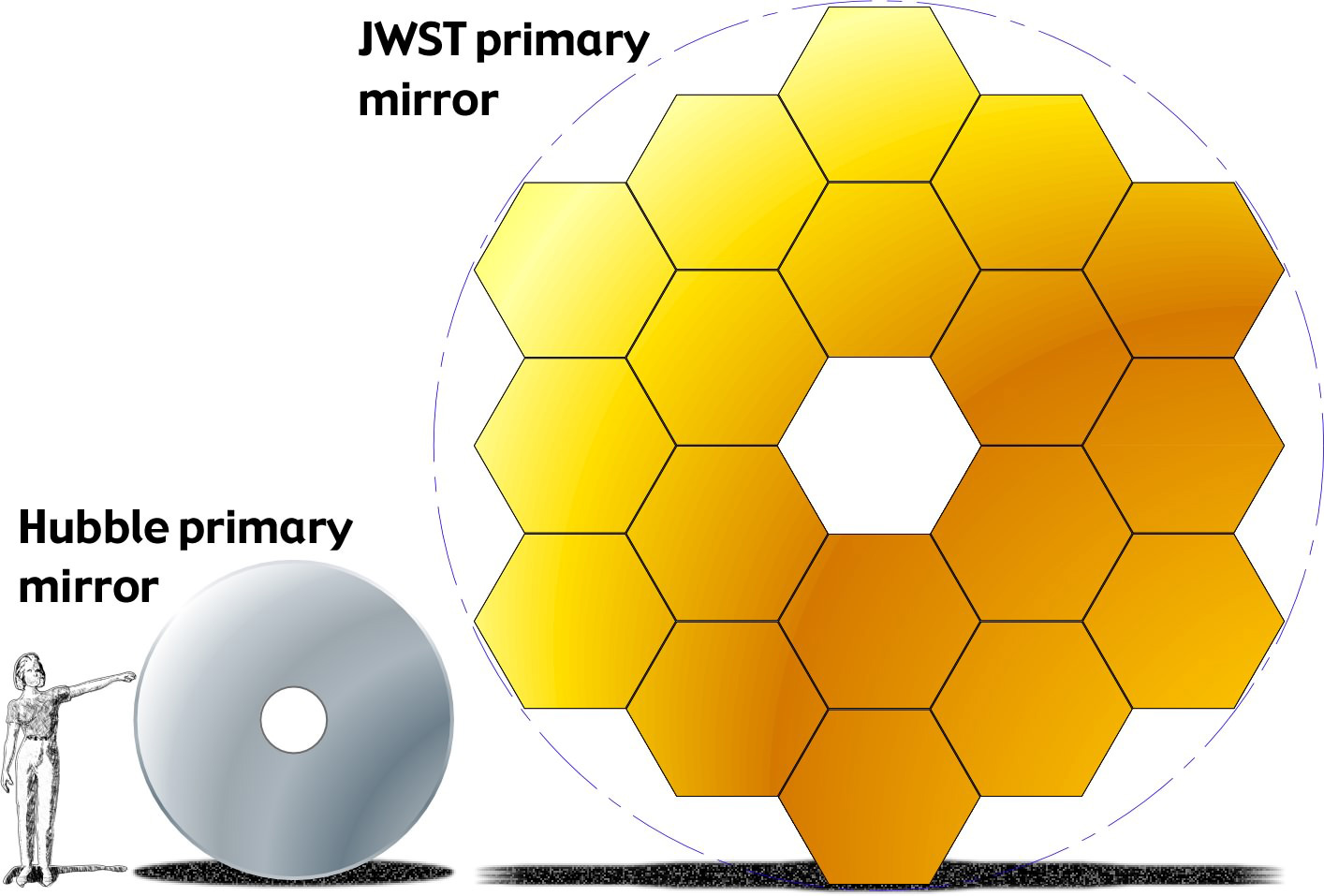
This picture (also from the NASA website) shows the difference in mirror size between the Hubble Space Telescope and the James Webb Space Telescope. The predecessor is certainly an improvement!

Posted in Instruments, Space Travel | Tagged , , , | Comments Off on The Hubble’s Cooler Younger Sibling

Transiting Extrasolar Planets

Extrasolar planets, or exoplanets, are planets that orbit stars other than our Sun. They are of great interest to the scientific community for many reasons, but are very hard to detect. Planets are extremely faint light sources, especially when compared to their nearby host stars, so many different methods have been created and refined in order to keep discovering new exoplanets. One of the most successful methods currently is transit photometry.
transit
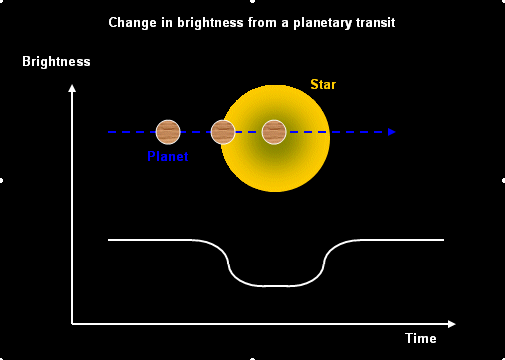
A transiting planet creates a dip in the star’s light curve.

Transit photometry is focused around finding planets that pass directly between their host star and us during their orbit. As the planet eclipses its star, the starlight is very slightly dimmed. If this dimming is observed periodically, it is possible that it is caused by a transiting exoplanet. The data from the star can be graphed into what is called a light curve, shown here to the left. If it is indeed caused by an exoplanet, the depth of the change in brightness can also be used to determine the size of the planet.


Vanderbilt University is actually part of a team called KELT (Kilodegree Extremely Little Telescope), a project conducting a sky survey for transiting exoplanets around bright stars. They are already responsible for the discovery of multiple exoplanets, and hopefully they will find many more!

Posted in Class, Exoplanets | Tagged , | Comments Off on Transiting Extrasolar Planets

Looking Through a Historical Lens

machu-picchu
This is Machu Picchu, a famous temple in South America that was constructed with the June solstice at least somewhat in mind.

Much of science is the act of investigating phenomena and elaborating on such investigations done by others. This is an incredibly difficult task to accomplish with modern technology. Incredibly though, there is a great source of proof to show that many peoples of the past were able to make some form of astronomical discoveries and observations. Archaeoastronomy is the combination of the two; it is the investigation of the astronomical instruments created throughout history by people who died long ago and left no explanation. Many of these instruments appear, to the unknowing eye, to just be weird rock formations and intricate architecture. I think one of the most interesting things about this field of study is the idea that figuring out the uses of these devices follows a similar sequence of events required to construct them. The most accurate way to tell if a building is meant to track the highest point of the sun throughout the year is to see if the roofline of the building matches said points. While matching the concept to the instrument might seem easier to determine than the initial crafting of the object, I think there’s a chance this is not true. I’m sure that archaeoastronomers have spent time analyzing objects that end up having no relation to the sky and space. Alternatively, they must guess what the instrument is trying to convey based on no context other than naked-eye observations. The discoveries would be very rewarding, but I’m not sure that the effort would make the accomplishments worthwhile. If given the opportunity, would you try your hand at archaeoastronomy?


Posted in Historical, Observables, Stars | Tagged , , | Comments Off on Looking Through a Historical Lens

Music City Eclipse 2017

As many of you heard, there will be a Total Solar Eclipse in Nashville, TN on August 21st, 2017. “It is a once-in-a-lifetime opportunity, because it is the first total solar eclipse to happen in the United States in 99 years,” – VisitMusicCity.com.

We can see a solar eclipse from the Earth when the Moon moves exactly between the Sun and the Earth, blocking the Star. At this moment only the Sun’s corona is visible to us, because the Moon completely obscures the sunlight.

We are very lucky to be able to see it, because a total eclipse occurs at a very narrow track on the Earth’s area. On August 21st there will be a couple locations in Nashville where you can watch the eclipse and hang out. Also, be sure to check out tips for viewing it.

I will be in Nashville at that time and will do my best to see the Music City Eclipse live! I hope you will be able to enjoy this breathtaking event as well!

Picture by Wikipedia


Posted in Class | Tagged , , | Comments Off on Music City Eclipse 2017

The Key Effortless Self-improvement

We’d all probably like to believe that astrology is real so we can identify with the redeeming qualities of our own sign and to hold fast to promising horoscopes. However, zodiac signs are not only false because of their vagueness, which allows each sign to at least partially relate to every human, but also due to the change in the constellations’ visibility over time. The initial assignment of signs followed the pattern of the constellations that reigned over the sky during the day.

The precession of Earth, a reorientation of the North/South Axis as a result of rotation, is completed once every 26,000 years. This is similar to the way the spike on the top of a top follows a circular path while it is spun. Precession is a natural phenomenon that happens with all rotating objects. As we know, tops eventually fall over, but precession will never be the cause of a no-longer rotating Earth; the lack of air resistance in space means that Earth will be stuck in this cycle. The tilt of the earth will remain at 23.5°, but the direction in which the tilt is leaning will change. Therefore, halfway through the cycle, summer in the northern hemisphere will be winter because that 32.5° tilt will be away from the sun.

So what does this mean for the zodiac? A Sagittarius will be Capricorn in 2,000ish years. This is not to say that people born from November 22-December 21 will become any less “adventurous.” The earth will have just completed 1/13 of its precessional cycle. On the bright side, if you’re a Gemini, but you secretly wish you had been born a Taurus, wait a couple thousand years and life goals will be achieved! Essentially, what we’ve learned is that you can be whoever you want to be because eventually, you’ll be everyone? Oh, wait, no…we learned that astrology is a coping mechanism for people who need to feel good about themselves (myself included) and that the earth is a top that will never stop spinning.

axis-precession
This photo shows the basic idea of precession. If things are still unclear, this video by Steve Sanders explains it even better.

Posted in Stars | Tagged , , , , , | Comments Off on The Key Effortless Self-improvement

Blog 3: NASA Astronomy Picture of the Day

jupitersouth_junopeach_960

This image was captured by Juno as clouds swirl around southern Jupiter. Juno is a spacecraft which was launched aboard an Atlas V-551 rocket from Cape Canaveral, Florida, on August 5, 2011 and arrive to its starting location near Jupiter in the past July. as of the past 11 days it has finished its elliptical polar orbit around Jupiter. Oval BA can be seen on the right-hand side only partially visible due to the current orientation of the planet. Oval BA is spot of intense storms which appears red, but current astronomers are uncertain of the cause of the red appearance. Current hypothesis is that the storm is so intense it is bringing materials called “chromophores,” color-changing compounds, to the top where solar ultraviolet rays turn them red. The redder the spot appears the more intense the storm is. The white swirls are cloud systems and planet circling-cloud bands; some of the lighter swirls have been suggested to be lighting storms.

Sources:

Image

Information about Oval BA

Information about Swirls 

General 

Information about Juno


Posted in Class | Tagged , , , | Comments Off on Blog 3: NASA Astronomy Picture of the Day

The successor to the Hubble Space Telescope

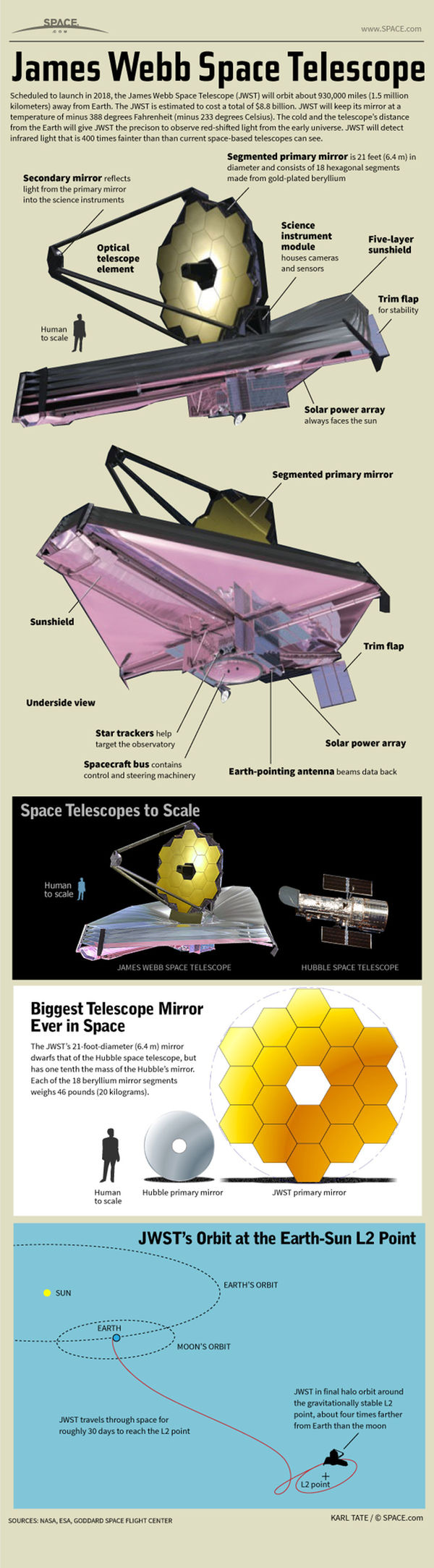
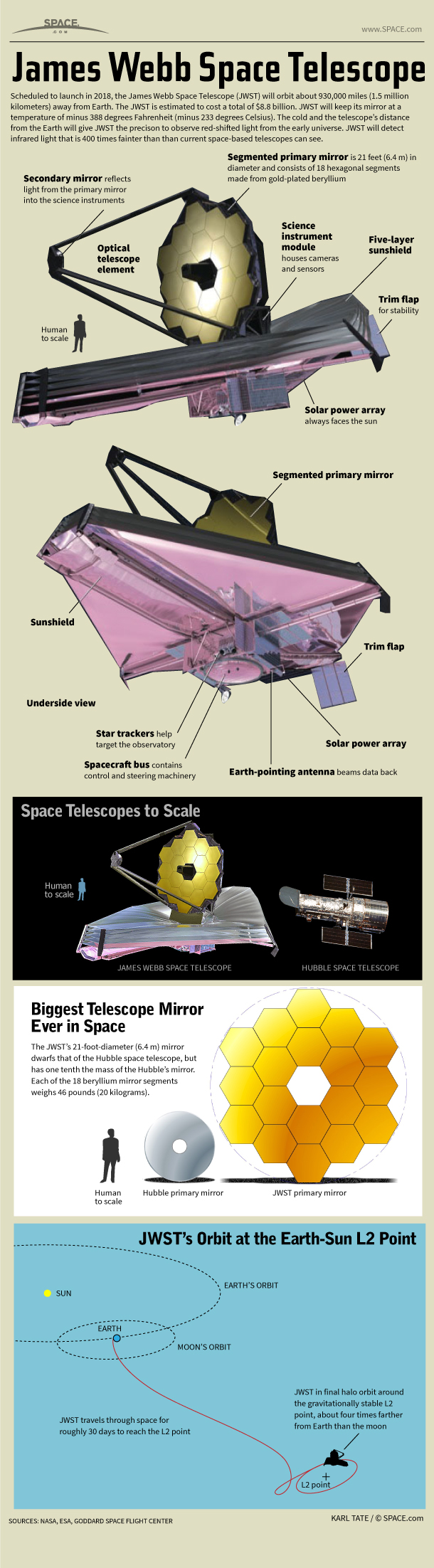
The Hubble Space Telescope has been delivering high-quality, in-depth images of the universe for almost three decades and has been critical in several astronomy discoveries, such as the rate of expansion of the universe. However, NASA is now planning to fully launch the James Webb Space Telescope in 2018 as the scientific successor to the Hubble Space Telescope. In construction for almost two decades, the JWST is an $8.8 billion space telescope that is designed to study and explore all parts of the infrared universe. In an announcement by NASA officials on November 2, 2016, NASA administrator Charles Bolden detailed some of the more revolutionary aspects of the JWST. As it set to go into rounds of intensive testing, Bolden described how the JWST has seven times the collecting area of the Hubble Space Telescope due to it being the biggest telescope mirror launched into space. Its main differentiating factor versus the Hubble Space Telescope is its ability to collect infrared light. This is the case because, unlike the Hubble, the JWST will operate at close absolute zero and will fly at a point behind Earth to block the Sun’s infrared emission. This is especially useful because infrared light can penetrate dust clouds in the universe, giving a much more in-depth view of our surroundings.
james-webb-space-telescope-130110b-02
Design of the James Webb Space Telescope

From now until launch, more and more of the JWST will be integrated into spacecraft that it will be launched in. The JWST is currently undergoing extensive temperature and space vacuum testing and testing of its instruments at NASA Goddard, NASA Johnson Space Center, and Northrop Grumman. After testing is complete, the JWST will launch from French Guiana in 2018. After the success of the Hubble Space Telescope, the whole world awaits what the James Webb Space Telescope can provide.


Posted in Class | Tagged , , , | Comments Off on The successor to the Hubble Space Telescope

New Horizons

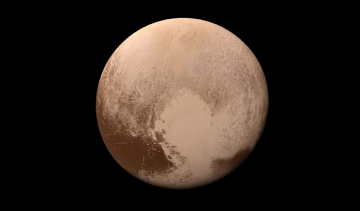
Way out on the edge of our Solar System, in the Kuiper Belt, lies an object that has held our fascination since 1930. Pluto! After enjoying 76 years of planet hood, Pluto was declassified into a dwarf planet in 2006. The declassification of this much beloved planet caused many people to feel personally attacked. While our disappointment over the loss of nine pizzas faded, it was renewed in the summer of 2015 when the New Horizons mission did a close flyby of Pluto. Launched in 2006, the New Horizons mission took a course leading it toward Pluto to get our first up-close images of the objects residing in the outer Solar System.


pluto
Photo Source


New Horizons already has completed its first task of flying close by Pluto and its moon Charon, but it still has a way to go before it has completed its jobs. It is in the process of exploring other objects that are in the outer Solar System, particularly in the Kuiper Belt. However, it won’t reach its targeted object until 2019. Here’s a video if you want to hear about the object it will be exploring!

Photo Source:

NASA -New Horizons


Posted in Historical, Instruments | Tagged , , , , | Comments Off on New Horizons