Finding the Way with the Stars


Image result for history of celestial navigation
Smithsonian Time and Navigation


It is amazing for me to think about the human race finding their way before the invention of the modern GPS. While Google Maps and Waze are modern conveniences accessible to all with a smartphone, the sky has a long standing tradition of helping people find their way.

In ancient times, sailors would venture out into the sea and use celestial bodies and landmarks to calculate their position and direction. While many may believe that sailors were able to look at the stars and quickly calculate and determine their position, they needed an array of tools for their calculations including a sextant, almanac, and clock, demonstrating the many steps needed to be taken to find their way.

Despite the modern advancements and conveniences, many space programs, including NASA, continue to use celestial navigation to find their way through the sky.While technology has evolved exponentially over time, this demonstrates that it is sometimes best to rely on methods that are tried and true.


Posted in Historical | Tagged , , , | Comments Off on Finding the Way with the Stars

Orientation Shift

According to my horoscope today, I’m motivated to complete a project I’ve left unfinished and I should approach my tasks one at a time. In reality, I have three piles of unfinished laundry and a to-do list a mile long with no desire to do any of it. My horoscope for the day could be wrong because astrology is fanciful storytelling, or it could be inaccurate because I’m not actually a Capricorn like I thought I was.

Turns out, the constellations are not in the same place that they were when the zodiac signs were first assigned. Well, they’re in the same spot, but our view of them is different. As the earth is rotating, its axis is very, very slowly changing orientation. Think of the earth as a giant gyroscope, like the one shown below.

gyroscope_precession
Wikipedia

As it spins, the axis shifts due to an imbalance. For Earth, the imbalance is due to the sun’s and moon’s gravity pulling at the equatorial bulges. This causes the Earth to stay at the same tilt of 23.4 degrees, but change orientation. This natural phenomenon is  called precession.

earthprecess
Blog

The changing orientation means that different stars and constellations are visible at different parts of the precession cycle. If we started a timer today, it would take the earth 26,000 years to reach the same exact orientation it is today. That means that the exact night sky we see tonight we would not see again for 26,000 years. This causes a shift in the zodiac signs that we commonly accept in astrology. At one time in history I was a Capricorn, but based one the current precession cycle I’m a Sagittarius. Therefore, it’s not my fault the laundry hasn’t gotten done today; I blame precession giving me false expectations.


Posted in Class | Tagged , , , | Comments Off on Orientation Shift

Fun Facts about Telescopes

FUN FACT 1: Galileo is often created as the inventor of the telescope when in fact he was simply the first to use it to study the night sky.

  • The first known practical telescopes were invented in the Netherlands at the beginning of the 1600s, by using glass lenses. They found use in both terrestrial applications and astronomy.
  • The inventor is called Hans Lippershey.
  • hans-lippershey-invented-the-telescope

Picture from Wikipedia

FUN FACT 2: The word telescope is derived from Greek words meaning “far” and “to look and see”.

FUN FACT 3: The reflecting telescope was invented by Isaac Newton

  • Isaac Newton was one of an elite group of individuals considered to have possessed one of the greatest scientific minds in history.
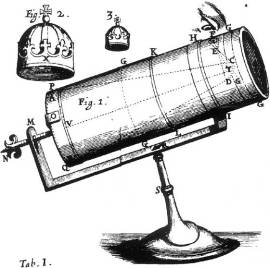
  • The first reflecting telescope built by Isaac Newton in 1668 is a landmark in the history of telescopes, being the first known successful reflecting telescope.
  • Newton made this telescope to study optics, not to observe the sky.
  • Although other scientists would have to improve Newton’s design before these types of telescopes became popular, today we still call them Newtonian reflectors, after their creator.
  • mn010113_w561
    Picture from Optics & Binoculars

FUN FACT 4: Most all telescopes have the ability to detect some type of electromagnetic waves.

  • Most detect electromagnetic radiation, but there are major differences in how astronomers must go about collecting light (electromagnetic radiation) in different frequency bands.
  • Telescopes may be classified by the wavelengths of light they detect: X-ray telescopes, Ultraviolet telescopes, Optical telescopes, Infrared telescopes, Submillimetre telescopes, Fresnel Imager and X-ray optics.
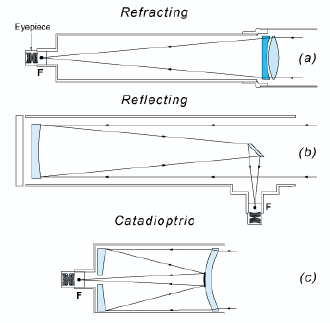
  • There are three main optical types:
howtelediag
Picture from NZ Telescopes
Posted in Class | Tagged , , , | Comments Off on Fun Facts about Telescopes

Gravity in Space?

Videos of astronauts floating around inside space shuttles have led many to believe that gravity does not exist in space. However, this is simply not true. While the force of gravity affects, for example, astronauts who are orbiting the Earth in the International Space Station differently than it affects us, it still exists in space, especially at such close distances to a planet. In fact, gravity is what allows the International Space Station to maintain its orbit. Objects are able to orbit planets because they are in a constant state of free fall. Objects like the ISS continuously fall down and around the planet they orbit. Earth’s gravity pulls them down, but their radial velocity is so great that they miss the planet and continue in an elliptical orbit around it.

Because of this phenomenon, astronauts in orbit experience a constant state of free fall. This may seem like a nightmare, especially to someone like me who can’t even handle a small roller coaster, but the astronauts get accustomed to the feeling much like we are accustomed to the feeling of our planet rotating beneath us. Without gravity in space, space travel would be much more difficult and the orbits of planets would be nonexistent, so we should appreciate the fact that the same gravity that operates here on Earth also operates in the vastness of space.

iss.jpg
International Space Station

Posted in General | Tagged , , , | Comments Off on Gravity in Space?

The Speed of Light

Growing up I had frequently heard the phrase “Faster than the speed of light” but until now, I had no idea what that truly meant. Prior to this class, all I knew was that faster than the speed of light meant FAST, and that all human travel was slow in comparison.

In fact, according to NASA’s website, someone moving at the speed of light would travel around the equator 7.5 times in 1 second.

Common belief, as demonstrated by Einstein, is that the speed of light is a constant. Einstein’s Theory of General Relativity says that because the speed of light is a constant, the laws of physics are the same everywhere. However, physicists João Magueijo and Niayesh Afshordi have begun to question this idea and proposed that the speed of light was actually much faster in the beginning of the Universe, and then slowed down to what it is today.

If this proves to be true, then many aspects of physics as we know it will be called into question and reevaluated.

Image result for speed of light
Speed of Light from Wiki

Posted in Universe | Tagged , , , | Comments Off on The Speed of Light

Is the speed of light constant or actually variable?

Throughout studies into interactions of various celestial bodies, one constant in putting into scope the mind-bogglingly vast distances has been the speed of light, via the distance unit of a light-year. The concept of the speed of light was first fully suggested when Einstein hypothesized that the speed of light plays the role of infinite speed in our universe and is, in fact, constant regardless of the perspective of the observer. This constant speed of light, measured to be 186,000 mi/sec, is an integral characteristic in the study of our universe, from matter/energy conversions to Maxwell’s equations.

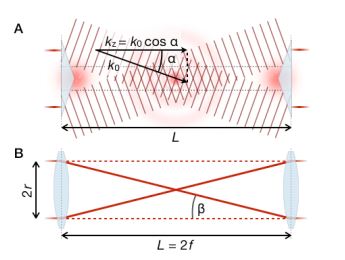
According to Einstein, light behaved as both a particle and a wave and is expressed as a massless particle of light called a photon. The speed of light was determined to be a constant due to the nature of photons not interacting with the Higgs field and, thus, having zero rest mass, letting them travel at the speed of light along the light wave. However, new studies have proposed that the speed of light may not actually be constant but, rather, an upper limit in which the exact speed is dependant upon the light structure. In a study by the University of Glasgow, scientists studied the effect of light structure on the speed by light by shooting one photon directly through a fiber and another photon via devices that manipulated the light structure.

capture
The two devices the photons were shot through

The results of the study showed that the photon with the changed light structure actually arrived later than the regular one. This proposes the phenomenon that the speed of light actually is variable dependent on the structure of the photons. (While light is usually thought of as plane waves, its structure can actually be manipulated due to the finite transverse size). While the findings of this study don’t overthrow modern physics concepts, they do suggest an interesting behavior in the speed of light.


Posted in Class, Light | Tagged , , | Comments Off on Is the speed of light constant or actually variable?

Light Cones

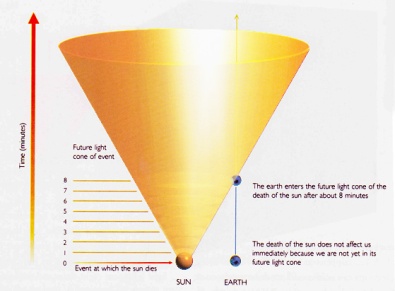
We all know that light travels really fast. It can appear instantaneous to us on earth, but when you look out into space, you are looking at objects in the past because the light from that object has not yet reached us. If the sun just vanished, we would not know it for 8 minutes because the light takes that long to reach us. One way to look at this effect is through light cones.


lightcone1
Photo Source


The point of the light cone is the object you are looking at. The object it affects starts at the same point in time (or at the same horizontal position). As the objects move forward in time they move upward through the cone. The cone represents the light’s range as it spreads out. So you can see when objects will finally be affected by the object causing the light cone. As in this diagram, you can see how earth doesn’t intersect the future light cone of the Sun for 8 minutes, so we wouldn’t notice a change in the Sun for 8 minutes.

lightcone2
Photo Source


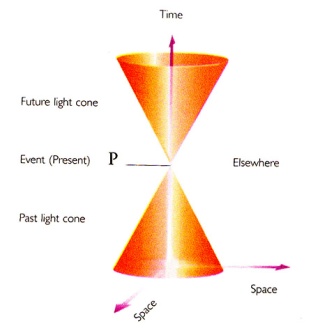
Another cool thing to look at is past light cones. You can see what events can affect an object, such as the Earth, at the present moment. Since nothing can travel faster than light, the event affecting Earth must be located inside the past light cone. If it were outside, then the light leaving the event must be traveling faster than the speed of light in order to get to us at the present, which is impossible. While they can be complicated, light cones are a very helpful way to view how the speed of light acts in relation to space-time and a cool representation of how light spreads out over time.


Sources:

A Brief History of Time, by Steven Hawking


Posted in Light, Physics | Tagged , , | Comments Off on Light Cones

Blog #2: Solar Tides

high-tide-4
High Tide Photograph

The first thing that comes to mind when thinking about tides is the lunar tides that create 2 high and low tides each day. This is due to daily rotation of the Earth, which causes the Moon to effectively move around the Earth every day. The Moon’s gravitational force pulls the water from the sides of the Earth towards the part that is facing the Moon, which creates higher water levels on the side of the Earth facing the Moon, as well as the side opposite the Moon. The moon, however, is not the only celestial body that has a gravitational pull on the Earth. While the Sun is significantly more massive than the Moon, it is much farther away, so its gravitational pull on the Earth is lesser than that of the Moon. Since the positions of the Sun and Moon are not always perfectly aligned relative to the earth (they rarely are), there is also a cycle of high and low tides affected by the position of the sun. These are called spring and neap tides. Spring tides occur when the Sun’s gravitational pull is in the same general direction as the Moon’s, causing high tides to be higher and low tides to be lower. Neap tides occur when the Sun’s gravitational pull is in the opposite direction of that of the Moon, causing high tides to be lower and low tides to be higher. Another interesting occurrence is the Proxigean Spring Tide, which occurs when the Moon is unusually close to the Earth during a spring tide. This occurrence creates a “super tide” where especially high and low tides occur.

Sources: The Moon and Tides


Posted in Class | Tagged , | Comments Off on Blog #2: Solar Tides

Blog 2: Archaeoastronomy

Archaeoastronomy:” The branch of archaeology that deals with the apparent use by prehistoric civilizations of astronomical techniques to establish the seasons or the cycle of the year, especially as evidenced in the construction of megaliths and other ritual structures.” (definition from dictonary.com)

Archaeoastronomy: “The study of the astronomical practices, celestial lore, mythologies, religions and world-views of all ancient cultures” (definition from the center of achaeoastronomy)

One of the most well known archaeoastronomy sites is Stonehenge World Heritage Site (WHS), the more notable part of the Stonehenge structure, even though both parts have astrological significance. One reason for its fame is that it is one of the most architecturally sophisticastones-wintersunsetted prehistoric stone circle in the world. this site helps us understand Neolithic and Bronze Age ceremonial and mortuary practices. Its construction was specifically made to align along the midwinter sunset-midsummer sunrise solstitial axis. The picture shows the sun align through Stonehenge during the winter solstice.


One of that is less well known archaeoastronomy sites is The Temple of Hathor at Dandara, Egypt. Known as the Dandara complex, it is extremely well preserved group including the temple to honor the goddess Hathor, the temple of Isis, two Mammisi, and a ruined C08temple-of-hathor-dendara-egyptoptic church. The temple of Isis is orientated towards the rising position of Sirius. The temple of Hathor contains different astronomical traditions which each add their own stars, asterisms and constellations. The monumental temple of Hathor is position to face the rising of Ursa Major while also being perpendicular to the flow of the Nile river. It is understood that the placement was to incorporate both astrological and topographic orientations. These ideas are understood from the ceremonies and related texts engraved on its walls. There are also feast calendars and the circular zodiac in the ceiling of the small chapel.



These archaeaoastronomy sites are use often to understand the history and tradition that was incorporated into the ancient societies.


Sources:

Definition

The Center of Archaeoastronomy

Stonehenge Picture

Temple of Hathor Picture

Case Study and Information on Sites


Posted in Class | Tagged , , , , | Comments Off on Blog 2: Archaeoastronomy

Star Chart App

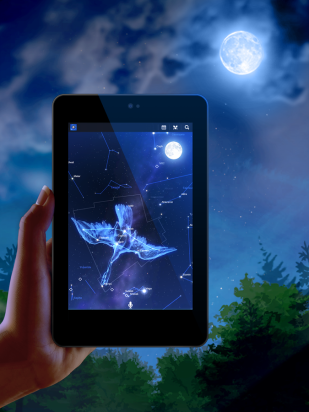
            It’s always fun to stare at the night sky! Yet stargazing is always more fun when you know what you are looking at in the sky. I always find it difficult to remember everything I am looking at. I also find it confusing to look on a 2D screen of my phone or computer to figure out where each star or planet is. After looking at several different programs and apps, I found the StarChart app.     

starchart
Photo Source

StarChart is a really simple and user-friendly app that helps me understand what I am seeing in the sky. It uses GPS on your phone to show you features of space that you can’t necessarily see. You just point your phone toward the sky and it labels everything in the sky as if you are looking through your phone’s camera. As you move around, the app shows what you are looking at. If you point your phone at the ground, it will even show you what appears on the other side of the earth. Besides showing planets and stars, the app has images and will show you locations of galaxies, satellites, and moons. It is a really fun and interesting app to use when observing the night sky. There is also both an IPhone and Android version!


Posted in Instruments, Stars | Tagged , , , , , | Comments Off on Star Chart App