Signing off, at least for now

captain’s blog, Stardate 69786.0

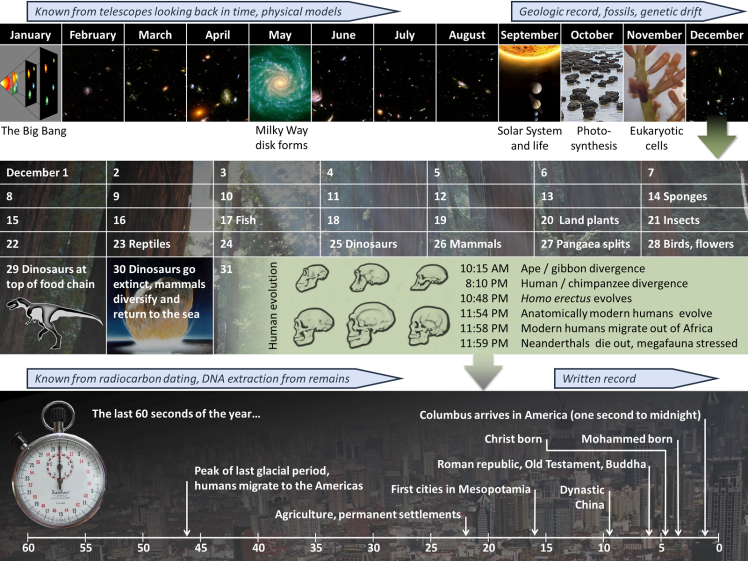
Well friends, this is it. This blog has covered a lot of ground and explored a lot of territory. Topics of discussion include the Cosmic Calendar, the theory of relativity, groundbreaking new research in astrophysics, and aliens. Lots of talking about aliens.

But I think the most important thing I’ve learned from this blog and from studying astronomy is that the Universe is enormous. What we know about how we got here is enough to convince anyone just how unbelievable the scope of the Universe is. The incredible part is, there’s much more we don’t know than what we do know. But for me personally, this is the fun part of astronomy — the impossible task of trying to understand the biggest possible scope.

So, speaking of the biggest possible scope, this video is not directly related to astronomy, but a personal favorite of mine. I’ve watched this video dozens of times, and it seems to never get old because it concisely presents some massive ideas. If you think it’s interesting, confusing, or full of crap, comment with your thoughts!

To all my followers out there, amongst the stars, it’s been a great ride.

captain Phil,
signing off, at least for now


Posted in Class | Tagged , , | Comments Off on Signing off, at least for now

Tardigrades

Water Bear
Tardigrade as NASA’s Picture of the Day

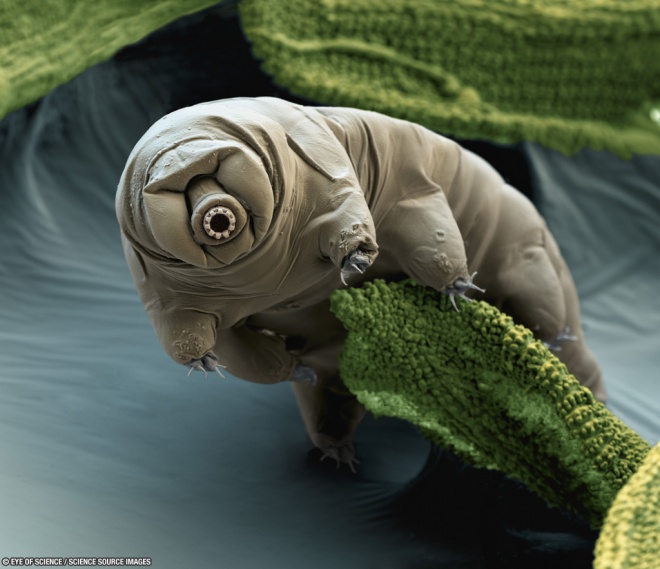
Tardigrades are amazing extremophiles! They are minute animals that are the only organism proven to withstand the vacuum of space. Recently, thousands of them were attached to a satellite that was spent into space, and were exposed into the vacuum of space to see how they would survive. As they dried out in space, their DNA broke down into smaller pieces, but when they were rehydrated, they repaired their DNA, while taking in foreign DNA, which results in DNA that is about 1/6 foreign. Their evolution and adjustment to their environment is more impressive than any other animal that we know of! Plus, they’re weirdly plushy and cute, and who doesn’t love how adorable they look. Thank goodness they are informally called “water bears,” since they deserve a sweet nickname that matches their hilarious appearance.

To find out more about tardigrades, watch a video, here!


Posted in Class, SolarSystem | Tagged , , , , | Comments Off on Tardigrades

What’s Next?

Cosmic_Calendar
The Cosmic Calendar

Wow. In these last few months, we have gone over the entire cosmic calendar. The last topic of the class, life elsewhere in the universe, covered stuff that hasn’t even happened on this calendar yet. In this class, I really believe I’ve learned a lot of material, rather than memorizing a lot. Studying for this upcoming final, I feel rather prepared and confident.

Something that amazes me is that we as humans have really not existed for that long, yet we’ve come such a long way. We know so much. I’m extremely excited to see what we will accomplish in the next minute, hour and day of the cosmic calendar. Another thing I find fascinating is that this calendar isn’t complete. As we learn more about the Universe, we are filling in gaps and dates in the cosmic calendar. We’re trying to get a very detailed itinerary of how we came to be.

Something that interests me is that this is a class covering the Solar System, the last few months of the cosmic calendar. And yet, we aren’t even 100% sure of everything that occurred during this time. Heck, even the last week is a blur. And not only is it a blur for our Solar System, it’s a blur for our galaxy and any other planetary system out there. Even when we know everything we possibly can about our galaxy and solar system, there is still going to be so much to learn about the other billion ones out there.


Posted in Historical | Tagged , , , | Comments Off on What’s Next?

Is The Drake Equation Useless?

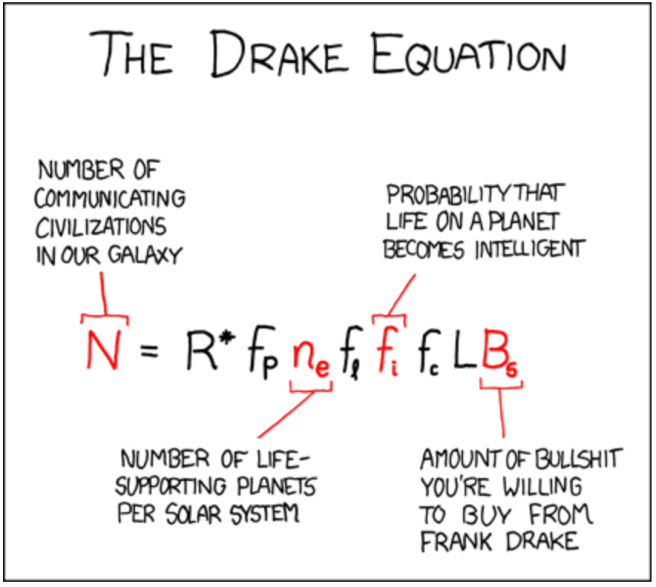
The Drake Equation is an equation that was developed to help us determine what life exists in our universe beyond planet Earth. In class, we have been doing much work with the Drake Equation, including filling it out ourselves using our own estimates. But…is the Drake Equation useful or even worth our time?

If you are not familiar with the Drake Equation, it is a formula that requires a significant number of estimations. And these estimations are not as simple as the amount of jelly beans in a jar. Instead, they are incredibly broad concepts that are virtually impossible to know accurately. For example, how many life supporting planets exist PER solar system? We don’t know of any life beyond our solar system so how can we begin guessing this percentage for millions of other systems?

So, with such difficult questions that no one truly has a strong estimate of, is the Drake Equation necessary? Sure, if we knew the figures better it could be effective in calculating how much life exists in our universe, but what’s the point? In my opinion, it is good that we have the equation so we can focus our research better. However, I don’t think it will be an equation that we actually use in my generation’s lifetime.

Screen Shot 2016-04-27 at 1.59.55 PM.png
Read the full article here


Posted in Observables | Tagged , , | Comments Off on Is The Drake Equation Useless?

Vanderbilt Aerospace

On the weekend of April 15th, the Vanderbilt Aerospace Design Lab (VADL) traveled to Huntsville, Alabama to compete in NASA’s Student Launch Initiative.  We competed against 40 other colleges and universities.  While in Huntsville, we participated in a rocket fair where we had the opportunity to showcase our rocket as well as learn about rockets designed by other schools.  On the last day, all of the teams launched there rockets to test their designs.  I can gladly say that our rocket launch went well and we were able to recover our rocket.

We were successful in our endeavors and won both the best payload design award and the best project review award.  Our payload design included a slosh abatement baffling system, a hydrogen peroxide monopropellant thruster and a structural health monitoring system.  The slosh abatement system refers to managing the liquid fuel in a fuel tank under the varying accelerations of the rocket during flight so that the fuel delivery system will be able to extract as much fuel as possible.  Our monopropellant thruster was a “green” thruster where the only byproducts were water and oxygen.  The structural health monitoring system involved using several accelerometers during flight to insure that our finite element models simulating the forces on our rocket were accurate.  We also won the project review award because of our report writing and the presentations that we gave to NASA regarding our design choices and testing processes.

We ultimately were very happy with our project and are in a very good position to win the overall competition for the fourth consecutive year.  We look forward to finding out the results of the competition in mid-May.

If you are interested in learning more about NASA’s Student Launch Initiative you can read about it here.


Posted in Class, Space Travel | Tagged , , | Comments Off on Vanderbilt Aerospace

Tardigrade: The Winter Soldier

Earth’s most resilient organism has once again astounded the scientific community. Tardigrades, also referred to as “waterbears”, have successfully demonstrated the ability to survive deep freezing for decades. In November of 1983 a Japanese research team harvested moss while on an anarctic expedition, contained within this harsh environment (as with many other equally harsh areas) were tardigrades who had been thriving in the cold climate where the average temperature hovers at or below the freezing point of water. After being collected, the moss and its microscopic occupants were placed in a storage container held at a balmy -20ºC. And there they sat, for 30 years.

A water bear (Paramacrobiotus craterlaki).
Tardigrade

In 2014 scientists finally retrieved the moss and, as it began to thaw, they made a remarkable discovery. Inside the moss were two tardigrades curled tightly into pill shapes, most commonly referred to as their “tun” form. In this form, tardigrades expel up to 95% of the water in their bodies and produce excess proteins and sugars to sustain their cells thus allowing them to survive in unimaginably harsh conditions such as boiling water, immense pressures, and even the vacuum of space. It seems now that tardigrades are also able to carry on in incredibly cold environments; after just a few days one of the specimens began to move, eat, and even effectively reproduce. In addition, a frozen egg found within the moss successfully hatched and went on to reproduce as well. Having such an incredible capacity for survival, tardigrades are the subject of hundreds of research studies striving to understand how these creatures are able to adapt, thrive, and survive under such extreme conditions. For the research team in this study the next goal is to determine the exact mechanism through which the tardigrade enters its “cryptobiosis” and perhaps one day apply those survival secrets to the advancement of other species or the discovery of life on another planet.


Posted in Class | Tagged , , , , | Comments Off on Tardigrade: The Winter Soldier

The Future of Humans on Mars

df-20457_rv2.jpg

Humans inhabiting Mars has been a much debated topic amongst engineers, astronomers, and scientists for decades. Stories of manned missions to Mars can be found in film, books, and other forms of popular culture. The notion of colonizing Mars is often accompanied by the imminent doom of our home planet. However, in order for a large population of biologically diverse humans to call the planet home, we most likely will need to terraform the planet in a few ways.

The first thing we need to make the planet livable is an atmosphere. This could be done through a series of nuclear bombings of the poles to release carbon dioxide. If we could generate enough CO2 on the planet, then it could have the potential to form an atmosphere to guard us from harmful radiation. Secondly, humans need oxygen to survive. The only way to generate enough oxygen to make the planet habitable would be to incorporate oxygen-producing organisms on the planet’s surface. Lastly, we need heat and water. Scientists have already theorized the presence of water underneath the martian surface; so the presence of enough heat to warm the planet to livable temperatures could allow this water to emerge onto the surface.

The idea of terraforming Mars is an exciting one, however it is a bit farfetched. The processes described above would take thousands of years to make Mars look even remotely like our home planet. Our efforts are better utilized in preserving our planet over building a new one.

Source

Image Source


Posted in Class, Space Travel | Tagged , , , , | Comments Off on The Future of Humans on Mars

What If Extremophiles Were Not First?

A recent and exciting discovery for scientists is the existence of extremophiles. Extremophiles are organisms that thrive in environments previously thought to not support life. Currently, the prevailing thought is that the first forms of life were some form of extremophile – potentially thermophiles.

However, what if most extremophiles (or all of them for that matter) were not the first living things on Earth? The question is more a speculative one right now. However, it’s a thought I have had several times during this discussion about life elsewhere in the universe. I am excited at the thought of extreme organisms potentially living elsewhere in the universe, but what if there is a particular type of organism that forms best as that first link in the chain to more complex organisms? What is there is a “too extreme” even for extremophiles? I think there is still a lot to learn in this area, and perhaps finding more on this topic will help us better understand how life forms in our universe.

Image courtesy of NOAA


Posted in Aliens, Universe | Tagged , | Comments Off on What If Extremophiles Were Not First?

A ~Record~ of Life on Earth

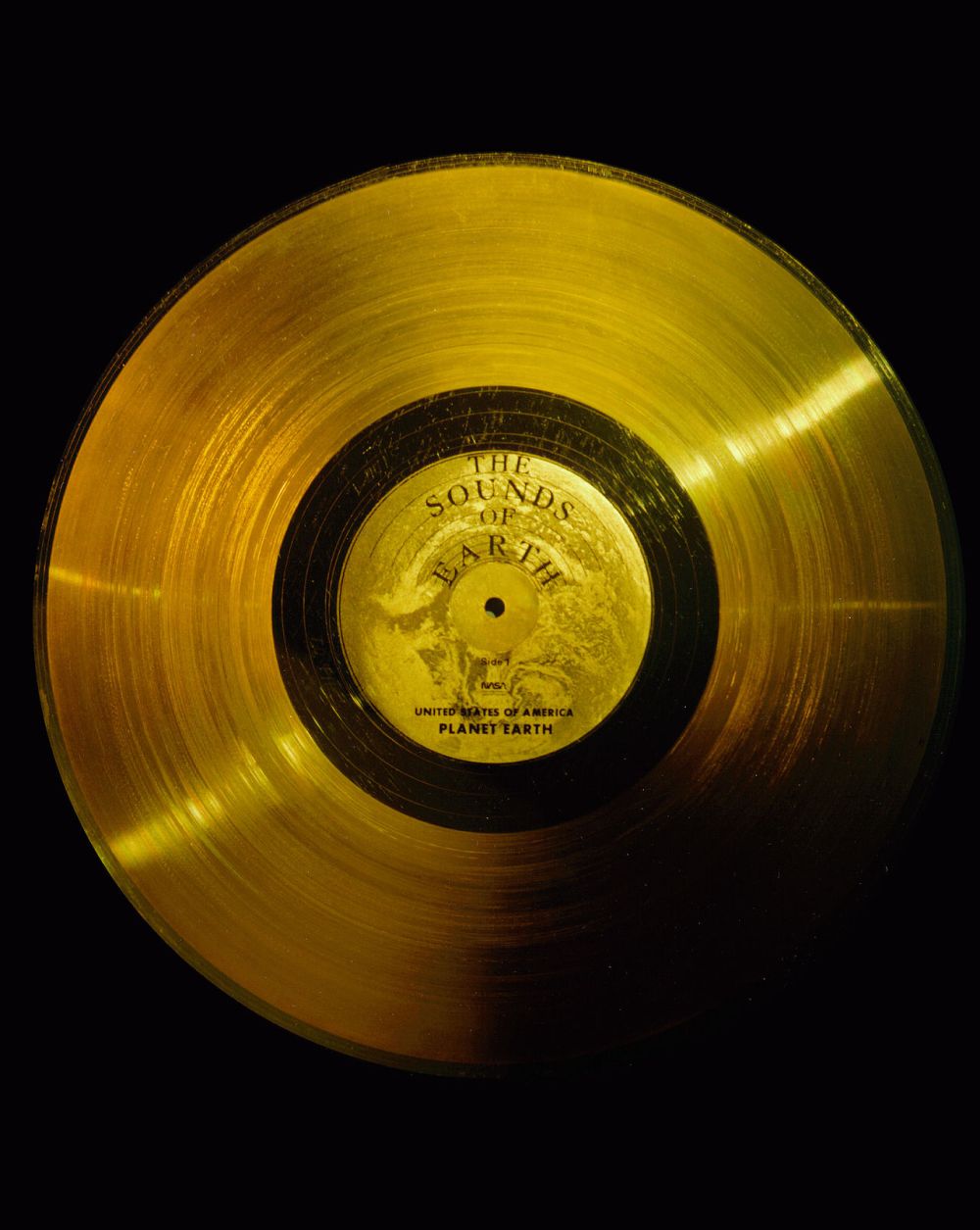
Before sending the Voyager spacecraft off into space in 1977, Carl Sagan and his team insisted on including a “bottle” to send off into the “cosmic ocean.” This message to potential intelligent life in the universe is contained in the Voyager record, a 12 inch golden record meant to encapsulate life on Earth. The record includes a number of photos, sound samples, music, and descriptions of humans, animals, insects, and the environment on Earth. It took just about a year to make the selections for the record.

voyager record 2
The Voyager Record


What I find fascinating are the things that did not or almost did not make the cut when it came to showcasing our culture to possible alien life forms. For instance, Johnny B. Goode’s music (check out my comment/West Wing reference here) was almost not included because at the time rock music was considered “adolescent.” Carl Sagan responded “There are a lot of adolescents on the planet,” and included it anyway. Not only was this a power move, I also think it speaks to the desire of people to seem sophisticated or perfect to our interstellar neighbors. It seems natural that, knowing nothing about who or what else may be out there, we want to cover up our possible flaws or weaknesses. Still, I’m glad rock music made it through. Another incredible piece of music was, however, left off the record. The Beatles song “Here Come the Sun” was not allowed on the Voyager record by the company EMI for copyright concerns. After the Pioneer Plaque controversy of sending “pornography” into space with sketches of nude men and women, Carl Sagan was forbidden from including pictures of a naked man and women on the plaque. It’s fascinating to see that even when dealing with space and extraterrestrial life, we have to have image control.


Posted in Historical | Tagged , , , , , , | Comments Off on A ~Record~ of Life on Earth

The Fermi Paradox

To be, or not to be? Is that really the question? According to the Fermi Paradox, it’s a perfectly valid one.

The Fermi Paradox, coined after Enrico Fermi, is a theory that addresses life elsewhere in the universe as a probable reality. The only issue is, however, that no other forms of life (that we know of) have visited or even communicated with us (again, that we know of).

The paradox also addresses the issue of space–that is, just how vast and, well, empty, it is. If life were out there, shouldn’t we already know about it by now? If the universe is so unbelievably large, there’s no way we could find other life if it existed … right?

Such questions bring us to an important aspect of the Fermi Paradox, known as the Great Filter. This theory is that, even if the right conditions are present for life to form, it’s only a matter of time before some greater force wipes out that life. How reassuring.

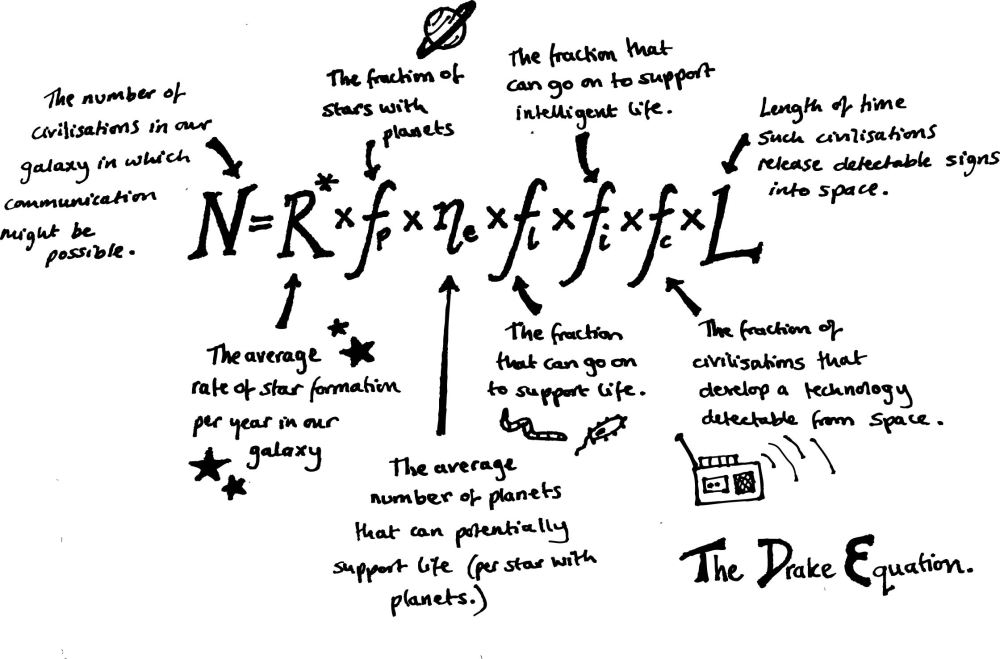
The Fermi Paradox isn’t always so depressing, however, and one aspect is actually quite exciting. The Drake Equation is a formal way to calculate the probability of life existing elsewhere in the universe, and many believe it actually proves that (though probabilities may be small and time may have been of the essence) life exist(ed) somewhere amongst the stars.

drake-equation.jpgThe Drake Equation

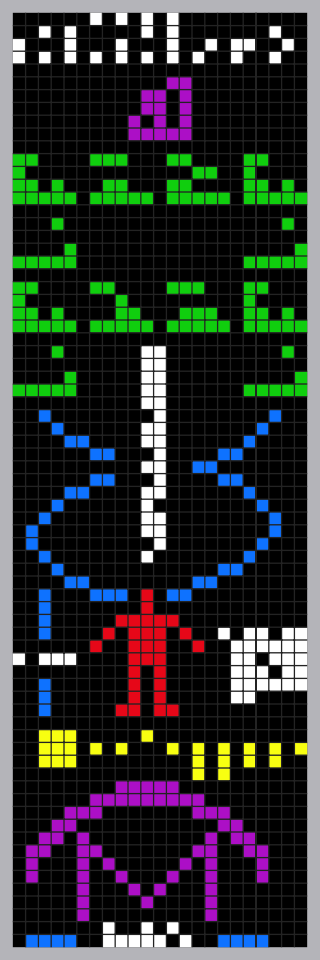
If there is life out there, then why haven’t we communicated with it yet? Well, we’ve tried! In 1974, we tried to send radio waves into space to communicate a message, visualized below:

320px-Arecibo_message.svg
Arecibo Message

If the Fermi Paradox turns out to be a positive one (and the life-seeking optimists are happy), perhaps life elsewhere in the universe will get back with us soon. It may very well be the case, however, that other life forms may not be intelligent enough to communicate with us – or we may not be intelligent enough to communicate with them. There are endless possibilities to the Fermi Paradox, and the Drake Equation is only a venue for us to explore such possibilities. Maybe we missed communications with other life forms by millions of years. Maybe they’ve yet to come. Until then, the optimists and pessimists of the life-seeking niche will get to argue over probability (likely for a long time to come).


Posted in Class, Science | Tagged , , , , , | Comments Off on The Fermi Paradox