Time can be lost. Time can be wasted. Time can be saved. Time can be valuable. Time is of the essence. Perhaps a less known is the fact that time can be dilated! What exactly does this mean? It means that differences of elapsed time for someone traveling at high velocity or in the vicinity of a higher source of gravity is slower than someone who is stationary or not in the presence of a high source of gravity. This is not a phenomena that only slows down the clocks but rather a phenomena thats slows down everything from your internal brain impulses to the surrounding world you live in. It is unnoticeable to the individual experiencing the slowing of time since everything is relative, but if an outside view was possible it would be very apparent that everything has slowed down. At 90% the speed of light, time would be passing at the rate of 44% of a stationary time source. At 99% the speed of light time would be passing at the rate of 14% of a stationary time source. At 99.9% the speed of light, time would only pass at the rate of 4.5% of a stationary time source.If 5 years passed while traveling at 99.9% speed of light almost 110 years would pass here on Earth. What does this mean ethically for Interstellar traveling? Well if we somehow manage to create the technology that allows for space travel at nearly this speed (we have a ways bit to go) we will have to deal with an incredible amount emotional strain caused by watching loved ones age or die as we pursuit knowledge. Perhaps the most powerful scene in Interstellar can give you a glimpse into the ethical dilemma that scientist in the nearby future will have to deal with. *IF YOU HAVE NOT SEEN INTERSTELLAR DO NOT WATCH.
The Fermi paradox is summarized in the video above. At a bare minimum, the Fermi paradox is the paradox of the Drake equation supposedly estimating a large number of possible planets in our Galaxy harboring life, yet no such evidence of intelligent life has been discovered. There are many possible speculations for why this might be, but as of now, we can’t be sure what drives this enigma. If there are so many habitable planets, where’s the proof?
I have one idea: perhaps the development of intelligent life is more difficult than we though. After all, we’re the only species to have evolved on Earth that has formed civilizations and has propelled technology.
Taking a step back, we have to remember that most of our hypotheses are shaped by what we observe around us. We originally presumed that in order for a planet to be habitable, it must have conditions very similar to those of Earth. But, upon the discovery of extremophiles in the hot, dark nooks of Earth, that assumption changed. now our notion of the habitable zone has greatly increased. Perhaps if life were to evolve elsewhere, it would adapt to its un-Earth-like conditions.
With this in mind, we really don’t know much about how life might form on other planets. We know that Earth has one species of highly intelligent life (by our standards), but no other such species have evolved. Although intelligence is a favorable trait to evolve from a Darwinian standpoint, who’s to say that this will always tend to occur? Maybe, like the Drake equation suggests, there are planets teeming with life, but that life is analogous to the simple-minded animals, invertebrates, and single-celled organisms. It could also be possible that there’s a barrier to having two or more co-existent intelligent species, which would explain why there’s only one on Earth. But this seems unlikely because we have yet to receive any signals from such species. Whatever the case may be, the reason behind the Fermi paradox is still limited to our speculations.
I’ve always thought that we weren’t alone in the world–and my Astronomy class has really helped to confirm my thoughts. After studying the Drake Equation, it seems almost certain that intelligent life and life that could eventually communicate with us must exist. After all, the Earth is only 4.6 billion years old–a baby compared to some of the other worlds on which intelligent life could have developed. If another planet was born a few billion years before the Earth, and life developed there on a similar time-scale to that of Earth, life on that world would have billions of years of development more than Earth’s life under it belt. It seems almost undeniable that life and civilizations far more complex than ours exist somewhere in the Cosmos. But even with the high possibility that other life exists, we have yet to detect it. We haven’t picked up any communications–deliberate or accidental–from an intelligent civilization and we haven’t even been able to investigate worlds in our own Solar System that have the prospects to harbor life.
The Kardashev Scale helps to categorize complex civilizations based on their ability to harness energy. A Type I society can harness all of the energy on its home planet–something that humans have yet to do, as we are a 0.7 on the scale. A Type II civilization can harness all of the energy of its star. Even more amazingly, a Type III society can harness all of the energy of its galaxy, something that is hard for humans to imagine. A Type III civilization would achieve this by colonizing star-systems in its home galaxy. With over 400 billion stars and star-systems in our galaxy alone, the likelihood that one of these would produce a civilization capable of reaching Type III status is high. Imagining that for every star in our galaxy, there is another galaxy with 400 billion stars, the likelihood that a Type III civilization with the ability to communicate and interact with our backwater civilization seems inevitable.
If there is so much possibility for life–and intelligent life far more complex than our own–to exist, why haven’t we discovered it? This question is known as the Fermi Paradox, and several answers have been proposed. But none of these potential answers bode particularly well for humanity or our long-term survival.
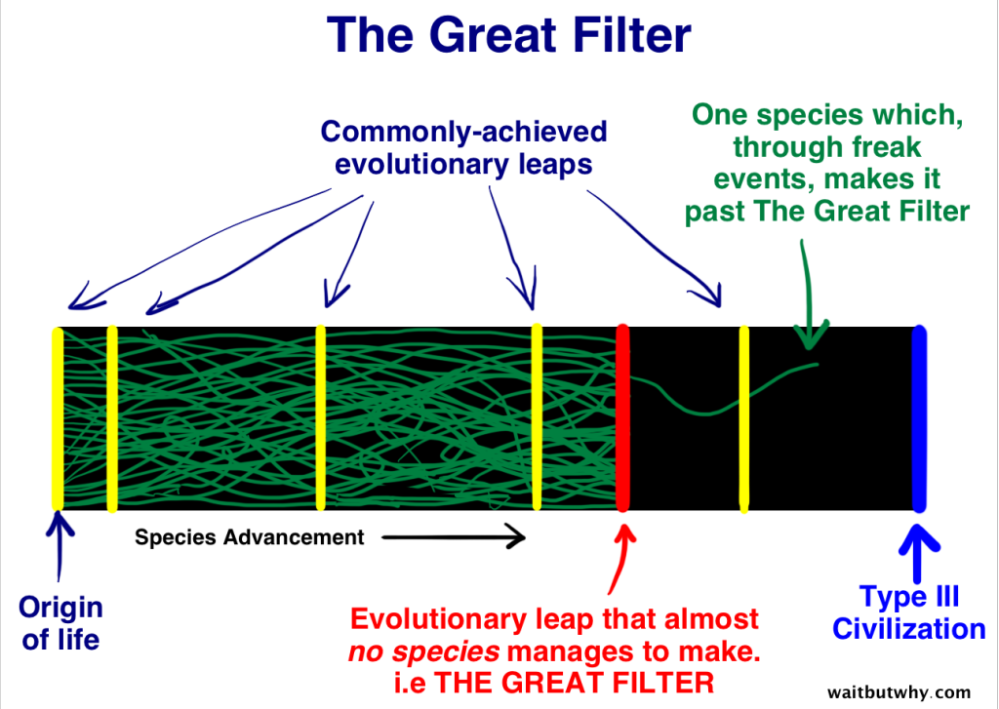
One possible theory incorporates what is known as the Great Filter. This theory proposes that if there are great prospects for life to develop, something must exist on the developmental track of evolution that all life hits that only one in a billion civilizations can get past. Such a theory proposes that it is so difficult for a civilization to reach Type III that there are few out there regardless of the number of potential planets for it to develop. The Great Filter could be something as simple as the development of life itself (which would place the Great Filter behind us) or as complex as almost all intelligent species eventually advancing to the point that inter-civilization war wipes them out (which would place the Great Filter ahead of us). Another possible Great Filter could be an advanced civilization that reached Type III billions of years ago and goes around exterminating all civilizations that reach a certain complexity (i.e. the first Type III civilization becomes the only Type III civilization).
A conceptualization of the Great Filter theory from the blog “Wait, But Why?”
The Great Filter theory would assert that we haven’t detected higher civilizations because these civilizations are not likely to exist. The Great Filter could be behind or ahead of us. Or we could be the first civilization to develop. This could be that the Universe is just reaching a point where intelligent life could develop. Understanding temporal habitable zones in the Universe make this a real possibility. So either we’re rare and the Great Filter is behind us but other intelligent civilizations exist in small numbers, we’re the first to pass the Great Filter and there are no other advanced civilizations out there, or the Great Filter is ahead of us and we are unlikely to pass it.
However, other logical reasons may exist as to why we haven’t detected any other complex life. The first possibility–that pains me to type and that my Archeology professor would kill me for if she knew that I was including it here–is that humanity was visited by a complex civilization, but that it occurred in the distant past before we had the capacity to understand it. The so-called “Ancient Alien” theory may seem unlikely (and extremely frustrating to Archeologists who have their work brushed aside with the phrase “Aliens built the pyramids”) but when considering the vast amount of Earth’s history that we weren’t present for, the theory doesn’t seem that far-fetched. Since we have only really been recording history for the past few thousand years, we have no way to know whether a complex civilization visited Earth in the past and didn’t deem our ancestors worthy of their time.
A second possibility is that our galaxy has actually been colonized by a civilization very near to a Type III, but that we live in a backwoods area that is of no strategic value to another species. This is a popular theory with many that don’t deem Earth special, and it does make sense. We are located pretty far from the galactic center, and its unlikely that any important galactic routes would include our area of space.
A third possibility–pretty scary for humanity–is that other advanced civilizations know better than to broadcast their location to predatory civilizations. This theory is pretty scary, but it’s a definite possibility. We don’t hear communications because other civilizations know to shield their communications from broadcasting their location in order to protect their sovereignty.
The last possibility that this post will cover (although there are countless theories) is that we are simply too primitive to detect the type of communication that advanced civilizations send out. This theory is entirely possible, and it could just show how primitive we actually are when compared to advanced civilizations with billions more years of evolution under their belts.
All of these possible theories show just how much we still have yet to learn from our Universe. Complex civilizations could be out there, or we could be a rare case of intelligent life. Personally–and perhaps pessimistically–I believe that we have yet to pass the Great Filter, although the jump from prokaryotic to eukaryotic cells seem a likely possibility for the Great Filter to be behind us. With the Great Filter still ahead of us, the possibility that far more advanced Civilizations are out there makes the Fermi Paradox all the more puzzling. Tell me your thoughts on the Fermi Paradox. Do you think we have passed the Filter? Do you think a Great Filter even exists? Do you like the show “Ancient Aliens”? Let me know in the comments below.
For more reading on the Fermi Paradox and theories about our lack of identyfing complex civilizations, visit “Wait, But Why?”.
This will probably be my last post, so thanks for reading!
Although SETI institute was founded in 1984, the search for extraterrestrial life concerned scientists for many years prior. In 1977, Ohio State’s Big Ear radio telescope heard exactly what it had been searching for: the “Wow!” signal. The radio telescope was attempting to detect radio waves around the three-star system, Chi Sagittarii, when it detected radio waves that were way above the noise background.
Sadly, the mystery of the signal was never uncovered. We still don’t know exactly what created the signal. Antonio Paris, an analyst in the field, hopes to find out in 2017 whether this signal was created by a comet that passes by the three-star system. If we detect a similar signal, then the mystery will be solved, but we will still have to wonder whether we are alone in the universe.
In 2012, Philip Metzger and some of his colleagues from the Kennedy Space Center worked on a paper theorizing how we could “bootstrap” our way across the Solar System. The first step of their plan was to get materials to the Moon’s surface. From there, development of the industry would continue as the field of robotics has advanced enough to automate the remaining growth. The main purpose of this industry would be to mine materials that are limited here on Earth and send them back, in addition to the natural exploratory and discovery benefits of expanding our reach. The industry would develop on the moon, and then the materials on the Moon would be used to build up enough goods to make another jump to the asteroid belt. This automated industry expansion is fascinating in that it could potentially solve many of the material limitations we have here on Earth. The same elements found here on Earth exist everywhere in our Solar System, so finding a way to reach the rest of the planets throughout the Solar System could be very beneficial to us here on Earth.
From a different perspective, this could also allow us to explore more planets than we ever thought possible. One of the major limitations of launching rockets and satellites from Earth is the tremendous amount of thrust needed to break through the atmosphere. If lunar development could proceed far enough along that space exploration could be manufactured and launched from the Moon instead, we could go further and faster than ever before. The possibilities are truly endless as the fields of robotics and manufacturing continue to expand.
Rendering of a theoretical lunar base under development
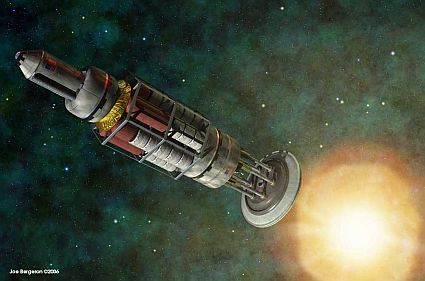
One of the biggest problems that we have when it comes to interstellar travel is that we don’t have a spaceship that can go fast enough to get us where we want to go in a reasonable time. Luckily, we have some really smart scientists trying to come up with ways to make a really fast space ship. One of these ideas was Project Orion. Project Orion proposed having a space ship that was propelled by repeated detonations of hydrogen bombs behind the ship. According to calculations, a ship accelerated by rapid detonation of a million hydrogen bombs could reach Alpha Centauri in a little over a century. That’s pretty fast. Although it is possible for us to build this space ship, it would be really expensive and would require an exception to the international treaty banning nuclear detonations in space, so this probably is not the best idea. Another design that has been proposed is the interstellar ramjet. This design would collect interstellar hydrogen with a really big scoop and use the gas as fuel for its nuclear engines. The only problem with this method is that the space ship would have to be insanely big to collect enough gas to fuel the ship, so this probably won’t do it either. Basically we got nothing, but that doesn’t mean we wont have something in the future. Hopefully with advances in technology we will be able to come up with some reasonable way to travel really fast in space and find aliens. The end.
Tardigrades, aka Water Bears, aka Moss Piglets, are the most resilient species on Earth. They transcend the extremophile label. Many extremophiles are only able to thrive in their own extreme environment. Tardigrades can live in almost every extreme environment. They’ve been known to survive temperatures ranging from 1 kelvin above absolute zero to boiling water. They can survive direct cosmic radiation. They can survive pressures ranging from the literal bottom of the ocean to the vacuum of space. They can even survive losing almost all of the water in their entire bodies. Extinction means nothing to them as they’ve survived five mass extinctions.
Perhaps most amazing of all, 1/6 of the tardigrade genome sequence may come from other creatures. Tardigrades have the ability to undergo horizontal gene transfer, which means that they can take DNA from foreign bodies. This is opposed to vertical gene transfer which is the transfer of genes through offspring. This diversity in its genome sequence is apparently partly responsible for why they’re so hardy.
The mechanism for their horizontal gene transfer is related to their ability to survive without water. When they lose most of the water from their bodies, tardigrades secrete a glassy-like molecule throughout their entire body, effectively turning themselves into a glass sculpture. When they come into contact with water again, this glass melts, allowing the tardigrade to rehydrate itself. During this rehydration, the cell nucleus becomes ‘leaky’, allowing foreign DNA to pass into it.
The use of anti-matter propulsion might be the key to interstellar travel. Anti-matter is basically normal matter that has opposite charges. When matter and anti-matter collide with one another, they annihilate one another and energy is released. Unlike with nuclear fusion, where only 3% of the total mass of the matter is converted into energy, the collision between matter and anti-matter results in the entire mass of the matter and anti-matter being converted into energy. Thus, these reactions are highly efficient.
A rocket using anti-matter propulsion would work by using energy created from the reactions to superheat liquid hydrogen. This hydrogen would then be funneled through a nozzle and would expand in space, providing thrust. Scientists believe that a rocket powered by anti-matter propulsion would be able to achieve speeds of roughly one third of the speed of light. This would enable us to get to the nearest star system, Alpha Centauri, in roughly 12.5 years. Furthermore, another benefit of using anti-matter propulsion is that it is relatively safe. Unlike with nuclear reactors, anti-matter reactors would not produce any harmful radiation. In the event of an accident during lift-off, only a tiny amount of gamma rays would be released, which would not be harmful.
The use of anti-matter propulsion might be the key to interstellar travel. Anti-matter is basically normal matter that has opposite charges. When matter and anti-matter collide with one another, they annihilate one another and energy is released. Unlike with nuclear fusion, where only 3% of the total mass of the matter is converted into energy, the collision between matter and anti-matter results in the entire mass of the matter and anti-matter being converted into energy. Thus, these reactions are highly efficient.
A rocket using anti-matter propulsion would work by using energy created from the reactions to superheat liquid hydrogen. This hydrogen would then be funneled through a nozzle and would expand in space, providing thrust. Scientists believe that a rocket powered by anti-matter propulsion would be able to achieve speeds of roughly one third of the speed of light. This would enable us to get to the nearest star system, Alpha Centauri, in roughly 12.5 years. Furthermore, another benefit of using anti-matter propulsion is that it is relatively safe. Unlike with nuclear reactors, anti-matter reactors would not produce any harmful radiation. In the event of an accident during lift-off, only a tiny amount of gamma rays would be released, which would not be harmful.
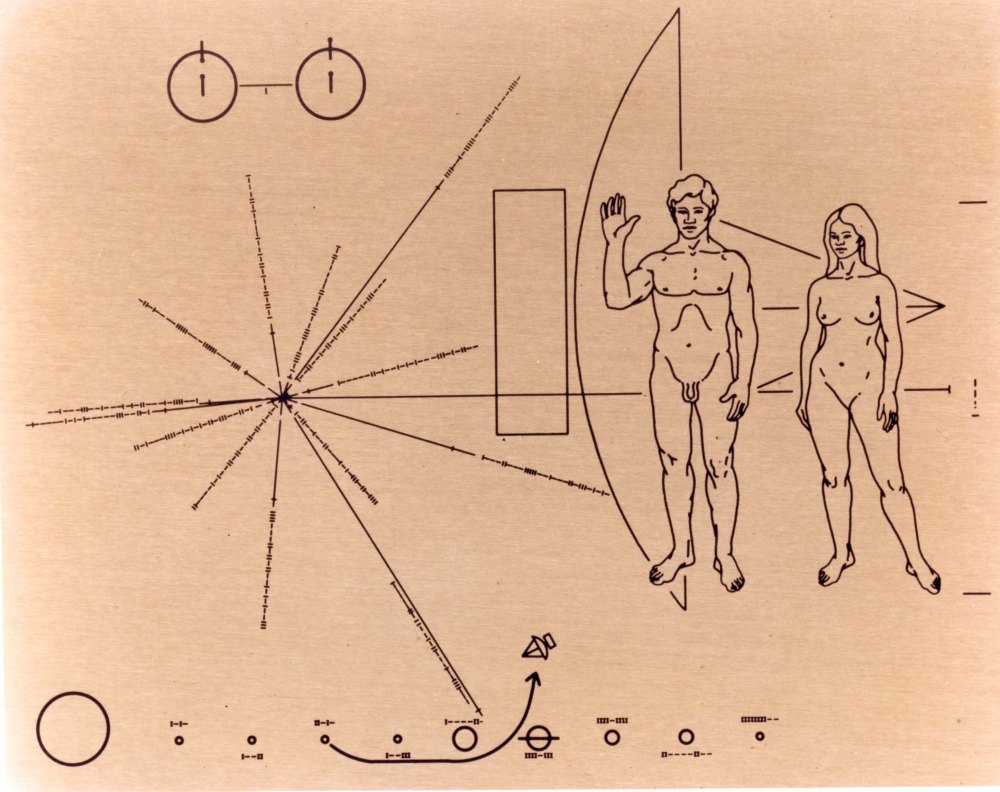
The famous Pioneer Plaque, containing information about us, that was sent out with the Pioneer 10 and 11 spacecraft (Source).
We have talked in class about sending out signals and messages to other potential other civilizations to let them know that we are here, but should we really be doing that? It’s open for debate. Frank Drake himself found “Active SETI to be, at best, a stunt and generally a waste of time.” (Source).
To start, its expensive to send these messages, and we might not have any success. But beyond that, could it potentially be harmful to us? For any civilization to be able to decode our radio messages, they would have to be at least as advanced as us. If they are more advanced than us, they would be able to wipe us out. Should we really be broadcasting our location to them? Stephen Hawking said, “If aliens visit us, the outcome would be much as when Columbus landed in America, which didn’t turn out well for the Native Americans.” (Source). On the other hand, it would also be an enormous scientific discovery to learn about the possibility for life elsewhere, and we would be able to learn a lot from it. Let me know what you think in the comments!